
Idea 1
Engineering Under Pressure: Building the Eagle
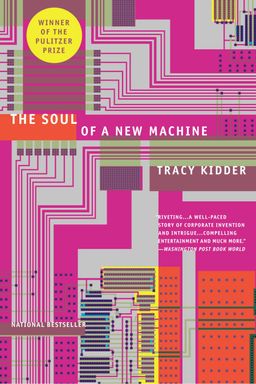
What drives a group of engineers to build a revolutionary computer under impossible conditions? In The Soul of a New Machine, Tracy Kidder reveals the drama behind Data General’s Eagle project—a story of invention, ambition, and exhaustion inside one of the scrappiest computer companies of the 1970s. More than a chronicle of technology, it’s an anatomy of human motivation under pressure. The book is about how people behave when they’re asked to do something extraordinary in an environment that fuses intellect, ego, and urgency.
You watch the project unfold inside Data General’s Eclipse Group, led by Tom West, a secretive and intense manager who manufactures urgency to push his team forward. The story opens in the wake of corporate power struggles—a small band of engineers in Westborough, Massachusetts, must build a 32-bit minicomputer to rival DEC’s VAX while pretending that another, official project in North Carolina has the company’s blessing. What follows is both an engineering race and a psychological experiment in leadership.
The Corporate Context
Data General was born from rebellion. Ed de Castro and his team left DEC to create cheaper, faster minicomputers. Their early success with the NOVA set a tone of defiant thrift: do more with less, prove the establishment wrong. By the time Eagle begins, the company has become a mid-size giant known for litigation, hard-driving sales, and a culture of cost-cutting. West’s department in Westborough feels neglected after senior management has relocated research to North Carolina. In that resentment and loss, West finds an opportunity: to build a machine that reclaims technical pride and corporate credibility.
Crisis as a Management Tool
West understands something about people: ordinary motivation won’t produce exceptional work. His genius lies in creating believable crises and noble missions. By calling Eagle an insurance project, he wins permission to proceed quietly, while telling his team their reputations and the company’s future depend on it. He offers no grand speeches—just high stakes and quiet expectations. You see him as a craftsman of tension: manufacturing urgency, isolating his team from bureaucratic noise, and translating threat into creative energy.
His rituals are subtle but powerful. He recruits for personality and intensity, not just talent. People sign up to join, a voluntary oath that binds them emotionally more than any contract could. This echoes military and startup cultures alike—where shared stress and identity outrun hierarchy—and suggests that leadership often means storytelling as much as logistics.
The Technical and Human Challenge
The task itself is audacious: to design a 32-bit successor to the 16-bit Eclipse line, fully backward-compatible with all older software. That demand for compatibility makes the engineering deeply constrained—an elegant architecture is sacrificed so customers can reuse old code. Steve Wallach’s ingenious memory scheme—rings and segments compressing MULTICS-style protection into cheap hardware—embodies the balance between purity and pragmatism that defines the whole project.
Meanwhile, the microcoders, led by Carl Alsing and Chuck Holland, translate high-level instructions into the machine’s lifeblood: 75-bit microinstructions that orchestrate its logic gates. To test them, Neal Firth builds a software simulator, a virtual Eagle that runs on an older Eclipse. This tool becomes central—allowing code to evolve before hardware is ready, letting rookies debug impossible sequences, and multiplying collective speed. The simulator is more than an instrument; it symbolizes how abstraction and imagination replace physical machinery in modern engineering.
Energy, Ritual, and Fatigue
Life inside the lab merges work and play. New graduates—nicknamed Microkids—trade sleep for late-night programming contests. They invent rituals, awards, and private jokes to cope with exhaustion. Humor and camaraderie become a survival strategy, even as tension rises and relationships strain. Kidder shows you how collective intensity can be both empowering and self-destructive: the same passion that builds the machine also erodes health and peace of mind.
As deadlines close in, “flying upside down” becomes mantra: take outrageous risks, pray the system holds together. Debugging is detective work—catching time bombs born of caching, parallelism, and speculation. The infamous missing NAND gate bug, fixed with a single eight-cent part named “NOT YET,” reduces months of terror to one elegant solution. Each fix restores faith that craft and patience can still conquer chaos.
Triumph and Disintegration
Eagle finally becomes the Eclipse MV/8000, a success in both performance and market impact. Yet triumph brings emptiness. Marketing takes over, executives rename the machine, and credits vanish into corporate bureaucracy. Key engineers leave, worn out or disillusioned. West moves to a quieter role, and the laboratory community dissolves. This bittersweet ending reframes the title: the soul of a new machine isn’t in its circuits, but in the human energy temporarily embodied within them.
Core lesson
Extraordinary innovation emerges from ordinary people united by purpose, pressure, and craft. But that same intensity burns them out once the crisis ends. The book captures this timeless paradox of engineering: you can build the future only by borrowing heavily against the present.
The story is both a celebration and a caution. It reminds you that technology is always social: machines carry not just code and transistors, but stories of ambition, collaboration, and cost. And in the end, what matters is not only that the machine works—it’s whether the people who built it still do.