
Idea 1
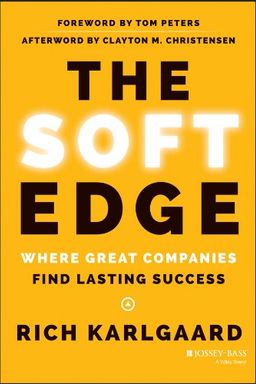
The Soft Edge: Where Great Companies Find Lasting Success
Why do some companies thrive decade after decade while others flame out as soon as the world changes? In The Soft Edge, Forbes publisher Rich Karlgaard asks a simple but urgent question: what makes success endure? His answer defies conventional wisdom—it’s not only sharp strategy or perfect execution, but what he calls the soft edge: the human-centered values, culture, and creativity that allow an organization to stay resilient in turbulent times.
Karlgaard argues that the business world has become obsessed with the hard edge of efficiency, metrics, and speed, often at the expense of the qualities that make innovation and loyalty last. In a world where data is limitless and competitors can clone your systems overnight, the soft side of business—trust, smarts, teamwork, taste, and storytelling—is what differentiates organizations that merely survive from those that achieve enduring greatness.
The Triangle of Long-Term Success
To explain his philosophy, Karlgaard uses a powerful metaphor: a triangle. On one side lies strategy, the foundation of knowing where you’re headed. On another side lies the hard edge, the operational backbone of speed, cost, logistics, and capital efficiency. But the crucial and often neglected third side is the soft edge—the sum of a company’s human and creative qualities. Together, these three sides make up the health triangle of an organization, much like the balance of physical, mental, and social health in a person.
Karlgaard warns that companies often lean too heavily on the hard edge because it’s measurable and satisfying to the data-driven mind. You can quantify costs and speed, optimize supply chains, and see quick ROI. Yet, as history shows—from Kodak to Digital Equipment—hard-edge perfection alone can lead to collapse when innovation dries up or culture erodes. Instead, companies like Apple, FedEx, and Northwestern Mutual succeed through a dynamic balance, where excellence on the soft edge sustains progress when technology or strategy shifts.
The Five Pillars of the Soft Edge
Karlgaard identifies five core pillars that define an enduring organization:
- Trust – the foundation of all strong relationships inside and outside the company. Trust builds resilience, innovation, and credibility when markets falter.
- Smarts – continuous learning and adaptability, fueled by grit and curiosity rather than mere IQ.
- Teams – collaboration between diverse, passionate people organized in small, high-performance groups.
- Taste – the sensibility of making products and experiences that enchant customers by combining form, function, and meaning.
- Story – the narrative that gives a company and its people purpose, uniting them around shared meaning and identity.
Through these five elements, Karlgaard invites readers to rethink what drives innovation and loyalty. It’s not just technology or analytics—it’s the combination of human intelligence and character. The soft edge, he shows, creates emotional connection with customers and employees, turning functional excellence into long-term advantage.
Why the Soft Edge Matters Now
Karlgaard situates his argument in a modern economy dominated by speed and disruption. With technology cycles shrinking from decades to months, efficiency alone can’t protect you. Hard-edge advantages—data, logistics, or automation—are easily replicated. But soft-edge mastery, forged through trust, learning, and taste, builds something competitors can’t copy: emotional engagement, adaptability, and identity.
He contrasts corporations like Hewlett-Packard, whose core culture (the HP Way) was eroded by short-term management, with enduring institutions like Northwestern Mutual or Mayo Clinic that invest deeply in ethics, learning, and purpose. Those organizations may not move as fast as a startup, but they thrive across generations because they unify hard, strategic, and human edges into one living system.
(Note: Karlgaard’s view parallels Tom Peters’ advocacy in In Search of Excellence, which argued decades earlier that the ‘soft stuff is the hard stuff.’ Like Peters, Karlgaard calls for rediscovering empathy, meaning, and creativity in business before the data-driven obsession leads to burnout and alienation.)
Ultimately, Karlgaard’s message is clear: lasting success isn’t built by machines alone. It requires human intelligence, ethical conviction, and cultural trust. Master the soft edge—your company’s capacity for connection, learning, and imagination—and you’ll not only innovate faster but sustain greatness long after the trends have passed.