
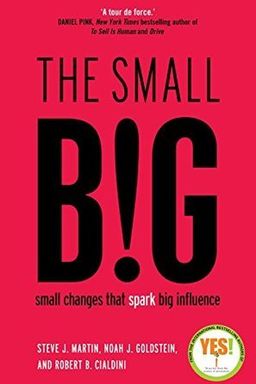
The Small BIG cover

The Small BIG

by Steve J Martin, Noah J Goldstein and Robert B Cialdini

The Small BIG reveals how small, strategic changes in your behavior and environment can lead to big improvements in your ability to persuade and influence others. Through 52 compelling examples, this book equips you with actionable insights to enhance your negotiation skills and make a significant impact in various aspects of life.

Small Changes That Spark Big Influence

How can a tiny tweak in your words, timing, or environment completely change the way people respond to you? In The Small BIG, persuasion experts Steve J. Martin, Noah J. Goldstein, and Robert B. Cialdini argue that influence doesn’t depend on grand gestures or complex strategies. Instead, it lies in scientifically proven small changes — subtle adjustments in how you frame, present, or time your message — that can transform outcomes in business, relationships, and daily life.

The authors build on decades of behavioral science research, including Cialdini’s classic principles from Influence: The Psychology of Persuasion, but they shift attention to what they call “SMALL BIGs”: low-cost, easily deployable techniques that yield disproportionate results. Each short chapter showcases a real-world example, from boosting tax payments through social proof to improving customer loyalty by adding structure, improving meetings through seating arrangements, or even getting better online reviews by mentioning the word “today.” The book makes the case that persuasion in the modern attention-overloaded world works not through force of information, but through mastery of context.

The Science Behind Small BIGs

Martin, Goldstein, and Cialdini explain that people make decisions not by carefully analyzing every fact, but by relying on psychological shortcuts. These shortcuts—social proof, reciprocity, authority, liking, scarcity, and consistency—allow humans to decide quickly without overthinking. Yet while these principles remain timeless, the authors show how tweaking the timing, framing, and specificity of these cues magnifies their effect. It’s not enough to tell people what others do; it matters who those others are, how similar they feel, and how the message connects to the listener’s identity.

In a world where buyers scroll rapidly, employees multitask, and attention spans shrink, the message isn’t always what persuades—it’s how that message is delivered. You might think strong logic wins the day, but the authors remind you that subtle cues — a name, a number ending, or a single word of thanks — are what trigger genuine compliance.

Why Small Beats Big

The power of small, say the authors, lies in the human brain’s efficiency obsession. When overloaded with data, we gravitate toward simple heuristics: shortcuts that feel safe. Finding the right small change means leveraging that tendency. Cialdini’s earlier research on social proof showed that when British taxpayers were told “most people in your town pay on time,” payment rates skyrocketed. This single line—added to a standard letter—generated hundreds of millions of pounds in extra revenue for the government. The insight? People don’t just follow rules; they follow others like themselves who follow rules.

What’s remarkable is how often these effects defy intuition. For example, we believe we’re not influenced by what others do, yet evidence shows we act more on perceived norms than on moral reasoning. We claim we want environmental appeals or cost-savings messages, but studies show social-preference cues outperform both. This mismatch reveals a key point throughout the book: we’re blind to what truly moves us.

From Words to Worlds

The authors invite you to see persuasion as environmental architecture. Each chapter reveals how surroundings, timing, and even physical space shape response. A high ceiling sparks creativity; a “home-field” negotiation boosts confidence; a simple posture (“power pose”) alters hormone levels and persuasiveness. Influence isn’t just psychological — it’s embodied.

The reason these adjustments work so well, Martin et al. argue, is that they engage automatic, not deliberative, processing. They bypass resistance. Small BIGs fly under the radar, altering perception before conscious defenses arise. Whereas traditional approaches bombard the mind with information, small BIGs align with the way the brain naturally filters and decides.

Why It Matters Today

In our fast-paced world, persuasion feels harder than ever. Customers ignore ads, employees tune out meetings, and citizens dismiss public campaigns. Yet the authors show that small scientific adjustments still break through — not through manipulation but through empathy and insight. Whether you’re leading a team, negotiating a contract, writing an email, or simply trying to get your kids to do their homework, The Small BIG offers a toolkit of invisible levers that make messages resonate.

Ultimately, Martin, Goldstein, and Cialdini contend that influence is less about persuasion and more about attention design. By shaping how people see options rather than forcing them to think harder, you align their natural motivations—accuracy, affiliation, and positive self-image—with your goals. The result isn’t manipulation but cooperation: small shifts that create big wins for everyone involved.


The Power of Social Proof

Humans are herd creatures. One of The Small BIG’s earliest stories shows how the UK’s tax authority, HMRC, solved a billion-dollar problem with just a single sentence. Instead of threatening late taxpayers with penalties, letters told recipients that most citizens — especially people in their own town — had already paid on time. That small shift in framing triggered a massive psychological lever: social proof.

How Social Proof Works

Social proof tells us that when people are uncertain, they copy what others do, especially those similar to them. It fulfills three basic human motivations the authors highlight: the need to make accurate decisions efficiently, to belong, and to maintain a positive self-image. We rarely admit it, but we feel safer aligning with the crowd. It's why restaurant queues attract us, why online reviews steer us, and why energy-saving programs work when presented as community norms.

Identity-Based Persuasion

Martin and Cialdini note that the more specific the social proof, the stronger the effect. People don’t just follow the crowd—they follow their crowd. In one HMRC test, letters mentioning “people in your postcode” paying on time outperformed generic versions. When even more local — “people in your town” — payments rose further. Such precise identity cues, whether geographic (New Yorkers) or nominative (“people named Emily”), intensify identification (as Jonah Berger’s research also supports).

When Not to Use It

However, social proof backfires when the desired behavior isn’t common. Highlighting that “many people miss appointments” increases no-shows, not attendance. The authors advise you to emphasize norms that show desirable behavior as the majority. When good behavior isn’t yet widespread, use injunctive norms — what people approve of — or highlight growth trends (“participation up 40% this month”).

Practical Takeaway

You can apply social proof in emails, websites, meetings, or public campaigns. Frame compliance as standard and specific: “Most of our partners have already adopted this solution.” The smaller and truer the group, the larger the effect. As Cialdini reminds us, ethical persuasion means showing truth, not inventing consensus. Done right, social proof turns ordinary reminders into extraordinary outcomes.


Framing and Deviance: The Subtle Art of Message Design

Want people to behave differently? Frame your message around deviance, not conformity. Psychologist Hart Blanton’s research, highlighted in The Small BIG, shows that people are more motivated to avoid being the odd one out than to simply match expectations. The book explains how messages framed around what happens when people deviate from social norms, rather than when they conform to them, significantly increase persuasion.

Positive vs Negative Frames

If your audience believes a behavior is common — say, covering your mouth when sneezing — emphasize the negative traits of those who fail to do it (“People who don’t are irresponsible”). But if your audience believes the opposite — that most people don’t cover their mouth — praise those few who do (“Those who cover their faces are considerate and thoughtful”). Framing around deviation engages self-identity: people want to be seen as responsible, smart, and socially integrated.

Behavioral Examples

This principle applies widely. Health clubs can reduce litter by saying “Most members use bins; those who don’t disrespect others.” Offices can frame punctuality as respect for team, not routine. Diabetics told “Most patients check sugar before driving; the few who don’t risk others’ safety” increase compliance. The small framing shift converts moral pressure into identity alignment.

Why It Works

We’re wired to protect self-image and group belonging. Deviance framing makes people weigh social costs more than logical benefits. Rather than debating rules, they internalize norms. (Compare with Dan Ariely’s insights in Predictably Irrational, which also note our bias toward social reputation.)

Key Lesson

Before crafting persuasive messages, examine your audience’s belief about the norm. If they already think most people do the right thing, use negative framing against deviants. If they think most don’t, celebrate those who break the norm positively. A small verbal recalibration—just shifting adjectives—produces big behavioral change.


Commitment and Consistency: Keeping Promises Alive

People want to be consistent with their commitments—especially those made actively and publicly. The authors illustrate this through their clever experiments on reducing missed appointments (“no-shows”). They found that patients asked to read aloud their appointment time or write it themselves were far more likely to attend than those handed pre-filled cards. This minor interaction turned a passive arrangement into an active promise.

Active vs Passive Agreements

When you write down or verbalize a commitment, you internalize it. Someone who says “Yes, I’ll watch your bag” feels obligated to act when a thief appears (as Moriarty’s beach study showed decades ago). Similarly, writing appointment details builds ownership. Active participation boosts consistency pressure; ignoring it violates personal integrity.

Scaling the Insight

Businesses can use this principle simply: have clients confirm attendance in writing, let teams recite goals aloud, or end meetings by having each person summarize their next action. Public or physical confirmation transforms intention into follow-through. Even a one-word “yes” email acknowledgment increases accountability.

Practical Magic

The beauty of this technique is scalability. A costless tweak—writing or repeating—is enough to reduce missed appointments by 18%. Applied widely, it saves industries millions. The message for you: don’t rush agreements. Take an extra few seconds to make commitments explicit; you’ll turn good intentions into consistent actions.


Defaults and Decision Architecture

Much of persuasion, the authors reveal, happens through design rather than debate. People often follow whatever option is easiest to stick with—the default. Automatic enrollment in company 401(k) plans, for example, raises participation from 50% to nearly 90%. But Martin and Goldstein show that clever tweaks such as Enhanced Active Choice make defaults even more persuasive by activating awareness without adding friction.

The Enhanced Active Choice Model

Instead of passive yes/no boxes, ask people to actively select between two explicit alternatives: “I will get a flu shot this fall” or “I will not get a flu shot and risk illness.” When both options are presented with tangible outcomes, more people choose the positive one. Adding a loss frame (“I will not save $50”) further raises compliance to 75% or more. This technique blends autonomy with persuasion—it lets people choose, yet makes not choosing feel costly.

The Logic of Inertia

Humans stick with defaults because change feels effortful. Enhanced choice flips that bias: staying passive now requires admitting risk or loss. By acknowledging free agency (“you choose”) while illuminating consequences, policymakers and businesses can guide decisions toward beneficial outcomes—health vaccinations, savings programs, or environmental behaviors.

Practical Use

Design your forms, websites, and requests to require active commitment framed around impact. Choice architecture isn’t about manipulation; it’s about making good decisions easier. As Thaler and Sunstein argue in Nudge, good defaults respect freedom while steering toward welfare—and The Small BIG gives you the blueprint to build them.


Power, Posture, and Presence

Before your next interview or presentation, take a minute to recall a moment when you felt powerful—or literally sit tall and expand your posture. The authors cite studies showing that recalling or embodying power dramatically changes how persuasive you appear. In one experiment, job applicants who wrote about feeling powerful were rated far more employable than those who recalled feeling powerless. Another group practicing “power poses” increased both confidence and hormone levels tied to dominance.

Body as Persuasive Medium

Our physiology silently communicates authority. Expansive postures (leaning forward, hands on desk, chest open) signal competence, reducing cortisol and raising testosterone. These micro-adjustments translate into visible confidence—something audiences and interviewers detect instinctively. Even short pre-interview poses improve performance.

Mental Priming

Writing about personal power primes assertiveness and competence. Interviewers, unaware of the exercise, uniformly rated these applicants as more persuasive and hireable. “Recollected power,” Martin writes, increased acceptance rates by up to 162%. (Compare Amy Cuddy’s famous TED talk on power poses for similar physiological evidence.)

Application

Before influencing, presenting, or negotiating, spend one minute recalling a success or assuming an open pose. Your mind and body will follow, silently broadcasting authority. The small BIG: postures, thoughts, and physical cues reframe your self-perception, which reframes others’ perception of you.


Unexpected Reciprocity

Few things trigger generosity like surprise. One of the most uplifting stories in The Small BIG recounts Yorkshire priest Reverend Richard Steel’s inspiring “uncollection.” Instead of asking congregants for money, he handed each a £10 note to invest however they wished—provided they later returned any profit to the church. That unexpected gift activated powerful reciprocity, yielding nearly £10,000 in donations, nearly twenty times the initial amount.

Why Surprise Works

Giving first creates moral obligation; giving unexpectedly magnifies it. Psychologists call this the “reciprocity principle,” but the authors emphasize the emotional spark of surprise. A gift we anticipate feels transactional; a gift we don’t expect feels genuine. That difference turns obligation into gratitude.

From Candy to Campaigns

In restaurants, when servers left mints with the bill, tips rose slightly; when they returned later with an extra mint, tips soared 21%. Supermarkets that handed coupons unexpectedly saw customers spend more than those who received them at entry. Small, surprising gestures reset social norms from “I’m being sold to” to “I’ve been treated kindly.”

How to Apply It

You can surprise through timing, form, or gesture: send handwritten notes instead of emails, follow up with a spontaneous gift, thank clients individually rather than generically. The lesson? Reciprocity isn’t just about what you give—it’s how unexpectedly you give it. People repay surprise with devotion, loyalty, and generosity.


Peak-End Influence: The Lasting Power of Final Moments

What people remember isn’t the whole experience—it’s the most intense moment and the end. Known as the peak-end effect, this simple psychological rule governs memory and satisfaction. Citing research by Nobel laureate Daniel Kahneman and colleagues, the authors show that people recall even painful experiences like colonoscopies based on the intensity of the worst moment and how the experience ended, not duration. This means endings are prime persuasion opportunities.

The Memory Shortcut

Whether it’s a medical procedure, a concert, or a business meeting, final moments disproportionately color perception. Waiters who are rude at the end of a meal erase earlier good service; companies that conclude interactions with warmth create lasting loyalty. The authors suggest designing experiences so the final touch—thank you notes, chocolates handed on departure, follow-up calls—cements positive memory.

Business and Life Applications

Instead of focusing solely on beginnings (first impressions), ensure endings sparkle. Airlines could hand out mints as passengers exit rather than enter. Teachers can end lessons with praise or takeaway insights; hospitals can make discharge experiences pleasant. Duration neglect means long meetings feel acceptable if they end positively.

Your Takeaway

Whatever you lead—sales interactions, presentations, events—end deliberately and warmly. People will forget the details but remember how they felt at the end. The small BIG: design endings as emotional peaks. As Kahneman’s research teaches, happiness is less about experience length and more about remembered feeling—and endings define memory.

Dig Deeper

Get personalized prompts to apply these lessons to your life and deepen your understanding.

Go Deeper

Get the Full Experience

Download Insight Books for AI-powered reflections, quizzes, and more.