
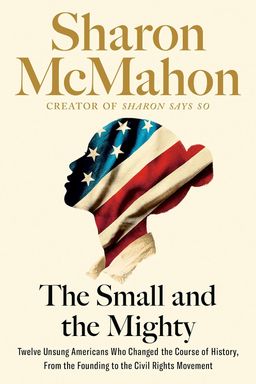
The Small And The Mighty cover

The Small And The Mighty

by Sharon Mcmahon

A former high school government and law teacher profiles lesser-known Americans who made an impact.

The Small And Mighty Republic

How do you see a nation clearly when the spotlight blinds you? Sharon McMahon argues that the United States is best understood not only through its marble statues but through its “auroras”—brief, brilliant lives often hidden by brighter celebrity. She contends that greatness is distributed: teachers who rebuild one-room schools, a laundress who steadies a boomtown, a poet whose hymn reshapes civic feeling, and wartime operators who connect armies under fire. To see them, you switch lenses: look beneath headline names to the people who drafted the last line, staffed the switchboard, taught the night class, or organized the carpool.

This lens changes how you read history and how you act today. You see that agency is accessible, cumulative, and moral—solidified through craft, care, and stubborn service. You also learn a method: ask who did the daily work; track how small design choices (a phrase in a ruling, a catalog’s order card, a school’s sunlight plan) ripple into structures that last. McMahon’s portraits—Gouverneur Morris, Clara Brown, Virginia Randolph and the Jeanes teachers, Julius Rosenwald and the Sears catalog, Katharine Lee Bates, suffragists and the Hello Girls, Daniel Inouye and Norman Mineta, Septima Clark, Claudette Colvin and Rosa Parks—show multiple pathways to influence.

What “small and mighty” looks like

You meet people who don’t fit the typical syllabus but who leave fingerprints on institutions and imaginations. Gouverneur Morris, a lesser-known founder with a peg leg and a scandalous private life, crafts the Preamble’s cadence—“We the People…”—and physically pens much of the Constitution with a goose quill. Clara Brown, once enslaved, becomes the “Angel of the Rockies,” turning laundry tubs and cooking pots into capital, shelter, and social glue. Virginia Randolph, a teenage teacher nearly run out of her job, invents the Henrico Plan and becomes the first Jeanes supervising teacher, transforming rural schools by training teachers, planting gardens, and insisting on community buy-in.

Scale appears in surprising places. Julius Rosenwald’s matching-grant strategy—paired with Booker T. Washington’s fundraising genius—builds nearly 5,000 Black schools with standardized plans that flood classrooms with light. The Sears catalog quietly undermines local segregation by letting Black families bypass hostile shopkeepers with postage-paid cards handed to mail carriers. Katharine Lee Bates climbs Pike’s Peak and comes down with “America the Beautiful,” a prayer-poem that millions sing, asking not for conquest but for refinement—“God mend thine every flaw.”

Movements need many tactics

McMahon shows you that rights expand when spectacle, service, and structure align. Inez Milholland rides a white horse before the 1913 suffrage parade; Maria de Lopez canvasses in Spanish and later serves in France; Rebecca Brown Mitchell wins frontier victories in Idaho; the Hello Girls—223 French-speaking switchboard operators—link commands “over there,” only to be denied veterans’ status until 1977. The throughline: indispensable service exposes the absurdity of exclusion, but recognition still demands relentless advocacy.

When systems fail—and how they’re repaired

The book anchors today’s polarization in historical breakdowns. “Bleeding Kansas,” born from the Kansas-Nebraska Act’s “popular sovereignty,” and the Dred Scott decision’s denial of Black citizenship made violence probable. A congressman canes a senator on the Senate floor; institutions flinch as moral questions get deferred. A century later, Brown v. Board proclaims “separate is inherently unequal,” but Brown II’s phrase—“with all deliberate speed”—becomes a loophole for delay. Federal power escorts nine children to school in Little Rock because local power refuses to obey.

Yet the book also offers blueprints for repair. Daniel Inouye, a Nisei amputee and war hero from the 442nd Regimental Combat Team, turns battlefield courage into a Senate career. Norman Mineta, once a ten-year-old behind barbed wire at Heart Mountain, later orders the grounding of flights on 9/11 and argues fiercely against racial profiling, helping pass the Civil Liberties Act of 1988 that apologizes and pays $20,000 in redress to surviving incarcerees. Septima Clark’s Citizenship Schools teach adults to sign their names and pass literacy tests; in neighborhoods touched by these classes, Black voter registration jumps 300% in four years. Claudette Colvin’s teenage refusal primes the city, Rosa Parks’s arrest triggers Jo Ann Robinson’s overnight mimeograph blitz, and Browder v. Gayle ends bus segregation—proof that disciplined inconvenience plus legal strategy wins.

How to use this in your life

Think like a builder, not a spectator. Ask: What small design could have big civic effects? Where can matching investments create ownership? Which words, songs, or symbols might reorient a public mood? Who is quietly running the switchboard in your world, and how can you resource them? (Note: This approach echoes Rebecca Solnit’s emphasis on grassroots hope and James C. Scott’s focus on everyday statecraft.)

McMahon’s invitation is practical: greatness is not a gate you pass; it’s a set of habits you practice. Write cleaner words, build brighter rooms, design clever workarounds, teach the next neighbor, and keep receipts for justice. If you learn to notice the auroras in the predawn, you’ll help bring them into daylight—and you’ll stop waiting for famous people to fix what ordinary people can build.


Words That Build Nations

Sharon McMahon shows you how language hardens into law and memory. Gouverneur Morris—scarred, witty, and prolific—doesn’t just attend the Constitutional Convention; he pens its most quoted line. Those seven words, “We the People,” widen the document’s frame from states to citizens. His 173 speeches (despite missing a month) and his goose-quill edits shape the Constitution’s cadence and coherence. You witness how a single drafter’s ear can give institutions a voice that survives centuries.

Morris embodies a vital paradox: flawed people can forge durable public goods. He was a philanderer, lived with disability, and died in a bizarre medical mishap (the whalebone catheter story you won’t forget). McMahon insists you keep both truths in view—human messiness and civic craft—so you don’t outsource responsibility to saints that never existed. The point isn’t to excuse wrong; it’s to recognize that democratic architecture is a human art built by imperfect hands.

How phrasing directs power

Words aren’t neutral; they allocate authority. “We the People” claims sovereignty for a public rather than for a coalition of states (a Madisonian ambition that Morris puts in memorable ink). A century later, another phrase—“with all deliberate speed”—will undercut Brown’s promise by making delay sound judicious. In the 1850s, “popular sovereignty” becomes a euphemism that exports the slavery fight to Kansas; soon, canes swing in Congress and ballots bleed. Language is a lever; it can open doors or lock them under velvet.

The book also shows you the other half of rhetoric’s power: the images and songs that settle in a people’s mouth. Katharine Lee Bates’s “America the Beautiful” isn’t a drumbeat; it’s a prayer for refinement: “God mend thine every flaw.” Set to Samuel Ward’s “Materna,” the poem becomes liturgy—recited in schools and churches, coded into national feeling. You see how art supplies shared words for aspiration (compare to Lincoln’s knack for moral music in prose).

Craft as civic skill

If you want to influence institutions, learn the crafts that embed ideas: drafting, editing, teaching, and songwriting. Morris refines constitutional clauses; Bates pairs meter with mountains; Septima Clark turns voter forms into literacy lessons; Jo Ann Robinson uses a mimeograph machine like a printing press for justice. Each act translates value into a repeatable form: a sentence, a stanza, a syllabus, a leaflet stack.

(Note: This echoes the “policy feedback” literature—institutions teach citizens what to expect—and also mirrors Marshall Ganz’s insight that stories of self, us, and now mobilize action.)

Practices you can adopt

  • Name the “we.” Write mission statements that widen, not narrow, the circle of belonging.
  • Audit euphemisms. Ask where soft phrasing (“deliberate speed”) hides hard avoidance.
  • Pair ideas with forms. A great phrase needs a platform—songbooks, switchboards, or school plans—to travel.

A durable lesson

Republics are kept by editors as much as soldiers. Attend to the sentence-level choices that invite people in—or let injustice hide in polite grammar.

Morris’s hand steadies the Constitution; Bates’s lines tune civic hope; later, Brown’s “deliberate speed” warns you to fight for clean language. The microphone of history isn’t always at the podium—it’s also at the drafting table and the hymnal rack. If you want to move a nation, mind your words and the forms that carry them.


Clara Brown’s Frontier Alchemy

Clara Brown turns grief into a civic asset. Sold as a child, separated from her children—Eliza Jane among them—she makes a vow to find them. That promise becomes propulsion. When George Brown’s will frees her, she works in St. Louis, then heads west with a wagon train to Colorado in 1859, hauling not just hope but tools: laundry tubs, cooking skills, storage know-how gleaned from German employers. On the mountain frontier, those humble crafts become currency.

In Central City, she launders miners’ shirts for gold dust, nurses the sick, hosts prayer meetings, and helps launch Union Sunday School. She invests in property, amassing about $10,000 (roughly a quarter-million today). That wealth is not hoarded; it circulates. She pays for relatives’ travel, feeds newcomers, and stakes others in business. Locals call her the “Angel of the Rockies” because she is more reliable than luck. Her house becomes a waystation, her reputation a local credit rating.

Practical resilience

McMahon emphasizes the mechanics of Clara’s resilience. She converts the practical—laundry, cookery, gardening—into leverage. She negotiates with wagon masters, haggles with miners, and uses property as both income and shelter for the stranded. When disaster and fraud wipe out much of her savings in 1873, she keeps the habit of generosity. Resilience here is not stoicism; it’s skill in motion.

Your takeaway is clear: in unstable systems, everyday competencies create options. A hot meal and a clean shirt may look small next to a governor’s decree, but on a cold night in a mining camp, they redraw the social map. (Compare to Rebecca Solnit’s accounts of disaster communities: kitchens and informal networks save lives before formal aid arrives.)

Private vow, public good

Clara never stops searching for Eliza Jane. Decades pass; she posts a $1,000 reward. At eighty-two, word arrives from Council Bluffs; the town raises funds, the train hisses, and mother and daughter meet in 1882, a reunion so vivid a newspaper records the tears. That vow—rooted in intimate loss—spilled into public life, sustaining an ethic of care that others relied on. Many civic projects begin this way: a private wound becomes a public work.

Mutual aid as infrastructure

Clara’s philanthropy prefigures later civil rights logistics. Her open table foreshadows the Montgomery carpool fleet; her reputation greases cooperation like the trust that powered Septima Clark’s Citizenship Schools. In both cases, daily service builds the relationships that movements require. You don’t get a 13‑month boycott or a 300% jump in registration without neighbors who already know how to pass a casserole or a ride.

A frontier ethic for now

Skills plus generosity equals durable influence. When big systems wobble, small dependable actors keep a town—then a city—then a country—stitched together.

Clara dies in 1885, honored locally and later by the Colorado Supreme Court Chambers and the Smithsonian. She didn’t hold office; she held people up. If you want to wield power without permission, learn useful trades, give more than you must, and let a worthy vow steer your choices. The returns often outlive the giver.


Teachers As Civic Architects

McMahon recasts the educator as a builder of public life. Virginia Randolph begins as a teenager in a one-room school in Henrico County, Virginia, facing a petition for her removal. She answers not with a speech but with service: whitewashing walls, planting gardens, sewing, cooking, chair caning, health lessons, and Arbor Days. She shows up at church forums with student-made goods, turns performances into partnerships, and builds trust one home visit at a time. The school becomes a hub for cleanliness, nutrition, and dignity.

Her approach scales. As the first Jeanes supervising teacher (funded by philanthropist Anna Jeanes), Randolph trains rural Black teachers, standardizes practical curricula, and insists on community contribution—money, lumber, labor. Superintendent Jackson Davis documents the “Henrico Plan,” and other counties copy it. The method matters: matching local sacrifice with small grants creates ownership and stewardship. A school no one sweated over is a school no one maintains.

The Jeanes network’s quiet power

Across the South, Jeanes teachers oversee clusters of one-room schools, troubleshoot repairs, and walk dirt roads to coach teachers. William Dillard calls them “nobler pioneers and missionaries” for good reason—they are infrastructure disguised as people. When schoolhouses burn, they help communities rebuild (later with Rosenwald funds, often in brick). They are the last line of defense when county budgets shrink, and in the 1950s many face harassment and arrest amid the KKK’s resurgence. Some stop riding buses for safety, driving their own cars between schools they helped raise from the ground.

This is systems change from below: decentralized, relational, and rugged. It anticipates what modern development scholars call “asset-based community development” and what organizers frame as “base-building.” The lesson for you is clear: lasting civic upgrades rely on trusted locals who translate outside dollars into inside commitment.

The justice question

McMahon also highlights exploitation. Randolph buys land, deeds it to the county, bakes bread to supplement her meager pay, and effectively subsidizes public infrastructure. When the county later helps pay off a mortgage, it reads as restitution more than reward. Philanthropy can scale good; it can also mask public underinvestment. Your task is to pair generosity with advocacy so institutions stop balancing budgets on private sacrifice.

What you can copy

  • Design for dignity: sunlight, gardens, clean paint, and clear routines raise expectations.
  • Match outside funds with local sweat—create stakeholders, not spectators.
  • Train the trainers: multiply impact by investing in the people who coach others.

An educator’s creed

“Train the hands, the eyes, the feet, and the soul.” When schools meet daily needs, they produce citizens, not just test scores.

Randolph and the Jeanes teachers don’t just teach reading; they teach upkeep, pride, and reciprocity—skills a republic runs on. If you want institutions that outlast any one leader, build them the way they did: slowly, publicly, and with everyone holding a hammer.


Matching, Design, And Markets

Two engines—philanthropic matching and distribution design—quietly rewired access for Black Southerners. Julius Rosenwald partners with Booker T. Washington to build nearly 5,000 Rosenwald schools. The mechanics are elegant: three-way matching (Rosenwald Fund + state/county + local Black community), standardized blueprints for 1–8 room schools that flood classrooms with daylight, and a bias for local ownership. Children bring fifty cents, elders add a dollar, counties chip in, and the fund matches. At its height, roughly 90% of Black students in Alabama attend Rosenwald schools, and across the South more than 600,000 children learn in buildings they helped will into being.

The results compound. Alumni include Maya Angelou, John Lewis, and members of the Little Rock Nine. Rosenwald also funds fellowships for Black intellectuals (Du Bois, Langston Hughes, James Baldwin), seeding a renaissance in letters. The moral ledger is complex: the schools are segregated and don’t challenge Jim Crow head-on (Washington’s pragmatic “industrial education” strategy drew criticism from W.E.B. Du Bois and later scholars like James D. Anderson). Yet the infrastructure they produce equips the very people who will dismantle segregation. It’s a strategic trade: build capacity now to fight for equality later.

Sears versus the local gatekeeper

Meanwhile, the Sears catalog—shaped by Richard Sears’s hustle and Rosenwald’s organizational rigor—erodes daily discrimination with logistics. In towns where postmasters refuse to sell stamps to Black customers or general stores refuse fair prices, Sears mails postage-paid order cards. Customers hand them to letter carriers and bypass hostile intermediaries. The catalog itself is designed to sit on top of the stack on a farm table—smaller than competitors so it stays visible. Trains, telegraphs, and rural free delivery do the rest.

Commerce here behaves like quiet civil rights. No court case, just engineering: packaging, routing, and price transparency that strip petty tyrants of leverage. Southern shopkeepers, threatened, spread rumors that Sears is a Black-run company—an unintended compliment to the catalog’s egalitarian effects. (Note: This foreshadows how digital marketplaces later route around gatekeepers; design choices can be moral acts by another name.)

Principles for scale

  • Require co-investment: match grants trigger local pride and maintenance.
  • Standardize the repeatable: good blueprints beat bespoke projects for reach and quality.
  • Design around chokepoints: postage-paid cards, not just pleas to unfair postmasters.

Scale with dignity

Rosenwald doesn’t just write checks; he writes conditions that honor sacrifice. Sears doesn’t just sell goods; it invents a path around humiliation.

If you want to open closed systems today, emulate both: pair money with local muscle and route resources through channels bigotry can’t easily block. Schools and supply chains can both be instruments of freedom when you attend to how people actually build and buy.


Culture, Suffrage, And Service

Movements win when songs, symbols, and service converge. Start with Katharine Lee Bates, the Wellesley professor whose 1893 Pike’s Peak view—“purple mountain majesties”—becomes “America the Beautiful,” published in 1895 for five dollars and later paired with Samuel Ward’s “Materna.” Unlike martial anthems, Bates’s hymn prays for moral refinement: “God mend thine every flaw.” That line lets you love your country and labor to improve it—a cultural permission slip that activists use again and again.

Suffrage leaders wield spectacle and inclusion. Inez Milholland, tall and radiant, leads the 1913 parade on a white horse; when police fail to protect marchers from a violent crowd, the nation notices. Milholland collapses on tour in 1916 and dies at thirty, becoming a martyr who tilts public opinion. Maria de Lopez, a Spanish-speaking educator, outfits her car in yellow bunting, distributes “POR QUE?” pamphlets in Spanish, and later earns a French commendation for WWI service. Rebecca Brown Mitchell works politics where she lives—Idaho—pushing schools, churches, higher age-of-consent laws, and state suffrage in 1896, then serving as the first female chaplain of a legislative body.

Service that shames exclusion

Enter the Hello Girls—223 bilingual, highly skilled telephone operators recruited by the Signal Corps and AT&T. They connect calls under fire, outpace male operators, and compress command times, saving lives. Yet the Army labels them “contract employees,” denies benefits, and even bills them for uniforms. Only in 1977 does Congress recognize them as veterans. Their quiet competence makes the injustice visible; decades of advocacy finally force the record to match the reality.

McMahon pairs these stories with wartime vignettes like the carrier pigeon Cher Ami, who delivers a lifesaving message to the “Lost Battalion” despite grave injury. The juxtaposition is deliberate: the nation celebrates a bird sooner than women who wired victory through copper and courage. That contrast sharpens your sense of what counts as heroism—and who gets written into the footnotes.

Tactics that travel

  • Make ideals sing: pair moral claims with art that people willingly repeat.
  • Stage the case: parades and pageantry create news hooks and memory.
  • Include the excluded: speak in every language your neighbors use.
  • Serve indispensably: become so necessary that exclusion looks absurd.

A cultural arithmetic

Song + Spectacle + Service + State wins (Idaho, 1896) = National momentum (19th Amendment).

If you’re building a cause today, learn from Bates’s hymn, Inez’s horse, Maria’s outreach, Rebecca’s localism, and the Hello Girls’ proof. Move hearts, fill news frames, invite everyone in, and do work that can’t be ignored—even if recognition takes far too long.


From Camps To Cabinet

American injustice and American repair often share a timeline. After Pearl Harbor, Executive Order 9066 (1942) authorizes military exclusion zones that trigger the incarceration of roughly 120,000 people of Japanese ancestry—most U.S. citizens—without due process. McMahon favors “incarceration” or “concentration camps” over “internment” because the latter blurs the reality: barbed wire, tar-paper barracks, confiscated livelihoods. In this crucible, two boys’ lives bend toward service—and reform.

Daniel Inouye, a Nisei from Hawaii, volunteers when the Army forms the segregated 442nd Regimental Combat Team. He survives firefights that sound impossible—a grenade in his right hand detonates as he tries to throw, his arm is later blown off, and he still clears German machine-gun nests. He earns high honors (ultimately the Medal of Honor), studies law, and serves decades in the Senate. Colleagues like Joe Biden and Barack Obama later praise the moral clarity he carried from battlefield to committee room.

Norman Mineta is ten when soldiers force his family from their California home. At Santa Anita and then Heart Mountain (which holds about 14,000 people), he loses his dog, watches his father weep on a train, and lives behind wire. He later becomes a congressman, then Commerce Secretary, then Transportation Secretary. On 9/11 he orders every U.S. flight grounded—an unprecedented act—and resists racial profiling of Arab and Muslim travelers, explicitly recalling his own incarceration as a warning.

Memory into policy

Both men work for restitution. Mineta champions the Civil Liberties Act of 1988: an official apology and $20,000 to each surviving incarceree. The act is modest next to the harm but monumental as a civic confession. Inouye’s presence—wounded veteran turned statesman—reframes who is “fully American” in the public mind.

Their arcs invert a cruel logic: the state that once caged them is the state they later steward. The lesson isn’t “trauma makes heroes” but that democratic systems can grow more just when survivors guide them. (Note: Their stories resonate with Bryan Stevenson’s argument that proximity to suffering clarifies moral priorities.)

What you can practice

  • Name harms precisely. Words like “incarceration” prevent soft forgetfulness.
  • Turn memory into guardrails. Write procedures that prevent repeat violations (Mineta’s anti-profiling stance on 9/11).
  • Seek restitution while building forward—apology plus structural reform.

A republic’s correction

Justice advances when those once excluded sit at the table, sign the checks, and set the rules.

If you steward an institution, invite the people harmed by it to help redesign it. Inouye and Mineta show that repair is not abstract; it’s a vote tally, a budget line, and a policy memo informed by lived memory.


Literacy To Mass Mobilization

Democracy runs on paperwork and practice. Septima Poinsette Clark sees that adults in the Jim Crow South can’t register to vote because they can’t read forms or sign their names. So she designs Citizenship Schools: two-hour, twice-weekly classes using the texts of daily life—Sears order cards, letters, voter registration forms. Hairdresser-turned-teacher Bernice Robinson listens to students’ needs and tailors lessons; Esau Jenkins recruits on island roads. The pedagogy is intimate and subversive: literacy as liberation, taught in church basements and back rooms, often in secret.

The impact is startling. In communities touched by these schools, Black voter registration jumps 300% in four years. Graduates don’t just vote; they start credit unions, build housing co-ops, lead PTAs, and run precincts. When the Highlander Folk School—where Clark teaches and where Rosa Parks experiences interracial education—is smeared as communist and shuttered by Tennessee, the model migrates to the Southern Christian Leadership Conference and spreads. Persecution prunes the tree; roots run deeper.

From a single seat to a citywide campaign

Nine months before Rosa Parks’s arrest, fifteen-year-old Claudette Colvin refuses to give up her bus seat, invoking Harriet Tubman and Sojourner Truth as moral witnesses. Brutalized and arrested, she becomes a crucial but imperfect test case. Organizers—aware of hostile media—decide Parks, a seasoned NAACP secretary trained at Highlander, is the right plaintiff to rally a city. When she is arrested, Jo Ann Robinson and the Women’s Political Council produce 35,000 leaflets overnight. Carpools form, shoe leather wears thin, and a 13-month boycott disciplines a community into daily resistance.

Legal strategy closes the loop. Fred Gray files Browder v. Gayle; a three-judge federal panel strikes down bus segregation; the Supreme Court affirms. Violence continues—bombings, snipers, Klan terror—but the habit of coordination holds. The boycott is not a viral moment; it’s logistics under pressure.

A franchise toolkit

  • Teach the forms. If people can complete applications, they can claim rights.
  • Train for dignity. Signing your name is a ceremony of self; honor it.
  • Pair courage with capacity. A refusal (Colvin, Parks) needs printers, drivers, and lawyers.

Disciplined inconvenience

Movements win by making the unjust system unworkable—one bus seat, one carpool, one court filing at a time.

If you want political change, get practical: map rides, master forms, and build a bench of trained neighbors. Courage is the spark; infrastructure is the flame.


Polarization And Power

The book draws a line from the 1850s to the 1950s to show what happens when institutions dodge moral clarity. In the run-up to the Civil War, Congress swaps principle for expedience: the Kansas-Nebraska Act repeals the Missouri Compromise under the banner of “popular sovereignty,” exporting the slavery decision to territories. Armed migrants flood Kansas; “Bleeding Kansas” earns its name. The Supreme Court in Dred Scott (1857) declares Black people—free or enslaved—not citizens, denying them standing in federal court and calling them a “subordinate and inferior class.” On the Senate floor, Representative Preston Brooks canes Senator Charles Sumner after an anti-slavery speech, and voters at home celebrate the assault. The message: when law abdicates, violence rushes in.

A century later, Brown v. Board (1954) is morally clear—“separate is inherently unequal”—and tactically careful—Chief Justice Earl Warren corrals a 9–0 decision to deny segregationists a dissent to rally around. But Brown II (1955) instructs desegregation “with all deliberate speed,” and those three ambiguous words become a bureaucratic brake. Southern Massive Resistance revs: state legislatures shut down public schools rather than integrate (Prince Edward County closes for five years), white “segregation academies” spring up, and local “Mothers’ Leagues” moralize delay. Eisenhower federalizes the Arkansas National Guard and sends the 101st Airborne to escort the Little Rock Nine—federal authority walking children to class.

Shared complicity, shared repair

McMahon refuses regional absolution. Northern industries—shipping, insurance, textile mills—profit from slavery’s cotton; later, Northern indifference slows civil rights enforcement. Systems of injustice are woven into national supply chains and sensibilities. Likewise, repair requires layers: court rulings, executive muscle, grassroots stamina, and cultural persuasion. No single lever moves the country; you need a synchronized gearbox.

The caution is contemporary. Euphemisms like “local control” or “parental rights” can become cover for exclusion if unexamined, just as “popular sovereignty” once did. Precision in words and courage in enforcement matter. Brown’s clarity had to be backed by soldiers; today’s rulings often need administrators, budgets, and patient organizers to become reality.

Operating principles for hard seasons

  • Name the moral core. Technical fixes without moral argument invite relapse.
  • Plan for resistance. Build enforcement pathways before the order drops.
  • Align fronts. Courts, cabinets, congregations, and classrooms must row together.

Pattern recognition

When elites punt hard questions to “the people” without guardrails, the strong prey on the unprotected. When the center holds, rights can expand.

From Kansas riverbanks to Little Rock’s sidewalks, the pattern is the same: words set the field, institutions either absorb or deflect the blow, and neighbors decide whether to step into the gap. Your job is to keep the words clean, build the channels strong, and be ready to walk with the kids when the door finally opens.

Dig Deeper

Get personalized prompts to apply these lessons to your life and deepen your understanding.

Go Deeper

Get the Full Experience

Download Insight Books for AI-powered reflections, quizzes, and more.