
Idea 1
Power, Conspiracy, and the Sleepwalkers' World
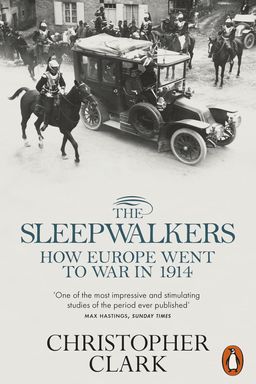
How can you explain the fact that Europe in 1914—an advanced, connected continent—stumbled blindly into one of history’s bloodiest wars? In The Sleepwalkers, Christopher Clark argues that the First World War was not the result of a single act or deliberate plot, but a chain of interlocking decisions made by leaders operating inside opaque systems, intoxicated by national mythologies and hemmed in by structural constraints. His thesis dismantles simplistic blame stories and invites you to see Europe as a network of fragile executives and self-deceiving actors—“sleepwalkers” who understood danger but could not stop moving toward it.
The tangled origins of catastrophe
You begin in Serbia, where political violence and clandestine nationalism intertwine. The 1903 regicide establishes a conspiratorial political culture led by men like Dragutin "Apis" Dimitrijević and secret societies (Narodna Odbrana, later the Black Hand). These groups mix military and civil authority, turning the state into both an incubator and shield for terrorism. Nikola Pašić, Serbia’s premier, maneuvers within this volatile mix—pragmatic yet secretive, unable to untangle the army’s shadow networks. When Gavrilo Princip and his young comrades head toward Sarajevo in 1914, they move through routes built by these conspiratorial webs: smugglers, agents, and ideological tutors steeped in irredentist doctrine. The assassination that results is not an accident but the explosive product of this hybrid of ideology, secrecy, and state complicity.
Imperial fragility and the Balkan ignition
Meanwhile, Austria-Hungary presents the tragic opposite: great military capacity, weak legitimacy, and endless internal division. Its dual structure—Austro and Hungarian parliaments, separate governments—breeds paralysis. Bosnia-Herzegovina, annexed in 1908, becomes a showcase and tinderbox where reforms coexist with repression. Repeated diplomatic blunders—Aehrenthal’s deal with Izvolsky, the Friedjung trial’s forgeries—damage Vienna’s credibility and deepen distrust of Serbia. The Balkan Wars of 1912–13 then redraw the map, transforming Serbia into a regional power with expanded population, French financing, and nationalist militancy. Austria views this rise as existential threat, and the region as Europe’s fault line. Franz Conrad von Hötzendorf’s militant dreams and Franz Ferdinand’s reformist restraint symbolize Vienna’s internal split: one pushing toward preventive war, the other toward cautious federalism. Sarajevo removes the latter, leaving hawks dominant.
The hidden architecture of decision
Across capitals, power flows through ambiguous channels. Russia’s “hydraulics of influence” move between Tsar Nicholas II, ministers, ambassadors like Hartwig and Izvolsky, and informal favorites such as Bezobrazov. The result is erratic policy—diplomatic promises made without cabinet knowledge, pressure from Balkan sympathizers, and inconsistent mobilization logic. In Germany, the military’s Schlieffen logic dominates: timetables and railway schedules define policy more than diplomacy. Britain’s Edward Grey maintains double-track diplomacy—private commitments to France alongside formal neutrality. France, under Poincaré, binds Russia tighter through loans and alliance extensions that make any Balkan clash a potential Franco-German war. Every state’s administrative maze ensures that no one can act quickly or coherently. Ambassadors, monarchs, and newspapers substitute personal will for institutional clarity, each reinforcing confusion.
Culture, masculinity, and misperception
Clark highlights that decisions are not only bureaucratic—they are deeply cultural. Ministers speak in a language of firmness, honour, and masculine resolve. To hesitate looks weak; to compromise appears effeminate. Such rhetoric imposes moral rigidity that makes diplomacy impossible. Combined with the press—governments planting ‘inspired’ articles and reacting to their own propaganda—the public sphere amplifies misperception. Each side reads the other’s statements in the worst light. Mobilizations, meant partly as signals or precautions, are read as aggression; deterrence becomes preemption. Once Russia orders general mobilization, Germany perceives war as a fait accompli.
Sleepwalking into war
The July Crisis showcases how systemic rigidity converts local signals into global action. Austria drafts an ultimatum deliberately too harsh for acceptance, buoyed by Germany’s “blank cheque.” Serbia, reassured by Russian support, replies with legalistic defiance. Vienna mobilizes; St Petersburg answers with partial and then general mobilization; Berlin enacts its own state of imminent war. Diplomats exchange confused messages (such as Grey’s misunderstood neutrality hint and King George’s “there must be some misunderstanding”), but mobilization timetables outrun them. Once the German 16th Division crosses Luxembourg, the machine moves irreversibly. Belgium’s refusal and defiant moral language transform a technical invasion into a moral cause, binding Britain to action.
(Parenthetical note: What distinguishes Clark’s interpretation from earlier historians like Fritz Fischer is emphasis on multiplicity—no single aggressor, but many intersecting failures. The Sleepwalkers reframes 1914 as a systemic tragedy rather than an intentional crime.) The final insight is unsettling: Europe’s leaders were not blind or wicked—they were rational in isolation but collectively catastrophic. By studying their mental maps, institutional constraints, and political cultures, you see how intelligent actors can drift into ruin, believing they act prudently. That is the enduring lesson of Clark’s work—and the reason its title feels timeless.