
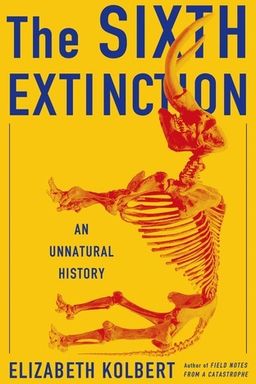
The Sixth Extinction cover

The Sixth Extinction

by Elizabeth Kolbert

In ''The Sixth Extinction,'' Elizabeth Kolbert explores humanity''s role in the ongoing mass extinction crisis. Through compelling narratives and scientific insights, she highlights the urgent need for change to prevent irreversible damage to the Earth''s biodiversity.

Understanding Extinction and Earth’s Changing Life

What does it mean to live in an age when extinction itself becomes a human artifact? The book traces the intellectual and biological history of extinction—from its shock to nineteenth‑century science to its twenty‑first‑century acceleration driven by human hands. It moves from fossil bones in Paris salons to bleached reefs in the Pacific, showing how the idea of species loss evolved from discovery to lived crisis. This isn’t just a story about dead animals; it’s a story about how you, an inhabitant of the Anthropocene, now play the role of both destroyer and potential rescuer in Earth’s unfolding history.

From disbelief to acceptance: the birth of the concept

Extinction once seemed unthinkable. Georges Cuvier’s insight, built from mastodon teeth and massive bones shipped from the Ohio Valley, established that some species truly vanish. His comparative anatomy and catastrophist worldview revealed a deep past punctuated by revolutions—biological wipeouts followed by renewal. Later thinkers like Charles Lyell softened the idea, arguing that slow, uniform processes could explain geologic change, and Charles Darwin extended gradualism to life itself: species evolve and disappear through natural selection over vast timescales. Yet reality refused to stay smooth. Fossil gaps, abrupt turnovers, and human‑caused disappearances all hinted that the tempo of loss could quicken dramatically.

Catastrophe as pattern: the planet’s mass extinctions

When you examine sites from Dob’s Linn to Gubbio you discover that crises are part of evolution’s fabric. The Ordovician crash, likely triggered by a CO₂ drawdown and global cooling, erased entire marine faunas recorded by graptolites. At the Cretaceous–Paleogene boundary, the Alvarezes’ discovery of a global iridium layer linked mass death to a cosmic impact that darkened the sky and ended the dinosaurs’ reign. Each episode demonstrates that life’s stability depends on planetary conditions—temperature, chemistry, light—that can flip quickly. Survivors were not always superior; they were merely the lucky inheritors of a reset world.

Humans join the geological stage

Fast forward to the present, and you find extinction no longer acts on million‑year tempo but on human time. Lyell’s and Darwin’s gradualism collides with the rapid extermination of species like the great auk or Galápagos tortoises, and later with pathogens shuttled around the globe. What the meteor and glaciers once achieved through physics, people now accomplish through trade, hunting, land use, and emissions. Paul Crutzen’s term Anthropocene captures that shift: human activities now alter climate, chemistry, and biogeography so profoundly that they will fossilize as a distinct layer in Earth’s record.

Why the amphibians matter

You encounter Edgardo Griffith’s tanks at the El Valle Amphibian Conservation Center in Panama—an ark built against a fungal plague, Batrachochytrium dendrobatidis. The chytrid fungus, spread by global commerce, has extinguished species that survived since the Devonian. Amphibians become a metaphor for the Anthropocene: ancient, sensitive, and suddenly undone by a microscopic hitchhiker. Their crisis signals a planetary pattern where ecological globalization meets biological vulnerability.

The planetary feedback loop

Carbon dioxide now links geology, chemistry, and biology. Undersea vents near Ischia show what future oceans might look like: zones stripped of calcifiers, pitted shells, and monotonous algae mats. Coral reefs at One Tree Island warn of parallel collapse above water: as aragonite saturation declines, corals stop building the frameworks that shelter reef life. In the tropics, Miles Silman’s plots in the Andes reveal trees scrambling upslope to keep pace with rising temperatures—and many failing because warming today runs ten times faster than ancient transitions. It is the rate of change, not merely its magnitude, that overwhelms evolution’s usual coping mechanisms.

Ecological entanglement and fragmentation

Having seen oceans and mountains, you turn to the forest fragments near Manaus—the BDFFP experiment where researchers monitor green squares surrounded by pasture. The findings are grim and precise: species vanish predictably as isolation increases, confirming the species‑area relationship’s warning that habitat loss scales nonlinearly with extinction. Inside fragments, specialized networks collapse: army ants no longer maintain continuous swarms, and the ant‑following birds reliant on them starve or disperse. Meanwhile, global traffic stitches distant continents into a “New Pangaea” where alien species spread as quickly as natives disappear.

Human responsibility and redemption

The story closes where it began—with people. From Pleistocene hunters who drove megafauna to early extinction to modern scientists performing ultrasounds on Sumatran rhinos like Suci, humanity’s role is paradoxical. The same ingenuity that caused collapse devises elaborate rescues: frozen zoos, artificial inseminations, captive‐breeding flights of whooping cranes. These efforts are poignant acts of repair in a world reshaped by us. Whether the Anthropocene becomes a catastrophe or a conscious stewardship depends on how you respond to this awareness: extinction is no longer merely a natural process; it is a mirror of human choices and capacities.

Seen as a whole, the book moves from discovering extinction’s reality to confronting its modern acceleration. It teaches that Earth’s history alternates between continuity and reset, and for the first time, one species holds the trigger. Your task is to decide whether that trigger yields ruin or renewal.


Deep Time and the Lessons of Catastrophe

Before you can grasp today’s biodiversity crisis, you need to see how Earth’s history is punctuated by cataclysm. The Ordovician, Devonian, Permian, Triassic, and Cretaceous extinctions together sculpted the tree of life. Each reflects different planetary stresses—glaciation, volcanism, anoxia, impact—and each remade ecosystems in their aftermath.

Reading extinction in rocks

At Dob’s Linn, thin shale bands record abrupt graptolite loss as ice sheets locked water into glaciers, lowering seas and stripping continental shelves. It was the planet’s first taste of climate‑driven mass death, probably triggered by CO₂ drawdown via primitive land plants. Far younger, the clay layer at Gubbio, Italy, captures the Cretaceous–Paleogene asteroid impact. Walter and Luis Alvarez’s iridium spike demonstrated that extraterrestrial events can rewrite life’s script in an instant. What paleontologists like Jan Zalasiewicz add is context: each layer in rock is both an archive of chemistry and a testimony to contingency.

Contingency and survival

The ammonites’ disappearance and the nautiluses’ survival illustrate how slight differences—larval depth, life cycle, or sheer luck—dictate outcomes. Survivors inherit the world by default, not merit. This pattern recurs through prehistory and shapes your moral reading of the present: the future biota won’t necessarily reflect resilience or intelligence but which lineages happen to endure the chaos humans unleash.

Rate and scale across eras

Comparison across events reveals the new scandal of speed. Past mass extinctions unfolded over thousands to millions of years; present change compresses equivalent shocks into a century. When CO₂ soars, seas rise, and temperatures shift ten times faster than post‑glacial rebounds, ancient analogies become warnings, not assurances. The biological record, once read as distant prelude, now mirrors daily headlines—acidification, warming, collapse. Deep time becomes a manual for humility: even super‑abundant lineages can evaporate when external forcing outruns adaptation.

Understanding these lessons helps you read current crises not as singular tragedies but as repetitions in a new key. Earth has died back before, but never previously by the hand of one intelligent species conscious of the cost.


From Natural Extinction to Human Acceleration

Once extinction became accepted fact, scientists sought its mechanism. Lyell and Darwin emphasized slow uniform processes, but they underestimated the brutal efficiency of human‑driven loss. The great auk’s extermination in 1844, hunted for feathers and meat, revealed that collapse could occur within decades, not epochs. Alfred Newton’s remorse led to one of Britain’s first wildlife laws—an early hint of conservation ethics forged in sorrow.

Modern vectors of destruction

With industrialization came novel accelerants: trade shipping pathogens and predators; fossil‑fuel emissions altering climate chemistry; deforestation isolating ecosystems. Amphibian declines driven by chytrid fungus, bat die‑offs from white‑nose syndrome, and coral bleaching all stem from human mobility and emissions. What once took millennia of tectonic or orbital change now unfolds through airplanes and shipping containers.

The amphibian sentinel

In Panama’s El Valle, Edgardo Griffith’s team scrubs boots with bleach to keep out Batrachochytrium dendrobatidis. Frogs that preceded dinosaurs now vanish in months. African clawed frogs and bullfrogs, asymptomatic hosts traded worldwide, carry the pathogen like tiny biological missiles. The amphibian crisis exemplifies globalization’s dark side: a single microbe, liberated by commerce, can erase entire evolutionary lineages.

Scale of difference

If the K–Pg asteroid was a geological instant, the Anthropocene’s weaponry—chainsaws, carbon, contagion—achieves planetary reach at continuous throttle. Amphibians, birds, corals, and forests now respond to a chronic event rather than an isolated blow. Unlike the iridium layer, this new boundary is being written consciously, day by day, into soils, plastics, and genomes.

Recognizing the shift from natural catastrophes to anthropogenic acceleration reframes extinction from fate to responsibility. You hold the pen writing Earth’s next stratigraphic line.


Climate Change and the Limits of Adaptation

Climatic oscillations have always directed the map of life, but today’s rate of change challenges the mechanisms that once guaranteed survival. The book’s comparison between Pleistocene migrations and current warming shows how speed alters outcomes.

Pleistocene lessons

During ice‑age cycles, forests marched across continents over millennia. Species tracked habitats as glaciers advanced and retreated. Darwin noted that Arctic and temperate forms alternated ranges without total annihilation. Those movements required centuries per degree of temperature change.

Acceleration today

Now warming proceeds ten times faster. Miles Silman’s Peruvian plots document tree species shifting upslope about 8–100 feet per year—too slow for many to keep climate pace. Some genera climb; others lag; entire ecological relationships (pollinators, pests, symbionts) fall out of sync. Mountaintop species simply run out of room. The Andes exemplify a future where composition itself changes, producing novel assemblages.

Key difference

Magnitude matters less than rate. A three‑degree rise over millennia allows migration; the same rise over a century outpaces life-history constraints, committing many species to delayed extinction.

From observation to projection

Ecologists use the species‑area relationship (S = cAz) to quantify these losses. Chris Thomas’s 2004 study applied it to warming scenarios, projecting up to one‑quarter of species committed to extinction by 2050 depending on dispersal ability. Critics note simplifications, yet the principle remains solid: shrinking climatic or physical area inevitably trims biodiversity.

When you hear numerical forecasts, remember that behind each percentage lie living webs. Climate change tests not only physiology but connectivity—whether landscapes remain porous enough for life to move. The faster the change, the less breathing space adaptation has.


Fragmentation, Invasion, and the New Ecology

Habitat loss fragments the stage on which evolution plays out. The Amazon’s Biological Dynamics of Forest Fragments Project offers a living laboratory for what happens when continuous forest becomes islands. Scientists banded 25,000 birds and tallied insects across isolated squares to witness ecological unraveling in real time.

The island effect on land

Immediately after clearing, some species surge as refugees crowd fragments. Over decades, diversity declines—"relaxation"—as small populations wink out and recolonization fails across hostile pastures. Edge‑loving butterflies replace deep‑forest specialists. Tom Lovejoy’s takeaway: even hundred‑hectare fragments can lose more than half their fauna and flora if isolation persists.

Webs undone

For creatures bound by interaction, fragmentation is lethal. Army ants need contiguous terrain for continuous swarming; when gaps sever colonies, ant‑following birds lose their foraging rhythm and vanish. Such coupled extinctions reveal a deeper loss: ecosystem functions disappear faster than visible species counts suggest. Complexity itself is the casualty.

A planet reconnecting artificially

While habitats break apart locally, global trade knits them cosmically. Ships carry about 10,000 alien species daily in ballast water. The resulting “New Pangaea” mixes once‑isolated biotas: brown tree snakes on Guam, zebra mussels in the Great Lakes, purple loosestrife in wetlands. Generalists thrive; specialists decline. The twin forces—fragmentation and invasion—yield homogenization: everywhere begins to look and sound the same life‑wise.

The BDFFP and New Pangaea stories remind you that conservation isn’t about saving single species but maintaining the architecture of interaction. Without continuous habitat, recolonization corridors, and control of invasives, even intact reserves become biological cul‑de‑sacs.


The Oceans under Chemical Siege

Ocean acidification and warming together constitute the marine arm of the Anthropocene. At volcanic CO₂ vents off Ischia, Jason Hall‑Spencer’s team witnesses the future: as pH drops below 7.8, mussels, barnacles, and coralline algae vanish, replaced by weedy algae. The patterns mirror laboratory predictions—the world’s largest experiment conducted by nature herself.

Chemistry of decline

When CO₂ dissolves, it forms carbonic acid, which strips carbonate ions from seawater, reducing the “building blocks” of shells. Because the pH scale is logarithmic, a 0.1 drop equals roughly a 30% rise in acidity. Models forecast further decline toward 7.8 by 2100, a chemistry reminiscent of ancient acidification events but far faster. Organisms that rely on calcium carbonate—pteropods, coccolithophores, shellfish—find it increasingly costly to build skeletons.

Coral reefs on the edge

On One Tree Island in the Great Barrier Reef, Ken Caldeira and Chris Langdon link coral growth directly to aragonite saturation. As saturation falls, calcification and reproductive success collapse. Warming adds bleaching, disease, and storm intensification, leaving reefs doubly assaulted. Ove Hoegh‑Guldberg warns that many reefs may stop accreting entirely within decades, reducing biodiversity by millions of dependent species.

A visible warning

Acidification isn’t invisible chemistry—it is seen in limpets with eroded shells, coral gametes failing to settle, and once‑vibrant reefs turning ghostly white. These changes collapse the physical structure that shelters countless organisms.

Because our carbon emissions outpace natural buffering, this transition will occur on human time, not geological. The ocean’s fate again emphasizes rate: life built over eons can dissolve in generations.


Humans, Pathogens, and the Paradox of Rescue

No reader leaves this narrative without confronting humanity’s dual role as both extinction engine and emergency responder. From Ice‑Age overkill to twenty‑first‑century biotech, humans define both problem and potential solution.

Ancient agents of extinction

Archaeological and genetic evidence ties megafaunal losses across continents to human arrival. In Australia, Sporormiella spores drop abruptly as hunters appear, followed by fires that reshape plant communities. In the Americas, even low harvest rates, modeled by John Alroy, suffice to drive mammoths and giant sloths extinct over centuries. The message: small, intelligent populations wield disproportionate ecological force.

Modern epidemics of globalization

White‑nose syndrome in bats repeats the amphibian tale: Pseudogymnoascus destructans, introduced from Europe, invades hibernating bats, causing fatal arousals. Within years, Aeolus Cave’s colonies fall from hundreds of thousands to dozens. These collapses reveal how behaviors once adaptive—colonial roosting—become liabilities under novel pathogens. Human mobility turns caves, ships, and airports into vector networks.

The conservation paradox

Yet humans also orchestrate rescues. Suci the Sumatran rhino, bred under Terri Roth’s care, represents a species surviving partly through reproductive technology. Frozen Zoos store cell lines; whooping cranes learn migrations from ultralights. Such acts blend compassion and irony—they are triumphs made necessary by earlier failures.

Moral inversion

The only species capable of industrial‑scale destruction is also the only one capable of deliberate restoration. Whether that redemption suffices depends on scale, timing, and will.

By ending on this note, the book situates humanity as both geologic and moral actor. You are no longer outside nature observing its demise—you are its principal force and, perhaps, its last line of defense.

Dig Deeper

Get personalized prompts to apply these lessons to your life and deepen your understanding.

Go Deeper

Get the Full Experience

Download Insight Books for AI-powered reflections, quizzes, and more.