
Idea 1
Flourish Through Simplicity: The Simplicity Principle
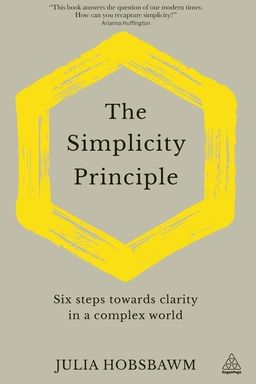
Have you ever felt that modern life—your overflowing inbox, endless to-do lists, constant notifications—is simply too much? In The Simplicity Principle, Julia Hobsbawm argues that our age of overwhelming information and digital distraction has made us addicted to complexity. Her solution is both ancient and elegant: simplicity is not naive; it’s a deliberate practice that lets you flourish rather than merely survive. She insists we can thrive again by learning to keep things simple and to learn from nature.
Hobsbawm roots her argument in two concise ideas—expressed through six words that power the entire book: Keep it simple. Learn from nature. This approach, which she calls the Simplicity Principle, urges you to pare down what you do until your choices are focused and meaningful. Instead of drowning in complexity, she invites you to operate on human scale again, aligning your rhythms with the patterns of the natural world. Through geometry, psychology, and examples drawn from bee colonies to business leaders, she demonstrates how order and balance—not chaos—are the keys to mental clarity and productivity.
Why Simplicity Matters in the Modern Age
Our brains, Hobsbawm reminds you, are the most complex objects in the known universe, with 86 billion neurons firing constantly. Yet they are only equipped to manage around seven pieces of information at once (a limit identified by psychologist George Miller). Facing a world of limitless inputs—35,000 decisions a day, trillions of bytes of data—our minds short-circuit. Stress, distraction, and anxiety are the price of too much complexity. The author even coins a term for the syndrome many of us face: CAT—Complexity, Anxiety, and (too little) Time. Modern individuals, she warns, operate under systems so tangled that failure or overload feels inevitable.
In response, she turns to nature’s intelligence and its preference for efficient design. Bees, she notes, never reinvent their honeycomb; they rely on the perfect hexagonal shape that tessellates endlessly, saving space and energy. This geometric shape becomes Hobsbawm’s metaphor for sustainable success: flexible, strong, and endlessly repeatable. Simplicity, she argues, is not the opposite of sophistication—it lies on the “other side of complexity,” as Oliver Wendell Holmes once said. You reach it by deliberate effort, by stripping away what is unnecessary and working with pattern and rhythm rather than noise.
Introducing Hexagon Action
From bees to geometry, Hobsbawm distills her system into what she calls Hexagon Action, a six-sided practical framework for living simply. Each side represents one arena of human experience: Clarity, Individuality, Reset, Knowledge, Networks, and Time. These are the six recurring “slices” where complexity usually traps us and where simplicity can liberate us. She encourages readers to think in sixes—to limit what you do to six focused areas, six priorities, or even six small changes. This numeric discipline mirrors natural efficiency: six is a “perfect number” in mathematics (1 + 2 + 3 = 6), and it fits beautifully within our cognitive limits.
Each element of Hexagon Action teaches a different aspect of simplicity: how to make clear decisions, how to protect your individuality amid digital conformity, how to rest and reset, how to manage knowledge in the age of infobesity, how to build authentic networks instead of performative ones, and how to make peace with the finite nature of time. Together, they form a life philosophy that’s both spiritual and pragmatic, rooted in pattern, geometry, and mindfulness.
The Bee as a Teacher
Central to the book’s imagery is the honey bee—what Hobsbawm calls “the poster-species for simplicity.” Bees embody collective intelligence without chaos. Each one performs a distinct role—worker, queen, forager—but all share the hive’s purpose through cooperation and rhythm. Their hexagonal comb literally mirrors Hexagon Action: strong, ordered, and economical. Humanity, she suggests, can learn from this “superorganism” structure. Like bees, we thrive when we understand our roles, communicate effectively, and create networks that are balanced rather than bloated.
Yet Hobsbawm’s bee metaphor goes beyond biology; it’s a call to mindfulness in work and technology. She introduces you to people she calls “Hexagon Thinkers”—from Arianna Huffington, who champions rest and sleep, to Faith Osier, the Kenyan scientist simplifying malaria research, and Greta Thunberg, whose clarity and conviction cut through global complexity. Each thinker embodies the practice of simplicity as power, not reduction.
From Complexity to Clarity
Ultimately, Hobsbawm contends that simplicity is not about minimalism or deprivation; it’s about equilibrium. Simplicity recognizes that complexity has its place—human life can never be entirely plain—but insists on finding a balance. She warns against confusing “simplistic” shortcuts with true simplicity. As one 1962 philosopher, Mario Bunge, noted, the rule “Simplify” must not lead to childish oversimplification. Instead, efficiency and beauty emerge from structure, attention, and boundaries. Simplicity, for Hobsbawm, is an aesthetic and an ethic. It’s clarity over clutter, depth over superficial multitasking, and focus over endless scrolling.
Through vivid examples—from the chaos of New York’s power outage to the quiet perfection of bees’ geometry—Hobsbawm makes the Simplicity Principle feel both urgent and achievable. Her challenge is not to flee from technology but to live with it on your terms. Thinking in sixes, learning from the natural order, and embracing human-scale solutions, she argues, will let you reclaim control, focus, and joy. In short, when you apply the Simplicity Principle, you stop surviving complexity—and begin to flourish through simplicity.