
Idea 1
The Silent Language of Leadership
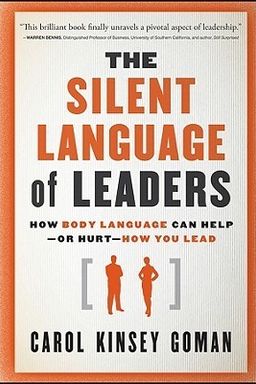
How much of what makes a great leader is visible, but unsaid? Carol Kinsey Goman’s The Silent Language of Leaders begins with this provocative idea: leadership is not only about what you say—it's about what your body says while you're saying it. Whether you’re giving a keynote, negotiating a deal, or trying to inspire your team, your gestures, posture, tone, and facial expressions send constant signals that can help or hurt your message. Goman contends that leaders need to become fluent in this “silent language,” because people believe what they see more than what they hear. In a world shaped by visual communication and global collaboration, this skill has become central to trust and influence.
At the heart of Goman’s argument is the idea that leadership communication happens in two streams: verbal (what you say) and nonverbal (what your body communicates). When these streams are aligned, you gain credibility. When they conflict, audiences perceive insincerity, even if your words are polished. Neuroscience research has confirmed how quickly people read these signals—within seven seconds, your audience decides if you’re confident, trustworthy, and likable. Goman captures this through vivid examples, such as the executive who unknowingly crossed his arms while inviting questions, thereby shutting down engagement before the audience realized why.
Why Body Language Matters Now
Three major factors make body language an essential leadership tool today: technology, science, and globalization. Video calls, virtual meetings, and recorded presentations mean we are constantly seen and judged through visual mediums. Advances in neuroscience—such as MRI and fMRI studies—prove that people’s emotional brains react faster to gestures than to words. And as the workforce becomes multicultural, subtle nonverbal differences can make or break trust across cultures. The book argues that modern leaders must cultivate nonverbal intelligence the same way they once did verbal eloquence.
What You’ll Learn
Across nine chapters, Goman weaves together psychology, anthropology, and practical coaching. She begins by exploring how people read a leader’s presence and credibility through “personal curb appeal.” She then moves to negotiation, showing how gesture clusters and micro-expressions reveal sincerity or bluffing. Later chapters explore leading change—where emotional contagion and empathy transfer through body language—and collaboration, where inclusiveness is conveyed through gaze, posture, and mirroring. Goman also tackles gender differences, cultural variations, and the complexities of virtual communication. Each chapter blends research with real stories from executives she has coached, turning abstract ideas into vivid workplace scenarios.
The Central Proposition
Goman’s central proposition is that leaders are always sending signals—intentional or not—and those signals drive how others perceive their confidence, warmth, empathy, and authority. While traditional leadership training emphasizes strategic communication, this book argues for alignment between verbal and nonverbal behavior. Alignment builds trust; incongruence breeds doubt. In coaching terms, Goman calls this “body language literacy,” the ability to both read and respond to others’ cues with awareness. She stresses that effective leaders don’t manipulate gestures but use authentic, congruent behavior that resonates emotionally.
A Leadership Mirror
Throughout her examples—from corporate boardrooms to video conferences—Goman invites you to act like a mirror. Watch how teams react when your tone or posture shifts. Notice if your words of encouragement are undermined by a clenched jaw or averted gaze. Her stance is pragmatic: body language is learned, not innate, and can be refined through conscious practice. Like Daniel Goleman’s work on emotional intelligence, her concept expands leadership competence beyond rational skills into the emotional and nonverbal domain.
Why This Matters
In a global, hypervisual era, leaders are communicating across screens and cultures that depend increasingly on subtle nonverbal signals. Goman’s book becomes a guide to authenticity and awareness: understanding how you look, sound, and move will shape what people believe about you. Whether you lead a multinational firm, a start-up, or a virtual team, your success now depends on mastering both languages—the spoken and the silent. As she puts it, nonverbal intelligence is the new literacy of leadership.