
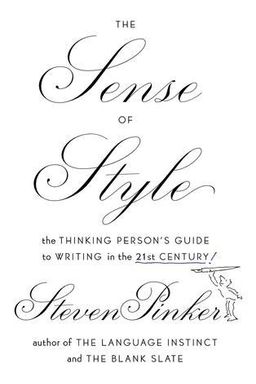
The Sense of Style cover

The Sense of Style

by Steven Pinker

The Sense of Style by Steven Pinker demystifies the art of writing with practical tips and insights. By exploring classic style, clarifying syntax, and using vivid imagery, Pinker provides tools to craft engaging and reader-friendly texts. This essential guide empowers writers to create compelling content across genres.

Seeing Through Words: The Art of Clarity

How can you make readers see what you mean? In The Sense of Style, Steven Pinker argues that good writing is not about memorizing rules—it is about clarity, vividness, and empathy. He treats style as a window onto the world: your job is to show readers something worth seeing and guide their gaze so they understand it as clearly as you do. The book blends linguistics, psychology, and examples of master prose to teach you how to make your writing as lucid as thought itself.

At its core, Pinker fights two enemies: jargon and self-consciousness. He blames most bad prose on what he calls the Curse of Knowledge—the inability to imagine what it's like not to know what you know. Once you understand a concept deeply, you forget the steps that lead to comprehension. Writing therefore becomes a test of empathy: you must reconstruct an outsider’s perspective and supply what your expert mind omits.

The Classic Style: Writing as Presentation

Pinker’s favored model is classic style, drawn from Francis-Noël Thomas and Mark Turner. In this style, you don’t lecture the reader; you show them something in the world and converse as equals. You give evidence through examples and trust readers to recognize truth when they see it. Whether explaining physics like Brian Greene or cultural ideas like Rebecca Goldstein, the writer acts as a guide rather than a preacher. The voice is confident but not pompous—crisp, visual, and collaborative.

Reverse Engineering Good Prose

Instead of memorizing dos and don’ts, Pinker encourages reverse-engineering passages you admire. Open them like a mechanic inspecting an engine. What makes a Dawkins opening irresistible? Why does a Goldstein sentence paint such a sharp image? When you can name the parts—sound, rhythm, diction, parallelism—and reassemble them in your own voice, you cultivate taste and technical mastery without worrying about brittle rules.

He insists that artists of prose begin with curiosity. An opening should instantly provoke thought: a claim or paradox that invites readers to look closer. From there, concrete imagery and intuitive rhythm carry the load. Readers remember scenes and sensations, not abstractions. If you replace vague nouns with vivid pictures, your sentences start breathing.

From Psychology to Syntax

The book connects style to cognitive science. Writing communicates by managing the reader’s working memory. You reduce confusion by structuring sentences in right-branching order (light before heavy) and by placing given information before new. Syntax is the tree that makes sense of thought. If your branches bend awkwardly—forcing readers to hold unfinished phrases—they will stumble. Pinker’s tree-based thinking shows why certain grammatical habits create clarity and why others generate bewilderment.

Logic Across Sentences: Arcs of Coherence

Even well-formed sentences can sound disconnected. Pinker teaches you to build arcs of coherence: topic continuity, clear references, and visible logical relationships. Readers follow threads—not random fireworks—and you guide their understanding by declaring your topic early, maintaining consistent subjects, and signaling relation words (“because,” “although,” “for example”) at the right moments. The result feels intuitively logical instead of mechanically pedantic.

Conventions, Not Dictates

Many supposed writing rules—no split infinitives, no sentence-final prepositions—are bubbe meises, old wives’ tales mistaken for law. Pinker dismantles these myths by tracing their Latin origins and comparing them to living English. He draws a sharp line between legitimate conventions (rules that foster clarity) and folk superstitions (rules that serve vanity). If Shakespeare or Austen violated a “rule,” you can probably relax.

The Real Rules: Usage with Judgment

In modern writing, correctness comes from community practice, not commandments. Dictionaries and style guides record evidence, not decrees. Their notes express tacit agreements among careful writers, much like standard sockets in engineering. You follow conventions not out of obedience but to respect your readers’ expectations. Pinker frames usage as a social contract: conventions help ideas travel smoothly through the public realm.

The Ethical Dimension of Style

Pinker’s central message is ethical as well as aesthetic: clear writing is an act of consideration. You write to make complex truths shareable, not to flaunt expertise. Every technique—from rhythm and syntax to punctuation and pronoun choice—ultimately serves empathy. The sense of style is the sense of another mind. When you write with that vision, your prose becomes what he calls “a window onto the world”—transparent, humane, and durable.


Mastering Classic Style

Classic style is Pinker’s standard for clarity and grace. It treats writing as joint attention: you show readers an object or idea as though you were talking across a table. The scene is conversational but disciplined. You respect your reader’s intelligence and keep the prose visual, concrete, and fluid.

Seeing and Conversing

The style combines two metaphors—seeing and conversing. You first present something for inspection, then discuss it naturally. That stance avoids both verbosity and arrogance. Writers like Brian Greene and Rebecca Goldstein illustrate this with analogies rather than abstractions: Greene compares the multiverse to shoe sizes; Goldstein makes metaphysics tangible through daily imagery.

Why It Works

Classic style contrasts sharply with academic or bureaucratic writing. It avoids over‑signposting (metadiscourse) and trusts readers to infer connections. When you adopt the classic stance, you stop writing about your writing (“This section will address...”) and start writing about your topic (“Gravity bends space”). The effect is direct engagement.

Concrete Moves

Pinker recommends beginning with a vivid instance before generalizing, using simple nouns and verbs, and omitting self-conscious commentary. Instead of hedging with “I would argue,” state the idea clearly. Instead of jargonized abstractions, give readers sensate examples. Trust allows clarity to prove itself rather than arguing for it.

When Not to Use It

Classic style is not universal; practical styles are better for contracts, manuals, or legal texts. Prophetic or oratorical styles suit persuasion and emotion. But for essays, scientific explanations, and literary nonfiction, classic style remains the most humane and persuasive approach—showing reality rather than describing reasoning about it.


Escaping the Curse of Knowledge

The Curse of Knowledge explains why intelligent people often write opaque prose. As expertise deepens, the ability to imagine ignorance fades. Your mental models compress detail into shorthand—abbreviations, jargon, and skipped steps—leaving readers behind. Pinker frames this as a cognitive illusion akin to hindsight bias and egocentric anchoring: you assume others share your internal map.

Psychological Roots

Studies show experts underestimate novices’ learning time and overpredict comprehension. They forget that technical terms like “stimulus post-event” mean nothing outside the lab. The more fluently you process something, the harder it is to recall how it looked to a beginner.

Practical Remedies

To exorcise the curse, Pinker advises slow revision. After drafting, step away—return as if reading it for the first time. Test drafts on outsiders, not colleagues steeped in your jargon. When introducing new concepts, give physical examples before theory (“tap the wrist” instead of “apply stimulus”). Spell out abbreviations on first mention and avoid homemade acronyms. These steps rebuild empathy into style.

Empathy as Technique

Writing for the uninitiated is not condescension—it’s generosity. You imagine what readers can picture and structure sentences around that visibility. Over time, the constant practice of checking your assumptions becomes the hallmark of real craftsmanship.


Building Structure: Syntax and Flow

Understanding syntax is crucial to clarity because English translates thought into linear order. Pinker invites you to think in trees—nested structures revealing how words attach. By visualizing clause geometry, you fix errors that copyeditors miss and improve rhythm, focus, and comprehension.

Tree Awareness

Common mistakes come from “tree‑blindness”: losing track of which words modify which. When subjects are fattened by phrases (“The bridge to the islands are crowded”), verbs lose agreement. Right-branching, where heavier material follows, keeps processing smooth. Readers expect light‑before‑heavy and topic‑then‑comment; those patterns match cognitive memory limits.

Coherence Across Sentences

Beyond syntax, paragraphs must connect logically. Declare your topic early, maintain reference consistency, and use relation markers where needed. Pinker invokes Hume’s triad—resemblance, contiguity, and cause—to describe how ideas link. When cues are invisible, readers invent connections and misread emphasis.

Ordering and Rhythm

Good order respects cognitive load. Temporal sequences and light‑before‑heavy ordering ease comprehension. Paragraph breaks act as rests, not arbitrary boundaries. You vary length to guide attention and emphasize transitions. Structural devices—passives, clefts, preposing—let you manage given versus new information for smoother flow.

Negation and Logical Clarity

Even logical particles need care. Negation works only when readers know which proposition is being denied. Stage the affirmative first (“You might think… but no”) so the rejection makes sense. Kennedy’s deliberate contrast (“not because it is easy but because it is hard”) exemplifies minimal confusion. Controlling scope and focus keeps ideas crisp and persuasive.


Managing Themes and Proportion

Beyond sentence craft lies macro‑coherence: thematic organization. Pinker warns that brilliant facts can drown arguments if themes scatter. To sustain understanding, group related material in contiguous blocks and match space to importance.

Good vs. Bad Models

John Keegan’s A History of Warfare collapses under thematic drift; his topics (Clausewitz, culture, Freud) appear randomly and inversely weighted. By contrast, John Mueller’s The Remnants of War names its two themes clearly—criminal and disciplined warfare—and develops each in well‑bounded runs. Readers can visually map the argument.

Practical Rules

  • Name major themes early.
  • Localize discussion: keep subtopics contiguous.
  • Use consistent vocabulary for each semantic cluster.
  • Match paragraph length to argumentative weight.

This method converts erudition into persuasion. Readers follow a clear map rather than decipher a maze of digressions. Control of proportion is not aesthetic excess—it is cognitive kindness.


Rules, Conventions, and Usage Judgment

Pinker's late chapters demystify usage: language evolves through collective habits, not commandments. Dictionaries describe patterns and sometimes recommend best practices. Their authority lies in evidence from educated usage, not decrees from purity campaigns.

The Social Contract of Language

Every rule derives from shared expectation. Formal prose works smoothly because writers follow the same conventions—like plug shapes in engineering. Ignoring those rules for rebellion’s sake often confuses rather than liberates.

Separating Myths from Facts

Pinker debunks common myths: that you must never split infinitives (“to boldly go”), never strand prepositions, never use restrictive “which,” or avoid possessive antecedents. These are historical accidents derived from Latin or prescriptivist misreadings. Modern evidence and great literature contradict them. Follow rules that help clarity; ignore those that obstruct it.

Practical Usage Choices

He surveys recurrent puzzles—adverbs vs. adjectives, who/whom, can/may, fewer/less, singular they—and shows pragmatic solutions grounded in meaning and register. Sound judgement matters more than rigid obedience. The return of singular they exemplifies evolving consensus: it preserves clarity and inclusiveness better than “he or she.”

Punctuation and House Style

Punctuation aligns with prosody and syntax. Use commas to separate supplements, serial commas to prevent ambiguity, apostrophes only for possession, and quotation style per publication. Logical punctuation may appeal in technical writing; American nesting works for journalism. The aim, always, is clarity of structure—not pedantry.

Dig Deeper

Get personalized prompts to apply these lessons to your life and deepen your understanding.

Go Deeper

Get the Full Experience

Download Insight Books for AI-powered reflections, quizzes, and more.