
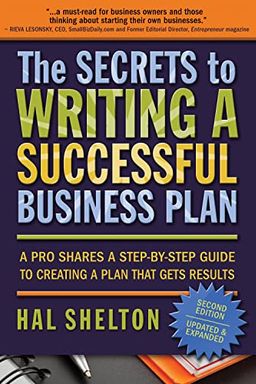
The Secrets to Writing a Successful Business Plan cover

The Secrets to Writing a Successful Business Plan

by Hal Shelton

The Secrets to Writing a Successful Business Plan offers a comprehensive, step-by-step guide to crafting a business plan that gets results. With expert insights on avoiding common mistakes, emphasizing financial clarity, and effectively communicating your business strategy, this book is an invaluable resource for aspiring entrepreneurs seeking to turn their ideas into successful, thriving businesses.

The Power and Purpose of a Business Plan

What separates a dreamer from a successful entrepreneur? According to Hal Shelton in The Secrets to Writing a Successful Business Plan, it’s not necessarily the boldness of the idea, but the discipline of the plan. Shelton argues that a well-developed business plan is more than a bureaucratic requirement or a fundraising tool—it’s a powerful roadmap that helps you test your ideas, attract partners and investors, and confidently steer your business toward success. The act of planning, he insists, is just as important as the final document, because it forces entrepreneurs to clarify their goals, think realistically, and find solutions before problems occur.

Shelton’s perspective is shaped by decades of experience as a corporate CFO, SCORE mentor, and angel investor. He has sat on both sides of the table: guiding entrepreneurs who dream big and evaluating their plans as an investor who must decide whether or not to fund those dreams. That dual insight gives this book a blend of realism and encouragement that many startup guides lack. He opens with relatable stories—Fred, the aspiring bed-and-breakfast owner who needed to see his dream through a financial reality check; Ann, the veteran business owner who had to reimagine her company in a changing marketplace; and Bob, Larry, and Barbara, whose nonprofit idea needed structure before passion could become impact. Each story highlights that writing a business plan is a process of education and focus.

Why a Plan Is More Than a Document

Shelton reframes business planning as an active learning journey. A business plan, he says, isn’t just a binder for investors—it’s a test bench for your concept. When you put your assumptions on paper, you discover what works and what doesn’t. The written plan becomes a living reference point—a blueprint to update as markets, technologies, and ambitions evolve. Entrepreneurs often say they’ve got everything “in their head,” but Shelton points out that clarity only comes through structured thinking. Comparing unrecorded ideas to an uncharted voyage, he notes that even the best captains need a map to avoid unseen shoals.

Shelton’s central argument is that writing a business plan helps you articulate three essential things: who your customers are, why your proposition matters, and how you’ll make money doing it. He also emphasizes something that new business owners often forget: a company has two sides—the visionary founder and the practical manager. A plan helps balance both roles, ensuring emotion is grounded in economics.

The Structure of Strategy

The book is divided into three major sections—Business Plan Basics, Business Plan Contents, and Financing 101—each walking readers from concept to execution. In the first section, Shelton demystifies the process: what a business plan is, why it matters, and the common mistakes that derail entrepreneurs. In the second, he walks through each component step by step—executive summary, company description, marketing strategy, operations, management, and financials. The third explores how to use the plan to secure funding, including practical explanations of bank loans, angel investments, and other sources such as crowdfunding or leasing. Rather than overwhelming the reader with theory, Shelton offers checklists, examples, and humor drawn from real coaching sessions.

Hal’s 12 Commandments

Shelton distills his decades of experience into his famous “12 Commandments for Writing a Business Plan,” a concise but powerful framework that runs throughout the book. These commandments—ranging from “Know your audience” to “It’s all about the money” to “Focus, Focus, Focus”—form a practical code of conduct. Perhaps most importantly, he says, your plan must prove that you are the right person to lead the business. Investors might be buying into your idea, but they’re really betting on you.

According to Shelton, every successful business plan shares five traits: clarity, credibility, focus, flexibility, and financial grounding. A good plan must read like a compelling story—one that convinces readers that the problem you’re solving matters, that you have the capacity to solve it, and that your approach will create both profit and impact. This isn’t about filling out a template; it’s about creating a narrative of confidence and possibility. As W. Kenneth Yancey, CEO of SCORE, writes in the foreword, a plan is not a one-time act but an evolving compass that keeps a business aligned with its mission and market.

Relevance for Today’s Entrepreneur

Why does this matter? Because in an era of fast startups, apps, and side hustles, it’s easy to confuse motion with progress. Shelton reminds readers that careful forethought isn’t bureaucracy—it’s survival. Whether you’re a founder seeking funding, a seasoned operator revisiting your goals, or a nonprofit leader learning to “think like a business,” the business plan remains the entrepreneurial lingua franca. It’s how you turn ideas into action and dreams into data.

Ultimately, The Secrets to Writing a Successful Business Plan is about empowerment through structure. It’s a practical blueprint for thinking clearly, planning realistically, and communicating persuasively. As Shelton puts it, your plan is not meant to sit on a shelf—it’s meant to keep you focused, flexible, and financially sound as you navigate the most unpredictable venture of all: your own business journey.


Business Plans as Living Roadmaps

Shelton begins by redefining what a business plan truly is. To him, it’s not just a presentation or a pitch deck—it’s a process of structured thinking that forces clarity and discipline. A well-written plan becomes a living roadmap, integrating goals, strategies, and financial outcomes into one evolving narrative.

What a Business Plan Is—and Isn’t

At its core, a business plan answers five critical questions: What do you want to achieve? Why is it feasible? How will you get there? What makes your offering unique? And who’s driving the effort? Shelton reminds readers that a good plan does more than describe an idea; it connects strategy to execution. It’s both a reflection of your current position and a compass for the future.

Many entrepreneurs, he notes, misunderstand this purpose. They treat business plans like elevator passes for banks and investors, rarely revisiting them after funding. Yet a plan’s real audience is you. It’s the tool that tests whether your concept can stand up to real data, realistic assumptions, and competitive analysis. Without one, you’re essentially flying blind.

Evolution Over Perfection

Shelton cautions against what he calls “analysis paralysis.” Too many founders spend months perfecting their plan instead of acting on it. He argues for a balance: be thorough, but don’t over-polish. A business plan should adapt as your business evolves—new opportunities, market changes, and customer feedback all necessitate updates. Fred, the aspiring B&B owner, learned this as his business idea shifted from a hospitality dream to a logistical enterprise requiring far more discipline, research, and 24/7 commitment than he initially imagined.

In this sense, Shelton’s approach parallels Eric Ries’s Lean Startup: both emphasize iterative testing over static documentation. A plan isn’t “done” once it’s printed; it’s rewritten with every major business decision.

Dispelling Myths

Shelton debunks several myths. First, not every plan must be 30 pages long. A one-person consulting business might need only ten concise pages, while a funded tech startup will likely need thirty with detailed financials. Second, having a plan doesn’t guarantee funding—banks care just as much about creditworthiness, collateral, and cash flow projections as about great prose. Finally, a business plan should center on customers, not founders. Entrepreneurs often write about themselves—why they love their idea—rather than how they’ll solve a real problem for others. Success, he insists, begins with seeing the world through your customers’ eyes.

A Mirror and a Map

A compelling takeaway from this section is how a business plan serves as both mirror and map. It reflects your motivations honestly—are you building a career or a lifestyle?—and maps the steps between where you are and where you intend to go. Shelton’s distinction between writing for yourself versus for others is crucial: you might have multiple versions for different audiences (a banker focusing on repayment security, an investor emphasizing growth potential). But the internal version is the most personal: the one that teaches you who you are as an entrepreneur.

The lesson is clear: while investors may read your plan once, you’ll live with it every day. As a dynamic, living document, it not only proves feasibility but keeps you aligned, humble, and focused as your business matures.


Avoiding Common Pitfalls

In a memorable section titled “Make No Mistake,” Shelton lays out the most frequent—and fatal—errors entrepreneurs make when writing business plans. Reading these feels like sitting across from a seasoned mentor gently telling you how not to sabotage your own dream.

Mistakes of Focus and Presentation

Many business plans sink because they talk about the entrepreneur, not the customer. Shelton recalls clients who described beach houses and yachts as goals, not customer needs. When your plan centers around personal rewards instead of solving problems, investors tune out instantly. The same goes for poor structure: sloppy layouts, typos, missing page numbers, and inconsistent figures. For financiers, presentation signals discipline. A disorganized plan raises doubts about how you’ll manage money.

Errors in Marketing and Assumptions

Another major pitfall is misunderstanding the market. Entrepreneurs frequently claim they have “no competition,” a red flag that screams naiveté. Every product competes—for dollars, attention, or alternatives. Ignoring this undermines credibility. Equally damaging are unrealistic sales forecasts. Shelton notes that overly optimistic projections show a lack of research. When numbers spike without supporting marketing strategies, seasoned investors simply discount them, and you’re not in the room to defend them.

Financial and Team Errors

For lenders, financial realism is everything. Shelton warns against requesting loans that don’t align with cash flow or collateral capabilities. Banks expect owners to have “skin in the game,” typically 20-25% of total capital. He recounts the story of a woman seeking $150,000 for a restaurant while projecting a large leftover cash cushion—an immediate sign her assumptions were off. Equally perilous is building your plan around paying yourself first. Investors want to see sweat equity, not founder salaries absorbing early funds.

He also highlights management blind spots. Too many founders underestimate the need for diverse expertise. Even if you’re a solo entrepreneur, having advisors or mentors strengthens your plan’s credibility. Remember: funders invest in people, not spreadsheets.

The Cure: Clarity and Candor

Shelton’s antidote to mistakes is radical clarity. Every number, chart, and claim must tell a cohesive story. If you change an assumption in your executive summary, update it in your financials. Avoid burying key details, hiding liabilities, or ignoring risk—investors will find them anyway, and transparency builds trust. As he quips, “You want them to nod, not to Google.”

Ultimately, avoiding mistakes means aligning your plan with your character: organized, honest, realistic, and customer-focused. A good business plan isn’t a pitch for perfection—it’s a display of preparedness.


From Feasibility to Execution

Shelton introduces the concept of a feasibility plan—a lightweight precursor to a full business plan that tests the waters before diving deep. This concept, borrowed from SCORE’s mentoring program, embodies prudence: start small, validate assumptions, then scale your effort.

The Feasibility Filter

Imagine having an idea for a bakery, but before renting space, you spend two weeks writing a five-page summary exploring demand, location, costs, and cash flow. In evaluating results, you realize you’d need to sell 20 cakes a day just to break even—an unlikely scenario. That discovery might save you years of financial pain. This is precisely what Shelton means by feasibility testing. Many SCORE mentors, he notes, guide clients through this exercise as a “go/no-go” checkpoint before committing serious capital.

Stages of Planning

Shelton sees planning as progressive. You begin with a preliminary feasibility sketch, then evolve into a full feasibility plan enriched by market research and advisor input. Only after confirming viability do you proceed to a full business plan, detailed with operations, management, and financial metrics. Each stage increases clarity and commitment. This tiered approach mirrors scientific testing: hypothesis → experiment → analysis → conclusion.

A Realistic Process, Not Endless Ideation

Entrepreneurs often think of planning as all or nothing—either wing it or spend months obsessing. Shelton argues for practicality: spend enough time to learn what you don’t know, but not so long that you never launch. His tone is calm but firm: “If after two months of steady work you’re still stuck, it’s time to get help or rethink your direction.” That’s tough love many dreamers need.

This scaffolding mindset—start lean, iterate fast, scale thoughtfully—turns planning into momentum. In fact, Shelton suggests that by the time you finish your feasibility plan, you’ve already begun writing the first draft of your business plan. Planning then becomes less of a mountain and more of a manageable climb, with each milestone sharpening your confidence and your concept.


Communicating Value Through Strategy

The heart of every business plan is its promise to customers. In Chapters 9 to 11, Shelton dives deep into how entrepreneurs can describe their products, markets, and operations in ways that inspire confidence and clarity. It’s the art of translating value into strategy.

Products and Competitive Edge

Shelton insists your product description must answer one question: “Why you?” Whether it’s a yoga studio, web app, or catering company, you need to articulate what makes your offering not only distinct but defensible. Intellectual property—patents, trademarks, or unique methods—matters, but so does perceived differentiation. For service businesses, that may mean location, responsiveness, or community reputation. As he notes, “Lowest price rarely wins long-term; people buy value, not bargains.”

Building a Marketing Engine

A good marketing plan, Shelton notes, is both analytical and action-oriented. It starts with understanding customer demographics and psychographics—who they are, where they are, and what drives them—and ends with measurable outreach tactics. From email newsletters to social media engagement, every tactic should trace back to conversion goals. He introduces Jeanne Rossomme’s six-stage “buy cycle”—awareness, discovery, engagement, active customer, repeat customer, and referral—which encourages businesses to nurture relationships beyond the first sale. (This concept echoes Seth Godin’s idea of “permission marketing,” focusing on long-term trust over quick wins.)

Pricing and Perception

Few small business owners calculate prices scientifically. Shelton provides simple models for setting rates based on cost structures, market comparisons, and desired profit margins. He emphasizes that pricing isn’t just math—it’s positioning. A café charging premium prices needs décor, branding, and experience to match. Conversely, discount pricing communicates lower perceived value. Entrepreneurs must decide: Are you the bespoke craftsman or the efficient producer?

Operational Credibility

Operations turn ideas into delivery. Shelton walks readers through the logistics: choosing locations, designing workflows, hiring staff, managing inventory, and staying compliant with local regulations. He uses vivid examples, like a soup and salad restaurant optimizing hours for lunch crowds, or an after-hours wedding designer building exclusivity by appointment. These decisions reinforce brand image as much as they manage costs.

Marketing and operations, he concludes, are two sides of credibility. The best marketing plan is meaningless if your operations can’t deliver the promise. And the best operations fail if no one hears about them. By aligning these, your plan becomes a narrative of reliability—one that sells itself.


Mastering the Numbers Game

Numbers, Shelton insists, are the pulse of your plan. They transform dreams into data and demonstrate that your business can sustain itself. In the “Number Sense” chapter, he demystifies financial statements for non-financial founders, showing how income statements, balance sheets, and cash-flow projections form a language investors trust.

From Assumptions to Analysis

Entrepreneurs often dread the financial section. Shelton flips the script: think of it as storytelling with numbers. You begin with assumptions—sales goals, pricing, expenses, staffing—and translate them into projections. If these projections don’t make sense, that’s not failure; it’s feedback. Rework your inputs until they align with realistic outcomes. He explains both bottom-up (unit-based) and top-down (market share-based) approaches and cautions against seductive but shallow “1% of a $10 billion market” reasoning.

Cash Is King

Shelton’s emphasis on cash flow echoes Warren Buffett’s pragmatism: profitability is theoretical, but cash flow pays the bills. He teaches how to track inflows and outflows by month, anticipate seasonal fluctuations, and identify the “burn rate”—how long your funds last before running dry. For startups, this metric determines survival. Banks look for proof that you understand this dynamic before lending.

Key Ratios That Really Matter

While textbooks list dozens of financial ratios, Shelton focuses on just a few: gross margin, net margin, inventory turnover, and day’s sales outstanding. These four metrics show health without drowning you in data. He even borrows a page from angel investing, emphasizing that “believability” trumps brilliance—your revenue forecasts must pass the sniff test of experience.

Reality Checks

Before finalizing your plan, Shelton advises what he calls a “reality check.” Ask yourself: Would you invest your own money in this business? Would your spouse? If not, why should anyone else? Applying this lens ensures humility and honesty. The goal is not to impress with big numbers but reassure with realistic ones. As one of his clients discovered, an overconfident $3 million profit projection drew laughter instead of loans.

Mastering the numbers isn’t about becoming an accountant—it’s about speaking the language of trust. When your numbers make sense, so do you.


Financing Your Dream

The final section, “Financing 101,” transforms the business plan from document to dialogue. Here, Shelton outlines how to use your plan as a persuasive tool to secure funding—whether through bank loans, angel investors, or alternative sources like crowdfunding and leasing.

Understanding the Banker’s Mind

Banks, Shelton explains, lend based on risk mitigation, not vision. A solid business plan proves you can repay the loan, but decisions hinge on collateral, credit score, and your own investment. He introduces what lenders call the “4th or 5th-tier rule”: financing first comes from the business owner, family, investors, and only then the bank. The takeaway? You must risk your own capital before expecting others to.

He also demystifies Small Business Administration (SBA) loans—particularly the 7(a), 504, and microloan programs—and debunks myths such as “SBA gives out loans directly.” In reality, banks make the loans; the SBA guarantees a portion, reducing lender risk. Understanding these programs’ requirements helps entrepreneurs avoid frustration and rejections.

Angels and Equity

As an angel investor himself, Shelton offers a rare insider’s view of what investors seek: scalable models, credible founders, strong margins, and clear exit strategies. Angel funds, he explains, typically invest $25,000 to $1 million, expecting a 5–10x return within five years. Angels bet on people, not products. A brilliant idea without capable leadership is, in his words, “like a Ferrari with no keys.”

He advises entrepreneurs to find angels in their geography and industry focus, build relationships before pitching, and tailor their executive summaries as “hooks,” not encyclopedias. In contrast to venture capitalists, angels are often more personal, willing to mentor as well as invest.

Beyond Banks and Angels

Shelton rounds out his financing overview with a pragmatic look at alternatives: crowdfunding (effective for tangible products but risky for intellectual property), borrowing from family and friends (use written agreements to avoid emotional fallout), home equity loans, and even factoring receivables. His approach is balanced—optimistic yet cautious. Every funding method trades something: time, ownership, flexibility, or security.

In the end, Shelton reframes financing not as begging for money but as inviting partnership. The business plan is your audition script—the more disciplined your story, the better your chances of being cast in your own success.

Dig Deeper

Get personalized prompts to apply these lessons to your life and deepen your understanding.

Go Deeper

Get the Full Experience

Download Insight Books for AI-powered reflections, quizzes, and more.