
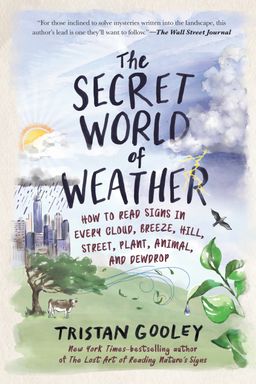
The Secret World of Weather cover

The Secret World of Weather

by Tristan Gooley

In ''The Secret World of Weather,'' Tristan Gooley teaches readers to interpret the language of clouds, winds, and landscapes. This book reveals how to make precise weather predictions by understanding microclimates and natural signs, offering a fresh perspective on meteorology.

The Art of Reading Weather

You live in two weather worlds at once—the broad, charted atmosphere that satellites and forecasts describe, and the intimate, personal realm that surrounds you: the secret microclimates of hill, hedge, tree, and street. In The Secret World of Weather, Tristan Gooley teaches you how to read both by combining scientific understanding with sensory observation. He argues that forecasts tell you the general trend, but the land, trees, clouds, and animals reveal what the sky means for you now, where you stand.

The Known and the Secret Worlds

Meteorologists work with data, maps, and global models—the “known world” of pressure systems, satellite imagery, and five‑day forecasts. But these tools average conditions across large grids and altitudes, missing the fine-grained experience beneath trees or between buildings. Gooley’s “secret world” exists at human scale. It’s felt rather than measured—how dew collects in one field but not another, how a hill channels gusts, or how a lone oak cools the air beneath it with a “tree fan.”

To truly understand weather, you must blend both perspectives. The broad pattern tells you what to expect in general; local signs reveal what will actually touch you. The forecast is the map, but your landscape is the compass.

Hidden Engines of Weather

Gooley explains how the invisible workings of energy—radiation, conduction, convection, and latent heat—govern every sign you see. Sunlight warms surfaces unequally by radiation; color and texture decide which spots become “sun pockets.” Conduction makes frost patchy, conduction differences explain why anthills insulate pigs or why one valley greens earlier in spring. Convection turns heat into motion: thermals lifting birds, seeds, and clouds. Latent heat—the energy hidden in water’s phase changes—drives storms and determines whether air remains calm or unstable.

Understanding these physical forces transforms every natural clue—the formation of dew, the shape of clouds, or the behavior of wind—into meaningful signals. Knowledge gives interpretation power; observation gives immediacy.

Reading the Sky and Air

Clouds become language once you know their families: cirrus (high heralds of change), stratus (steady layers), and cumulus (puffed local messages). Their height, texture, and trends—growing, lowering, roughening—form an intuitive seven-rule code to forecast short-term change. High cirrus ropes hint at approaching fronts, low ragged bases point to rain below, and growing cumulus tells of instability rising from the ground.

Air itself changes character when masses meet. Gooley explains fronts as boundaries between air of different heritage. A warm front’s high cirrus and halo haze give a day’s warning; a cold front’s steep wedge brings gusts, showers, and clearing air within hours. Watch wind direction like a gauge needle—its veering or backing announces pressure shifts and air‑mass rearrangement long before the rain arrives.

The Wind and the Land

Wind speaks constantly. At high levels it paints cirrus forms; at treetop height it defines weather systems; at ground level it becomes personal. Feeling gusts, listening to rustling or wires whistling, or watching birds orient tells you how patterns aloft and terrain below combine. As the day warms, gustiness grows with thermals—proof that air and ground interact minute by minute.

Landscape sculpts local wind characters: gap winds accelerate through valleys; channel winds snake along coasts; rebel winds swirl behind obstacles. Sea and land breezes are miniature systems—warm land pulls cool sea air which stacks cumulus along the coast like a parade. At night, the pattern reverses. Mountain and valley breezes follow sun and slope, explaining frost hollows and sudden evening chills. Once you feel these rhythms, you begin to predict comfort and safety intuitively.

Earthly Instruments: Trees, Plants, and Animals

Nature records weather continuously. Trees reveal thermal layers and prevailing winds in their shapes—flagging branches pointing downwind, moss climbing trunks as humidity barometers, pine cones closing and opening with moisture. Junipers create microdeserts under their canopies; spruce acts as perfect rain shelters. Plants trace exposure and seasonality: dandelions bloom earlier on sunny slopes, hawthorn flowers first on lower branches, and leaf size shrinks with altitude and windiness. Fungi and lichens map humidity and pressure changes, fruiting after shocks or in fog-rich locations.

Animals too act as sensory gauges. Birds soar on thermals that measure atmospheric instability, insects vanish with rising wind, spiders modify web size to cope with gusts, and frogs or ants alter routines with humidity shifts. These clues tie the living landscape directly to the pulse of air and heat around you.

Water Signs and Extremes

Dew and frost translate the invisible into touchable maps. Calm radiative nights produce dew where heat escapes most easily; sheltered or insulated spots stay dry. Frost types—hoar, rime, glaze—reveal local air movement and surface conductivities. Rain divides into “blankets” and “showers,” large layers or short bursts shaped by terrain; hills trigger relief rain, while lee slopes bask under foehn warmth. Storms crown this system: towering cumulonimbus release latent heat and display life stages through their shapes—pileus caps, anvil tops, mammatus bellies, and funnels. Observing these reveals safety: when cold gusts strike before thunder, you’re meeting a downdraft’s edge.

The Weather in Human Spaces

Cities amplify the same forces: asphalt stores heat and launches “city breezes” like miniature islands; tall buildings channel or squeeze wind into street-canyon gusts through Venturi acceleration or the Monroe downward rush. Pollution and turbulence create “city splitters,” diverting clouds and rainfall. Even here, you can find calmer or cleaner spots by watching flag flutters, steam plumes, or birds’ flight paths.

Seeing as a Natural Navigator

Gooley’s lesson is philosophical as well as practical. Weather is not something broadcast—it is something you experience through attention. The more you practice linking the large‑scale patterns to local cues, the more the world becomes legible in real time. Like early navigators who read island cumulus and Polynesian sailors who read sea shadows, you can build an inner forecast instrument—one rooted in place, trained by curiosity, and calibrated by touch and sight.

Core message

Weather is not remote science but intimate experience: the landscape and sky always converse—you simply need to learn their language.

By merging physics with perception, Gooley shows that your surroundings are a living forecast. Clouds are paragraphs; trees are instruments; winds and animals are voices. When read together, they transform your everyday walk into a meteorological adventure guided by curiosity and awareness.


Hidden Laws of Heat and Motion

Weather exists because of energy—the continual movement of heat and water. Gooley focuses on four invisible actors: radiation, conduction, convection, and latent heat. By learning how they behave, you discover why dew forms, clouds rise, and air suddenly becomes unstable. You begin to see motion where most see calm.

Radiation: Uneven Warmth

Radiation from the sun warms surfaces differently. Dark objects absorb more and radiate faster; pale ones stay cooler but lose heat slowly. This explains why frost avoids walls or why morning sun pockets appear along south slopes. Even invisible infrared radiation matters—it pulls heat from surfaces under clear skies and creates the perfect conditions for dew. Observing shade lines and color tints teaches you how radiation operates in real space.

Conduction and Convection

Conduction transfers heat through touch: soil, stone, and vegetation conduct it at different rates. That uneven transfer creates frost mosaics, causes anthills to be sought out for warmth, and shapes morning dew patterns. Convection—a more dramatic movement—transfers energy through rising air. It powers thermals visible in birds’ spirals or the glowing silk of spiders drifting in fall sunlight. Thermals strengthen as the day warms, and watching which size bird begins circling first is like reading a “thermal clock.”

Latent Heat and Stability

When water changes form—from vapor to liquid or back—it exchanges hidden energy. Condensation releases warmth, fueling cloud growth; evaporation absorbs heat, cooling surroundings. Latent heat determines whether the atmosphere restores balance or runs away into storms. Gooley’s apple analogy captures this: a stable system pushes the apple back into its bowl; an unstable one lets it roll away. Tropical humidity thus breeds instability, while dry, cool air resists vertical motion.

Essential rule

The moment condensation begins to add warmth to rising air, a simple cloud can become a storm machine—the hidden engine of instability.

Reading these laws helps translate observation into prediction: when cumulus persist after sunset, latent heat—not sunshine—is driving them; when frost maps vary across a field, conduction differences mark insulation contrasts. Understanding the physics behind sensory clues gives your forecasting intuition a reliable foundation.


Clouds and Air in Conversation

Clouds are storytelling instruments. Their shape, height, and motion reveal what the air is doing invisibly above you. Gooley reduces their complexity to three families—cirrus, stratus, and cumulus—and teaches a few repeatable patterns that let you translate visual impressions into short-term weather expectations.

Families and Progressions

Cirrus are high heralds: pure white ice filaments that often mark an approaching front or jet stream. Stratus form steady sheets, signaling calm or long-lasting rain. Cumulus are heaped, local, and direct; they speak of rising warmth at your location. If small cumulus grow through the day, instability is increasing; when they shrink at dusk, calm returns. Trends—not snapshots—tell the forecast.

High Cloud Signals

Cirrus “commas” or “mare’s tails” trace wind shear; long “jet‑stream ropes” across the sky foretell mid‑latitude systems arriving in the next day. Persistent contrails mean moist upper air—a front approaching—while crisp dissipating ones show dryness and stability. Lenticular lens clouds mark mountain waves, stationary but powerful; rotors and banners show turbulence and flow direction.

Reading Fronts Through Clouds

Warm fronts produce long cloud progressions—cirrus to cirrostratus halo, to altostratus, to steady nimbostratus rain. Cold fronts bring shorter drama: towering cumulus, gusts, showers, and then clear air. A simple watch for lowering cloud levels or mixed families warns you of instability brewing. Clouds are both cause and consequence of energy flow; learn them as vocabulary and you can translate the sky’s grammar anywhere.

Gooley’s rule holds: the lower the cloud you read, the shorter your forecast window. High wisps write tomorrow’s story; ragged bases tell the next hour.


Wind and Terrain

Wind is the atmosphere in motion—a messenger linking pressure gradients, temperature contrasts, and landscape shape. Gooley urges you to listen and feel it: its direction shifts are reliable weather needles, and its local behaviors reveal hidden interactions between land and sky.

Sensing Wind Layers

You experience wind at three levels. Cirrus trace high, fast currents; treetop winds represent synoptic systems; ground winds express terrain. Forecasts focus on the middle layer, but it’s the lowest that colors your personal experience. As thermals rise in afternoon warmth, gustiness signals convection’s increase. In urban spaces, heat concentration doubles that gustiness—a perceptible rhythm linking temperature and turbulence.

Local Wind Characters

Gap winds accelerate through mountain passes; channel winds follow valleys and coasts; split winds curve around ridges and rejoin downwind as rebels—eddies that can even reverse flow. Summit winds express the main atmospheric flow most clearly, while sea and land breezes enact diurnal temperature contrasts in miniature. Watch the first cumulus lines parallel to a coast: they mark a sea‑breeze head, behaving like a miniature cold front.

Practical Reading

Use fixed anchors—a steeple, hill, or tree—to monitor direction changes. Veering usually means fairer weather behind a warm front; backing signals an approaching low. Listen, too: rustling leaves and whistling cables tell you strength changes before you feel them. Train your senses, and wind becomes the simplest real‑time weather gauge.

Wind truth

A change in wind direction—however subtle—is usually the first local sign of a major atmospheric rearrangement.

Learning this interplay of flows and shapes helps you anticipate gusts, locate shelter, and even sense upcoming rain. Wind is not random noise—it is the voice of pressure revealing what the air will soon deliver.


Water Clues: Dew, Frost and Rain

The behavior of water on the ground and in the air creates maps of heat flow and humidity that you can read visually and physically. Dew, frost, and rain speak of the balance between radiation, moisture, and air movement—the fine-scale details that forecasts never capture.

Dew and Frost Microclimates

On clear, calm nights, radiation cools surfaces to the dew point; moisture condenses first on grass and other insulating material. When air is still, frost can form instead. Hoar frost is feathery condensation frozen directly; rime builds from fog droplets blasting onto windward faces; glaze forms as transparent ice from rain freezing. These variations map surface conduction and air movement. Frost pockets form in hollows where dense cold air sinks—the same mechanics create local agricultural risks and frost traps at valley floors.

Rain Types and Terrain

Gooley divides rain into blankets and showers. Blanket rain comes from layered stratus and lasts long; showers fall from cumulus cells and are sharp, local, and often triggered by terrain. Ragged cloud bases (pannus) mark active precipitation, while virga—rain evaporating before groundfall—traces dry layers below. Relief rain arises when moist air rises over hills and condenses; on the lee side, air descends, warms, and clears—the foehn effect. These microscopic interactions sculpt real rainfall boundaries you can walk across.

Field tip

Follow the line where dew or frost stops under branches—you can feel temperature differences of several degrees and trace microclimate edges by touch.

Reading water’s signs gives practical insight: where to sleep warm on a camping trip, where crops may suffer, where a brief move upwind saves you a soaking. It teaches you that wetness itself is structured—an outcome of invisible patterns that become visible when you notice the details.


The Living Forecast: Trees, Plants and Animals

All life around you records weather. Gooley invites you to treat trees, plants, fungi, and animals as instruments that respond to air, temperature, and humidity. They are active sensors embedded in the landscape—you need only learn their dialect.

Trees as Instruments

Woods manufacture their own microclimates. In daylight they cool you; at night they trap warmth. Dense firs preserve heat beneath them; open oaks let frost through. Moss climbing high marks damp conditions; pine cones open when the air dries. Tree shapes record prevailing winds as flags, and lower wind bulges beneath canopies mark air channels where breezes sneak through.

Plants, Fungi, and Lichens

Plants reveal exposure and season: dandelions bloom early on sun-facing slopes, hawthorn lower branches flower first, leaf size and angle decrease with wind and altitude. Fungi fruit after humidity spikes; puffballs eject spores during rain impacts—a humidity trigger visible in moments. Lichens harvest moisture and form “lichen flags” pointing toward humid, foggy sides of trunks, even used by coastal researchers to estimate fog frequency.

Animals and Habits

Birds ride thermals as indicators of instability; their altitude is a thermal gauge. Insects disappear in rising wind or swarm in calm humid air before rain. Spiders adjust web size by windiness; frogs and toads vocalize after humidity rises. Even ants build walls before rain or orient mounds toward the sun in exposed grasslands. These behaviors, synced to microclimate cues, foretell changes hours before weather apps update.

This living layer turns observation into companionship: when plants, animals, and air all signal together, you witness weather as an ecological conversation rather than a forecast chart.


Storms and Urban Weather

Extreme conditions bring the book’s lessons together—energy, convection, and landscape shaping dramatic weather. Cumulonimbus storms and urban heat systems show nature’s heat engines at full power, exposing how human environments and natural forces reflect one another.

Storm Anatomy

A thunderstorm evolves from cumulus into towering cumulonimbus: updrafts build cauliflower tops that spread into anvils at the tropopause. Lightning and hail mark the mature stage; downdrafts and mammatus signal collapse. A sudden cold gust—the gust front—is a microburst reaching ground. Reading structure saves lives: pileus caps mean explosive growth, anvil bulges mark violent updrafts, and rotating tubas point to tornado risk. Lightning colors reveal content—white for dry air, blue for hail-rich zones. Cycles of latent heat make storms self-feeding; respecting them means watching, not assuming safety from distance.

City Microclimates

Urban areas act as miniature weather factories. The heat‑island effect warms city centers by more than ten degrees compared to countryside. This sets up convective “city breezes” and turbulent canyons. Wind hitting tall buildings deflects downward—the Monroe effect—creating bursts at street level. Narrow streets amplify flow via the Venturi principle, and intersecting gusts form calm pockets and double eddies known as Heart Eddies. Watch flags and smoke: they outline these micro‑fronts in real time.

Pollution patterns and warm updrafts can even split incoming clouds, a "city splitter" effect diverting rainfall around metropolitan cores. City meteorology becomes an applied version of Gooley’s main idea: physical processes magnified by structure, readable through sensory detail.

Safety insight

Count seconds between lightning and thunder—under thirty means shelter now, and wait thirty after the last strike before venturing out.

Together, the storm and city chapters reveal the same truth: the weather’s grandeur and intimacy coexist. Even engineered landscapes echo natural patterns. Learn to read them, and you understand that every breeze, drop, and flash is a dialogue between energy and environment.

Dig Deeper

Get personalized prompts to apply these lessons to your life and deepen your understanding.

Go Deeper

Get the Full Experience

Download Insight Books for AI-powered reflections, quizzes, and more.