
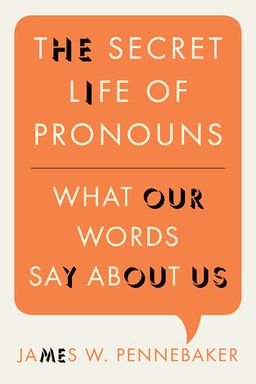
The Secret Life of Pronouns cover

The Secret Life of Pronouns

by James W Pennebaker

The Secret Life of Pronouns illuminates the hidden messages in our everyday language, revealing insights into personality, social connections, and emotional health. Through intriguing studies and examples, discover how simple words like pronouns and articles can offer a window into the human psyche and interpersonal dynamics.

The Hidden Life of Words

What if the most revealing parts of our speech are not the vivid nouns or verbs but the tiny, invisible words we overlook? In his research and book, James Pennebaker argues that small, frequent function words—pronouns, articles, prepositions, auxiliary verbs—form the social DNA of language. These 'stealth words' are processed in milliseconds, yet they encode attention, emotion, relationship, and power dynamics. Pennebaker’s decades of work with text analysis show that language is not just a tool for expression but a dynamic social sensor recording how we think and connect.

Pennebaker’s central argument is deceptively simple: how you talk reveals more than what you say. Function words, though seemingly dull, convey patterns of thought and social awareness that reflect everything from leadership style to emotional resilience. Using computer-assisted analysis like LIWC (Linguistic Inquiry and Word Count), he demonstrated that word patterns systematically relate to personality, social context, deception, and recovery from trauma. They provide an x-ray into psychological and social processes that people rarely articulate explicitly.

From Invisible Grammar to Social Cues

Function words appear ordinary—I, you, we, the, to, of—but Pennebaker shows they are central to our mental coordination. Damage to the brain’s Broca's area disrupts these small connectors and impairs social fluency, emphasizing how they align cognitive structure with social meaning. They act as markers of attention: when you say “the ring” instead of “a ring,” you signal shared context; when you switch between “I” and “we,” you reveal shifts in identity and inclusion.

Measuring Minds in Words

To make hidden linguistic signals visible, Pennebaker built LIWC. This program counts categories of words—emotion, cognition, function words—and quantifies their frequency. In expressive writing experiments, students asked to write about trauma improved in health and well-being. The LIWC data revealed that how their language evolved mattered: increased positive emotion words, balanced negative emotion, and more cognitive terms like “because” or “think” predicted healing. Words reflected the process of acknowledging pain and constructing meaning—a psychological restructuring written into syntax.

In these studies, even pronoun use foretold outcomes. Healthy writers fluctuated naturally—some days focusing on self ('I'), others on others ('we', 'you'). That pattern indicated flexible perspective-taking, a hallmark of adaptive emotional recovery. People trapped in self-focused loops ('I' dense) tended to remain stuck. Writing and linguistic style thus became windows into mental movement rather than word choice alone.

Language Style and Identity

Beyond emotional expression, Pennebaker explores how style encodes enduring psychological traits. His collaborations with Laura King revealed basic style dimensions—formal, analytic, narrative—that correlate with thinking habits. Formal language (articles, nouns, prepositions) signals object focus and professionalism; analytic style (cause, reason words) shows complex, structured thought; narrative style (tense verbs, pronouns) reflects interpersonal and social engagement. Style mirrors personality almost as reliably as self-report questionnaires.

These distinctions illuminate how age, gender, and social class influence speech. Women tend to use more pronouns and social-emotional language, men more articles and nouns. Older adults shift toward formal, positive language; younger people speak more personally and emotionally. Higher socioeconomic status correlates with abstract, noun-heavy writing—object-focused mental models—while lower-SES speech shows intimacy through pronouns and present-tense verbs. These linguistic gradients echo differences in perception and attention within social contexts.

Emotion, Deception, and Power

Emotions reshape syntax as much as they shape tone. Happy people use inclusive 'we' and concrete nouns; sad individuals ruminate through 'I' and past tense; anger shifts outward with more 'you' and present-tense verbs. After 9/11, blog posts showed massive collective shifts—'I' words dropping, 'we' rising—as a country redefined itself socially through grief and unity. Function words mapped the emotional pulse of shared trauma better than sentiment labels.

Deception, paradoxically, also leaves traces. Liars avoid 'I' and self-attribution, use more positive emotion and social references, and rarely describe concrete details. Their syntax reveals cognitive distance. Honest writers own by saying “I,” include sensory specifics, and show cognitive processing. Truth and lie detection, when approached probabilistically, rests on patterns, not single words—a richer behavioral index than intuition alone.

From Individual Talk to Collective Voice

Language connects social structures at every scale. Pronouns map status—leaders drop 'I' and adopt 'we' and 'you'; subordinates say 'I' more. Group identity emerges through 'we'—couples, teams, even cities show linguistic cohesion that predicts cooperation. Synchrony of style, called Language Style Matching (LSM), measures alignment in function-word use. High LSM can indicate mutual engagement—whether affection, conflict, or collaboration. It’s a linguistic fingerprint of attention and shared rhythm.

Across history and correspondence—Freud and Jung’s letters, the Brownings’ poems—LSM reveals the rise and fall of relationships. Divergence signals disengagement long before explicit rupture. Thus, Pennebaker offers not only cognitive psychology but a subtle chronicle of how relationships talk themselves into or out of harmony.

Reading Lives, Predicting Behavior

Language becomes predictive when interpreted statistically and contextually. Presidential speeches forecast shifts in policy focus; admissions essays foretell academic success; essays from incarcerated women predict post-release adjustment. Function words, stable and pervasive, quietly track cognition across time and situation. Pennebaker cautions, however, that words reflect rather than cause behavior—they are mirrors, not engines.

Across all chapters, Pennebaker’s lesson is clear: pay attention to the smallest words. They form a continuous, measurable guide to emotion, truth, identity, and connection. You don’t need to guess someone’s personality or intentions—listen to how they stitch their sentences. In the spaces between nouns and verbs lies the mind itself.


Function Words and Social Mapping

Function words are the connective tissue of human communication. They link ideas, reveal relationships, and silently mark how your brain organizes thought. Pennebaker calls them 'social sensors' because they map the dynamics of attention, status, and shared knowledge between speakers.

The Grammar of Relationship

Pronouns such as I, you, and we define point of view and power. Articles like 'a' and 'the' reveal whether speakers assume mutual context. Prepositions, auxiliary verbs, and negations structure the flow of time, responsibility, and certainty in conversation. Lincoln’s Gettysburg Address, rich in small words, shows how such connectors form 37% of its speech—embedding unity and shared presence in linguistic scaffolding.

Attention and Brain Systems

Neuropsychological findings affirm this view: Broca’s area governs function-word fluency, the social syntax of connection. Patients with damage often struggle not with nouns but with relational grammar, showing that social language is neurologically grounded. These tiny words are how the mind signals attention—whether it’s inward ('I'), outward ('you'), or inclusive ('we').

Social Function and Culture

Usage patterns differ across cultures: Spanish pronoun-dropping contrasts with English’s constant self-reference, revealing distinct social frameworks. When you speak, your function words synchronize with your cultural concept of self and relationship. They are universal but sensitively tuned to social norms.

Key insight

Listening for function words offers a real-time map of where people’s minds are—focused on objects, tasks, others, or self.


Language Style and Personality

Every sentence has style—the unseen rhythm guiding how ideas connect. Through thousands of analyzed essays and conversations, Pennebaker found consistent clusters of style. These patterns reveal personality traits and thinking modes more accurately than topic content.

Three Dimensions of Style

Formality uses high noun and preposition rates, signaling detachment and status-awareness. Analytic style features causal and insight words, showing cognitive effort and complex thought. Narrative style uses tense verbs and pronouns, indicating social focus and storytelling instincts. Each dimension shapes interpersonal and professional strengths—analytic writers think deeply; narrative types connect broadly.

Meaning Extraction and Attention

Through tools like the Meaning Extraction Method, Pennebaker and Cindy Chung mapped content focus alongside stylistic tendencies. Written descriptions of simple images revealed recurring clusters—some writers emphasized light and shadow, others texture and shape—patterns that related to personality and academic performance. What you notice and describe mirrors cognitive filters shaping perception.

Practical Takeaway

Ask yourself: do you write in formal object terms or relational pronouns? Each style implies a mental stance toward the world. Narrative thinkers value connection; analytic minds seek order; formal speakers navigate hierarchy. Together, they illustrate how personality is woven linguistically, sentence by sentence.


Emotion in Words and Healing

Language not only reflects emotion—it transforms it. Pennebaker’s expressive writing studies showed that turning trauma into structured language improves health. By tracking word patterns through LIWC, he discovered that emotional healing involves linguistic evolution as the brain constructs meaning from pain.

Healing Through Story Construction

Students writing about trauma consistently improved when their language patterns shifted: greater positive-emotion words, moderate negative-emotion words, and rising cognitive terms ('because', 'think'). These changes signaled reflection and narrative formation. The act of making sense linguistically mirrored psychological reorganization.

Pronouns and Perspective

Adaptive writers oscillated between 'I' and 'we'—owning their pain while reaching outward. That switching predicted better recovery. Ruminative 'I'-heavy patterns correlated with poorer mental outcomes. Emotional flexibility thus appears not just in feeling but in the movement of pronouns.

Collective Emotion

Large events like 9/11 reveal similar shifts. National blogs showed drops in 'I', spikes in 'we', and transient boosts in cognitive words. Grief temporarily expands community identity. Function words become metrics of shared coping strategies—social processing written at the scale of millions of sentences.

Pennebaker’s insight: healing requires linguistic movement—from isolated self to integrated whole. As stories form, health follows.


Pronouns, Power, and Leadership

Pronouns are linguistic barometers of power. When you silently analyze email or speech, frequency of 'I', 'you', and 'we' reveals social rank and leadership dynamics. High-status individuals consistently use fewer I-words and more you/we—language that orients outward and collectively.

The Status Signal

Pennebaker demonstrates this through casual correspondence: students write 'I', professors reply with almost none. Leaders frame goals through nouns and directives, subordinates through self-reference. Status shapes attention—dominant speakers attend outward; lower-status people monitor themselves. Even eye gaze patterns align with pronoun use.

Cultural Variations and the 'We' Spectrum

There are multiple 'we’s—some inclusive ('you and I'), others exclusive ('my group, not yours'). Leaders often deploy distancing we-forms to signal authority. In collectivist cultures, we-management balances humility and shared responsibility. Knowing which 'we' applies is central to reading power correctly.

Role Language and Authenticity

Experiments in leadership assignments (Ethan Burris’s groups) show how quickly language shifts with role: chosen leaders drop I-words immediately. Yet Pennebaker warns that style alone doesn’t ensure effectiveness; dominant task-focused speech can harm collaboration. Words both reflect and shape perceived authority, but authentic power blends we-language with empathy.


Synchrony and Connection

The dance of conversation is measurable. Language Style Matching (LSM) captures how closely two people’s function-word usage aligns, reflecting attention and rapport. High synchrony means mental engagement—whether affectionate or adversarial.

Unconscious Mirroring

LSM operates within seconds of conversation. People unconsciously synchronize pronouns, articles, and conjunctions as their brains mirror social rhythms. Neuroscientific parallels to mirror neurons show how empathy and anticipation drive linguistic alignment.

Engagement vs. Agreement

Matching doesn’t always mean harmony. Heated arguments can show high LSM because both sides intensely focus on each other. In Jeff Hancock’s deception studies, when one partner lied, the innocent partner’s synchrony actually increased—compensating for cognitive load imbalance.

Lasting Relationships

LSM predicts lasting connection. Speed-dating pairs with high LSM wanted second meetings twice as often. Couples with sustained high daily LSM were far likelier to remain together. Synchrony over time—seen in letters of Freud and Jung or lovers like Elizabeth Barrett and Robert Browning—maps the trajectory of unity and distance.

Pennebaker widens the lens: synchrony scales from couples to communities. Linguistic cohesion in city databases correlates with social equality—shared words are shared worlds.


Language as Behavioral Forecast

Pennebaker’s research extends into prediction. The way people use small words anticipates academic success, social reintegration, and even geopolitical shifts. Words trace mindset transitions before actions occur.

Political and Leadership Forecasts

Presidential language patterns reveal psychological states preceding key decisions. Drops in I-words have preceded moments of intense operational focus—from wartime planning to crisis response. Obama’s low I-count communicates calm authority; Bush’s higher emotional verbosity shows relational focus. Leaders unconsciously broadcast changing cognitive frames through stealth words.

Academic and Rehabilitation Outcomes

Admissions essays rich in articles and concrete nouns predicted higher GPAs—reflecting categorical, analytical thought linked with academic success. In contrast, rehabilitated women whose essays used more pronouns and positive emotion words achieved better post-release outcomes, emphasizing that social integration thrives on emotional language.

Limits and Interpretation

These predictions underline that language mirrors cognition rather than causes it. Function words are diagnostic tools, not levers. Used responsibly, linguistic analysis guides understanding and intervention at scale—from therapy to leadership assessment.


Reading History Through Style

Pennebaker’s language analytics illuminate history and identity. By tracing style through correspondence and documents, you can see how relationships, collaborations, and creative bonds evolve. Function words endure as fingerprints across time.

Authorship and Signature

Function words and punctuation habits uniquely identify writers. Analyses from anonymous legal cases to literary debates (like the Federalist Papers) show impressive though imperfect accuracy. Combined clues—articles, conjunctions, favorite phrases—build probabilistic portraits. Collaboration adds nuance: Lennon–McCartney songs and Hamilton–Madison essays developed distinctive joint styles, proving that collective voice isn't just statistical average but emergent synthesis.

Relationships Over Time

In poetry pairs like the Brownings versus Plath and Hughes, LSM traced intimacy and conflict. The Brownings maintained synchrony through shared worldview; Plath and Hughes diverged linguistically as emotional distance grew. Freud and Jung's letters mirror similar decline—from friendship to rupture through falling style alignment.

Language thus archives emotion and cognition across generations. Every text you write is a timestamp not just of thought but of connection. Reading history through small words reveals how minds intertwine—and when they fall apart.

Dig Deeper

Get personalized prompts to apply these lessons to your life and deepen your understanding.

Go Deeper

Get the Full Experience

Download Insight Books for AI-powered reflections, quizzes, and more.