
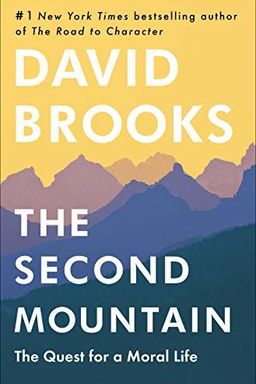
The Second Mountain cover

The Second Mountain

by David Brooks

In ''The Second Mountain,'' David Brooks challenges the pursuit of individual success and happiness, urging readers to find joy in serving others. Through insightful exploration of community, vocation, and commitment, Brooks offers a transformative path to a meaningful life.

From Self to Surrender: Climbing Two Mountains

Why do moments of success often leave you feeling empty? In The Second Mountain, David Brooks argues that modern life tempts you to ascend a first mountain of achievement, status, and self-creation—but fulfillment arises only when you surrender to the second mountain: a life devoted to love, vocation, faith, and community. Brooks’ model is both metaphor and map for maturity. You climb the first mountain by chasing résumé virtues and external validation, then fall into a valley when achievements fail to satisfy. From that valley, if you listen deeply, you are called to commitments that reorient life from self-centered to other-centered.

The First Mountain: Achievement and Identity

The first mountain represents the culture of autonomy and individual success—the pursuit of reputation, career, and personal happiness. Brooks calls this the domain of hyper-individualism, where the question is “How do I measure up?” You climb through education and achievement, mastering the logic of the résumé. Yet, the summit feels hollow because the moral ecology around you prizes performance over connection. You build a life but rarely a soul. The cultural shift since the 1960s—from duty to expressive individualism—cemented this ecology, encouraging people to worship freedom and authenticity while neglecting obligation. (Note: Brooks’s moral-ecology framework echoes Robert Bellah’s “Habits of the Heart” in diagnosing the rise of expressive individualism.)

The Valley: Crisis and Disillusionment

Something happens—failure, divorce, illness—and you tumble into the valley. Brooks calls this the moral crucible: a telos crisis, when you ask, “What is my purpose?” You can retreat into bitterness or let suffering hollow you enough to make room for grace. The valley becomes wilderness—a time of solitude and listening where ego dies and vocation begins to whisper. Brooks draws from Moses, Parker Palmer, and Henri Nouwen to describe wilderness as soul-training through patience and quiet. If you learn to stay still, your deeper longing for relationship emerges. The valley is not punishment but purification.

The Second Mountain: Commitment and Moral Joy

On the second mountain, the question changes. You stop asking “What can I get?” and start asking “What do I belong to?” The summit is not conquered—it conquers you. Brooks identifies four major commitments that define second-mountain life: vocation, marriage or family, philosophy or faith, and community. These are not contracts but covenants—vows that reshape identity. Through them you experience what he calls “moral joy,” a durable happiness born of giving yourself away. This joy differs from fleeting happiness; it grows through sacrifice and service. Brooks’s “Weave” project—neighbors like Kathy and David of AOK or Mack McCarter in Louisiana—illustrates ordinary people who radiate moral brightness through small acts of care.

Core Claim

“You conquer the first mountain; you are conquered by the second.” In surrendering, you discover freedom—to serve, to belong, and to love.

The Cultural Turn: From 'I' to 'We'

Brooks ends with a manifesto against hyper-individualism, proposing relationalism—the moral ecology of interdependence. A relationalist life treats commitments as the pathways to wholeness. You become yourself not by asserting independence but through faithful participation in relationships. To reweave the social fabric, you enact small acts of care that create trust; you build thick institutions sustained by shared rituals; and you help your community move from “I” stories to “We” narratives. The book invites you to surrender not as defeat but as the only way to ascend—climbing the second mountain not alone but together.


Moral Ecologies and Cultural Overhaul

Brooks believes every generation lives within a moral ecology—a set of cultural norms defining what is admirable and expected. Mid-century America prized duty and community; the 1960s pivoted toward expressive individualism—freedom, authenticity, and self-expression. While that pivot liberated creativity and rights, it also eroded the social frameworks that gave life structure. The new ecology’s shadow side is hyper-individualism: loneliness, distrust, meaninglessness, and tribalism.

Ratchet, Hatchet, Pivot: How Cultures Evolve

Brooks traces cultural change with his “ratchet, hatchet, pivot” cycle. Innovation begins with a moral advancement (ratchet), then becomes rigid (hatchet), and finally gets corrected by a counter-movement (pivot). The current pivot is toward relationalism—a revival of attachment and obligation. The challenge is to invent new ways of belonging suited to modern mobility and pluralism. Places like Englewood’s RAGE or Baltimore’s Thread show that transformation begins with a few people who decide to stay, convene, and commit to local relationships.

Four Crises of Hyper-Individualism

  • Loneliness—soaring isolation and loss of communal patterns.
  • Distrust—erosion of civic confidence and institutions that bind people.
  • Loss of Meaning—privatized spirituality without shared telos.
  • Tribalism—fragmented individuals clinging to hostile group identities.

Relationalism as Remedy

Relationalism proposes a new moral ecology of commitments. It redefines freedom: not liberation from constraints but freedom-to devote yourself to something worthy. Brooks’s relationalist manifesto is a “Declaration of Interdependence”—to belong, serve, and weave trust through shared projects. In a culture of expressive autonomy, relationalism is countercultural heroism.

Practical Lesson

If you want a meaningful life, anchor it in few durable loyalties and design habits that make goodness easy.

(Comparative note: Brooks’s relationalism parallels Alasdair MacIntyre’s call for virtue-centered communities and Charles Taylor’s vision of re-enchanting the moral horizon.)


Vocation and the Daemonic Call

For Brooks, vocation is not career—it’s a moral calling, the intersection where your deep gladness meets the world’s deep need (echoing Frederick Buechner). Your vocation reveals itself through moments of awe or outrage, often in early life or crisis. He calls these “annunciation moments”—when a small encounter hints at a lifelong summons.

Discovering the Call

Brooks collects vivid origin stories: E.O. Wilson’s boyhood fascination with sea creatures, Orwell’s awakening in Spain, and Viktor Frankl’s struggle to make meaning amid suffering. These show vocation as both discovery and creation—something you hear and build. You uncover clues by asking when you felt most alive; your daemon (Goethe’s term) usually lies close to those moments. Mentors help translate raw longing into disciplined practice. (Note: Brooks here departs from the modern view of “follow your passion” by insisting vocation always serves a social need.)

The Role of Mentors

Mentors transmit wisdom you can’t read. They shape not only your craft but your character. Through figures like Bert Williams mentoring E.O. Wilson, Brooks shows how mentorship tempers ambition with humility and seriousness about practice. You learn moral habits—patience, perseverance, and joy in mastery. William James’s preference for “strenuous mood” over comfort captures the transformation: vocation requires tension and effort.

Testing Your Daemon

Brooks urges you to treat discernment as experiment: say yes, try, observe what sustains attention and enthusiasm. Transformative choices—like marriage or vocation—cannot be previewed (L.A. Paul’s paradox). So you rely on repeated attraction, willingness to sacrifice, external confirmation, and service to a real need. Swaniker’s African Leadership network exemplifies answering a daemonic call for social repair.

Action Point

Don’t overthink calling—cultivate mentors, engage in apprenticeships, and let practice reveal purpose through doing.

Vocation thus marks the positive turn after the valley: it converts suffering and curiosity into sustained moral joy—the joy of self-forgotten usefulness in service of something larger.


Commitments That Shape Identity

The second mountain is built on commitments—enduring promises that form character. Brooks distinguishes contracts, which protect interests, from covenants, which transform identities. When you commit, you fall in love with something and build a structure of behavior that holds you steady when love wanes.

The Nature of Commitment

Commitment fuses love, promise, and discipline. You don’t just pledge; you arrange your future actions around that pledge. Ruth’s vow to Naomi—“Where you go, I will go”—exemplifies covenantal depth. A teacher, a Marine, or a spouse defines themselves through mutual obligation. The repetition of keeping promises forms habit, which becomes identity. Thus, commitment refines character—making goodness automatic.

Freedom Through Binding

Brooks redefines freedom: true freedom is “freedom-to,” the ability to devote yourself to higher purposes. In commitment you become freer because you are focused. Parents embody this paradox—accepting hardship without complaint because devotion resets their priorities. (Note: This echoes Erich Fromm’s “freedom to love” rather than freedom from obligation.)

In Practice

You keep commitments alive through routines, rituals, and recommitments—like marriage rites or community dinners. Kathy and David’s AOK gatherings, Luke the janitor’s patient service, and Lincoln’s political humility illustrate commitments lived daily. When passion ebbs, ritual sustains fidelity. You become someone who loves consistently, not just when emotions cooperate.

Key Definition

“A commitment is making a promise to something without expecting a reward.” It binds future selves to present loves.

The secret of second-mountain freedom is binding yourself wisely—because constancy, not spontaneity, unlocks joy.


Love, Marriage, and Recommitment

Brooks treats marriage as the most intense workshop for moral growth. It begins in mutual disclosure and combustion, proceeds through crisis and forgiveness, and matures into fusion—the paradoxical unity where self-forgetting yields greater self-knowledge. Love here is both surrender and education.

From Spark to Fusion

Relationships start with small disclosures—the tennis rally of opening up. Each returned volley builds trust. Combustion follows: idealization and embodied adventure turn attraction into devotion. Yet, the leap into “we” brings inevitable crisis—jealousy, tension, and disagreement. The cure is forgiveness, not perfection. Real forgiveness balances judgment and mercy, rebuilding trust through honest confession.

Marriage as a Moral School

Marriage teaches metis—empathetic wisdom about knowing when to comfort or withdraw. You learn daily communication: honoring bids, practicing politeness as moral technology, and maintaining the 5:1 positivity ratio. Brooks frames marriage as civic work for two people rebuilding relational fabric from domestic acts—vacuuming, walking, or gentle conversation. These routines are moral infrastructure.

Second Love and Recommitment

Over decades you encounter dry spells—new parenthood, midlife, illness—and must recommit deliberately. Choosing closeness becomes heroism. Brooks revives Lincoln’s “charity for all” as a model for renewed unity. Couples who persevere reach second love—less ecstatic but deeply loyal. Their union becomes a second-mountain marriage founded on forgiveness stories and shared sacrifice.

Moral Lesson

Treat hardship as curriculum. Every disagreement is a class in patience, empathy, and mercy.

Marriage thus trains you in covenantal fidelity—the daily art of recommitting, forgiving, and serving that reveals moral joy through intimacy.


Faith and the Sacred Path

Brooks portrays religion as another second-mountain commitment—a surrender to transcendent reality that reorders the self. Faith often begins in porous experiences—moments of awe or desperation where the boundary between self and world dissolves. From mystical flashes to gradual pilgrimages, people find that surrendering to the sacred grants inner freedom and joy.

Mystical and Ordinary Conversions

Brooks collects examples: Jayber Crow’s quiet revelation by a river, William James’s astonishment at inner consciousness, and nature-based awe like his own American Lake experience. These are ramps into faith—brief alignments between the inner and outer worlds that awaken longing for something eternal. Religious practice then sustains the insight through ritual, prayer, and community, converting transient wonder into durable devotion.

Suffering and Inner Freedom

Brooks cites Frankl, Havel, Solzhenitsyn, and Sadat—figures who discovered the “last human freedom” in confinement: the freedom to choose one’s attitude. Suffering stripped away illusion and revealed moral sovereignty. In that threshold you exchange control for trust. Religious conversion often follows this template—pain as purification for grace.

Ramps and Walls of Community Faith

Faith grows within community structures. Ramps—ritual, synchrony, prayer, and moral vocabulary—elevate worship. Walls—siege mentality, bad listening, invasive care, and intellectual laziness—block genuine connection. The goal is middle-voice spirituality: acting with, not against, divine will. Leaders like Jean Vanier and Mother Teresa demonstrate how downward service—helping the least—becomes the ultimate ramp toward God.

Central Claim

Faith is not passive belief—it’s training desire to align with divine purpose through disciplined love.

Brooks’s own journey—Jewish roots, Anglican liturgy, and Christian mentors—illustrates faith as slow pilgrimage. You cross invisible borders and inhabit a moral story that locates you within something infinite.


Building Community and the Relationalist Manifesto

Brooks concludes with practical civic theology: community as moral training ground. Lonely individuals become citizens again when they weave connection. The “weavers” he met—Asiaha Butler in Englewood, Sarah Hemminger with Thread, Dottie Fromal’s dinners—demonstrate structured love at neighborhood scale. They commit locally, convene repeatedly, and turn vulnerability into collective purpose.

Stages of Fabric Repair

Community revival unfolds in stages: people decide to stay, treat the neighborhood as the unit of change, design convening technologies, spark combustion stories, and formalize collective commitments. Engagement isn’t charity—it’s covenant. The result is civic ecosystems where trust compounds. Institutions like Spartanburg’s SAM and StriveTogether prove coordinated local loyalty yields systemic renewal.

Relationalism as Public Philosophy

Brooks’s relationalist manifesto reframes politics and morality around attachment rather than autonomy. Hyper-individualism treated freedom as self-assertion; relationalism defines freedom as belonging. Its moral grammar begins with “Whose am I?” not “Who am I?” You find identity through obligation, meaning through participation, and joy through service.

A Declaration of Interdependence

Relationalism envisions life as a jungle of interdependence where every act of kindness strengthens the human weave. You reanimate civic trust by hosting dinners, volunteering for long horizons, and creating rituals that normalize generosity. Small acts scale upward; moral joy becomes social glue.

Practical Principle

You cannot clean just the part of the pool you swim in. Commit to the whole neighborhood—place-based love builds national renewal.

The manifesto’s simple command—love your way outward—ties every chapter together. Private surrender becomes social strength; moral joy is the felt experience of community reformation.

Dig Deeper

Get personalized prompts to apply these lessons to your life and deepen your understanding.

Go Deeper

Get the Full Experience

Download Insight Books for AI-powered reflections, quizzes, and more.