
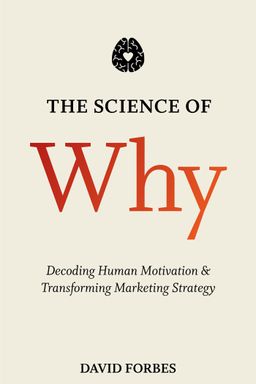
The Science of Why cover

The Science of Why

by David Forbes

The Science of Why by David Forbes unravels the mysteries of consumer motivation, equipping marketers with insights to craft compelling strategies. Dive into the MindSight Matrix to learn how understanding diverse consumer desires can transform your marketing approach and strengthen brand loyalty.

Breaking White Silence and Relearning Whiteness

How do white people learn to talk about race when silence itself has been their shelter? In Breaking the Code of White Silence, editors Gabrielle David and Sean Frederick Forbes present a landmark anthology that collects more than eighty first-person accounts from white Americans confronting their racial identity. Their goal is not confession for its own sake but transformation: to break the habit of avoidance that keeps racism unchallenged. Debby Irving’s introduction and Tara Betts’s afterword frame the text as both provocation and invitation — a call for white readers to speak, listen, and stay present to the discomfort of learning.

Silence as a system of protection

David and Forbes argue that silence is an active force. Many white people avoid racial topics out of fear of being wrong or rude, but such silence protects inequality. The editors recall hostile emails they received while assembling the book — minor on the surface, but emblematic of how defensiveness buries dialogue. As Debby Irving and others remind you, silence is not neutral; it is complicity.

Whiteness as a deliberate invention

Across the essays you are led to see whiteness not as biology but as an invented social category. The editors invoke historians like Nell Irvin Painter and W. E. B. Du Bois to trace how economic elites in colonial America built whiteness to divide workers and justify slavery. Laws such as Plessy v. Ferguson, the GI Bill, and redlining later hardened those divisions into policy. The message is blunt: if whiteness was designed, it can also be redesigned.

Stories as tools for reckoning

Rather than theory alone, the anthology relies on first-person storytelling as its operating method. Narratives like Kurt Michael Friese’s “I Am the Man” or Patrik McDade’s “Give Me Some Skin” turn abstract privilege into lived recognition. Jan Priddy’s “White Noise,” Martha Collins’s historical research, and Anne Mavor’s costumed project “I Am My White Ancestors” show that childhood lessons, family habits, and art can all be mirrors. Through personal confession, the contributors model how you move from blindness to understanding.

Moral and practical evolution

The book’s architecture progresses from awakening to accountability. It begins with people identifying privilege and ends with acts of allyship — in classrooms, homes, and communities. The editors do not promise closure; unlearning whiteness is lifelong work. Yet the act of speaking transforms both teller and listener. As Audre Lorde warned, your silence will not protect you. This anthology makes that warning an organizing principle: to remain silent is to side with the status quo, to speak is to start the repair.

If you read closely, you see that the editors propose a social experiment: redistribute the emotional labor of race talk. Let white people narrate their own process so that people of color are not always asked to explain racism. In doing so, the book sketches a pedagogy for an anti-racist future — one grounded not in blame but in sustained, accountable voice. The core argument is clear: whiteness can be unlearned only when you dismantle the silence that protects it, face its history, and keep practicing the messy art of seeing yourself anew.


Seeing Whiteness as a Social Design

Whiteness is not fate or essence; it is design. David and Forbes remind you that the appearance of racial hierarchy stems from centuries of construction: from class divisions in Europe to colonial labor laws in early America. Drawing on Du Bois’s notion of the “psychological wages of whiteness,” they show how elites offered symbolic privileges — respect, mobility, legal standing — to certain Europeans, ensuring obedience to racist systems. That engineering still shapes who owns homes, gets loans, or feels 'normal.'

How laws and policy sealed advantage

American legal history encoded race into property. After slavery, Jim Crow laws and mortgage redlining ensured that whiteness yielded tangible assets: suburban houses, education benefits, safety from arbitrary policing. The GI Bill is repeatedly cited as an example — theoretically race-neutral, yet administered through segregationist structures. Privilege persists when you inherit those gains as “normal life.”

Expanding whiteness, shifting boundaries

Because whiteness is political, it expands when advantageous. Irish, Italian, and Jewish Americans who were marginalized at first gradually entered its circle, often by distancing themselves from Black neighbors or aligning with power. Essays like Rabbi Gil Steinlauf’s “Are Jews White?” reveal the tension: you gain protection but risk erasing memory. The book invites these voices to model what choosing responsibility over assimilation looks like.

Why this history matters

Understanding invention makes change plausible. If whiteness arose from policy and culture, then anti-racist reform must attack both. Economic justice — fair housing, equitable schools, criminal legal reform — pairs with cultural honesty about who benefited. You are asked to move past moralizing individuals and address the scaffolding itself. In that sense, history is not guilt; it is strategy.


Everyday Privilege and Its Invisible Weight

Privilege operates most effectively when it goes unnoticed. In personal essays throughout the anthology, contributors like Barbara Beckwith and Christina Berchini expose how comfort, safety, and deference follow white people through ordinary spaces. You rarely have to prove belonging; your skin buys trust before you speak. That accumulation, the editors explain, is what power feels like when you mistake it for ordinariness.

Snapshots of unequal safety

Beckwith’s “Aha Moments” begins at an ATM at dawn, where a stranger lets her inside without hesitation. She realizes instantly that such trust is racial. Similar awareness unfolds when McDade’s “Give Me Some Skin” explores casual interactions that expose unearned security. Privilege surfaces not in grand gestures but in tones of belief, micro-chances that shape how long you wait, how police address you, or how teachers score your children.

Defense mechanisms that block learning

Berchini’s satirical “How to Be White” catalogs the scripts that shut conversation down: “I’m color-blind,” “reverse racism,” “I have a Black friend.” Each phrase masks fear. The anthology suggests that humility — saying “I don’t know” — is a better start than insisting innocence. When you replace reflex with curiosity, privilege becomes visible and thus dismantlable.

From realization to responsibility

The contributors insist that awareness alone is insufficient. They urge you to translate recognition into practice: listen more, intervene in jokes, audit your workplace habits. “You may feel awkward,” the editors write, “but awkward honesty is the beginning of change.” Privilege’s invisibility is its armor; calling it by name is the first crack.


Learning Through Story and Memory

The anthology positions narrative as a moral technology. Gabrielle David and Sean Forbes collect confessions, epiphanies, and reckonings because stories do what statistics cannot: they teach empathy. Reading another’s awakening helps you imagine your own. Debby Irving calls these essays 'case studies in consciousness'—maps of how white Americans confront the architecture of their own perception.

Childhood as training ground

Several stories trace racism to its origins in childhood. A stolen letter from a town sign, a teacher’s slur, or a family joke becomes the first lesson in difference. Roger Barbee’s “Useless” and Beth Lyon Barnett’s “Liza Pearl” show how casual ridicule teaches belonging by exclusion. Later, writers like Martha Collins revisit these formative lessons with shame and resolve, demonstrating that the past can be rewritten through awareness.

Art, confession, and transformation

Anne Mavor’s project of embodying her ancestors in costume literalizes reckoning: she becomes the faces of those who benefited from colonization. Others, like Christopher Rzigalinski, turn confession into pedagogy, teaching courses on privilege after naming their own. Storytelling thus operates as both self-diagnosis and civic education. You are invited to tell your own story not to center yourself but to practice change.

Why stories move culture

Narratives collapse distance. When you feel discomfort reading someone’s confession, that discomfort becomes shared ground. The editors believe storytelling multiplies courage: each articulation weakens denial. In this sense, every story in the book builds collective stamina for uncomfortable truth-telling—the prerequisite for any sustainable anti-racist movement.


Microaggressions and the Work of Listening

Parts of the anthology focus on microaggressions—the small, repetitive acts that sustain inequality. Elena Murphy’s “White‑Handed Compliments” and Josh Couvares’s silent turn on a Hudson boardwalk reveal how bias lives in instinct. Saying to a Black man 'You speak so well' or crossing the street in fear are not neutral; they perpetuate distance.

Intent vs. impact

Carol Ehrlich’s hostel story illustrates the self‑absolving power of “I didn’t mean it.” When white hosts sing a racially charged song and later seek reassurance from their Black guest, his polite “I’m okay” becomes a mask for unease. The room moves on unchanged. The lesson: intentions don’t negate consequences, and politeness can perpetuate harm.

Practicing better responses

The essays model alternatives. Stop mid‑sentence when you hear yourself perform stereotype; ask genuine questions; resist self‑defense. Small acts of listening, like Murphy’s later decision to let the offended person speak without interruption, mark growth. You learn that humility, not justification, begins repair.

Pattern recognition as moral discipline

Microaggressions accumulate the way dust does—imperceptibly but relentlessly. Seeing the pattern turns scattered incidents into structural evidence. The anthology trains readers to monitor reflex, bridging awareness and accountability in daily life.


Intersection, Body, and Identity

Whiteness interacts with other forms of identity—religion, class, gender, and body. Essays by Deborah Mashibini‑Prior, Carol Weliky, and Gil Steinlauf show how physical markers and histories modulate privilege. Hair, skin, and faith become social currencies expressing who sits safely inside the white frame and who stands just beneath it.

Hair as work and politics

Mashibini‑Prior’s “Good Hair” traces her biracial daughter’s expensive, labor‑intensive hair care—keratin treatments, braids, and time—contrasted with her own ease. Hair becomes a symbol of daily negotiation with normativity. The essay exposes how even love across color lines requires economic and cultural literacy; solidarity costs labor.

Faith, ancestry, and choice

Rabbi Steinlauf’s call for Jews to 'give up whiteness' reframes faith as ethical lever: if you inherit safety from assimilation, you owe resistance. Carol Weliky’s “Just Beneath White” reveals the precarity of Jewish whiteness—accepted until a synagogue is vandalized. Collectively, these essays warn against treating whiteness as homogeneous or eternal.

Embodiment and humility

Physical difference carries emotional economies: envy, admiration, rejection. The writers confront their own longing for cultural vitality in Black expression, cautioning that appreciation without accountability slips into consumption. Ethical regard begins with attending to bodies as laboring, signified, and real.


Parenting, Teaching, and Everyday Activism

Julie Parson Nesbitt’s chronicle of raising her Black son Daniel after her husband’s death anchors a section on relational responsibility. Love, she writes, isn’t enough; you need strategy. From navigating biased schools to having 'the talk' about police, White parents of Black or mixed‑race children enter systems not built for their families. Nesbitt’s lawsuits against Chicago Public Schools and her search for safe education materialize anti‑racism at ground level.

Education as applied practice

Teachers like Christopher Rzigalinski also make the classroom a site of action. After admitting his privilege publicly, he redesigned courses around McIntosh’s and Kimmel’s works and real‑time events like Ferguson. His approach, called 'prefigurative politics,' lets students rehearse equitable futures through dialogue and curriculum. Whether you are a parent or teacher, the pattern holds: awareness must locate an arena of practice.

Everyday arenas for change

You are invited to start where influence lives—family, workplace, community boards. The anthology models moral apprenticeship rather than instant expertise. Unlearning whiteness becomes a daily discipline: naming bias at dinner, supporting Black‑led efforts, or revising institutional policy. These repeated small acts, the editors argue, accumulate like microaggressions in reverse—constructing equity instead of harm.


From Awareness to Sustained Allyship

True allyship, the book insists, begins when acknowledgment matures into consistent action. Janie Starr’s question “What’s a white girl to do?” summarizes the challenge: how to help without re‑centering the self. Through varied contexts—protests, classrooms, hometown conversations—the contributors chart forms of co‑conspiracy rather than charity.

Beyond performance

Performative gestures—hashtags, symbolic apologies—soothe ego but not injustice. Real allyship, as Feminista Jones and others stress, is repetitive, often unglamorous labor: showing up at city meetings, diverting resources, refusing silence when relatives joke. Debby Irving’s mentorship within the anthology exemplifies supportive presence without dominance.

Choosing to see

Wendy Zagray Warren’s phrase “I am choosing to see” summarizes the moral verb the book teaches. You must actively perceive what privilege taught you to overlook. For Warren, that meant learning from the Blackfeet Nation; for others, it’s legislative advocacy or local volunteerism. Each action tests sincerity through endurance.

Allyship as lifelong practice

The editors close on realism: anti‑racist life is iterative, not certified. Mistakes are inevitable, corrections essential. When you treat allyship as a sustained habit—policy work, mentoring, voting, storytelling—you participate in breaking the code of white silence not once but continually. That repetition, the book suggests, is how cultures turn.

Dig Deeper

Get personalized prompts to apply these lessons to your life and deepen your understanding.

Go Deeper

Get the Full Experience

Download Insight Books for AI-powered reflections, quizzes, and more.