
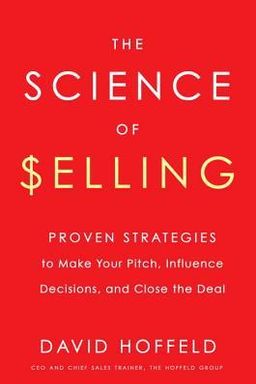
The Science of Selling cover

The Science of Selling

by David Hoffeld

The Science of Selling by David Hoffeld merges neuroscience and social psychology to offer an evidence-based approach to sales. This guide reveals scientifically-proven methods for crafting compelling pitches, influencing decisions, and closing deals effectively. It empowers salespeople to understand buyer psychology, enhance persuasion techniques, and achieve success through practical, research-backed strategies.

Selling the Way People Buy: The Science Behind Influence

Why do some salespeople seem to close deal after deal while others struggle endlessly? David Hoffeld’s The Science of Selling argues that the answer lies not in charisma, luck, or gut instinct but in science—specifically, decades of research into how the human brain makes decisions, processes information, and constructs trust. He contends that successful sales strategies must align with the brain’s natural buying process, rather than fight against it. Selling, he insists, is no longer an art of persuasion but a science of influence.

Across more than a decade of studying behavioral economics, neuroscience, and social psychology, Hoffeld discovered that sales performance skyrockets when sellers model their process on how buyers actually decide. He demonstrates that salespeople fail not because they lack confidence or charm, but because they use outdated methods that contradict how people form and justify purchasing decisions.

From Guesswork to Science-Based Selling

For generations, the sales profession has relied on anecdotal evidence and the opinions of self-proclaimed experts. Hoffeld admits he once fell into this same trap: selling based on intuition until he realized that neither he nor other trainers could prove why one method worked better than another. This revelation led him to rebuild his entire sales philosophy from scratch, grounding it in empirical research. He found that every effective sales interaction rests on one foundation: understanding and leveraging how human beings are influenced.

Salespeople are persuaders. Whether you’re presenting a product or pitching an idea, your job is to help someone make a confident, positive decision. Hoffeld’s insight is that influence follows predictable scientific patterns. Like Daniel Kahneman’s work in Thinking, Fast and Slow, Hoffeld reveals that buying decisions are shaped by automatic biases, emotional shortcuts, and small commitments made along the way—not by rational arguments or charisma alone.

Selling in a Transformed Marketplace

Hoffeld sets the stage with a sobering statistic: nearly half of all professional salespeople fail to meet their quotas each year. The reason isn't laziness; it’s that the world has changed faster than sales training. Today’s buyers research online, compare vendors easily, and expect value at every stage of the relationship. They don’t need walking brochures. They need trusted advisors who can guide them through complex decisions. Unfortunately, most sales tactics—like pushy closes or one-size-fits-all pitches—collide with how the brain naturally decides. The result? Missed quotas, lost customers, and eroded trust.

Hoffeld’s research shows that successful sales methods don’t invent new tricks; they align with science. If you understand how people process choices, form emotional associations, and commit to small steps before big ones, you can sell in a way that feels natural to buyers—because it is natural to their brains.

The Two Paths of Influence

Drawing on Richard Petty and John Cacioppo’s Elaboration Likelihood Model, Hoffeld explains that persuasion operates through two mental routes: the peripheral route and the central route. The peripheral route relies on shortcuts like trust, likability, confidence, and social proof—quick judgments that help conserve mental energy. The central route, by contrast, goes deeper: it engages logic, meaning, and evidence. Both matter in selling, but they serve different purposes. The peripheral route opens the door; the central route keeps it open. Neglect either, and you weaken the buying decision.

For example, rapport and likability (peripheral cues) can gain initial attention, but lasting loyalty—the kind that withstands competitor pressure—comes from helping buyers think through their decision logically (the central route). Together, they mirror how the brain forms confidence in a purchase.

The Six Whys® and the Science of Decision

At the heart of Hoffeld’s framework lies the Six Whys®—a model describing the six commitments every buyer must make before saying “yes.” They are: Why Change? Why Now? Why Your Industry Solution? Why You and Your Company? Why Your Product or Service? and Why Spend the Money? Each represents a mental bridge that a buyer must cross to reach a decision. Skip one, and the sale collapses.

This model is anchored in what Hoffeld calls the sales equation: BD = f(SW, ES). A Buying Decision (BD) is a function (f) of the Six Whys (SW) and the buyer’s Emotional State (ES). In short: if buyers commit to each of the Six Whys® and feel emotionally positive, they purchase. Fail to address either side, and you lose.

Why Emotions and Commitments Matter

Few sales books treat emotion with the rigor Hoffeld does. Building on neuroscientist Antonio Damasio’s discovery that patients without emotional processing can’t make decisions, Hoffeld shows how emotions act as the brain’s value system—the “glue” binding logic to choice. Buyers in negative emotional states struggle to perceive value; those in positive states process information more accurately and trust more freely. That’s why every good salesperson must regulate and elevate their buyer’s emotional state.

Similarly, Hoffeld demonstrates that closing is not a single moment at the end of a pitch. It’s a series of strategic commitments that lead naturally to purchase. Behavioral evidence from Freedman and Fraser’s famous “billboard experiment” shows that people who first agree to small requests are far more likely to agree to large ones. Applying this, Hoffeld transforms “closing” into an incremental, science-based process that reduces resistance and builds confidence.

Why Selling with Science Works

Hoffeld ultimately makes a bold, optimistic claim: when you sell with science, you don’t just make more money—you make selling ethical again. His method rejects manipulative tactics in favor of mutual value creation, empathy, and cognitive alignment. By understanding how buyers form trust, weigh risk, and commit to change, you become not a persuader but a partner. The science of selling, as Hoffeld presents it, is a bridge between rigorous behavioral research and the human art of helping others make better decisions—a transformation that he believes can redefine the entire sales profession.


The Two Routes of Influence

Imagine having the perfect pitch yet still losing the client. Hoffeld explains that this happens because persuasion travels two different mental roads: the peripheral and central routes of influence. Both are vital—but they serve different psychological roles in how people decide to buy.

The Peripheral Route: How Buyers Feel

The peripheral route operates on what Daniel Kahneman calls “fast thinking.” It’s emotional, intuitive, and efficient. It relies on heuristics—mental shortcuts that produce quick judgments. When buyers decide someone is trustworthy, likable, or authoritative, they are processing peripherally. These impressions are powerful but fleeting.

Hoffeld identifies four key heuristics that shape this route. Single-option aversion means buyers distrust solo choices—they crave comparison. Asymmetric dominance explains how introducing a weaker option makes a stronger one look better (as Dan Ariely demonstrated with subscription experiments at MIT). Likability bias reveals that we agree more readily with people we like, and social proof shows we trust what others already trust. Together, these shortcuts decide first impressions long before data enters the equation.

The Central Route: How Buyers Think

The central route engages deliberate reasoning. When buyers weigh ROI, verify claims, or debate competitors, their prefrontal cortex—the “slow thinking” part—takes charge. The goal, Hoffeld writes, is to help buyers process the central message: how your product uniquely solves their problem. This deep persuasion creates lasting loyalty because it gives buyers a clear, rational story for why they said yes.

Imagine a political debate: a candidate’s charisma (peripheral) draws voters in, but their policies (central) secure enduring support. In selling, rapport gets you the meeting; clear reasoning closes the deal. The key is synchronizing both routes—warmth and logic, emotion and evidence.

“Sell with both wings,” Hoffeld writes. “Emotion lifts the message. Logic gives it direction.”

Balancing Emotion and Evidence

Many salespeople, Hoffeld argues, over-focus on the peripheral: being likable, telling jokes, or relying on social proof. While these can attract buyers, they fade fast. To create durable influence, the central route must take over through meaningful discovery questions, tailored presentations, and evidence-backed storytelling. When both are aligned, persuasion becomes effortless. The buyer not only feels good but also thinks you make sense—and that combination is unbeatable.


The Six Whys® Framework

Hoffeld’s most practical breakthrough is his Six Whys®, a cognitive map of how every buyer, consciously or not, constructs a purchasing decision. These six questions act as milestones. Skip one, and the sale crumbles.

1. Why Change?

Buyers default to the status quo because change feels risky (Richard Thaler calls this the status quo bias). Hoffeld insists your first job is to make inaction feel more dangerous than taking action. That means uncovering the buyer’s hidden problems, expanding their pain, and showing the cost of staying the same. “Change begins,” he writes, “when problems start to hurt.”

2. Why Now?

Even when buyers want change, they delay. Hoffeld warns that time kills deals. The cure? Combat reactance—people’s instinctive pushback against pressure—by giving them choice language like “It’s entirely up to you.” This reduces resistance while reinforcing urgency. When you let buyers feel free, they move faster.

3. Why Your Industry Solution?

Your biggest competitor may not be another company—it’s the buyer’s do-it-yourself instinct. To win, position your industry as the expert path and show why outsiders can’t match your results. Tell cautionary tales of failed self-built systems and contrast them with professional outcomes. Credibility wins this Why.

4. Why You and Your Company?

Trust is the antidote to risk. Drawing from George Akerlof’s research on information asymmetry, Hoffeld shows that buyers fear the unknowns behind a purchase. Demonstrate expertise (through insights, case studies, or credible evidence) and confidence (through your tone and posture). Trust elevates perceived safety—and buyers always choose the safest path.

5. Why Your Product or Service?

Here, Hoffeld invokes Harvard’s Michael Porter: you win through competitive advantage—either lower cost or unique differentiation. Most sellers cannot be the cheapest, so they must be the most distinct. He defines distinct value as “the unique value a buyer desires and will receive that competitors cannot match.” The more personal and relevant this distinction, the stronger your position.

6. Why Spend the Money?

Buyers don’t just choose you—they choose you over something else. To justifying price, tap into two primal motivators: the desire for gain and the fear of loss. Daniel Kahneman’s Nobel-winning research shows that losses loom twice as large as equivalent gains. Frame your offer in both directions—what they’ll gain by acting and what they’ll lose by waiting.

Hoffeld’s Six Whys® don’t just explain why people buy; they give salespeople a roadmap to guide every conversation. Each Why builds the foundation for the next, culminating in a confident, emotionally aligned “yes.”


Selling to the Brain’s Emotions

What if emotion, not logic, is the true decision-maker? Hoffeld’s answer is clear: emotions don’t just color decisions—they create them. Citing neuroscientist Antonio Damasio’s patients who became pathologically indecisive after losing emotional capacity, he shows that emotion assigns value. Without feelings, the brain can’t tell what matters.

Understanding Emotional States

Every buyer’s brain operates through an “emotional state,” the set of feelings experienced at a given moment. Positive states heighten receptivity, trust, and cognitive clarity. Negative ones distort perception and make buyers dismiss good options. In one revealing study, judges were far more likely to grant parole when in positive emotional states—eating or rested—and almost never when fatigued. Emotion determines judgment, even for experts.

Changing Emotional States

Hoffeld provides four evidence-based strategies to shift buyer emotions:

  • Emotional contagion: People adopt the emotions they sense around them. Exude positivity through energy and tone, and buyers “catch” it neurologically.
  • Hawthorne effect: Simply acknowledging a buyer’s emotional state (“You seem concerned—everything okay?”) jolts them back to self-awareness and breaks negativity.
  • Shared positivity: Discuss topics linked to joy—family, hobbies, aspirations. This primes the brain with positive memory associations.
  • Nonverbal shifts: Physical gestures and facial expressions, like smiling, literally influence brain chemistry and mood.

When you manage your buyers’ moods, you transform selling from manipulation to alignment. Emotion is the bridge between information and decision.


The Power of Questions

Great salespeople don’t just talk; they ask. Hoffeld shows that questions activate a neurological phenomenon called instinctive elaboration: when the brain hears a question, it must answer. This reflex focuses the buyer’s entire attention on your idea and increases the likelihood of compliance—what behavioral researchers call the mere measurement effect.

Beyond Types: Asking by Levels

Most sales training categorizes questions—open-ended, probing, implication—but Hoffeld finds this approach cognitively impossible. The brain can’t process types while listening deeply. Instead, he proposes the three levels of questions based on how the brain discloses information:

  • First-level: Fact-finding (“What’s your process for…?”).
  • Second-level: Thought-provoking (“Why did that approach work?”). These questions make buyers reflect and feel pleasure, strengthening rapport.
  • Third-level: Emotional (“If this issue isn’t solved, how will it affect your team?”). These uncover dominant buying motives.

This model mirrors the social penetration theory in psychology: people reveal information layer by layer, like peeling an onion. Sales questions should follow that rhythm, guiding buyers naturally toward self-discovery—and trust.

In Hoffeld’s view, asking the right questions is how you lead buyers to find their own reasons to say yes.


Creating and Communicating Value

Buyers make time for what feels valuable. Hoffeld draws on social exchange theory to show that all human relationships—including sales ones—are value exchanges: people maximize rewards and minimize costs. If a buyer perceives the effort of speaking with you as exceeding the benefit, they disengage.

Primary Buying Motivators

Value lives in the buyer’s world, not yours. Hoffeld identifies three primary buying motivators:

  • The buyer’s problems
  • Dominant buying motives (emotional gains and losses)
  • Buying requirements (decision criteria like timing, authority, and budget)

Once you understand these, you can craft what he calls a Primary Buying Motivator Statement®—linking your product’s value directly to what matters most to them. Example: “You mentioned data accuracy is critical. Our reporting feature provides real-time verification so you’ll never worry about errors again.”

The Science of Reciprocity and Labeling

Social norms also guide value perception. Reciprocity—the urge to repay kindness—means that giving small, genuine value early (a helpful insight, a report, an introduction) increases compliance later. In one experiment, adding a simple question—“Will you call us if you change your plans?”—dropped restaurant no-shows from 30% to under 10%. Similarly, labeling assigns positive identities that people subconsciously seek to honor (“You seem like someone who acts quickly on opportunities”).

Together, these scientific insights reveal that value isn’t just communicated—it’s experienced. When buyers feel helped, understood, and respected, they reciprocate with trust and purchase intent.

To sell more, Hoffeld urges, stop proving value and start co-creating it.


Closing Through Strategic Commitments

Forget the hard close. Hoffeld redefines closing as a sequence of small, strategic commitments that build toward a natural conclusion. This insight stems from Jonathan Freedman and Scott Fraser’s classic “foot-in-the-door” experiment: homeowners who agreed to display a small safety sign were vastly more likely to allow a huge billboard two weeks later. Small yeses lead to big yeses.

Consistency and Self-Perception

Why do small commitments matter so much? The brain craves consistency. Once people state something publicly, they align future behavior with it. Hoffeld illustrates this through Norbert Kerr’s jury research: once jurors voiced their opinions aloud, they rarely changed their votes. Buyers are the same—ask for verbal micro-commitments (“Will you review the proposal by Monday?”) and they will comply to maintain integrity.

Small commitments also reshape identity through self-perception theory. When someone agrees, they start to see themselves as the kind of person who supports your solution. Their belief system evolves to match their actions, making future agreements more likely.

Trial Closes that Build Momentum

Hoffeld introduces two types of trial closes: involvement (implying ownership) and commitment (prompting action). For example: “If you were to install this software, would you prefer doing it after hours?” primes the brain with ownership imagery. Later, “Would you ever choose a system without that feature?” cements commitment. These psychological nudges mirror how buyers step by step justify buying decisions.

When paired with positive framing (choice architecture), these micro-asks become almost irresistible. Just as restaurant menus influence choices through anchors and visuals, thoughtful phrasing primes agreement. Ask first for engagement, then for action—and the final close simply feels inevitable.

“Commitments unlock the sale,” one of Hoffeld’s trainees summarized. “It’s just so easy when you get your commitments.”


Presenting Persuasively Through Science

A weak presentation can undo even the strongest pipeline. Hoffeld turns to cognitive psychology to explain how to design presentations that the brain enjoys following. He identifies five science-backed strategies that make messages stick and convert buyers into believers.

1. Less Really Is More

The brain has limited processing capacity—George Miller’s famous “magical number seven” shows it can hold only a few chunks of information at once. In one experiment, offering shoppers 24 flavors of jam led to fewer purchases than offering six. The takeaway: simplify. Cut cluttered slides, focus on essentials, and buyers feel clarity instead of cognitive strain.

2. Anchoring

Perception of value depends on the first number we see. That’s why menu prices or “compare at” labels affect our choices. Hoffeld teaches sellers to set the anchor first—mention high-value metrics or premium package costs early. Everything after will feel reasonable by contrast. It’s subtle pricing alchemy grounded in behavioral economics.

3. Mirroring

Years of social psychology confirm that copying a buyer’s tone, pace, and gestures builds trust. We are wired with mirror neurons that make us like those who reflect us. Matching posture or rate of speech sparks rapport faster than any flattery could.

4. Picture Superiority

The mind thinks in images, not words. People remember 65% of information paired with visuals but only 10% delivered verbally. Replace text-heavy slides with vivid visuals and metaphors that let buyers “see” your promise.

5. Storytelling

Humans are narrative creatures. Citing research from Princeton and Stanford, Hoffeld shows that stories sync the speaker’s and listener’s brainwaves. Use stories with relatable characters, emotional tension, and clear lessons—mirror your buyer’s situation and end with their ideal future. As author Walter Fisher argued, stories are how people make sense of life.

Together, these techniques—simplicity, anchoring, mirroring, imagery, and storytelling—turn ordinary presentations into neural experiences that buyers feel, remember, and trust.


The Future of Sales: From Art to Applied Science

Hoffeld closes his book by looking forward. He envisions a profession transformed by data and behavioral science. Just as marketing became a discipline through measurement and research, selling is on the verge of a similar evolution. “Science-based selling,” he writes, “will define the next era of business.”

Three Shifts Ahead

  • Sales truth takes center stage: Objective, evidence-based methods replace guesswork. Salespeople will judge strategies by scientific validity, not comfort or tradition.
  • Sales research blossoms: Like universities once taught marketing, sales will regain academic legitimacy. Hoffeld traces how the Great Depression stunted early sales scholarship and predicts its return, fueled by neuroscience and behavioral economics.
  • Hiring improves: Science will guide how organizations select and develop sales talent, focusing on five traits: intrinsic motivation, empathy, integrity, growth mindset, and communication skill.

These qualities are measurable, teachable, and predictive. Intrinsically motivated reps don’t need pushing. Those who focus on buyer perspectives adapt faster. Growth-minded professionals continually evolve, while those with integrity and strong interpersonal skills build resilient trust loops.

“Sales,” Hoffeld concludes, “is too important to be based on anything except proven science.”

When salespeople merge empathy with evidence, and organizations treat persuasion as a teachable science, both profits and integrity rise. Selling, Hoffeld predicts, will become one of the most data-driven—and respected—professions of the 21st century.

Dig Deeper

Get personalized prompts to apply these lessons to your life and deepen your understanding.

Go Deeper

Get the Full Experience

Download Insight Books for AI-powered reflections, quizzes, and more.