
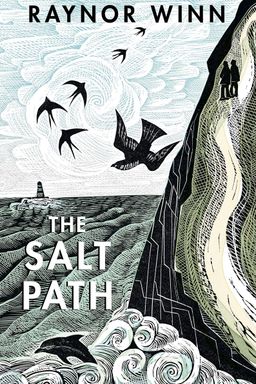
The Salt Path cover

The Salt Path

by Raynor Winn

The Salt Path is a gripping true story of Raynor and Moth Winn, who face eviction and a terminal diagnosis by embracing the transformative power of nature. Their 630-mile trek along the South West Coast Path is a testament to resilience, hope, and the enduring strength of the human spirit.

The Healing Power of Nature and Connection

Have you ever felt that being outdoors—truly immersed in the wind, the earth, the rain—somehow brings you back to yourself? The Wild Silence, Raynor Winn’s profoundly touching memoir, asks this question again and again as it digs into what it means to belong to both land and life after losing almost everything. Winn argues that nature is not just scenery: it is a reciprocal, living force that restores the human spirit. In the wake of homelessness, illness, and grief, she and her husband Moth rediscover hope through walking, through wildness, and through listening to the silent voice of the earth.

This book follows Winn’s attempts to rebuild life after the events of her first memoir, The Salt Path. Having lost their home and faced Moth’s diagnosis of corticobasal degeneration (CBD)—a terminal neurological disease—the couple step off the coast path and try to live under a roof again. Yet indoors, Winn feels restless, claustrophobic, haunted by an invisible voice: the land calling her back. Through vivid storytelling—journeys to Welsh childhood fields, the forests of Cornwall, and even Iceland’s volcanic plains—she explores grief, trust, marriage, and the wild silence that binds all things.

Listening to the Voice of the Land

For Winn, the earth itself speaks—a low hum connecting every living thing. She begins the narrative on a cliff above Polruan, where she senses this vibration and realizes that her sleeplessness and disquiet come from being cut off from that sound. It’s the missing link between the outer and inner worlds. In her words, the wild is not outside us but something woven into our very molecules. This insight forms the emotional core of the book: we’re not separate observers of nature but participants in its cycle. That recognition becomes both her therapy and her compass through grief.

Loss, Illness, and the Search for Meaning

When Winn’s mother dies after a harrowing hospital stay—one where she must decide whether to end life support—the experience shatters her sense of peace. It echoes Moth’s earlier diagnosis, forcing her to confront mortality twice. But instead of retreating into despair, Winn seeks solace in memory and landscape. Her recollections of a childhood farm, bluebell woods, and running through meadows reawaken her connection to life itself. She realizes that understanding death also means understanding what it is to live fully—and to do that, one must listen to the land’s pulse.

The Chemistry of Hope and Movement

Science threads quietly through Winn’s personal story. Research into CBD and Alzheimer’s shows how physical activity and interaction with natural environments can trigger beneficial chemical changes—what some researchers call “biophilia effects.” Winn connects this to her own observation: walking long distances, enduring weather, and carrying weight seemed to awaken something vital in Moth’s brain. His cognitive decline slowed dramatically when he was outdoors, walking the path, working with plants, or breathing sea air. This isn’t romantic idealism—it’s biology interwoven with emotion, reminding readers that hope can sometimes be rewritten in the body’s own language.

Silence, Writing, and Rediscovery

At the chapel where they now live, Winn battles invisibility and fear of reentry into society. She feels dislocated until she begins writing—translating the penciled notes from the South West Coast Path into what becomes The Salt Path. Through writing, she recreates the walk on paper, re-entering the land and remembering who they were before loss. Words become her new trail, connecting voice to silence, just as the mycorrhizal fungi described later in the book connect tree to tree beneath the forest floor.

From Wild Silence to Wild Speech

The journey culminates in renewal. Winn and Moth, offered a chance to live and steward a neglected cider farm, embrace it as an act of ecological restoration and of faith. As they nurse the land back to life, wildlife returns—curlews, toads, roe deer—and so does trust, both in others and in each other. In the closing chapters, they even trek across Iceland, walking through volcanic landscapes that mirror the creation and destruction of their own lives. Through it all, Winn shows that healing comes not from control but from surrendering to what she calls the “wild silence”—the space where nature, love, and loss coexist. The message, at once lyrical and practical, is that reconnecting with the land is not escapism but remembering who we are. If you ever feel displaced or broken, her story whispers: start with one footstep, listen to the wind, and you’ll find your way back home.


Grief and the Language of the Land

Raynor Winn turns grief into geography. After losing her mother in agonizing circumstances, she is pulled back to the fields of her childhood—a terrain that holds both pain and peace. She describes dying rooms, hospital corridors, and pine woods not just as places but as emotional landscapes. Each patch of earth reflects a stage of mourning. The earth becomes a teacher, urging her to rejoin life rather than shrink from it.

Death as a Return to Nature

Winn sees death not as an end but as reabsorption. When her mother’s body releases a faint mist—“a movement of molecules through time and air”—she recognizes the continuity between human life and the soil beneath. That observation anchors her philosophy: life, death, and landscape share the same carbon cycle. In this, she echoes poets like Seamus Heaney, whose verses she quotes, and naturalists such as John Muir, who wrote that everything is 'hitched to everything else.' The voice of the land becomes the voice of eternity.

Memory Rooted in Soil

By revisiting her childhood farm, Winn reconnects with her origins—the place where she first learned that the earth itself whispers wisdom. Her grief transforms into curiosity. Why do the woods feel different now? Why have the wild things gone? The answer, she realizes, lies in an ecological shift: pesticides, modernization, and human detachment have muted nature’s voice. The “wild silence” isn’t emptiness; it’s what remains after we stop listening.

Walking as Mourning Ritual

Just as mourners in many traditions walk behind coffins, Winn walks behind memory. Every step through field or wood becomes a conversation with loss. This echoes Annie Dillard’s reflections in Pilgrim at Tinker Creek, where walking allows grief to dissolve into wonder. For Winn, to walk is to breathe—the rhythm of footsteps synchronizing with the rhythm of healing. Grief and geography finally merge, revealing that both are forms of mapping our way back to love.


The Science of Wild Healing

In one of her most moving threads, Raynor Winn searches for scientific explanations behind Moth’s unexpected physical improvements when walking the South West Coast Path. As she reads research on tau proteins and neurological disease, she discovers evidence that endurance exercise and exposure to nature may chemically alter human physiology, regenerating cognitive function and mood. Her personal observations become a mirror of modern neuroscience.

Movement as Medicine

Winn connects long-distance walking with changes in Moth’s health. Despite medical predictions of decline, his coordination and clarity improve. She compares this to Alzheimer’s studies showing how aerobic routines trigger neuroplasticity—the brain’s ability to rewire itself. To her, movement within nature amplifies this process. As muscles stretch, the mind stretches too, recalling forgotten memories and emotional resilience. (Note: Similar ideas appear in Florence Williams’s The Nature Fix, which argues that natural immersion boosts cognition and calm.)

Nature’s Chemical Conversation

Drawing from horticultural science, Winn explores how plants secrete volatile compounds—“secondary metabolites”—that humans inhale. These subtle chemicals interact with our own bodies, affecting hormones and mood. In forests, you literally breathe the biochemistry of growth. Japanese 'forest bathing' research supports this idea, showing lowered cortisol and improved immunity among those who linger under trees. For Winn, it validates her intuition: the land heals by touch and breath, not by miracle.

Hope, Molecules, and Faith

Science becomes a modern theology for her—a way to rationalize hope without invoking divine intervention. She treats each research paper as scripture, reaffirming belief not in God but in continuity. The molecules go on in some other form; healing is never separation but transformation. Whether through exercise or ecology, what saves Moth is not cure but connection. The message for you: even without answers, movement and wild air can change your chemistry—and your spirit.


Trust, Love, and the Invisible Bonds

Trust operates like a fragile ecosystem in The Wild Silence. Winn recounts how betrayal—losing their home through a friend’s deception—shattered her ability to rely on people. Living among villagers again, she battles social anxiety so fierce it makes her hide behind garden walls. But Moth’s steady presence, and the rediscovery of community, slowly rebuild that trust. Her story shows how relationships mirror landscapes: when tended, they flourish; when neglected, they wither.

Learning to Speak Again

Winn’s isolation in the chapel becomes a metaphor for silence between people. Invitations terrify her. At a party, she blurts out that she’s “thinking of writing,” then retreats in shame. Yet that slip leads to connection—a neighbor named Gill encourages her writing. Gradually, Winn realizes that vulnerability is not weakness but the seed of trust. Like opening soil to light, speaking truth allows growth even when she expects rejection.

Love as Wild Reciprocity

At heart, the book is a love story. Moth isn’t simply a companion; he is the “thin place”—the sacred overlap between worlds. His faith in her becomes the measure of her faith in herself. Winn treats love as an ecological phenomenon: give and take balanced like the mycorrhizal networks she later describes, where fungi feed trees and receive sustenance in return. This reciprocity powers her marriage and guides her toward a wider compassion for community and land alike.

Relearning Human Connection

Through the kindness of neighbors and new friends, she learns that the human world can mirror the generosity of nature. Trust isn’t restored by words but by shared labor—gardening, writing, walking side by side. By the end, the silence between people turns fertile. The lesson for readers: vulnerability reconnects you to the wider web of life, the same way wind and root reconnect the earth beneath your feet.


The Restoration of Land and Soul

When Winn and Moth move to a derelict cider farm in Cornwall, their physical labor—clearing waste, reviving orchards, coaxing wildlife back—serves as spiritual restoration. This section of the book reads like environmental philosophy fused with memoir. Healing the land becomes synonymous with healing the self.

Rewilding Life

The neglected farm initially seems hopeless: damp walls, poisoned soil, no birds. Yet they commit anyway. Gradually, green shoots emerge. Curlews feed in restored fields; badgers and toads return. As ecosystems recover, so does confidence. Winn coins the phrase “rewilding-lite,” balancing conservation with sustainable agriculture. It’s not escapism—it’s participation. (She parallels thinkers like Isabella Tree in Wilding, who argue that giving land autonomy revives biodiversity and human purpose.)

Land as Mirror for Emotion

Every weed pulled and wall scrubbed mirrors a psychological act. Clearing the red graffiti that brands them “scum” symbolizes erasing old wounds. As the fields grow green again, self-respect returns. Physical engagement with the earth counters despair more effectively than therapy. This principle—mending through making—is echoed in environmental psychology: work with living systems to mend your inner one.

Ecological Compassion

Through caring for nonhuman life, Winn rediscovers empathy for human life. The farm’s transformation shows how healing isn’t linear—it’s ecological. You cannot save yourself without participating in the network that saves everything else. The land’s restoration is not a backdrop but a conversation between survival and belonging. That conversation ends with simple wisdom: if life feels broken, begin by tending to the nearest patch of earth.


The Road to Iceland and Beyond

In the final chapters, Winn shifts from the green of Cornwall to the icy desert of Iceland—a landscape stripped bare to its geological core. With friends Dave and Julie, she and Moth walk the Laugavegur Trail, braving rivers, volcanic ridges, glaciers, and winds like fire. The trek becomes a metaphor for transformation: forging new life out of destruction.

Volcanoes and Creation

Crossing black lava fields, Winn sees the frozen lava as the planet’s heartbeat. Iceland’s terrain shows the earth’s raw creative power—how each eruption annihilates yet renews. She parallels this with personal regeneration: after homelessness and grief, she and Moth walk not to escape pain but to witness rebirth. When glacial soot evolves into soil, she feels it as evidence that life always finds its way back.

The Wild Silence Amplified

Silence here is not emptiness but abundance—the resonance of molecular life moving unseen. At night, during an aurora, Winn experiences awe that feels like communication between the universe and her heartbeat. The barren land speaks louder than any crowded city. Each step reaffirms that peace comes from humility before nature’s vast intelligence. (This resonates with Barry Lopez’s Arctic Dreams, which links wild extremity to spiritual revelation.)

Finishing the Circle

The walk ends at Skógar waterfall, where Moth moves with unexpected strength. It’s a physical redemption. Iceland’s glaciers, volcanoes, and rivers remind Winn that change is the only constant. When they return home, that insight shapes how they live: embracing impermanence, celebrating small miracles, and listening—always—to the unspoken hum beneath everything. The wild silence is not something outside of us; it’s what we’ve carried all along.

Dig Deeper

Get personalized prompts to apply these lessons to your life and deepen your understanding.

Go Deeper

Get the Full Experience

Download Insight Books for AI-powered reflections, quizzes, and more.