
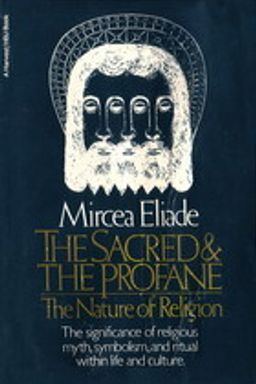
The Sacred and the Profane cover

The Sacred and the Profane

by Mircea Eliade

The Sacred and the Profane delves into the dichotomy between religious and secular life, revealing how various cultures perceive the sacred. Through an analysis of sacred spaces, time, and nature, this book uncovers the enduring influence of the divine in shaping beliefs and practices across history.

The Sacred and the Profane: Understanding Humanity’s Two Worlds

How do you experience the world around you—solely as matter and movement, or as something charged with mystery? In The Sacred and the Profane, historian of religions Mircea Eliade argues that every human being lives in two distinct dimensions of existence: the sacred and the profane. The sacred represents the realm of meaning, order, and transcendence, while the profane represents ordinary human life—routine, secular, and stripped of spiritual significance.

Eliade contends that religion is not merely a set of beliefs about gods; it is a fundamental human way of experiencing reality. For traditional and archaic societies, the cosmos itself is a living, sacred revelation. Mountains, trees, rivers, and even stones can reveal the divine—what Eliade calls a hierophany, a manifestation of the sacred. The modern secular world, by contrast, has largely lost this capacity for wonder. Yet, Eliade emphasizes, even the most secular person remains haunted by ancient religious patterns: our rituals, myths, and even our architecture bear traces of the sacred world we once openly inhabited.

Two Modes of Being: Religious and Nonreligious

The sacred and the profane represent two modes of being in the world, two fundamental human orientations. For the homo religiosus—the religious human being—existence is meaningful only because it imitates divine acts and participates in sacred reality. Life is continually reconnected to the transcendent, whether through ritual, myth, or daily gestures. In contrast, modern nonreligious humanity sees the world as desacralized, as neutral space and time in which human activities take place without metaphysical reference.

This distinction, Eliade argues, is not abstract philosophy but a lived experience. When you step into a temple and feel you have entered a qualitatively different space, you are momentarily crossing from the profane into the sacred. The church, the shrine, or the altar mark ruptures in ordinary space—a point of contact between heaven and earth. In traditional cultures, every city’s center, every home’s hearth, and every festival were ways of re-experiencing this unity between human life and cosmic sanctity.

Modern Alienation and the Loss of the Sacred

Eliade’s concern is deeply existential: modern people live in a desacralized world that has lost its axis, its center. We are surrounded by matter, not meaning. This shift, which began with scientific rationalism and the secularization of time and space, has left the modern spirit disoriented. Without access to the sacred “center of the world,” our existence can feel fragmented and unstable.

Yet Eliade insists that the sacred has not vanished—it has merely been repressed or disguised. We continue to create "crypto-religious" experiences in secular forms: our fascination with sports heroes, celebrities, and fictional quests are secular echoes of ancient myths. Our impulse to seek renewal—through New Year celebrations, lifestyle changes, or psychological therapy—echoes the ancient rites of passage that symbolized death and rebirth. Eliade’s thesis implies that modern humanity’s hunger for meaning is really nostalgia for the sacred cosmos we have forgotten.

Why These Ideas Matter

Eliade’s argument reaches far beyond academic theology—it’s an invitation to rediscover dimensions of being that give life coherence. Recognizing the sacred can restore depth to your daily experience: seeing nature not as "stuff" but as revelation, seeing your home not as shelter but as a symbolic center, and seeing time not as an endless succession of moments but as cyclical renewal. The book challenges you to notice how ritual, myth, and symbolism continue to inhabit even secular modern life, offering glimpses of transcendence beneath everyday appearances.

Ultimately, Eliade asks: Can modern humanity recover the sacred dimension without reverting to superstition? Can we live once again in a world that speaks, that reveals meaning through its rhythms and structures? His work suggests that rediscovering the sacred may be the key to healing modern existential disorientation.


Sacred Space: Making the World Real

Eliade explains that space for religious man is never homogeneous. Certain places—mountains, temples, sanctuaries—break the monotony of geography by revealing the sacred. These ruptures in ordinary space create a “center” through which communication with the divine becomes possible. They anchor human life in reality, for only sacred space is truly real.

Hierophany and Orientation

Every manifestation of the sacred—what Eliade calls a hierophany—transforms its location. A church is not just an architectural container; it participates in a different cosmic order. The moment Jacob dreamed of the ladder connecting heaven and earth (Genesis 28), he experienced this transformation of space: “This is none other than the house of God, the gate of heaven.”

For traditional societies, to live near the sacred was to dwell in reality itself. The cosmic axis—the center of the world—offered orientation and meaning. Every city, from Babylon to Jerusalem, was imagined as this cosmic center, the point where the heavens, earth, and underworld intersected.

The Repetition of Cosmogony

When human beings consecrate a place, they repeat the divine act of creation. Building a temple, founding a village, or even a home is equivalent to transforming chaos into cosmos. Ancient builders laid cornerstones or performed sacrifices not as superstition but as symbolic acts of creation. The Mesopotamian temple stood as an image of the universe; its seven levels represented the seven heavens.

The Desacralization of Modern Space

Modern experience, Eliade laments, flattens this cosmic dimension. Urban space has become neutral, interchangeable, without sacred orientation. Yet traces remain: even the most secular person keeps “holy places” in private memory—the park of childhood, the street where one fell in love, the place of first independence. These secular sanctuaries reveal an unconscious persistence of sacred space.

Eliade reminds you that to inhabit space meaningfully is to live centered. Without a sacred orientation, existence drifts in chaos. To create—or rediscover—your own center is to participate in the enduring human work of making the world real.


Sacred Time: Escaping History

Just as space can be sacred, so too can time. For religious humanity, time is not a linear flow but a rhythm of eternal returns. Eliade contrasts sacred time—cyclical, reversible, continually renewed—with profane time, which passes irreversibly toward death.

Mythic Time and Ritual Renewal

In sacred time, past divine events can be re-lived through ritual. Every festival recreates the time of origins: at New Year, ancient Babylonians recited the Enuma Elish, reenacting the god Marduk’s victory over chaos to recreate the world. By doing so, they abolished ordinary time and re-entered mythical time—when creation first happened. Eliade notes that this recurrence expresses humanity’s deep desire to begin again, to return to purity and strength.

Rebirth and Regeneration

Sacred time allows renewal. Through rites of purification or festivals, society symbolically returns to chaos to be recreated anew, much like the cosmos after the Flood. This cycle of destruction and regeneration reflects not pessimism but hope—the assurance that life can be renewed. Even in Christian liturgy, which sanctifies historical time through Christ’s incarnation, the principle of re-actualization remains: Easter and Christmas reenact sacred beginnings within history.

Modernity and the Linear Prison

Modern man dwells only in historical time—irreversible, quantitative, and flattened. Yet, Eliade argues, our obsession with novelty and reinvention reveals a secular echo of sacred recurrence: starting a new life, changing careers, or observing anniversaries simulate ancient regeneration rituals. Your longing for “a fresh start” is, in Eliade’s terms, a modernized version of the timeless human yearning to return to the origins.

Sacred time teaches that renewal is possible because creation itself repeats. To rediscover reversible, eternal moments—even briefly—restores the sense of meaning that profane time obscures.


Nature as Revelation of the Sacred

To Eliade, nature is not passive matter but a living manifestation of the sacred. The cosmos shows divine structure in every feature—the sky’s transcendence, the earth’s fertility, the waters’ regeneration, the sun’s life-giving power. Ancient humanity read the world as a text written by the gods; modern people, he says, have forgotten how to read it.

The Celestial and Telluric Sacred

The heavens reveal eternity and transcendence: from the Mongol Tengri to the Hebrew Yahweh, sky gods symbolized the absolute. The earth, in contrast, embodied motherhood and fecundity. The Terra Mater, from Hesiod’s Gaia to the Indian Rig Veda’s Earth Hymn, represents the mystery of generation and death, reminding humanity of its dependence on the rhythms of creation.

Water, Tree, and Cosmic Renewal

Water, Eliade writes, symbolizes both death and rebirth. Baptism draws on this universal pattern of immersion and emergence—a return to chaos followed by regeneration. Likewise, the cosmic tree, from Norse Yggdrasil to the Biblical Tree of Life, mirrors the perpetual renewal of life and connects heaven and earth through its vertical axis.

Desacralizing the World

Modern scientific consciousness has rendered nature silent. Where earlier cultures saw transparent symbols, we now see only biological processes and raw resources. Yet Eliade urges you to recover the “religious sense of the world” —to rediscover that nature speaks through its own rhythms and forms. Even today, artistic expressions, ecological movements, and meditative practices hint at the sacredness once felt in the natural world.

For Eliade, to see nature as sacred is not superstition—it’s ontology. Through cosmic symbolism, humanity perceives being itself as divine revelation.


Initiation and the Sacredness of Human Life

Every significant human transformation—birth, puberty, marriage, death—is a passage from one mode of being to another. Eliade shows that initiation rites throughout cultures renew the structure of existence itself: they represent death to the profane self and rebirth to sacred life. In this sense, to live fully is to be continually initiated.

Rites of Passage and Rebirth

Among the Australian tribes, adolescents endured symbolic deaths—burial in the earth or enclosure in ritual huts—before being accepted as adults. The ordeal mirrored cosmic creation: just as the gods fashioned order from chaos, the initiate’s new consciousness emerged from darkness. Similar patterns appear in African secret societies, Indian sacrifices, and early Christian baptism, where immersion in water expresses descent into death and resurrection.

The Second Birth of the Spirit

Eliade links modern spiritual growth to these initiatory structures. When you confront suffering, loss, or transformation, you are unconsciously reenacting the archaic schema of symbolic death and rebirth. Psychoanalysis, he notes, mirrors initiation: descending into the unconscious to overcome inner demons recalls the shaman’s passage through the underworld. Life’s crises are thus potential initiations into deeper freedom.

Continuity in Modern Life

Even today, we celebrate beginnings—a new home, a new year, a new role—as symbolic rebirths. Although these rituals have lost explicit religious content, they preserve the ancient structure of the sacred passage. Eliade’s insight transforms your perspective on change: every transition, properly understood, can be sacred, grounding you in the timeless rhythm of becoming.

Initiation reveals that human existence itself is a spiritual process—an unfolding of sacred transformations. To accept the rhythm of dying and being reborn is to rediscover what it means to truly live.


Rediscovering the Sacred in Modern Life

In his concluding chapters, Eliade confronts the modern condition directly. While proclaiming the death of the sacred, modernity remains haunted by symbols, myths, and rituals. Secular society repurposes religious forms in disguised ways—political ideologies, art, psychology, and even consumer culture echo the ancient structures of myth and initiation.

Hidden Sacred Patterns

Eliade argues that myths have not vanished but migrated. The hero stories in cinema, the redemptive arcs in novels, and the desire for transformation through therapy all follow mythic templates: descent into chaos, confrontation with trials, return with wisdom. Even Marxist eschatology—the dream of a classless society—repeats the ancient myth of paradise regained. Humanity cannot escape the sacred structure of imagination; it only reinterprets it.

The Unconscious as Religious Memory

Freudian and Jungian psychology, Eliade suggests, rediscover in the psyche the ancient ciphers of religion. The unconscious preserves archetypes—the serpent, the tree, the hero—that once served spiritual understanding. Even when one denies God, these symbols survive in dreams and art, acting as bridges to transcendence. Your inner life, he implies, keeps the sacred alive beneath rational consciousness.

A Call for Re-Enchantment

Eliade’s challenge is not to restore old religions blindly but to rekindle the perception of meaning that those religions embodied. To re-sanctify life requires learning to see again—to recover awareness of symbolic connection between human experience and cosmic order. Doing so allows you to inhabit the world not as chaos, but as cosmos—a living, speaking totality.

In the end, Eliade offers both diagnosis and remedy: modern humanity suffers disorientation because it has rejected the sacred dimension of existence. By rediscovering the hidden sacred within even secular forms, we can once again live in a world that feels real, connected, and alive.

Dig Deeper

Get personalized prompts to apply these lessons to your life and deepen your understanding.

Go Deeper

Get the Full Experience

Download Insight Books for AI-powered reflections, quizzes, and more.