
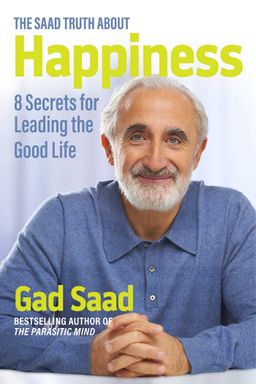
The Saad Truth about Happiness cover

The Saad Truth about Happiness

by Gad Saad

In ''The Saad Truth about Happiness,'' behavioral scientist Gad Saad reveals eight essential secrets to living a happier life. Through insights on moderation, resilience, and authentic connections, readers learn how to cultivate joy and avoid regret, achieving a balanced and meaningful existence.

The Science and Art of True Happiness

What does it really take to live a happy, meaningful life? In The Saad Truth About Happiness, Dr. Gad Saad—a Lebanese-Canadian evolutionary psychologist and public intellectual—argues that happiness isn’t a mystery or a fleeting emotion but a measurable result of how you align your life with timeless truths from both science and wisdom. Saad’s central premise is deceptively simple: you can’t chase happiness directly—you can only create the conditions that allow it to flourish. The book combines empirical psychology, ancient philosophy, and relatable personal anecdotes to show that happiness is both a mental discipline and a practical art.

Saad positions himself as a “happy professor,” a scientist who treats joy as a serious field of inquiry. Drawing on thinkers from Aristotle to Viktor Frankl, he explores how the good life depends on rooted purpose, moderation, resilience, and gratitude. Modern psychology backs this up: as Martin Seligman’s positive psychology has shown, happiness is tied not to pleasure alone but to engagement, meaning, and achievement. Saad weaves these threads together with an evolutionary lens, arguing that our instinctual drives—toward connection, variety, and play—are not obstacles to happiness but part of its design when properly harnessed.

The Author’s Central Claim

Saad contends that happiness depends on three categories of influence: innate disposition (your genes and temperament), environment (your relationships, job, and culture), and mindset (the cognitive habits you develop to interpret life’s events). You may not control your genes or every circumstance, but you can master your mindset—which makes optimism, moderation, and humor practical tools rather than abstract virtues. Happiness, he insists, is strengthened by discipline: choosing the right partner and work, cultivating gratitude, viewing life as a playground, and maintaining persistence in failure.

He illustrates these ideas with his own story—a child of war-torn Lebanon who survived multiple brushes with death and learned existential gratitude by recognizing, quite literally, the miracle of his own existence. (His mother almost had an abortion; a friend convinced her otherwise.) That awareness, he says, made him immune to trivial misery. “It is statistically improbable that any one of us should exist,” he writes. “We should be grateful for it.” This existential gratitude anchors his philosophy of happiness: every moment is precious when you’ve faced nonexistence.

Science Meets Ancient Wisdom

In subsequent chapters, Saad demonstrates how modern behavioral science often validates what the ancients knew. The Stoics taught that it’s not events but our judgments about them that disturb us—a principle now verified through cognitive behavioral therapy (CBT). Aristotle’s Golden Mean, the Buddha’s Middle Way, and Confucian balance echo what psychologists call the inverted-U curve: nearly everything in life has an optimal dose, and both deficiency and excess are harmful.

Similarly, Saad emphasizes that happiness is both hedonic (pleasure) and eudaimonic (meaning). From the Greeks to the cutting-edge research of scholars like Jonathan Haidt and Sonja Lyubomirsky, fulfillment emerges when purpose complements pleasure. He frequently points out that structureless freedom—what modern society often equates with happiness—leads instead to emptiness. Freedom requires form, just as joy requires self-restraint.

The Blueprint for a Good Life

Across nine chapters, Saad constructs a holistic framework for the good life:

  • Happiness begins with self-awareness—choosing a mindset of gratitude over victimhood.
  • Key life decisions—especially romantic and professional—determine most long-term fulfillment.
  • Moderation is a universal law: all good things, even health or pleasure, follow the inverted-U principle.
  • Playfulness, humor, and curiosity protect against cynicism and stagnation, especially in adulthood.
  • Variety, persistence, and purpose create intellectual and emotional vitality.
  • Regret can be transformed into motivation through authenticity and timely action.
  • Finally, happiness is not pursued but cultivated—it ensues, as Viktor Frankl said, when we serve something greater than ourselves.

Each concept is colored by Saad’s mixture of humor and science: he can cite Daniel Kahneman’s “peak-end rule” to explain how we remember pleasure while joking about his mother calling him “fish food.” His goal isn’t to offer “life hacks” but to restore sanity to a culture overwhelmed by self-help quick fixes. “There is no magical formula for happiness,” he writes—yet there is a method rooted in reality and resilience.

Why It Matters Today

Modern Western culture, Saad argues, suffers from an epidemic of misery fueled by ideological victimhood, material obsession, and loss of personal agency. He warns that “idea pathogens”—destructive ideas like toxic relativism or militant feminism—have infected the collective psyche, convincing people that happiness depends on others or oppressive systems. His antidote is responsibility, humor, and gratitude. You can’t tweet your way to well-being, but you can choose how to interpret life’s trials.

Thus, The Saad Truth About Happiness is not a naïve cheerfulness manifesto but a realist’s manual for joy. It honors ancient virtues using modern proof; it rejects ideological despair in favor of personal fortitude. When you finish the book, you’re invited to become your own “happy professor”—a pragmatic optimist who treats life as an experiment in meaning, moderation, and play. Saad’s message, distilled: happiness is not finding yourself; it’s designing yourself through courageous, grateful, rational living.


Using Ancient and Modern Wisdom for Well-Being

Saad bridges time by comparing the philosophical sages of antiquity with today’s behavioral scientists. For thousands of years, humans have pondered the formula for happiness; from Aristotle and Confucius to Kant and Seneca, different traditions arrived at eerily similar conclusions. Modern psychology has only confirmed their insight: happiness stems from purposeful action and internal mastery, not external conditions.

Ancient Foundations

Greek philosophers like Aristotle and the Stoics recognized happiness as the ultimate goal of human life—an end in itself. Unlike early fatalists who viewed joy as divine luck, Aristotle argued that happiness could be earned through virtuous behavior. Epicurus and Seneca preached moderation and tranquility (ataraxia), while the Stoic Epictetus taught that peace comes from controlling our reactions, not circumstances. These principles live on in modern therapy through cognitive restructuring and mindfulness—a point Saad loves to make when paralleling Stoicism and CBT.

Eastern and Religious Perspectives

Saad also compares Greek thought with Eastern traditions. Confucianism prized social harmony; Buddhism emphasized detachment from craving; Taoism advised flowing with nature. All three warned against extremes and echoed the Aristotelian “mean.” Meanwhile, religious traditions like Christianity and Judaism reframed happiness as divine alignment through virtue, service, and gratitude. Though Saad approaches these systems scientifically, he appreciates their shared human wisdom: all urge a balanced, ethical life.

Scientific Parallels

Modern psychology, Saad shows, has empirically validated many of these ideas. Happiness correlates with good relationships, autonomy, and purpose. It also strengthens physical health—lowering blood pressure, stress hormones, and inflammation. The happier you are, the longer you live. And while personality may predispose you toward optimism, mindset training (gratitude journaling, reframing thoughts, meditation) can measurably improve well-being—a scientific echo of ancient practice.

Lessons Across Eras

By combining ancient and empirical wisdom, Saad reinforces a timeless insight: human flourishing depends on virtue, agency, and gratitude more than wealth or comfort. The ancients prescribed discipline; scientists now prescribe CBT and gratitude interventions—but they all address the same human architecture. As Saad writes, happiness “is not about avoiding pain but aligning with the nature of being human.” His synthesis across epochs creates a unified theory of the good life that sits comfortably between Aristotle’s virtue ethics and positive psychology’s PERMA model (Positive emotion, Engagement, Relationships, Meaning, Achievement).


Choosing Love and Work Wisely

Two life decisions, Saad insists, dominate your long-term happiness: your romantic partner and your career. These are the twin pillars of daily existence—who you spend your life with and what you dedicate your energy to. Drawing on decades of research and personal experience, Saad explains how wise choices in love and work create emotional stability, purpose, and joy.

Marriage as the Happiness Multiplier

The Harvard Study of Adult Development, one of Saad’s favorite sources, has shown that loving relationships—not income or status—predict happiness and longevity. Warm relationships act as emotional armor against stress and even physical decline. Saad illustrates this with his own marriage, where laughter, humility, and daily rituals—like long morning walks—strengthen connection. He cites John Gottman’s research on communication, emphasizing kindness over criticism and the importance of apology as a “costly signal” of sincerity (a concept borrowed from evolutionary biology).

Relationships thrive on friendship and humility: “Love is patient, love is kind… it is not proud.” Saad warns against pathological pride—the failure to apologize—since humility keeps love resilient. His humor punctuates his advice: if you and your spouse can laugh together, you can survive almost anything.

Careers That Give Meaning

The second foundation of happiness is purposeful work. Saad urges readers to find professions aligned with their personalities rather than market trends. He critiques “careerism” as a hollow path to misery, highlighting studies showing that life purpose protects against mortality more than wealth does. Meaningful work—teaching, medicine, art, science—fuels a deeper satisfaction than money or prestige.

Drawing from his own experience in academia, Saad celebrates creativity as the ultimate source of fulfillment. The joy of creation—whether in writing, designing, or problem-solving—connects to what he calls “memetic immortality,” or leaving intellectual offspring. You might not own a Ferrari, he quips, but ideas can outlive your genes. The key: choose work that lets you create, contribute, and play, not merely earn.


Moderation: The Universal Law of Happiness

Aristotle’s Golden Mean meets modern psychology in Saad’s argument that all good things require balance. Whether it’s ambition, love, sex, food, or stress, too little stagnates and too much harms. He symbolizes this with the inverted-U curve—a simple but profound pattern showing that optimal happiness lies at the midpoint.

The Inverted-U Pattern

From stress to exercise to empathy, Saad demonstrates that life’s benefits follow the same shape: moderate levels maximize outcomes. The Yerkes-Dodson law, for instance, proves moderate stress enhances performance; excessive pressure leads to burnout. Even in relationships, some jealousy signals care, while obsessive jealousy destroys trust. Likewise with pleasures: moderate sex, alcohol, or food intake yields happiness; excess or deprivation doesn’t.

Every Domain Has a Sweet Spot

Saad applies this principle broadly—from business to politics. Companies that overinvest in social virtue signaling or environmental projects eventually lose focus; nations that overtax their citizens in pursuit of equality breed resentment instead of prosperity. His own experience in highly taxed Quebec fuels this point: too much social engineering kills personal happiness. Yet he also stresses that moderate regulation and social support sustain collective well-being—the true art of governance is balance.

By making moderation a scientific law, Saad elevates a moral maxim into a practical imperative. Happiness, he concludes, is the equilibrium between indulgence and restraint, self and society, effort and rest. Find your sweet spot, and you find peace.


Living Life as a Playground

Saad’s most endearing message is that happiness requires playfulness. Adults, he warns, forget how to play—and in doing so, they lose creativity, resilience, and joy. Citing neuroscientist Stuart Brown and humanist psychologist Abraham Maslow, Saad calls play “the purest expression of our humanity.” It’s how we explore, adapt, and connect.

The Evolutionary Purpose of Play

Play, Saad explains, evolved as adaptive training for survival—building resilience, problem-solving, and cooperation. Even in war zones (he recalls his Lebanese childhood amid snipers and shells), children instinctively play to cope. Adults need the same instinctual therapy: whether in humor, hobbies, or work. “Science,” he writes, “is the highest form of play.” His own research, including quirky YouTube sketches and academic papers, stems from curiosity as recreation.

The Healing Power of Humor and Nature

Humor, Saad argues, is not frivolous—it’s anti-fragile. Laughing at yourself shows confidence and inoculates against ideological extremism. Dictators hate jokes because humor undermines tyranny. Likewise, reconnecting with nature (his “biophilia”) restores mental health: walking, sunlight, and fresh air are evolutionary antidepressants. Even dogs, he notes, embody joy better than most humans—loyal, playful, and present. When life gets grim, “forget about Prozac; get a dog.”

By viewing life as a playground, Saad reframes happiness as an active stance: stay curious, generous, irreverent, and grateful. Humor and play aren’t distractions from life; they’re how we survive it beautifully.


Variety: The Spice and Balance of Fulfillment

Too much routine deadens joy; too much novelty causes chaos. Saad devotes an entire chapter to variety because it explains the tension between stability and stimulation—the twin needs wired into our brains. Variety satisfies curiosity, prevents boredom, and reinforces adaptability, yet craving it uncontrollably can fragment focus and meaning.

Healthy vs. Unhealthy Variety

In food, sex, and ideas, variety pleases evolutionarily because it signals abundance and learning. Changing routines can spike happiness by refreshing attention—psychologists call this preventing “hedonic adaptation.” But Saad also warns against compulsive novelty: chasing endless options (from consumer goods to partners) creates paralysis and regret. He cites Barry Schwartz’s The Paradox of Choice to show how modern abundance breeds dissatisfaction.

Intellectual and Experiential Balance

As a scholar, Saad champions interdisciplinarity—the intellectual variety that fuels creativity. Like Leonardo da Vinci or Richard Feynman, he believes cross-pollination between fields sparks discovery. Yet he reminds readers not to confuse breadth with shallowness: the “sweet spot” again lies between specialization and curiosity. Pursue multiple interests deeply enough to connect them.

Ultimately, variety feeds happiness because it mirrors the mind’s need for novelty within order. Whether trying new foods, ideas, or hobbies, Saad’s advice is concise: when in doubt, explore—but don’t scatter. Master variety with purpose, and life stays fresh without losing coherence.


Persistence and the Power of Anti-Fragility

Saad’s view of resilience blends evolutionary realism with motivational grit. Failure, he argues, isn’t the opposite of happiness—it’s its training ground. Like trees strengthened by wind or bodies built through stress, humans develop character through adversity. The key is not avoiding hardship but responding anti-fragilely—growing stronger under pressure (a concept popularized by Nassim Nicholas Taleb).

Adversity as Growth Catalyst

Saad’s own life—escaping war-torn Beirut, academic rejection, political backlash—illustrates anti-fragility. Adversity made him defiant, not defeated. He compares this to lions who fail most hunts yet persist; or entrepreneurs whose rejections refine their success. Citing studies and anecdotes (from J.K. Rowling’s twelve rejections to Michael Jordan’s tryout failure), he shows that persistence predicts eventual triumph more than talent does.

Rejecting Victimhood Culture

In contrast, modern “victimology,” Saad warns, breeds misery. He critiques public figures who glorify grievance over growth, arguing that personal agency—not oppression narratives—builds happiness. “You are the architect of your happiness,” he reminds readers. The mindset shift: ask not “Who harmed me?” but “What can I learn?” That’s the psychology of resilience echoed from Stoicism to CBT to modern grit research (Angela Duckworth’s work). Happiness thrives on struggle transformed into strength.


Eradicating Regret and Living Authentically

Regret is one of Saad’s most human themes. Everyone looks back and asks, “What if?”—but dwelling too long on that question hijacks peace of mind (the Stoics called tranquility ataraxia). Saad distinguishes between regrets of action (what we did) and inaction (what we didn’t do). Modern psychology confirms that the deepest suffering comes from inactions—the chances not taken. Happiness requires transforming regret into resolve.

The Science of Regret

Drawing on studies by Cornell psychologist Tom Gilovich, Saad explains that immediate regret tends to follow mistakes, but lifelong regret follows avoidance. Whether it’s a missed career change, untold love, or unexplored passion, inaction gnaws longest. He illustrates this with his own lost dreams of professional soccer and his later academic satisfaction, showing how adaptability can redeem regret.

Authenticity as Antidote

The cure to regret, Saad insists, is authenticity—living in harmony with your true self. People who conform to social or ideological expectations wake one day realizing they’ve led false lives. He contrasts political figures he considers “inauthentic” (Hillary Clinton, Kamala Harris) with blunt honesty—even if divisive—as a happier alternative. Authenticity frees you from cognitive dissonance and self-betrayal. As Socrates taught, know yourself; then live accordingly.

The Regret Minimization Framework

Saad highlights Jeff Bezos’s “regret minimization framework”—making choices today that your future self will thank you for. In essence: act boldly, pursue curiosity, and accept failure over inaction. Borrowing from Viktor Frankl’s logotherapy, he argues that purpose converts regret into peace. Do what aligns with your values, and even mistakes become sources of wisdom rather than sorrow.


The Happiness Blueprint: Gratitude, Purpose, and Humor

In his final message, Saad circles back to what truly sustains happiness: gratitude, purpose, and humor. Drawing on Viktor Frankl’s insight that success and happiness cannot be pursued directly—they must ensue from meaning—he urges readers to stop chasing happiness like a possession. Instead, cultivate the conditions where it naturally blooms.

Gratitude as Anchor

Gratitude reframes suffering into perspective. Saad shares stories of immense human grace: David McCallum, who lost 29 years in prison yet remained grateful, and Bijan Gilani, a once-wealthy man who found peace in homelessness by cherishing his ability to think and laugh. Gratitude, Saad explains, isn’t naïve—it’s realism properly scaled. No matter how bad life seems, someone’s situation is worse. This awareness inoculates against bitterness.

Purpose and Humor as Lifelines

Happiness persists when anchored to purpose—work, family, or service—and when seasoned with laughter. Saad’s humorous YouTube antics or his playful interactions with critics embody his point: humor rebuilds resilience, diffuses fear, and reveals perspective. To quote him, “Life is too serious not to play.”

Ultimately, Saad’s path to happiness merges existential courage with everyday joy. His blueprint—choose love, work with purpose, live moderately, laugh frequently, and act authentically—isn’t revolutionary, yet its synthesis of science and sanity feels urgently needed. Happiness isn’t a mood; it’s a life crafted through gratitude, curiosity, and play.

Dig Deeper

Get personalized prompts to apply these lessons to your life and deepen your understanding.

Go Deeper

Get the Full Experience

Download Insight Books for AI-powered reflections, quizzes, and more.