
Idea 1
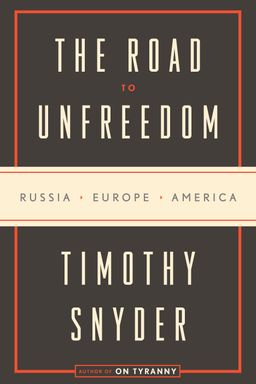
The Road to Unfreedom: Time, Truth, and Power
How does a free society collapse into authoritarianism without a coup or an invasion? In The Road to Unfreedom, historian Timothy Snyder traces how ideas about time, truth, and leadership can dissolve democracy from within. His argument begins with time: societies that believe history is a smooth path of inevitable progress—what he calls the politics of inevitability—become passive. When that belief collapses, citizens often turn to the politics of eternity, a cyclical view of time that glorifies past suffering and permanent enemies. Together, these temporal illusions prepare citizens to surrender responsibility and accept myths over facts.
Snyder’s book weaves this philosophical thread through the concrete story of post-Soviet Russia, the rise of Vladimir Putin, and the global export of an authoritarian model built on lies, spectacle, and managed democracy. The argument extends from Russia's internal transformation to its influence over Ukraine, Europe, and the United States. Along the way, Snyder explains how propaganda kills factuality, how kleptocracy replaces law, and how foreign interference exploits domestic inequality and despair. His key warning: authoritarianism now spreads through networks—financial, digital, and emotional—more than through armies.
From Progress to Myth
In the 1990s and 2000s, liberal societies embraced the politics of inevitability—the belief that globalization and democracy were unstoppable. When the 2008 financial crisis and rising inequality shattered that faith, people felt unmoored. In Russia, this disillusionment allowed Putin to replace reform with myth. He adopted what Snyder calls the politics of eternity: instead of promising a better tomorrow, he taught Russians to relive and avenge past humiliations. By invoking philosopher Ivan Ilyin, Putin’s regime turned Christian and nationalist imagery into justifications for arbitrary power and violence. Law became an instrument of loyalty, and truth became subordinate to the leader’s will.
Managed Democracy and the Sacralization of Power
Snyder shows that Putin’s ascent in 1999 was no accident but a case study in manufactured leadership. The apartment bombings of that year, the Chechen wars, and the managed media ecosystem created a mythology of the indispensable protector. The system that resulted—“managed democracy”—kept elections but hollowed out competition. Succession became impossible because the system personalized rule. When challenges arose, the regime responded by invoking foreign enemies or escalating foreign policy crises. Political time froze; the present was to be defended, not reformed.
Eurasia versus Europe
When the European Union offered integration through law, Russia countered with Eurasia, an imperial project disguised as civilizational alternative. Integration pulled countries toward rule of law; Eurasia pulled them toward empire. Ukraine, poised between both worlds, became the pivot. When Ukrainians gathered on the Maidan in 2013–2014 to demand accountability and lawful governance, they embodied political novelty: self-organization, mutual care, and faith in institutions yet to be built. Russia responded with invasion, disinformation, and hybrid warfare, fearing not just NATO expansion but the example of citizen-led democracy next door.
Truth Under Attack
Central to Snyder’s story is the destruction of factuality. Russian propaganda did not merely distort facts; it sought to annihilate the concept of truth itself. By generating contradictory stories—about the downing of MH17, the supposed crucifixion in Sloviansk, or the “Lisa F.” hoax in Germany—the Kremlin trained audiences to live without certainty. Vladislav Surkov, Putin’s information architect, called this creative chaos “postmodern politics.” Abroad, these same tools—cyberwar, bots, and targeted ads—fueled Brexit, U.S. polarization, and distrust of democratic institutions. The goal was not persuasion but paralysis.
Strategic Relativism and Global Unfreedom
Unable to compete on growth or innovation, Russia embraced a doctrine Snyder calls strategic relativism: win by making others lose. If democracy fragments, if Americans distrust elections, if the EU splinters, Russia’s relative power increases even as everyone suffers. This is a negative-sum strategy, corrosive yet effective in a networked age. What Moscow perfects abroad often boomerangs home; conversely, Western complacency mirrors Russia’s initial surrender to inevitability. The cure, for both, lies in reclaiming historical time—the ability to imagine and build a different future.
Why It Matters for You
For Snyder, history is an ethical practice. When you situate facts in time, you resist both inevitability and eternity; you make freedom possible. Democracy depends on factual truth, lawful succession, and civic solidarity. These cannot survive if citizens see the world only as spectacle or conspiracy. In the end, The Road to Unfreedom offers a path back to agency: study how narratives shape power, defend institutions that ground truth, and act with historical awareness. The antidote to unfreedom is not nostalgia—it is responsibility in time.