
Idea 1
Freedom, Planning, and the Fate of Liberal Civilization
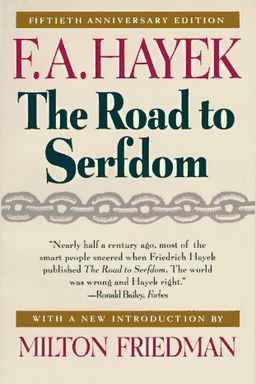
Why do well-intentioned efforts to plan prosperity so often end in coercion? In The Road to Serfdom, Friedrich Hayek argues that the more a society centralizes decisions to promote equality or security, the more it must compel obedience. Freedom, he insists, depends not on benevolent rulers but on dispersed power—markets, private property, and the Rule of Law. His book is both an intellectual history and a warning: the road to serfdom is paved with rational plans.
The moral and political foundation
Hayek defines liberty as freedom from coercion. Unlike socialists who equate freedom with power or plenty, he ties it to the absence of arbitrary control. When individuals can act according to their own values under general laws, a moral order of responsibility and creativity can emerge. But when authority directs each person’s ends, moral autonomy disappears. This distinction between negative freedom (from compulsion) and positive freedom (power to get what one wants) underlies all his arguments.
He insists that liberty requires material means—property, contract, and competition—that disperse control. Wealth and opportunity are not moral goods in themselves but preconditions for self-direction. Planning, by redirecting those means toward collective designs, substitutes another’s values for your own.
From liberal individualism to collectivist planning
Tracing intellectual history, Hayek shows how classical liberalism, born from the Renaissance and Enlightenment, gradually surrendered to collectivist thinking. Nineteenth‑century progress, he writes, produced impatience with its own limits. Influenced by German historicism and the “Cult of Science,” intellectuals such as Sidney and Beatrice Webb, Karl Mannheim, and others began to treat social life as a domain to be engineered. Tocqueville’s early warning about a “new servitude” under benevolent despotism becomes prophetic in Hayek’s account.
For Hayek, this shift was less about moral decay than intellectual hubris. The belief that the complexity of economic life could be made transparent and controllable seduced scholars and reformers. The very tools that advanced science generated a desire to extend control from laboratory to society.
The knowledge problem and the limits of reason
Central to his argument is the “knowledge problem.” No planner, however brilliant, can assemble the countless local facts that markets communicate through prices. These signals condense dispersed information about scarcity and preference; they evolve from countless decisions no one fully sees. Oskar Lange’s “market socialism,” with simulated prices, might work on paper, but to Hayek it misses the living feedback that competition provides. Coordination through prices is not a moral doctrine; it is an epistemic necessity.
If this knowledge cannot be centralized, any central plan must rely on coercion rather than understanding. You cannot persuade millions to behave as if they knew the central facts; you must compel them to comply with instructions based on guesses. This is why, he argues, planning logically expands coercion even without evil intent.
Coercion, democracy, and the Rule of Law
Once planning requires case‑by‑case discretion, law loses its character as a general rule. Parliaments cannot deliberate every detail of a comprehensive plan, so they delegate vast powers to administrators. Whether in Britain’s wartime regulations or Laski’s proposals for government by decree, discretion replaces general law with executive orders. The distinction between legality and arbitrary command blurs. Hayek insists that the Rule of Law means predictable, universal rules—not ad hoc commands—which make individual freedom possible.
Why freedom declines even with good intentions
Hayek takes pains to reject fatalism. He does not claim tyranny is inevitable, only that planning has an inner logic: once it reaches a certain scale, it demands uniformity. Without a shared moral consensus on ends, coercion fills the gap. Each concession to planning, if unchecked, erodes the tolerance and pluralism that sustain liberty. The book is therefore a warning, not a prophecy, urging readers to recognize the danger before it becomes destiny.
Economic, moral, and international stakes
Hayek closes the circle by connecting the domestic and the global. National economic planning breeds trade barriers, strategic blocs, and conflicts of interest—an economic prelude to war. International peace, he suggests, demands a limited federal order that enforces common rules but forbids global planning. Just as freedom thrives on dispersed domestic power, peace depends on balanced international institutions that restrain coercion without central dominance.
His moral conclusion is clear: a free civilization rests not on perfection but on humility—the readiness to accept that no one mind or committee can design all outcomes. Freedom requires the courage to live with uncertainty, the willingness to bear risk, and the refusal to trade responsibility for illusory security. The road away from serfdom, in short, begins with recognizing how easily the dream of control becomes the instrument of bondage.