
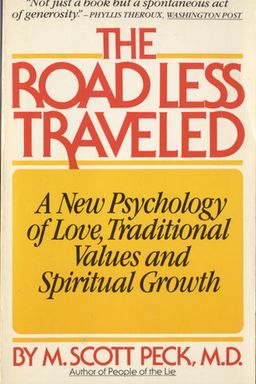
The Road Less Traveled cover

The Road Less Traveled

by M Scott Peck

Explore a transformative journey towards spiritual growth and enlightenment with M. Scott Peck''s ''The Road Less Traveled.'' Discover how discipline, love, and grace intertwine to offer a more balanced and fulfilling life, while facing the challenges of personal growth with courage and responsibility.

Life, Discipline, and the Journey of Growth

What does it mean to live a psychologically and spiritually mature life? In The Road Less Traveled, psychiatrist M. Scott Peck argues that life is difficult—not accidentally, but necessarily. Problems and pain are the engine of growth. You mature by suffering legitimately and by practicing discipline, love, and spiritual awareness. Peck fuses psychology with philosophy, religion, and clinical insight to show that personal development is an act of moral courage.

Accepting Difficulty as a Starting Point

Peck opens with the radical but liberating premise: if you accept that life is difficult, difficulty loses its power to victimize you. You stop hoping for a frictionless existence and start treating problems as opportunities for growth. This attitude resembles Buddhist realism—"life is suffering"—but Peck focuses on its practical psychology: when you endure pain consciously, you become free. The refusal to face unavoidable suffering, he says, is the source of mental illness.

The Four Disciplines of Growth

Peck defines discipline as the toolkit for handling life's pain creatively. There are four interconnected components: delaying gratification (doing the painful first for long-term benefit), accepting responsibility, dedication to truth, and balancing. These disciplines sound simple but are hard to live—they demand willingness to face discomfort. Each provides a lens for understanding pathology: avoidance of these practices breeds procrastination, denial, blame, and rigidity.

Peck illustrates these principles with ordinary and clinical examples: a procrastinating analyst learns to schedule pain before pleasure; addicts and character-disordered clients avoid responsibility by blaming environments; neurotics suffer from assuming too much. Growth, he insists, is not about perfection but movement toward realistic self-awareness and freedom.

Love as a Discipline, Not a Feeling

After diagnosing discipline as the foundation, Peck expands his framework to love. He defines love as the will to extend oneself for the purpose of nurturing one’s own or another’s spiritual growth. Love is not sentiment or desire but deliberate effort. It unites discipline and will. Falling in love, he explains, is an instinctual collapse of ego boundaries; genuine love is chosen and sustained when infatuation fades. You love someone not because it feels good but because you decide to serve their growth.

Real love requires attention (truly listening), commitment (staying through difficulty), and confrontation (challenging with humility). Peck’s clinical stories—Rachel, Marcia, Helen, and the minister—illustrate how love heals when expressed through disciplined involvement and truth. Love is always an ethical choice: it may mean telling painful truths, setting limits, or letting others go from dependency.

Separateness and Narcissism

Love preserves individuality. Peck warns that narcissism—the inability to recognize another as distinct—corrupts parenting, marriage, and therapy. In one case, Susan X’s mother projects her own feelings onto her daughter, erasing Susan’s separateness. This self-centered care prevents both from growing. Healthy love respects boundaries and fosters autonomy. (Note: this theme echoes Erich Fromm’s The Art of Loving and Kahlil Gibran’s reminder that children are “not your children.”)

Spiritual Dimensions: Religion and Grace

Peck’s later chapters merge psychology with spirituality. He argues everyone has a religion—a worldview shaped by formative family experiences. Atheist or believer, you hold metaphors of meaning that affect your behavior. Therapy helps you revise these inherited maps. Cases from Kathy, Marcia, and Ted show how different religious evolutions—rejection, rediscovery, or maturation—emerge from healing.

Then comes the leap to grace: the mysterious force outside conscious will that guides growth through dreams, synchronicities, and miraculous rescues. Peck connects this to Jungian synchronicity and unconscious wisdom, suggesting that the universe supports evolution when you cooperate with truth and discipline.

Evolution, Laziness, and the Moral Task

He interprets evolution as love opposing entropy. The obstacle is laziness, his reinterpretation of original sin—the temptation to avoid effort and responsibility. Evolution toward consciousness requires facing fear and accepting the loneliness of freedom. Symptoms like anxiety and depression, Peck says, are often invitations to growth, like Orestes’ Furies turning into guides once he accepts guilt.

A Road Less Traveled

By blending clinical psychology, theology, and philosophy, Peck maps a path of deliberate spiritual evolution. Discipline provides structure, love supplies energy, and grace adds mystery. To travel this road, you must suffer skillfully, love responsibly, question reality courageously, and surrender pride when faced with larger truth. Growth, for Peck, is both a human duty and a cosmic process—the universe asking you to participate consciously in its unfolding.


Practicing Discipline Daily

Discipline is Peck’s first instrument for spiritual and emotional health. It means facing reality and managing pain through deliberate effort rather than avoidance. If you want freedom, you must schedule and structure your responsibility instead of obeying impulse.

Delaying Gratification and Ordering Time

Delaying gratification means doing the unpleasant task first. Peck’s example of the financial analyst who learns to work differently—doing hard parts first—shows how a minor behavioral re-sequencing creates psychological liberation. She stops being ruled by avoidance. You can practice this daily by confronting the day’s hardest problem immediately. The act is small, the effect cumulative.

Learning Delay in Childhood

Children learn delay from loving structure. Parents who model patience and consistency teach discipline without shame. Two invisible gifts—feeling worthwhile and safe—allow delay. When a child experiences emotional instability or parental narcissism, the result may be impulsivity and addiction later in life. Teaching delay builds faith in the future.

Responsibility and Escaping Freedom

Responsibility means owning choices rather than blaming fate. Peck contrasts neurotics (overresponsible) and character-disordered people (underresponsible). Both distort reality. The story of the Okinawa sergeant blaming alcoholism on the island illustrates avoidance. Peck’s colleague Mac Badgely teaches him that resentment about workload is a time management issue—Peck must accept his own responsibility to set limits. Real freedom begins when you stop escaping painful choices.

(Note: This echoes existential psychiatrist Viktor Frankl, who holds that freedom is always tied to responsibility.)

Dedication to Truth

Truth requires revising your mental maps. Peck’s metaphor of maps reminds you that childhood beliefs must evolve as the world changes. He defines transference as outdated maps—assumptions like "no one can be trusted" carried from childhood into adulthood. Revising maps hurts but heals. You must cultivate openness and self-questioning: ask which cherished beliefs contradict reality. Institutions, as well as individuals, resist truth because revision is painful.

Balancing and Giving Up

Balance integrates all disciplines. It means judging wisely between competing goods and sacrificing lesser desires for greater values. Giving-up produces depression, which Peck calls the healthy mourning of growth. You cannot expand without shedding parts of yourself—career ambitions, fantasies, or illusions. This “disciplined flexibility” lets you evolve through continuous recalibration. Practicing these four tools—delay, responsibility, truth, balance—turns suffering into material for growth.


Love as Willful Growth

Love, for Peck, is not an emotion but a decision and work of will. His famous definition—the will to extend oneself for the purpose of nurturing one’s own or another’s spiritual growth—turns love into a spiritual discipline. You love by effort, not impulse.

Falling In Love vs. Real Love

Falling in love collapses ego boundaries temporarily. It feels ecstatic but lacks responsibility. Real love begins when the collapse ends and you choose to act lovingly despite the absence of thrill. Peck’s clinical stories of parents confusing protection with love—the mother chauffeur hindering her son’s independence, or the minister who infantilizes his family—demonstrate how false love blocks growth.

Attention as the Practice of Love

Love starts with attention. Listening deeply is hard work—it demands bracketing your own judgments. A parent who listens carefully to a child’s seemingly trivial talk gives the child a sense of worth and teaches value through presence. Similarly, a therapist’s patient attention enables trust. Attention, Peck insists, is love’s first act of service.

Commitment and Confrontation

Commitment sustains relationships through struggle. Peck’s perseverance with Rachel, who faced sexual frigidity, illustrates healing through loyalty. Confrontation, equally, is a loving act when done humbly: challenging another’s self-deception to aid growth. Power in love must be exercised cautiously—you “play God” when influencing others, so do so with humility and reflection.

Love and Separateness

True love respects individuality. Peck’s case of Susan X and her narcissistic mother dramatizes how fusion destroys growth. The mother saw Susan as an extension of herself; any independence felt threatening. Love must nurture differentiation. Parents and spouses who treat others as separate souls—not instruments of ego—create conditions for spiritual evolution. This principle extends to community and therapy alike: empathy without enmeshment is love’s mature form.


Parenting, Marriage, and Boundaries

Relationships form the microcosm of spiritual development. Peck’s chapters on narcissistic parenting and mature marriage show how respect for boundaries fuels growth. Families that fail at separateness breed confusion and pathology.

Narcissistic Parenting

In Mrs. X’s case, the mother cannot perceive her daughter Susan as independent. Every event redirects to the mother’s feelings—Susan’s success or pain becomes commentary on Mrs. X’s day. This distortion denies Susan’s emotional reality. Peck notes that similar patterns appear subtly in everyday families: when parents say "You’re just like me," or expect replication of their own lives. The child’s autonomy disappears, producing emotional immaturity or resentment.

Effects and Healing

Children of narcissistic parents struggle to identify feelings and boundaries. Severe versions correlate with schizophrenia and chronic confusion; mild versions yield guilt or compliance. Peck highlights Sally, a general’s daughter, whose parents misread healthy introversion as illness because it didn’t match their image. Therapy restores separateness through validation and self-exploration.

Separateness in Marriage

Marriage, Peck says, should be treated as a base camp—a secure hub for two climbers who explore separate peaks. Over-dependence or domination collapses the partnership. Couples must tend the camp collaboratively, supporting each other’s external voyages of achievement and growth. Healthy marriage balances communality and individuality; unhealthy ones oscillate between selfish capitalism and smothering communism.

Practical Boundaries

Ask yourself: do I see loved ones as independent persons or as my personal reflections? That question, Peck insists, diagnoses maturity. When you permit others’ separateness, your relationships shift from control to cooperation. Boundaries are not coldness; they are the soil of genuine intimacy.


Therapy and the Power of Human Love

Peck brings his philosophy alive through psychotherapy. He argues that what heals in therapy is not just method, but love—honest, disciplined involvement. Techniques matter, but human contact matters more.

Human Involvement over Technique

Peck’s accounts of Marcia and Helen demonstrate transformative honesty. With Marcia, his candid compliment triggered self-respect and behavioral reform. With Helen, admitting frustration helped her trust. Love is ethical risk-taking: expressing real emotion responsibly to affirm another’s worth.

Boundaries and Countertransference

Traditional analysis warns against therapist emotion. Peck disagrees: feeling love is therapeutic if disciplined. The danger lies in crossing boundaries—especially sexual ones. He forbids exploiting affection. Authentic care may include warmth, disclosure, or sustained commitment, but never gratification that hinders the patient’s autonomy.

Psychotherapy as Reparenting

Many clients suffer from parental deprivation. Intensive therapy rebuilds trust by serving as temporary reparenting—a model of consistent, honest love. You can extend similar care to friends and family if disciplined enough; love is the heart of all healing relationships. The rule: practice therapy only within your capacity to love.

Choosing and Practicing Therapy

If you seek therapy, select a practitioner you intuitively trust—a blend of humility, discipline and care matters more than prestige. Peck’s criterion is simple: choose people whose love is evident in how they conduct daily life. Therapy succeeds where honest involvement replaces sterile detachment.


Religion, Worldviews, and Grace

In the book’s later chapters, Peck explores spiritual growth as a universal psychological process. Everyone operates from a religion—a worldview formed by family microcosms—and evolution of consciousness involves revising this worldview through experience and humility.

Family and Microcosm

Families act as prototypes for cosmic belief. Stewart, the atheist, unknowingly worships a "monster-god" modeled on abusive parents. Kathy’s rigid Catholicism fosters neurosis until defied; Marcia’s therapist-guided trust leads her from atheism to spiritual openness; Ted’s loss and rediscovery of faith embody rebirth. Religion evolves as psychological maturity deepens.

Science as Religion

Peck calls science itself a form of religion built on faith in doubt. He urges you to behave as a “scientist of your own life”—observant, skeptical, disciplined—but warns against scientism, the arrogance that denies mystery. Understanding worldview is not optional; therapists must uncover their patients’ implicit religions to interpret meaning.

Grace and Synchronicity

Beyond the conscious work lies grace: a mysterious, benevolent force that furthers growth through synchronicity and unconscious wisdom. Dreams, coincidences, even crises often act as Divine nudges. Peck’s examples—dreams revealing truth, unlikely rescues, intuitive insights—suggest grace operates when you live truthfully. (Note: His ideas align with Jung’s concept of synchronicity and the mysticism of Teilhard de Chardin’s evolutionary theology.)

Evolution and Laziness

Evolution, for Peck, is love resisting entropy. Original sin is psychological laziness—the avoidance of work and truth. Growth demands energy and courage. Symptoms like depression and anxiety often herald evolution: once you face pain responsibly, what tormented you becomes a guide. The myth of Orestes and his Furies embodies this transformation—your inner torment shifts into wisdom once you act ethically.

Dig Deeper

Get personalized prompts to apply these lessons to your life and deepen your understanding.

Go Deeper

Get the Full Experience

Download Insight Books for AI-powered reflections, quizzes, and more.