
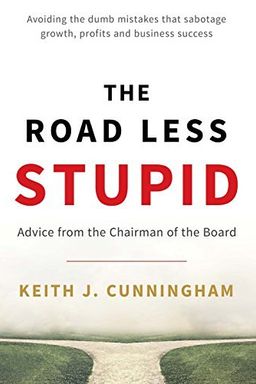
The Road Less Stupid cover

The Road Less Stupid

by Keith J Cunningham

The Road Less Stupid by Keith J. Cunningham provides essential strategies to avoid costly business mistakes. Through the practice of focused Thinking Time, readers learn to enhance decision-making, anticipate consequences, and unlock growth opportunities, fostering a sustainable and successful business environment.

The Discipline of Thinking Time: Avoiding Dumb Decisions

Have you ever looked back on a decision and thought, “What was I thinking?” In The Road Less Stupid, business mentor Keith J. Cunningham argues that the key to lasting success is not doing smarter things—it’s simply doing fewer dumb things. His central premise is that most business mistakes—the ones that cost time, money, and emotional energy—have little to do with intelligence and everything to do with emotional decision-making. As Cunningham puts it, business is an intellectual sport. The champions are those who discipline themselves to think deeply before acting.

The book presents a structured process Cunningham calls Thinking Time: dedicated sessions of deliberate questioning to reduce what he calls the “dumb tax”—the costly consequences of impulsive choices. By systematically practicing the art of thinking rather than reacting, anyone—CEO or entrepreneur—can minimize unforced errors, create better choices, and ultimately sustain success over time.

Why Thinking Is the Ultimate Business Skill

Cunningham learned the hard way. Despite being a seasoned businessman and investor, his career included bankruptcy and millions lost to bad decisions. It wasn’t a lack of IQ that caused his downfall; it was his failure to slow down and think. Each mistake, he realized, started as a “good idea”—emotionally justified, optimistic, and impulsive at the time. The resulting “dumb tax” was paid in cash, stress, and lost opportunity. His revelation: success comes not from doing more smart things but from avoiding stupid ones.

The book uses vivid bumper-sticker summaries like “Emotions and intellect work inversely. When emotions go up, intellect goes down.” This warning reminds you that decisions made under enthusiasm, fear, or optimism are precisely the ones that deserve scrutiny. Cunningham echoes Warren Buffett’s maxim that “Optimism is the enemy of the rational investor.” The emotional rush of the “next big thing” blinds rational thought and creates dumb taxes—ideas that look brilliant until reality hits.

The Structure of Thinking Time

Cunningham developed a ritualized method for Thinking Time. Once or twice a week, he sits in his “thinking chair” with a journal and a high-value question. The rules are simple: no distractions, no phone, no computer, and no multitasking. The focus is on generating insights, not on judging them. He asks questions like, “What could go wrong?” or “What assumptions am I making that might be wrong?” or “How would I run my business if 100% of customers came from referrals?” Each session lasts about forty-five minutes, followed by fifteen minutes of reviewing the ideas generated.

The key insight is that a good question is more valuable than a good answer. Finding and framing the right questions reveals unasked problems, flawed assumptions, and unseen risks. As Peter Drucker famously said, “The danger is not in wrong answers but in asking the wrong questions.” Cunningham’s Thinking Time teaches you to ask questions that expand possibilities rather than reinforce stories you’ve already decided are true.

Avoiding the Dumb Tax

Cunningham makes the concept of the “dumb tax” central to his argument. Every time you act without rigorous thinking, you risk paying this tax. It shows up as bad investments, wrong hires, misjudged markets, or emotional overreactions—all self-inflicted wounds. He asks readers to consider how much richer they’d be if they could reverse just three bad financial decisions. The point is clear: Your current net worth reflects your best thinking to date.

Unlike motivational books that preach action and enthusiasm, The Road Less Stupid insists that action without thinking is suicide for entrepreneurs. Cunningham mocks the popular fantasies of “easy success”—the four-hour workweek, instant millionaire formulas, or passive wealth creation. True prosperity, he argues, comes through disciplined mental work, practice, and self-correction. The people you admire—Warren Buffett, Jeff Bezos, Steve Jobs—became great not because of passion but because of their obsession with thinking, measuring risk, and planning second- and third-order consequences.

Why This Matters

Cunningham’s lessons have life beyond business. We all pay dumb taxes—financial, relational, health-related—when we act impulsively. Thinking Time is not just for CEOs; it’s a model for introspection and mindfulness. By pausing long enough to identify the real problem (not the symptom) and asking better questions, you reduce the number of future regrets. As M. Scott Peck wrote, “Life is difficult,” but Cunningham adds, “It’s much tougher if you’re stupid.”

In the chapters that follow, Cunningham builds on this foundation with practical disciplines—how to frame the right questions, separate symptoms from problems, check assumptions, foresee consequences, and build execution machines. He also explores leadership, culture, risk management, and habits of mastery. At its heart, The Road Less Stupid is a manual for thinking clearly in a world that rewards speed and emotion. Its message is timeless: Success is built not on avoiding mistakes entirely but on avoiding the ones you didn’t think through first.


The Five Core Disciplines of Thinking

Cunningham’s Thinking Time process rests on five essential mental disciplines that sharpen judgment and prevent the brain from jumping to conclusions. These disciplines are practical mental tools you can apply to any business or personal decision to minimize your dumb tax and improve outcomes.

1. Find the Unasked Question

The difference between progress and stagnation often lies in the questions you never thought to ask. Most people believe they’re stuck because they don’t know the right answer—but in truth, they haven’t found the right question. Cunningham suggests reframing problems into “How might I... so that I can...” questions. For example, “How might I generate an extra $20,000 per month so that we can double our capacity?” produces richer thinking than “Why are profits low?” The former drives action; the latter invites blame.

In other words, statements close thinking; questions open it. Problems are unanswered questions disguised as facts. Reframe them and watch your creativity expand. Peter Drucker’s advice—“Having the right answer is smart; having the right question is genius”—captures the heart of this first discipline.

2. Separate the Problem from the Symptom

Here Cunningham borrows from diagnostic medicine: treat the disease, not the fever. Most business owners misdiagnose their problems by focusing on symptoms like low sales or poor profits rather than the underlying obstacles causing them. A weak culture, poor messaging, or bad onboarding might be the true culprit. Like an attic full of unused exercise equipment, buying a new treadmill doesn’t fix the habit of not exercising. Fix the root cause, not the visible discomfort.

This distinction echoes thinkers like Jim Collins (Good to Great), who argues that successful companies confront the “brutal facts” of reality rather than blaming external forces. Until you locate the obstacle in the gap between where you are and where you want to be, every fix will be tactical and temporary.

3. Check Your Assumptions

Unexamined assumptions are silent killers. Cunningham invites you to look for where you’ve substituted opinion for fact. Kodak assumed digital photography was a fad. Myspace assumed being first to market guaranteed dominance. They both went bankrupt. The problem isn’t intelligence—it’s arrogance. Write down your assumptions, test them, and ask, “What don’t I see?” Warren Buffett’s golf story in the book illustrates this beautifully: Buffett refused a 1,000-to-1 bet on hitting a hole-in-one because the odds were bad, even though he could afford the loss. “Stupid in small things,” he said, “stupid in big things.”

4. Consider Second-Order Consequences

Most people stop thinking after the first consequence. Cunningham insists you must think through the second, third, and fourth effects before acting. His cobra bounty story—where British officials paid for dead snakes, inadvertently incentivizing locals to breed more cobras—is a masterclass in unintended consequences. The result: twice as many cobras. Always ask: What is the upside? What is the downside? Can I live with the downside? It’s a simple mental checklist that professionals use and amateurs ignore.

Tom Kite’s “double bogey lesson” drives this home: a bad shot followed by a stupid shot is worse than just taking a bogey. Thinking ahead prevents doubling your mistakes.

5. Create the Machine

Finally, insight without execution is useless. A machine is your plan—a set of processes, people, dashboards, and measurement systems that convert ideas into results. Cunningham likens it to a pie recipe: even if everything is perfect, one teaspoon of paprika will ruin the pie. Likewise, one flawed assumption or missing metric can destroy an otherwise great system. Machines must include accountability, dashboards, and standards—what he calls “keeping the lug nuts tight.”

When you align all five disciplines, you create sustainable forward motion. Problems become solvable, ideas become executable, and dumb taxes shrink. The five disciplines—questioning, separating, checking, anticipating, and building—turn thinking into a blueprint for action and protection against impulsivity.


Culture Is King: You Get What You Tolerate

Cunningham insists that smart strategies fail in toxic cultures. Perks—nap rooms, free snacks, and beanbag chairs—don’t create high performance. Values on a plaque don’t create accountability. Culture is what you tolerate, not what you say. The environment you permit becomes the silent teacher that instructs people how to behave.

The Decay of Standards

Cunningham’s vivid opening story of the “first ninety days” of a new employee captures how enthusiasm decays when culture lacks discipline. Day one is full of optimism—early wake-up, ironed clothes, enthusiasm. Ninety days later? Late arrivals, gossip, and mediocrity. Why? The culture taught her what was acceptable. It didn’t reward excellence; it rewarded getting by. You get what you tolerate.

Perks Are Not Culture

He mocks companies that confuse perks with culture—nap rooms, snack bars, and massage chairs. These don’t build accountability; they build entitlement. A culture rooted in kindness and urgency—where people “see it, own it, solve it, do it”—beats a perk-driven workplace every time. Cunningham contrasts this with Navy SEALs: their culture delivers performance, teamwork, and pride because accountability is nonnegotiable.

Icebergs That Sink Culture

  • Iceberg #1: Changing culture isn’t a one-time project. It requires stamina and courage.
  • Iceberg #2: The “special rules” person—the star employee who’s toxic but “irreplaceable”—will sabotage transformation. Fire them.
  • Iceberg #3: An unenforced rule is merely a suggestion. Cultural enforcement requires consequences.

When leaders lack the courage to confront mediocrity, culture collapses. Cunningham calls cowardice “the root of all leadership failure.” True caring means saying what needs to be said, even when it’s uncomfortable. “Nothing can change until the unsaid is spoken,” he warns. If you truly care about people, you’ll tell them the truth so they can improve.

His bumper stickers summarize this chapter’s philosophy: “Employees are #1, not customers.” Great leaders build culture around accountability, kindness, urgency, and excellence. Jelly beans don’t create engagement—expectations do.


A CEO’s Non-Delegable Jobs

Cunningham identifies seven responsibilities a CEO can never delegate. Charisma, vision, or motivation are not enough; leadership rests on disciplined execution of these core jobs. Miss one and the company will stall or implode.

1. Define Point A and Point B

The CEO must know exactly where the business is (reality) and where it’s going (vision). Most leaders romanticize Point B while ignoring Point A. As Cunningham quips, “If you want to get to New York City, you’d better know if you’re starting in Hong Kong or Hoboken.”

2. Identify the Gap and Obstacle

Every business has a gap between current results and desired outcomes. The obstacle buried inside that gap is the real problem. Without locating it, you’ll build machines for symptoms, not for solutions—what Cunningham calls “running the wrong direction enthusiastically.”

3. Design the Plan and Machine

The plan and operational system must overcome the obstacle directly. An elegant plan addressing the wrong issue is a complete waste. Plans fail not from lack of effort but from misdiagnosing the root problem.

4. Allocate Resources

New priorities demand new resource allocation—money, time, and people. Announcing a new initiative without redistributing resources is delusional. You can’t keep adding without stopping something else. CEOs cook tomorrow’s breakfast while serving tonight’s dinner.

5. Top Grade for A Players

Cunningham’s description of “A players” is one of his best insights: they crave metrics, accountability, and challenge. They ask questions like “What else can I do?” and “Where can I improve?” B and C players avoid measurement. The most expensive employee isn’t the one you pay too much—it’s the mediocre one you tolerate.

6. Build the Organization Chart

Structure is the antidote to chaos. Create an outcome-based organization chart that lists deliverables in each box, not titles. This makes accountability visible.

7. Create the Culture

Finally, the CEO sets the tone and ethics of the business. Jellybeans don’t drive excellence; culture does. If your organization lacks urgency, accountability, and kindness, look in the mirror—the CEO sets the temperature. These seven jobs form the spine of leadership discipline. Ignore one, and you pay a heavy dumb tax.


Ordinary Things, Consistently Done

Success, Cunningham insists, is not a grand leap but a series of ordinary actions done consistently. Extraordinary results arise not from brilliance but from habits and persistence.

Consistency Over Intensity

When you start anything new—from learning an instrument to running a business—you’re bad at it. Mastery comes from practice, mistakes, correction, and repetition. “Ordinary things, consistently done, produce extraordinary results,” he writes. Dabblers seek intensity; pros seek consistency. Dabblers look for massive action on Tuesday. Pros measure their habits over months.

Cunningham emphasizes patience through the lens of delayed gratification. Business owners quit too soon—they expect five pounds of profit after one day of effort. Sustainable growth demands long-term commitment, not gimmicks. This principle mirrors James Clear’s ideas from Atomic Habits. Small, consistent actions compound into transformation.

The War Against Instant Gratification

Cunningham points out that our greatest enemy is impatience. He calls it “glandular decision-making”—operating from emotion rather than logic. Like people switching diets after a week, entrepreneurs jump from project to project chasing “magic pills.” He reminds readers: You didn’t get into debt or bad health overnight; you won’t reverse it overnight either. Success is built on discipline and time.

Consistently reviewing your financials, measuring performance by the 10th of every month, and revisiting goals weekly will transform your decision-making. It’s a slow process—but it sticks. In his pragmatic style, Cunningham urges you to stop chasing secret formulas and start executing basic practices. Simple doesn’t mean easy, but it does mean effective.


Not All Risks Are Created Equal

Cunningham reframes risk from an enemy into a teacher. Progress isn’t just measured by ground gained; it’s measured by losses avoided. Successful businesses play defense as well as offense, minimizing risk through awareness and assessment.

The Three Components of Risk

Every risk has three moving parts: its probability of occurring, the cost if it does, and its controllability. Failure happens when you ignore one of these dimensions. For example, new government regulations might have low controllability and high cost—a red flag. A small operational glitch may have high controllability and low cost—worth monitoring but not panicking over.

Mapping Risks Visually

Cunningham introduces a Risk Assessment bubble chart. You list potential risks, rank their likelihood and cost, and plot them. The largest circles—high probability and high cost—are your danger zones. If two or three exist in the top right corner, you should “run!” He calls this process “thinking through what could go wrong” before acting. This thinking dramatically increases the odds something will go right.

The Power of the Pre-Mortem

Borrowing from psychologist Gary Klein, Cunningham recommends doing a pre-mortem: imagine your project has failed spectacularly, then write what probably went wrong. This reversal of perspective exposes blind spots and prevents disaster. As investor Howard Marks says, “It’s more important to ensure survival under negative outcomes than to predict maximum returns under favorable ones.”

For Cunningham, humility is the essence of risk management. Assume you might be wrong—it’s how you survive. Optimism without skepticism is suicide. Paranoia, properly directed, is prudence.


Creating Enterprise Value and Thinking Like a Board

In Cunningham’s world, every business owner should think like a member of a Board of Directors: unemotional, skeptical, and rigorous. While operators sweat, owners think. This mindset turns short-term success into long-term enterprise value that can be sustained—or sold profitably.

Predictability and Sustainability

Enterprise value depends on one thing: the predictable and sustainable stream of future earnings. Buyers don’t pay for past success—they pay for future certainty. Cunningham lists six key risks that destroy value: concentration risk (reliance on one client or employee), sustainability risk (lack of clear revenue path), business model risk, external risk, leverage risk, and excess capacity risk. Each adds volatility and erodes trust in your ability to deliver future profits.

Boards Think About Consequences

A good board questions assumptions, identifies 2nd-order consequences, and develops contingency plans. They don’t cheerlead—they challenge. Cunningham’s mantra: “Skepticism and thinking are your best friends in the owner’s box.” Optimism belongs to sales meetings, not boardrooms.

Optimizing vs. Expanding

Owners get in trouble by chasing growth before optimizing their foundations. Scaling a weak process multiplies mediocrity. “Growth is what you say yes to,” Cunningham says, “Success is what you say no to.” He quotes Warren Buffett: “The difference between successful people and very successful people is that very successful people say no to almost everything.”

For Cunningham, thinking like a board member means prioritizing clarity, measuring outcomes, and planning risks before “pouring in rocket fuel.” Business mastery is chess, not checkers. Passion is valuable—but only if paired with a disciplined brain that can see around corners.

Dig Deeper

Get personalized prompts to apply these lessons to your life and deepen your understanding.

Go Deeper

Get the Full Experience

Download Insight Books for AI-powered reflections, quizzes, and more.