
Idea 1
Flow and the Architecture of Human Potential
Flow and the Architecture of Human Potential
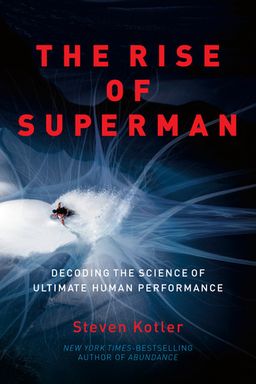
What if your best work didn’t require more grit or talent—but a different state of mind? In Flow and the Architecture of Human Potential, Steven Kotler and Jamie Wheal argue that the ability to control attention and access flow—the state where you feel and perform your best—is the central human upgrade. Flow isn’t reserved for Olympians or artists; it’s a learnable condition where action and awareness merge, effort vanishes, and performance spikes. The book explores how action and adventure athletes became the accidental research subjects revealing what’s possible when you engineer this state deliberately.
What Flow Is and Why It Matters
Mihaly Csikszentmihalyi coined “flow” after interviewing people across disciplines who described the same sensation: a merging of action and awareness, loss of self-consciousness, and altered perception of time. Kotler and Wheal extend that framework—showing that what once sounded mystical now maps to identifiable neurobiology. Flow amplifies performance, creativity, and learning. For Danny Way, Laird Hamilton, and Dean Potter, it wasn’t optional; flow was a survival tool. In your daily life, it works just as reliably, enhancing focus and meaning through clear conditions.
The Scientific Mechanisms Behind the Magic
Flow correlates with identifiable shifts in brainwave states—smooth transitions from beta (focused thought) down through alpha and theta (relaxed awareness and intuition) and up to gamma bursts (sudden insight). Leslie Sherlin’s EEG research with elite athletes shows these transitions as the signature of mastery: seamless cognitive adaptation that allows instantaneous decision-making. At the same time, Arne Dietrich’s concept of transient hypofrontality explains the “loss of self”—your prefrontal cortex quiets, silencing inner criticism and enabling creative intuition.
The Neurochemical Cocktail and the Motivation Loop
Flow pours out dopamine, norepinephrine, endorphins, anandamide, and serotonin—five chemicals that together create deep pleasure, pain resistance, and pattern recognition. These same chemicals underlie addiction, which explains why people risk everything chasing flow. Yet when channeled properly, this chemistry becomes a virtuous loop: dopamine enhances exploration, norepinephrine focuses attention, anandamide encourages creative connections, and serotonin sustains post-flow contentment.
Triggers: How You Enter the State
Flow isn’t random. Kotler identifies conditions that act as “triggers.” Internal triggers—clear goals, immediate feedback, and a balanced challenge-to-skill ratio—tighten attention. External triggers like risk, novelty, and embodiment activate neurochemistry. Mandy-Rae Cruickshank’s Freedive world records, achieved by micro-goals such as counting kick cycles, illustrate how structure and attention collapse into presence. In contrast, the chaotic richness of Teahupoo’s waves or Yosemite’s granite walls show how complex environments force intense focus. Whether risk is physical or psychological, it drives the attention necessary for flow.
The Broader Narrative
This book isn’t just about athletes—it’s about the evolution of human performance. Flow accelerates learning, compresses the 10,000-hour rule, fuels creativity, and builds community. It also carries a cautionary note: the same chemistry that lifts you can destroy you when chased recklessly. The freeride movement and the Red Bull Air Force illustrate both sides—innovation born from risk and tragic loss from escalation. The authors end with vision: technology, neurofeedback, and culture are converging so future generations can train flow as systematically as physical fitness.
Core takeaway
Flow is not a mystical gift—it’s a biological skill. When you learn how to trigger, sustain, and recover from it, you unlock the architecture of human potential that drives peak performance, creativity, and purpose.
Across vivid stories—from McConkey’s experiments to brain labs and Flow Dojos—the book reveals one continuous truth: mastery, happiness, and innovation share the same neurophysiological pathway. Learn flow, and you learn the blueprint of human greatness.