
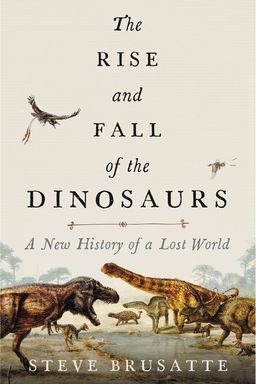
The Rise and Fall of the Dinosaurs cover

The Rise and Fall of the Dinosaurs

by Steve Brusatte

In ''The Rise and Fall of the Dinosaurs,'' Steve Brusatte takes you on a thrilling exploration of the prehistoric world. Discover how dinosaurs ruled for millions of years, evolving into a myriad of forms before a cataclysmic event ended their reign. Uncover how their legacy continues today in the form of birds, and learn about the scientific discoveries that illuminate their fascinating history.

Dinosaurs and the Evolutionary Story of Life

What does it mean when you learn that birds are dinosaurs and that many of Earth’s past crises mirror those of today? In Steve Brusatte’s synthesis of paleontological discovery, you see how dinosaurs aren’t dead relics—they’re dynamic players in the ongoing story of life. His narrative weaves anatomy, climate, catastrophe, and technology to reveal how evolution unfolds across deep time through both destruction and renewal.

From catastrophe to creativity

The book begins in the ashes of global catastrophe—at the end of the Permian, when over 90 percent of species perished after massive Siberian eruptions. It is a moment of planetary reset. From that devastation, new ecological vacancies invited survivors to reinvent themselves. Among those survivors arose the archosaurs, whose upright posture and efficient lungs would become the blueprint for dinosaurs. This cyclic pattern—collapse followed by innovation—threads throughout Brusatte’s storytelling, reminding you that change drives evolution’s greatest leaps.

The rise under Triassic skies

As you move through the Triassic, Brusatte situates the first dinosaurs against the massive backdrop of Pangea: a world of monsoons, droughts, and climate extremes. Ischigualasto in Argentina and Ghost Ranch in New Mexico become windows into the early ecological experimentation—tiny upright dinos among sprawling crocodile cousins. Their tracks in Poland (Prorotodactylus) and skeletons like Herrerasaurus show innovation in locomotion and metabolism long before dinosaurs conquered global ecosystems. At first provincial and hemmed in by climate bands, they rose gradually through opportunity shaped by environmental turnover.

Catastrophe as evolutionary catalyst

Dinosaurs seized dominance only after another upheaval—the end-Triassic volcanism that split Pangea and unleashed the Central Atlantic Magmatic Province. The resulting extinction wiped out rival archosaurs, enabling dinosaurs to thrive. Brusatte emphasizes that success here wasn’t pure superiority; it was timing and adaptation after crisis. Morphological disparity studies show pseudosuchians were once more diverse—until catastrophe redrew the ecological map. Earth’s volatility, not perfection of design, determined who survived.

Innovation, adaptation, and longevity

You follow evolutionary creativity as dinosaurs diversify—from sauropods mastering gigantism through pneumatic bones and air sacs, to theropods evolving feathers and color. These adaptations reveal how biology answers environmental constraint with structural innovation. CAT scanners and photogrammetry, tools woven throughout Brusatte’s fieldwork, deepen this picture—turning ancient bones into data on motion, brain capacity, and coloration. Dinosaurs, once mythic monsters, become visible as real, measurable animals capable of adaptation over 150 million years.

The birds among us

Brusatte’s key idea—that birds are dinosaurs—reconnects the ancient past to modern life. From feathered fossils in Liaoning to the winged display behaviors of non-flying giants, the evolutionary path becomes clear: feathers originated not for flight but for insulation and spectacle, later repurposed for aerodynamics. When you watch a sparrow or a hawk, you glimpse living dinosaurs. The continuity of anatomical and physiological traits—from air-sacs to rapid growth—shows that extinction didn’t end the lineage; it redirected it.

The fall and rise of worlds

The book culminates in the K-Pg impact—a moment of instant ruin and long recovery. The asteroid near Chicxulub ended dominance but triggered resurgence. Mammals occupy the storytelling’s final act, their small, flexible bodies advantaged in post-impact ecological chaos. Brusatte draws an explicit warning: the planet’s history of extinction by environmental stress echoes current climate concerns. Evolution thrives on change, but resilience depends on adaptability and scale.

A living science and moral parallel

Through the lens of modern tools—CT scans, computer modeling, melanosome mapping—paleontology becomes a living science, one that reveals the mechanisms of change rather than just lists extinct names. For you as a reader, Brusatte’s synthesis is both a guide to life’s resilience and a mirror of our own ecological moment. The fossil record’s pattern is unmistakable: crisis creates opportunity, adaptation defines survival, and dominance never guarantees endurance. The dinosaurs’ story becomes Earth’s story—and, by extension, yours.


Catastrophe and Renewal

At the heart of evolution lies catastrophe. Brusatte begins with the end-Permian mass extinction — Earth's most dramatic collapse — to show how destruction paves the way for innovation. The Siberian Traps erupted for hundreds of thousands of years, blanketing continents in basalt and choking climates with carbon dioxide and methane. The cascading effects — ocean acidification, suffocating temperatures, and ecological collapse — killed roughly 90 percent of species. Life nearly ended.

Aftermath and invention

Yet from that devastation came opportunity. When ecosystems cleared, survivors evolved into new lineages. Archosaurs — upright reptiles with efficient lungs — emerged from this vacuum. Brusatte and Niedźwiedzki describe Polish rocks showing exactly where the transition occurred: from barren sediments to new trackmakers pressing footprints into Triassic mud. In those prints, you witness the shift from the sprawling gaits of Permian reptiles to erect postures — the anatomical prequel to dinosaurs.

Time scales of recovery

Recovery was not instant; it took millions of years for ecosystems to stabilize. Brusatte stresses that Earth's systems have memory, and large-scale perturbations leave prolonged biological scars. When life rebuilt itself, its architecture had changed — dinosaurs and their kin emerged as vertical runners, high-metabolism creatures capable of exploiting new niches. Catastrophe thus acts as an evolutionary reset button, reshaping both the cast and the script of life's drama.

Parallel lessons today

You come away understanding extinction as both an ending and a beginning. Brusatte’s message resonates beyond prehistory: greenhouse crises can swiftly flip Earth systems, and today's climate changes echo ancient warnings. Evolution's creative bursts often start at its edges — survivors reshaping a broken world — and that interplay between destruction and innovation recurs throughout the book’s arc.


Origins and Adaptations

How did small Triassic archosaurs evolve into vast Jurassic ecosystems? Brusatte builds that bridge by following tracks and bones from Poland to Argentina. At sites like Stryczowice and Ischigualasto, fossils tell the step-by-step origin of dinosauromorphs: animals transitioning from small, quick walkers with erect limbs to fully fledged dinosaurs.

Tracks as behavioral fossils

Footprints preserve motion more vividly than bones. Narrow, digitigrade trails with tucked limbs reveal an evolutionary experiment in efficient gait and posture. Brusatte explains how these footprints—Prorotodactylus—reveal the physics of early upright walking: balanced center of gravity, reduced twisting ankles, faster stride. From there, Argentine fossils like Herrerasaurus and Eoraptor confirm skeletal blueprints of the first dinosaurs — flexible hips, long legs, hollow bones.

Dating the dawn

Brusatte confronts the difficulty of knowing exactly when dinosaurs appeared. Sedimentary rocks rarely carry datable minerals, so paleontologists like Arthur Holmes pioneered indirect radiometric techniques using volcanic layers bracketing fossil beds. This precision reveals dinosaurs emerging nearly simultaneously across continents — not instantly, but through scattered evolutionary experiments.

Gradual global takeover

From these beginnings, dinosaurs expanded unevenly. Pangea’s intense seasonal patterns confined them geographically at first; they thrived in humid bands rather than deserts. As climates moderated, they spread farther, replacing amphibian giants and crocodile relatives. Brusatte’s regional contrasts — Portugal’s amphibian mass graves versus Argentina’s rising dinosaur fauna — demonstrate how climate and geography guided evolution’s early steps.


Volcanoes and Dominance

The next geological flip—at the end of the Triassic—redefined who ruled the land. Brusatte vividly describes fissure eruptions that tore Pangea apart, flooding continents with molten basalt and carbon dioxide. These eruptions triggered mass extinction and global warming. Out of this convulsion, dinosaurs surged into dominance.

Reading rifts

Field sites like the Newark Basin and Palisades Sill preserve lava layers and fossil footprints spanning this transition. Paul Olsen’s work tracking dinosaur footprints through those layers shows abundance explosions following eruptions. Dinosaurs leap from minority to majority in the fossil record just as rival pseudosuchians vanish. Brusatte quantifies this shift through morphospace analysis: before extinction, crocodile-line reptiles had greater anatomical diversity; after, dinosaurs filled the vacant ecological space.

The paradox of advantage

Mass death became opportunity. Dinosaurs didn’t win because they were intrinsically superior; they won because catastrophic conditions eliminated competitors. This pattern echoes earlier Permian recovery and later Cretaceous collapse. Dominance itself is transient—contingency, not perfection, dictates biological fate.

Ecological message

Brusatte’s geological storytelling reminds you that environment drives evolution as forcefully as genetics. When continents shift and climates burn, survival favors adaptability over strength. Dinosaurs’ rule emerged from Earth’s instability—a lesson mirrored in all evolutionary epochs.


Anatomy of Greatness

Dinosaurs achieved extraordinary physical extremes, and Brusatte turns anatomy into a study of biological engineering. Sauropods represent colossal innovation; tyrannosaurs embody mechanical precision. Together they reveal evolution’s capacity for structural mastery.

Sauropod gigantism

Brusatte walks you through the recipe for size: elongated neck vertebrae, rapid growth, bird-style air-sac lungs, and pneumatic bones. These traits allowed sauropods—from Diplodocus to Patagotitan—to reach weights exceeding fifty tons while staying mobile. On Scotland’s Isle of Skye, sauropod trackways show herd movement across lagoons, demonstrating behavioral complexity. (Note: Karl Bates and Peter Falkingham’s photogrammetry supports size estimates consistent with these tracks.)

Design of predators

Tyrannosaurs represent the other extreme—power concentrated into efficiency. From feathered forebears like Dilong and Guanlong to bone-crunching T. rex, you see gradual refinement of skull architecture and muscle leverage. CT scans by Larry Witmer and finite-element analyses by Emily Rayfield show reinforced skulls optimized for puncture-pull feeding. T. rex’s tooth and jaw design created bite forces sufficient to crush bone without self-damage.

Growth and life history

Greg Erickson’s bone-ring analyses uncover that T. rex grew explosively, maturing within three decades. Thomas Carr’s skull studies show how youths were sprinters, adults were ambushers—a reflection of ecological niche partitioning through life stages. You learn that dinosaurs were dynamic, developing and adapting at different ages to distinct hunting strategies.

Evolutionary engineering

Across both herbivores and carnivores, Brusatte’s central anatomical insight holds: evolution innovates by recombining existing parts—light bones, lungs, muscles—into new solutions for size and power. Dinosaurs achieved feats of physiology that remain unparalleled among land animals, proving adaptation’s creative reach.


Science Behind the Fossils

Behind every sweeping evolutionary claim lies a revolution in tools. Brusatte illustrates how modern paleontology merges technology with fieldcraft, turning fossils into data-rich archives of movement, growth, and behavior.

Scanning inside life

CT scans by researchers such as Larry Witmer and Amy Balanoff reveal internal anatomy: olfactory bulbs, semicircular canals, brain shapes. These datasets allow inference of senses and agility, transforming skulls into maps of perception. Tyrannosaurs’ enlarged olfactory bulbs show capacity for acute smell, while birdlike air-sacs trace evolutionary respiratory efficiency.

Simulations and models

John Hutchinson’s computer reconstructions calculate muscle volume and limits of locomotion. Such modeling corrects myths—proving T. rex was not a sprinting racer but an ambush predator capable of explosive bursts. Karl Bates and Peter Falkingham’s 3D photogrammetry complements this by estimating volume and mass. Together, digital and physical methods move dinosaurs from imagination to measurable reality.

Field precision

Technology depends on meticulous excavation. Brusatte’s account of the Burpee Museum dig underscores mapping, plastering, and documentation as essential scientific rituals. You see paleontology as collaborative craft—equal parts digital and dirt. The result: fossils become contextual stories, not isolated specimens, allowing reconstructions grounded in environment and social behavior.


Feathers, Flight, and Continuity

The realization that birds are living dinosaurs revolutionized both biology and imagination. Brusatte narrates how evolutionary continuity connects Zhenyuanlong’s feathered body to the pigeon outside your window.

Origins of feathers

Feathers began not as flight tools but as insulation and display. Fossils from Liaoning—Sinosauropteryx, Microraptor, Yutyrannus—document stages from filaments to branching quills. Jakob Vinther’s melanosome studies add color to this transformation, proving many dinosaurs wore vibrant, patterned coats. Darla Zelenitsky’s discovery of winged but flightless ornithomimosaurs supports a display-first hypothesis.

Multiple paths to flight

Microraptor’s four-winged form and Yi qi’s membranous structures show evolution experimenting with aeriality. Some glided, some flapped weakly, some only showed off feathers. Archaeopteryx anchors the lineage where display turned to flight. (Note: John Ostrom’s Deinonychus research revived this dinosaur-bird connection in the 1970s.)

Birds as surviving dinosaurs

What you conclude is striking: all birds descend from theropod dinosaurs that combined feathers, air-sacs, and rapid growth long before flight evolved. Every modern robin and crow carries the biological legacy of those experiments. The lineage survived extinction and diversified anew, illustrating evolution’s continuity across catastrophe.


Extinction and Survival

The book’s climax transports you to the most famous death of all: the asteroid impact that closed the Cretaceous. Brusatte reconstructs it as a day of apocalypse followed by millennia of recovery.

Evidence of impact

From Walter Alvarez’s iridium anomaly to the Chicxulub crater’s buried scar, the data converge. Shocked quartz, glass spherules, and tsunami layers confirm the collision. Immediate effects included firestorms and darkness as soot blocked sunlight; subsequent cold and food-chain collapse destroyed most dinosaurs not already declining. Computer models show ecological destabilization cascaded through herbivore and carnivore networks.

Deccan and debate

Brusatte acknowledges competing hypotheses—the role of India’s Deccan volcanism and long climate shifts—but consensus argues for the asteroid as primary cause. Volcanic CO2 exacerbated the warming aftermath, prolonging instability. The extinction was instantaneous geologically and total biologically, sparing only small, adaptable survivors.

Lessons from collapse

The extinction teaches that dominance breeds vulnerability. Titanosaurs and tyrannosaurs fell not from weakness but from scale—they required dense food webs that vanished overnight. What endured—birds, mammals, crocodiles—shared traits of flexibility and smallness. Brusatte’s story becomes Earth’s cautionary tale about abundance without adaptability.


Aftermath and Evolution’s Continuity

In the post-impact world, life rebooted. Brusatte concludes with the mammals that rose in the Paleogene and with the reflections those fossils evoke for humans today.

New life from ruin

Within a few million years of the asteroid, forests reappeared and mammals diversified rapidly. Fieldwork by Tom Williamson in New Mexico reveals puppy-sized Torrejonia and other early primate relatives. These small omnivores thrived because they could burrow, reproduce quickly, and adapt diets—all survival advantages absent in dinosaurs. Evolution filled the vacancy quickly; ecological niches never lie empty for long.

Resilience and chance

The rise of mammals demonstrates both contingency and resilience. Brusatte’s message echoes Darwin’s: survival is not reward for superiority but compatibility with environment. Had the asteroid missed, our lineage might never have appeared. Chance, coupled with adaptability, defines evolutionary success.

A mirror to the present

Ultimately, Brusatte turns the fossil record into reflection: ecosystems can flip fast, dominance can vanish, and adaptability ensures continuity. By embedding dinosaurs within the broader story of life’s endurance, he offers both scientific synthesis and environmental perspective—past lessons for a changing planet.

Dig Deeper

Get personalized prompts to apply these lessons to your life and deepen your understanding.

Go Deeper

Get the Full Experience

Download Insight Books for AI-powered reflections, quizzes, and more.