
Idea 1
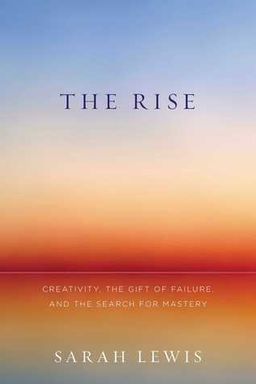
The Rise: The Gift of Failure and the Pursuit of Mastery
How do you respond when life knocks you down—when your plans go awry, when success slips through your fingers, and all that remains is the echo of effort? In The Rise, Sarah Lewis invites you to see those moments not as defeats but as starting points. She argues that failure, far from being an endpoint, is often the foundation of creativity, resilience, and mastery. To rise, she contends, is not simply to overcome failure—it is to use it as fuel for transformation.
Lewis builds her thesis around a deceptively simple idea: what we call failure is often just the gap between where we stand and where we hope to be. That gap, that stretch between mastery and incompletion, contains our most fertile ground. Through stories of artists, scientists, explorers, and athletes—from Michelangelo to Andre Geim, from Paul Taylor to Ben Saunders—she reveals how 'the rise' itself, not the victory, defines real excellence. Failure becomes an act of becoming—an unfinished masterpiece that forever propels the creator forward.
Rethinking Success
Lewis asks a provocative question: what if success isn't the pinnacle but the beginning of decline? In modern culture, mastery often masquerades as perfection—a static state achieved by a select few. Lewis dismantles that notion, showing how true mastery is dynamic, iterative, and rooted in humility. Michelangelo’s struggles while painting the Sistine Chapel, Cézanne’s endless revisions, and Faulkner’s obsessive rewriting illustrate that greatness resides not in a final product but in the perpetual striving toward vision. These figures understood that incompletion is not failure—it is the heart of genius.
At its core, The Rise redefines creativity as a process of conversion. Every artist, innovator, or maker faces the curve of effort—the painful but generative tension between intent and result. This is the 'archer’s paradox' that Lewis introduces in her opening chapter at Columbia University’s archery field: an arrow must aim slightly off-center to strike true. The act of hitting the mark requires displacement and correction, not flawless precision. Likewise, our own growth demands deviation and course correction. Each failure, each near miss, reshapes the self that is trying to create.
Failure as a Catalyst
Drawing from psychological studies and real-world examples, Lewis introduces a new emotional lexicon for failure. Rather than shame, failure can foster clarity; rather than loss, it can ignite purpose. Duke Ellington loved his next composition most—the one he hadn’t yet written. Einstein confessed his mathematical shortcomings to a schoolgirl, turning vulnerability into connection. Polar explorer Ben Saunders risked his life to complete Robert Falcon Scott’s unfinished trek to the South Pole, discovering that surrendering to fear unleashed unforeseen strength. Each of these individuals reframed difficulty as discovery, turning defeat into momentum. (As in Carol Dweck’s concept of a 'growth mindset,' Lewis expands failure into a lifelong practice of learning—continuous, adaptive, and rooted in curiosity.)
The Arc of Creativity
Lewis argues that creativity itself demands failure. Artistic and scientific breakthroughs often begin in what she calls 'the crucible'—the pressure zone where expectations collapse and imagination ignites. She juxtaposes the choreographer Paul Taylor’s disastrous 1957 performance, which earned only blank reviews, with Andre Geim’s 'Friday Night Experiments,' playfully reckless trials that led him to levitate a frog—and eventually win the Nobel Prize. Through these stories, Lewis reminds you that progress rarely comes from stability. It emerges from experiments that flirt with absurdity, yet generate insight. Failure gives coherence to exploration; it forces creators to ask better questions.
Why The Rise Matters
Lewis situates 'the rise' in a wider cultural argument: we have become obsessed with perfection at the expense of perseverance. Schools reward correctness over curiosity; workplaces prize flawless execution over risk. But the creative heart beats in uncertainty. Lewis shows that mastery unfolds through deliberate practice, grit, play, and humility—the ability to be both expert and amateur, confident yet open to failure. Echoing Angela Duckworth’s research on grit and Mihaly Csikszentmihalyi’s work on flow, she contends that enduring discomfort is the price of real achievement. You rise by falling forward—by meeting defeat with attention instead of avoidance.
What You’ll Learn
Across Lewis’s beautifully structured chapters, you’ll learn how failure shapes creative and moral growth. You’ll encounter the paradox of mastery, the discipline of surrender, the influence of aesthetic force on justice, and the playful humility behind innovation. You’ll see why critiques, blank pages, and near wins often matter more than triumphs themselves. By the end, Lewis leaves you with the haunting image of Mizuta Masahide’s poem: 'My barn having burned down, I can now see the moon.' In loss, there is clarity; in failure, illumination.
Ultimately, The Rise is not a celebration of hardship for its own sake—it is an invitation to reframe how we live. To rise is to recognize that our unfinished selves, like Michelangelo’s rough-hewn stone figures, are already moving toward greatness. Failure is not the opposite of success. It is the foundation of art, wisdom, and the human spirit’s enduring ascent.