
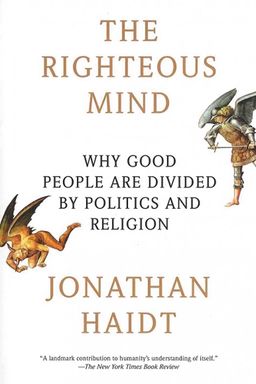
The Righteous Mind cover

The Righteous Mind

by Jonathan Haidt

The Righteous Mind delves into the intricacies of moral judgment, revealing how emotions and intuition shape our beliefs more than logic. Jonathan Haidt''s extensive research uncovers the universal foundations of morality and how they divide and unite us across cultures and political landscapes.

The Righteous Mind: Why Good People Divide

Why do intelligent, kind people reach opposite moral and political conclusions and then struggle to understand each other? In The Righteous Mind, psychologist Jonathan Haidt argues that moral judgment is not primarily a product of reasoning but of intuition, evolved to bind individuals into cooperative groups and to justify themselves within those groups. The book’s unifying claim—summed up in Haidt’s phrase “intuitions come first, reasoning second”—explains both everyday political polarization and the evolutionary origins of morality.

Across three interconnected parts, Haidt takes you from the inner workings of the moral mind to the structure of moral diversity, and finally to how morality both unites and divides communities. He weaves together philosophy (Hume, Durkheim), neuroscience (Damasio, Greene), anthropology (Shweder), and social psychology.

Part I: Morality as Intuition—The Elephant and Rider

Haidt begins by dismantling the rationalist assumption—common in moral theories from Kant to Kohlberg—that moral reasoning drives moral behavior. Using the metaphor of a rider (reason) atop an elephant (intuition), he shows that moral judgments emerge instantly and emotionally, with reasoning used afterwards to justify or signal virtue. Experiments on “harmless taboos”—a family eating its dead dog, or a man using a dead chicken in a sexual act before cooking it—demonstrate what Haidt calls moral dumbfounding: our inability to explain emotional condemnations that feel self-evident.

Neuroscience supports this: patients with damaged emotional centers (vmPFC) may reason flawlessly but make catastrophic moral and social choices. Functional MRIs of people solving personal versus impersonal dilemmas reveal distinct emotional activation. These findings show emotional intuition as the fountainhead of moral life, while reasoning functions more as post hoc spokesperson or press secretary than as judge.

Part II: Morality as Taste—Six Evolutionary Foundations

Building on cultural psychologist Richard Shweder and evolutionary theory, Haidt identifies six innate “moral taste receptors” that cultures tune into local moral cuisines: Care/harm, Fairness/cheating, Loyalty/betrayal, Authority/subversion, Sanctity/degradation, and Liberty/oppression. These moral foundations arise from adaptive challenges—protecting children, building coalitions, coordinating hierarchies, and avoiding disease. Cultural variation emerges as cuisines built from the same limited set of moral ingredients.

Haidt’s Moral Foundations Questionnaire (with Jesse Graham, Brian Nosek, and others) reveals a robust political pattern: liberals emphasize Care, Fairness (as equality), and Liberty; conservatives draw on all six foundations more evenly, valuing Loyalty, Authority, and Sanctity alongside Care and Fairness. The result, Haidt argues, is a “conservative advantage” in moral persuasion—conservatives speak a broader moral language, while liberals often dismiss moral flavors they don’t personally value.

Part III: Morality as Group Glue—How Morality Binds and Blinds

In its third movement, the book extends morality from the individual to the group. Humans, Haidt writes, are “90% chimp and 10% bee.” That 10% explains why religion, nationalism, and ritual can provoke powerful collective emotions. Through multilevel selection and gene–culture coevolution, tribes that cooperated more successfully outcompeted others. Experiments from Muzafer Sherif’s Robbers Cave to Ernst Fehr’s public-goods studies confirm humans’ instinct to form groups, and to punish defectors even at personal cost.

Morality therefore strengthens cooperation but also blinds groups to outsiders and rival moral matrices. You see this tension in religion (as both social glue and exclusionary force) and politics (as tribal warfare of moral sentiments). Haidt’s metaphor of the “hive switch” captures your capacity to lose the individual self in transcendent, groupish unity—through awe, ritual, or shared purpose. That same hive mechanism can produce both peaceful solidarity and dangerous fanaticism.

Toward Moral Humility and Civil Politics

Haidt concludes by urging moral humility: recognize that each moral matrix expresses partial truths, constrained by evolved foundations. Liberals promote compassion and reform; conservatives preserve stability and moral capital—the social infrastructure that sustains cooperation. Society needs both tendencies in balance. To transcend polarization, you must learn to speak in others’ moral languages, address intuitions before arguments, and reform institutions that reward demonization.

In short, The Righteous Mind offers not just a theory of morality but a practical guide to coexistence. To understand others, Haidt insists, begin with their elephants, not their riders.


Intuition and the Moral Mind

At the heart of Haidt’s psychology lies a vivid image: your moral mind is an elephant guided by a tiny rider. The elephant represents deep, automatic intuitions shaped by evolution and emotion; the rider represents reasoning that justifies, not drives, moral judgment. You don’t reason your way to moral conclusions—you feel your way, then explain them.

Moral Dumbfounding and the Power of the Gut

In classic studies, Haidt asked people about “harmless taboos” such as siblings consenting to sex or families eating their dead pet. Most respondents quickly declared these acts wrong but struggled to explain why when harm was absent. They felt moral revulsion first, and reasoning followed to defend the feeling. Haidt called this pattern moral dumbfounding: the mind gropes for logic to rationalize a gut sense of right and wrong.

Neuroscience and Emotion

Antonio Damasio’s work on patients with damaged ventromedial prefrontal cortices shows that cold reasoning alone fails to guide real-world decision-making: people with intact logic but blunted emotion make dangerous, erratic choices. Joshua Greene’s fMRI scans of participants faced with moral dilemmas find distinct emotional networks igniting when decisions involve direct harm—confirming that emotions are central to moral cognition rather than side effects of reasoning.

Reasoning as Social Strategy

If intuition calls the shots, what is reasoning for? Haidt compares it to a press secretary: a savvy explainer who builds coherent narratives for the elephant’s choices. Studies by Peter Wason, Deanna Kuhn, and Dan Ariely all document how people generate biased “my-side” arguments and even deceive themselves to protect moral self-image. Philip Tetlock’s metaphor of people as intuitive politicians reinforces this: we argue to please audiences, not pursue truth.

Recognizing this pattern can make you a better communicator and thinker. If you want to sway opinions, appeal to intuition first—through empathy, stories, and shared experiences—then bring reasoning to consolidate trust. If you want to think more honestly, diversify your audiences and incentives for accuracy. In moral conversations, elephants lead; riders catch up.


Moral Foundations as Taste Receptors

Imagine your moral sense as a tongue with multiple taste buds—not for sweetness and saltiness but for moral flavors. Haidt’s Moral Foundations Theory identifies six such receptors that evolved to detect recurring social challenges and that cultures recombine into moral cuisines.

The Six Foundations

  • Care/harm: compassion and protection of the vulnerable.
  • Fairness/cheating: reciprocity, proportionality, and justice.
  • Loyalty/betrayal: solidarity with one’s group.
  • Authority/subversion: respect for legitimate hierarchy and order.
  • Sanctity/degradation: purity, disgust, and the sacred.
  • Liberty/oppression: resistance to domination and control (later added to capture modern equality movements).

Each foundation reflects adaptive pressures in human evolution: nurturing children, managing coalitions, or avoiding disease. Richard Shweder’s earlier framework of autonomy, community, and divinity ethics inspired Haidt to broaden morality beyond the harm principle dominant in WEIRD psychology.

Cultural and Political Variations

Cross-cultural and class-based research in Brazil, India, and the U.S. shows that elite Westerners emphasize individualistic foundations (Care and Fairness) while others moralize loyalty, authority, and purity. Liberals, measured by the Moral Foundations Questionnaire, exhibit a three-foundation morality centered on harm, fairness, and liberty, whereas conservatives draw upon all six. This “moral palate” difference explains why conservative messages resonate widely: they appeal to a broader array of moral intuitions, while liberal appeals often seem narrow or technocratic.

For you, this model offers a diagnostic tool: when you observe moral outrage, ask which foundation it touches, and when you aim to persuade, engage the moral receptors of your audience. You can’t change another’s taste by argument alone—but you can offer new moral recipes.


The WEIRD Problem and Moral Diversity

Most moral psychology has been built on the narrow experiences of WEIRD—Western, Educated, Industrialized, Rich, Democratic—populations. Haidt demonstrates that these societies are psychological outliers, especially in moral reasoning. Scholars like Lawrence Kohlberg and Elliot Turiel interpreted morality through the lens of rational, autonomy-based justice. But anthropologist Richard Shweder’s fieldwork in Orissa, India, shattered that view: Oriyans moralize purity, duty, and community concerns that Westerners see as mere convention.

Cross-Cultural Moral Maps

Haidt’s own research in Brazil and the U.S. extended Shweder’s insights. Working-class and non-Western participants frequently judged non-harmful but impure acts as universally wrong, showing that moral domains are culturally structured. WEIRD elites, by contrast, rely almost exclusively on harm and fairness judgments. This diversity underscores that morality is not a universal code but a family of intuitions shaped by ecology, religion, and social structure.

Why It Matters

When moral theories ignore loyalty, authority, and sanctity, they mistake a parochial subset of morality for human nature itself. This misunderstanding fuels political and global miscommunication: secular Westerners often regard traditional moralities as irrational or oppressive, while traditionalists see liberals as cynical or rootless.

Recognizing WEIRD bias helps you appreciate moral pluralism. Morality, Haidt argues, is like cuisine: built from the same ingredients but cooked into profoundly different flavors. Cross-cultural humility is the starting point for cross-cultural understanding.


Sanctity, Purity, and the Sacred

Among Haidt’s six foundations, Sanctity or Purity is the most contested in modern secular societies. Yet it is also among the oldest and most powerful. Originating in pathogen avoidance, disgust evolved as an emotional guardrail against contamination—not only physical but symbolic. Haidt traces how this visceral defense transformed into moral and spiritual notions of the sacred.

From Dirt to Divinity

As the omnivore’s dilemma forced humans to sample new foods with caution, disgust evolved to shield from toxins. Then it generalized: bodily purity became social purity. Food taboos, sexual restrictions, and rituals of cleanliness spread, amplified by religion. Modern experiments demonstrate the link—people judge moral infractions more harshly when reminded of physical disgust (such as foul smells or dirty environments). This psychological bridge explains why purity norms dominate religious and political taboos across cultures.

When Harm Isn’t the Issue

Cases like the German cannibal Armin Meiwes, who killed and ate a consenting participant, expose the limits of harm-based ethics. Even without victims, society senses violation through the sanctity foundation—a degradation of human dignity itself. The outrage stems not from harm but from desecration of what feels sacred.

In politics, sanctity underlies debates on abortion, sexuality, and biotechnology. Conservatives often tap this foundation explicitly (“sanctity of life”), while liberals tend to reframe or ignore it. Haidt advises you not to dismiss purity intuitions but to understand their psychological roots and rhetorical power. Moral persuasion and coexistence require taking disgust seriously.


Groupishness and the Hive Switch

If earlier chapters focus on moral taste buds, the later sections explain why you care so fiercely about your group’s moral cuisine. Humans evolved remarkable groupishness: a capacity to cooperate, conform, and sometimes transcend individuality for the collective. Haidt’s “90% chimp, 10% bee” formula captures this paradox—self-interest tempered by group identity.

Multilevel Selection and Fast Evolution

Darwin speculated that tribes with cooperative members would outcompete selfish ones. Modern biology, from David Sloan Wilson to Michael Tomasello, supports a nuanced version of this view called multilevel selection. Shared intentionality allowed humans to form joint goals—“we build”—a crucial social revolution. Combined with rapid gene–culture coevolution, this explains how moral dispositions like loyalty and self-sacrifice could arise and spread within historical timeframes.

Experiments such as Dmitri Belyaev’s fox domestication and William Muir’s chicken group selection prove that cooperation can evolve quickly when groups, not individuals, face selection pressure. The traits that foster stability—trust, punishment of defectors, reverence for norms—mirror human moral tendencies.

The Hive Switch

Certain experiences can flip your “hive switch,” transforming you from an individual self into part of a moral organism. Awe, ritual synchrony, and even psychedelics dissolve boundaries of self, producing euphoria and cooperation. Haidt compares festivals, rituals, and military drills to evolutionary workouts for group cohesion. Leaders who understand this psychology can design “hivish” communities that channel belonging toward pro-social ends rather than fanaticism.

Groupishness is therefore morally double-edged: it births both the most sublime human solidarities and the most devastating tribal conflicts. The challenge is not to suppress the hive but to steer it wisely.


Religion, Moral Capital, and Civil Politics

Haidt invites you to reimagine religion as social technology—a set of shared beliefs and costly practices that generate trust, suppress selfishness, and build moral capital. While New Atheists emphasize false beliefs, Durkheim and Haidt emphasize shared belonging. Communes with costly religious commitments outlast secular communes; temples and rituals coordinate irrigation and cooperation without bureaucracy. Gods, as David Sloan Wilson puts it, are “maypoles around which people dance.”

The Value of Moral Capital

Moral capital—the web of virtues, norms, and institutions that restrain selfishness—takes centuries to build but can erode quickly. Conservative thinkers highlight its fragility; Haidt agrees that social systems relying only on rational contracts fail when trust decays. Churches, civic groups, and traditions sometimes achieve what laws cannot: internalized virtue.

Yet moral capital is not static. Excessive loyalty and sanctity can stifle innovation, while pure individualism corrodes cohesion. Societies flourish when reformers (liberals) and preservers (conservatives) balance each other. Haidt casts this as a Durkheimian utilitarianism: measure policies by their effect on social cohesion as well as individual freedom.

From Tribalism to Civility

Modern politics amplifies tribal instincts through media, gerrymandering, and ideological sorting. The cure is both structural and interpersonal: design institutions that reward cooperation and deliberately cultivate empathy. Haidt’s rule for conversation—“open hearts before minds”—summarizes this approach. Engage the other side’s moral matrix with respect, then reason together.

Moral humility, not moral relativism, is the goal. Understanding the righteous mind—your own and others’—is the first step toward building a society that binds without blinding.

Dig Deeper

Get personalized prompts to apply these lessons to your life and deepen your understanding.

Go Deeper

Get the Full Experience

Download Insight Books for AI-powered reflections, quizzes, and more.