
Idea 1
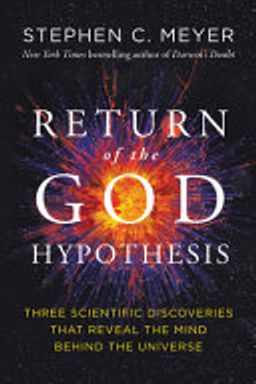
The Return of the God Hypothesis
How do you fairly weigh what the sciences say about beginnings, fine-tuning, and biological information without overreaching on metaphysics? In Return of the God Hypothesis, Stephen C. Meyer argues that three major scientific discoveries—the universe’s beginning, the exquisite fine-tuning of the cosmos, and the origin of functionally specified biological information—together make a cumulative, abductive case for a personal, transcendent cause. He invites you to compare rival metaphysical frameworks (theism, deism, naturalism, pantheism) using the same method scientists already use in historical inquiries: inference to the best explanation, sharpened by Bayesian confirmation.
Meyer does not claim a deductive proof. He asks you to compare explanatory virtues across live options, in light of empirical findings from cosmology, physics, and biology. He also shows how modern science arose within a theistic culture (Kepler, Boyle, Newton) and then shifted toward scientific materialism under the influence of Hume, Kant, Laplace, Lyell, and Darwin. The book’s wager is modest yet ambitious: if you judge worldviews by explanatory scope, causal adequacy, and parsimony, theism fits the big discoveries of modern science better than its major rivals.
Three converging evidential strands
First, cosmology now strongly favors a finite past: the expansion discovered via Vesto Slipher’s redshifts and Edwin Hubble’s distance ladder (built on Henrietta Leavitt’s Cepheids) led to the Big Bang paradigm, later cemented by Arno Penzias and Robert Wilson’s detection of the cosmic microwave background radiation (CMBR). Hawking–Penrose singularity theorems and the Borde–Guth–Vilenkin (BGV) theorem reinforce a past boundary for spacetimes on average expanding. If spacetime itself began, whatever explains it lies beyond matter, energy, space, and time.
Second, physics uncovers dramatic fine-tuning in constants and initial conditions. Fred Hoyle’s prediction of a precise carbon-12 resonance (the triple-alpha process) and Roger Penrose’s calculation of the initial entropy’s staggering specificity (roughly 1 in 10^(10^123)) exemplify how tightly many parameters must sit for life-permitting chemistry and stable structures to exist. Chance within a single universe looks implausible; deeper laws don’t eliminate the need for initial/boundary values; multiverse proposals often smuggle in new fine-tuning.
Third, biology is coded. DNA stores digitally encoded, functionally specified information that directs protein synthesis and development. Claude Shannon quantified information as uncertainty reduction, but living systems display specified information—sequences arranged to achieve functions. Work by Douglas Axe and others suggests functional protein folds are exceedingly rare in sequence space, making blind search across Earth’s history wildly insufficient. RNA-world experiments (e.g., John Sutherland; Tracey Lincoln & Gerald Joyce) show clever chemistry under heavy investigator guidance, not unbiased pathways to long, sequence-specific macromolecules. Intelligence is the only known cause that reliably produces large amounts of specified information (software, languages, codes), which is why Meyer treats design as a live explanatory candidate.
Abduction, Bayes, and comparative evaluation
Meyer relies on Charles Sanders Peirce’s abduction: if hypothesis T (theism) would make evidence E (beginning, fine-tuning, information) expectable, and rival N (naturalism) would not, then observing E confirms T over N to some degree. Bayesian language clarifies this: if P(E | T) >> P(E | N), the evidence proportionally boosts T’s posterior probability. You don’t need precise numbers to reason well; scientists routinely update credence this way (as they did when CMBR crushed steady-state cosmology).
Why the history matters
Modern science emerged where thinkers already expected an orderly, intelligible creation authored by a rational God (Boyle’s "book of nature," Newton’s divine legislator). Later, materialism consolidated after powerful naturalistic stories (Laplace’s nebular hypothesis, Lyell’s deep time, Darwin’s mechanism) plus Hume’s and Kant’s critiques of classical theism. Meyer argues that recent discoveries undercut the materialist confidence that nature explains itself without remainder, inviting a “return” to the hypothesis that helped launch science in the first place.
Scope, humility, and what follows
You’ll see Meyer contrast theism, deism, pantheism, and naturalism. Deism can explain a beginning and fine-tuning but struggles with later biological information if all information was front-loaded at t = 0 (Shannon’s noisy-channel theorem and thermodynamics predict signal decay without fresh inputs). Pantheism identifies God with the universe and so cannot precede it causally. Naturalism lacks the causal resources to initiate spacetime or generate massive specified information. Theism, by contrast, posits a personal agent who can select parameters, initiate a beginning, and, if necessary, add or preserve information within history.
Takeaway
Meyer’s case is cumulative and comparative: beginnings, fine-tuning, and biological information jointly raise the likelihood of a theistic hypothesis relative to its competitors. You don’t have to accept the conclusion to appreciate the method: weigh rival worldviews as scientists do—by explanatory fit, causal adequacy, and simplicity. (Note: This reframes “science vs. religion” as a contest of explanations, not a culture war.)