
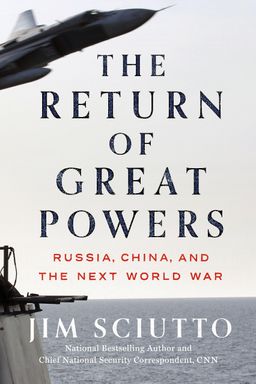
The Return Of Great Powers cover

The Return Of Great Powers

by Jim Sciutto

The CNN anchor and chief national security analyst examines shifts in the global order, including how they impact technology and the web.

Rival Powers, Broken Guardrails

Rival Powers, Broken Guardrails

How do you live and plan in a world where the safety net of the last century no longer holds? In The Return of Great Powers, Jim Sciutto argues that we have entered a structural reversal from the post–Cold War order to a multipolar rivalry among the United States, China, and Russia. He contends that the guardrails that kept crises from spiraling—hotlines, arms-control accords, and routine military contacts—are frayed or gone, even as flashpoints multiply and new technologies compress decision time. To understand the stakes, you have to see the battlefield lessons of Ukraine, the deterrence dilemmas around Taiwan, the recalibration of alliances in Europe and Asia, and the rise of contested domains—cyber, space, near space, and AI—where rules lag far behind capabilities.

From unipolar comfort to V-shaped fault lines

Sciutto asks you to shift from a 1990s mindset of U.S. primacy to a world of three centers of power that sharpen dividing lines. One axis runs across Europe—Russia vs. NATO—now stretched further by Finland’s entry and Sweden’s bid. The other runs across the Indo-Pacific—China vs. a widening web of U.S.-aligned partners. These are not abstract lines but live theaters where ships shadow each other, pilots take risky passes, and undersea infrastructure becomes a battlespace. CIA Director Bill Burns’s warning—“we’re playing without a net”—recurs throughout: channels that once managed risk have atrophied just as close encounters grow more frequent.

Guardrails frayed

“Having those kinds of channels, especially military to military, are not a favor to us or to China. It’s in both of our interests ... That, I think, doesn’t really exist today.” — Bill Burns

Ukraine: case study in miscalculation and resilience

You watch the run-up to the 2022 invasion reveal a paradox: superb intelligence—satellite imagery of battalion tactical groups, field hospitals, and communications intercepts—coexisted with a widespread failure of imagination. Many leaders and citizens, like Yana in Bucha, stayed in denial until Russian helicopters thundered overhead. Moscow’s audacity met Kyiv’s unexpected agility: Javelins, Stingers, HIMARS, and small-unit initiative flipped assumptions at Hostomel. Yet success bred new risks: as Russian losses mounted around Kherson and Kharkiv, U.S. officials measured a real risk that Putin might contemplate a tactical nuclear strike, prompting coordinated deterrent messages to Moscow and quiet pressure on Beijing and New Delhi to weigh in.

War’s new grammar: old mass, new sensors

Sciutto treats Ukraine as a live laboratory where twentieth-century massed fires meet twenty-first-century autonomy. Drones—off-the-shelf quadcopters and loitering munitions—have become ubiquitous spotters and strike platforms, while mines, trenches, artillery barrages, and armored assaults still decide ground. The decisive edge often comes not from any single technology but from adaptation speed and an industrial base that can sustain it. Early in the war the U.S. produced roughly 14,000 155mm rounds per month; Ukraine could expend that in days, forcing hard choices like supplying cluster munitions and urgent factory ramp-ups. Logistics and production become strategy, not back-office chores. (Note: Think Clausewitz updated by sensors—mass and will still matter, but information and industry are force multipliers.)

Alliances widen and middle powers hedge

Russia’s invasion galvanized NATO: a new Strategic Concept named China as a challenge for the first time; Finland joined and Sweden moved to follow, doubling NATO’s border with Russia. Across the Pacific, AUKUS and a new U.S.–Japan–ROK trilateral tightened defense and technology ties. Yet “nonmonogamous middle powers” hedge—trading and partnering across blocs—making alignments more fluid and issue-specific than the Cold War’s rigid blocs. For you, risk radiates in multiple directions: defense plans in Tallinn or Tokyo now intersect with semiconductor export controls and LNG supply chains.

New domains, thinner rules

Near space, low Earth orbit, cyberspace, and AI become new escalation ladders. A Chinese balloon at 60,000 feet forced NORAD to re-tune sensors and sparked a political firestorm that derailed diplomacy. In orbit, “kidnapper satellites” and ASAT tests threaten the satellites that power civilian life and military command. Cyber actors seed malware inside critical infrastructure for activation later. MI6’s Richard Moore calls AI an amplifier for intelligence and operations, which also shortens decision time and complicates attribution. The rules are thin to nonexistent.

The book’s promise: rules plus power

Sciutto closes by charting ways to step back from the brink: revive nuclear dialogues (now trilateral), craft norms for cyber/space/AI, and practice “constrainment” of rivals—mixing deterrence, selective decoupling in critical tech, and cooperation on shared problems. He also warns that U.S. domestic politics—up to and including a second Trump term—could unnerve allies and embolden adversaries, making “bulletproof” commitments and home-front resilience essential. For you—whether a policymaker, business leader, or citizen—the message is plain: accept that the guardrails are weaker, invest in adaptation and resilience, and help rebuild the rules that keep crises from becoming catastrophes. (In spirit, this echoes Tuchman’s Guns of August and Kennan’s emphasis on patient strategy, but adapted to drones, chips, and near space.)


Surprise in Ukraine

Surprise in Ukraine

Sciutto turns the run-up to Russia’s 2022 invasion into a tutorial on how strategic surprise happens even when warning lights flash red. By November 2021, U.S. and allied intelligence tracked Russia’s buildup: battalion tactical groups, fixed- and rotary-wing aircraft, field hospitals, logistics trains, and command nodes repositioned near Ukraine. Bill Burns flew to Moscow and returned convinced Putin was ready to move. Still, many officials and pundits downplayed the threat, a “boiling-frog” denial echoed by ordinary Ukrainians like Yana in Bucha who could not imagine a full-scale war until helicopters roared overhead on February 24.

Narratives that blind, plans that fail

The Kremlin spent years reshaping Russian historical institutions to delegitimize Ukrainian sovereignty. That story created political cover for invasion but also fed Moscow’s own illusions—that Ukrainians would fold, that Kyiv would fall in days, that Russia’s logistics could support a lightning decapitation. Instead, Hostomel became a televised humiliation for Russia’s special forces; Javelin teams, mobile air defenses, and motivated small units shattered assumptions. Western analysts had overestimated Russian combined-arms competence and underestimated Ukrainian morale and adaptability.

Phases of a grinding war

Sciutto traces distinct phases: the defense of Kyiv, rapid counterstrokes around Kharkiv, and attritional battles in the south and east. Each phase taught new lessons: empowered NCOs and decentralized command multiplied the value of Western kit; HIMARS and Storm Shadow struck deep logistics; minefields and trenches restored the lethality of massed artillery. The war’s tempo outpaced Western industry—U.S. monthly 155mm output (about 14,000 rounds then) lagged the daily burn rate—forcing hard choices including cluster munitions and multiyear production surges.

A nuclear scare—real, not rhetorical

As Russian forces risked rout near Kherson and Kharkiv, U.S. officials assessed a tangible risk that Moscow could consider tactical nuclear use. This was based on doctrine (nuclear use under certain existential conditions), battlefield pressures, and intercepted chatter. The White House coordinated deterrent messaging—public statements by the G7 about “severe consequences,” and private warnings to the Kremlin. Bill Burns met Sergey Naryshkin; India and China were quietly pressed to dissuade Moscow. Contingency plans, for the first time, contemplated direct NATO strikes on Russian forces in Ukraine if a nuclear weapon were used.

Lesson in escalation management

Private, credible warnings—paired with allied unity—can shape an adversary’s calculus even when formal arms-control channels are suspended.

Intelligence vs. decision—why we still get surprised

The paradox of Ukraine is that visibility did not equal inevitability. Satellite transparency and intercepted plans did not erase human biases—wishful thinking among some allies and myth-driven overconfidence in Moscow. You see how political narratives can overpower military reality, and how even accurate intelligence fails if leaders do not convert it into timely action. (Note: The pattern rhymes with 1914 mobilizations and 2003’s WMD fiasco, though here the intelligence was stronger and the surprise lay in leaders’ psychology.)

What this means for you

If you work in policy or business risk, treat early warning as a decision trigger, not a curiosity. Build “pre-mortems” that challenge your assumptions. Calibrate escalation ladders in advance: What messages would you send if a cornered adversary contemplated crossing a taboo? Who can influence them? The Ukraine chapters show that preparation—industrial, diplomatic, and informational—matters most before a crisis crests. Once the shooting starts, your room to maneuver narrows to inches.


War’s New Grammar

War’s New Grammar

The book frames Ukraine as a laboratory where old and new ways of war collide. You see trench lines, artillery duels, and armored thrusts—yet hovering over them are swarms of commercial quadcopters and long-loiter strike drones shaping every engagement. What wins is not technology alone but your ability to integrate sensors, shooters, and decision-making faster than your adversary, then sustain that edge with munitions and maintenance over months and years.

Drones change tactics; mass still kills

Ukrainian and Russian units use drones for ISR, artillery spotting, and direct attack. Small FPV drones drop grenades into trenches; Iranian-made loitering munitions hunt radars and power stations. Yet the heaviest toll still comes from massed artillery and mines. Lieutenant General Mark Hertling and NATO’s Jens Stoltenberg both stress a hybrid reality: “We have trench warfare…and autonomous weapons systems and unmanned drones.” The modern battlefield punishes exposure; concealment, dispersion, and deception become survival skills.

Adaptation outpaces blueprints

Ukraine’s early edge came from fast improvisation: Javelin teams ambushing armored columns; HIMARS crippling ammo dumps; small-unit leaders empowered to exploit openings. Russia, initially hampered by rigid doctrine and poor logistics, adapted too—fielding EW to jam drones, layering defenses with thick mine belts, and increasing domestic production. The competition feels Darwinian: tactics and countermeasures iterate weekly, rewarding learning organizations over rigid hierarchies. (Note: This echoes Stephen Biddle’s “modern system” updated by cheap autonomy and ubiquitous sensors.)

Industry is strategy

Munitions dictate tempo. At one point, U.S. industry produced around 14,000 155mm shells per month while Ukraine fired several thousand per day. Shortfalls forced controversial steps like providing cluster munitions and multiyear contracts to ramp output into 2025 and beyond. Stockpiles of air defenses (NASAMS, IRIS-T) and anti-armor systems (Javelin, NLAW) became strategic levers. Europe, the U.S., and partners convened “Ramstein” meetings to sequence deliveries and training, acknowledging that logistics calendars now shape battlefield calendars.

Invisible fronts: cyber, space, and seabed

Contrary to early predictions, Ukraine did not go dark. Russian cyber operations disrupted but did not collapse Ukrainian command or civilian life; defenders adapted, with help from Western tech firms and governments. Space became a lifeline—commercial constellations provided resilient communications and ISR—but also a vulnerability as states test ASAT tools and “grappler” satellites. On the seabed, undersea cables and pipelines emerged as critical arteries; NATO commanders in the Baltic track suspicious Russian activity along cable routes, underscoring a new maritime mission: protect the internet’s backbone.

Implications for you

If you plan defense or manage critical infrastructure, translate battlefield lessons into peacetime investments: drone countermeasures and EW; dispersed logistics; surge contracts for artillery and air-defense munitions; satellite redundancy; cable monitoring and rapid repair capacity. War’s grammar has expanded—any credible strategy now writes in the languages of autonomy, mass, cyber resilience, and industrial throughput.


Alliances Recharted

Alliances Recharted

Russia’s assault on Ukraine didn’t just redraw front lines; it rewrote alliance playbooks. In Europe, NATO’s 2022 Madrid Summit delivered a new Strategic Concept naming the PRC as a challenge—an unprecedented acknowledgement that Europe’s security now has a global dimension. Finland joined NATO, Sweden followed suit, and the alliance shifted from a “tripwire” posture to plans for forward, layered defense, with prepositioned equipment and higher-readiness forces.

NATO’s revival: purpose and perimeter

The alliance’s mission sharpened. Doubling its land border with Russia, NATO now fields the Very High Readiness Joint Task Force (VJTF), integrated air defenses, and expanded exercises across the Baltics and Arctic. Jens Stoltenberg, evoking a “new 1939 moment,” underlined that relative peace had ended. For frontline states like Estonia, that shift was existential: Kaja Kallas rejected the old model that tolerated initial occupation before counterattack. Forward defense is now the standard, backed by HIMARS, NASAMS, and quick-reaction brigades that move in hours, not months.

Across the Pacific: AUKUS and Camp David

In Asia, alliances evolved toward tech and industry as much as troop numbers. AUKUS binds the U.S., U.K., and Australia in a generational submarine and defense-tech partnership, while the U.S.–Japan–ROK trilateral at Camp David tightened missile-warning networks, exercises, and supply-chain coordination. The emphasis shifts from static basing to interoperable forces and resilient production—deterrence by denial, backed by shared technology. Japan deepened links with Europe through reciprocal access agreements and joint fighter development, bridging theaters once treated separately.

Hedgers and “nonmonogamous” partners

Bill Burns’s phrase—“nonmonogamous middle powers”—captures the new reality: India, Gulf states, Southeast Asian nations, and parts of Africa mix relationships with Washington, Beijing, and Moscow according to interests. They might sanction Russia lightly, buy Chinese tech, and conduct exercises with the U.S.—all at once. Economic interdependence, especially around energy and semiconductors, makes clean bloc lines hard. Expect “variable geometry” coalitions tailored to issues like food security, climate, or maritime patrols rather than universal alignment.

Why this matters to you

If you manage risk, alliances now affect freight rates, insurance, export controls, and capital flows. AUKUS reshapes shipbuilding and undersea surveillance markets; NATO’s focus on China influences Europe’s tech screening and 5G choices. For policymakers, the lesson is to bind security and industry: deterrence depends on ammunition factories, chip supply, and shared data networks as much as on tanks and destroyers. (Note: Compared to Cold War blocs, today’s coalitions ride on supply chains and software—more fragile, but also more adaptable.)

Core claim

Support for Ukraine is not regional charity but a system-level bet that deterring successful territorial conquest preserves stability in Europe and signals credibility in Asia.


Baltics to Black Sea

Baltics to Black Sea

To see the new risk environment up close, Sciutto rides with NATO’s Very High Readiness Joint Task Force in the Baltic Sea. Kaliningrad, Russia’s exclave, bristles with coastal anti-ship missiles (Bal, Bastion), air defenses, and reported Iskander systems. NATO ships and aircraft operate under strict rules—five-nautical-mile buffers, restrained responses—while Russian pilots sometimes fly without transponders and perform aggressive passes, including an inverted MiG-29 over a German vessel. Professionalism keeps peace; thin margins raise odds of miscalculation.

The quiet war for cables and pipes

Beyond the theatrics of buzzing jets, commanders point to maps of undersea cables and pipelines. Russian vessels have repeatedly scouted cable routes. The Nord Stream explosions and other incidents reinforced a grim truth: seabed infrastructure is an Achilles’ heel for economies and militaries. NATO’s maritime mission now includes surveillance of the ocean floor, protection of repair ships, and rapid restoration plans. Insurance markets and data centers should treat the seabed as a first-order risk, not an edge case.

Tripwire is dead in the Baltics

Estonia’s Kaja Kallas declares that a defense plan accepting temporary occupation is morally and politically unacceptable after Bucha and Mariupol. Western leaders, some shocked to learn that older plans could take months to contest an invasion, endorsed NATO’s pivot to forward defense—prepositioned kit, integrated air defenses (NASAMS), HIMARS, and quick-reaction brigades. The aim is to deny any fait accompli. This is deterrence measured in hours, not weeks.

Moldova: subversion over invasion

Outside NATO, Moldova shows Russia’s other playbook: covert operatives, FSB influence, and false-flag protests in a fragile state with a breakaway region, Transnistria. Zelensky publicly warned that Ukrainian intelligence intercepted plans to destabilize Moldova, echoing Russia’s prior interference in Montenegro in 2016. Expect more attempts to flip governments through disinformation, energy leverage, and street agitation rather than tanks.

Takeaways for you

If you operate in Northern Europe or the Black Sea region, plan for persistent gray-zone pressure: close military encounters, infrastructure probing, cyber intrusions, and disinformation aimed at elections. Governments should harden critical nodes, diversify energy routes, and practice rapid mobilization. Private firms—ports, telecoms, insurers—need playbooks for cable cuts and airspace closures. The frontline is now everywhere a cable lands or a pipeline comes ashore.


Taiwan’s Dilemma

Taiwan’s Dilemma

Taiwan is Ukraine’s mirror with island constraints. Sciutto takes you to the Penghu archipelago, eighty-six miles from China’s coast, where early-warning radars, anti-ship missiles, and mechanized units stand ready. Colonel Chang puts it plainly: “If you want to take Taiwan, you have to take Penghu first.” The operational problem for Beijing is immense—Gen. Mark Milley calls an amphibious seizure the most complex mission in war, a modern Normandy under the eye of satellites, drones, and long-range fires. Beijing has invested in A2/AD to push U.S. carrier groups back “over the horizon,” but complexity and casualties would still be staggering.

Porcupine defense—before the shooting starts

Taipei embraces asymmetry: mobile anti-ship missiles (Harpoon), air defenses (Stinger), coastal rockets, mines, drones, and dispersed C2 to raise the invasion price. Admiral Lee Hsi-Min warns that once a blockade or war starts, resupply becomes nearly impossible. So deterrence must be front-loaded: stockpiles, training, and hardening now. U.S. policy has inched closer—small training contingents, accelerated approvals for asymmetric kit—while Taiwan shifts procurement away from showpiece platforms toward survivable systems.

Ambiguity vs. presidential clarity

For decades, Washington practiced “strategic ambiguity” to deter both a Chinese invasion and a Taiwanese declaration of independence. President Biden, however, has repeatedly said the U.S. would defend Taiwan. Aides insist policy has not formally changed, but Gen. Milley’s maxim—“Great powers don’t bluff”—suggests you should take such statements seriously. Still, Taiwan plans as if alone: Foreign Minister Joseph Wu and Deputy Minister Jan emphasize self-reliance; Ukraine’s lesson is harsh—only winners get more help.

The “asphyxiation” alternative

Invasion is not the only path. China can throttle Taiwan through gray-zone pressure: ADIZ incursions, cyberattacks, disinformation, and maritime blockades that interrupt LNG and food imports. Congressman Jake Auchincloss and others warn about a “starve the porcupine” scenario—no Pearl Harbor moment, just daily pressure that erodes will. Cutting undersea cables or manipulating financial links could isolate Taiwan without crossing a bright red line.

Your checklist for credible deterrence

Three pillars matter: (1) Taiwan’s visible, survivable defenses and stockpiles; (2) clear international messaging—economic and diplomatic costs for aggression; (3) U.S. political will tethered to public understanding of risks and casualties (John Kelly foresees carrier losses and thousands of casualties on day one). For businesses, map exposure to a Taiwan contingency—chips, shipping lanes, insurance—and pre-plan rerouting and inventory buffers. (Note: Compared to Ukraine, the tyranny of distance makes pre-crisis decisions decisive; help blocked at sea is help denied.)


New Domains, New Ladders

New Domains, New Ladders

A single white balloon drifting over Montana showed how a tiny platform can jolt geopolitics. NORAD detected a large Chinese balloon moving from Alaska into the continental U.S.; after a political uproar and risk calculus, an F-22 used an AIM-9X to down it over coastal waters. The episode delayed Secretary Blinken’s Beijing trip and froze military hotlines. It also revealed a gap: “near space” around 60,000 feet sits between regulated airspace and outer space, where norms are murky and detection systems, tuned for missiles and jets, often miss slow movers. After retuning sensors, the U.S. shot down several additional objects, some likely benign—proof of both improved detection and a hair-trigger environment.

Space and cyber: the wild west

In orbit, states test antisatellite (ASAT) weapons, close-proximity operations, and even “kidnapper satellites” with grappling arms that can disable or tow. The commercial surge—thousands of smallsats—creates resilience but also congestion and interference risks. In cyberspace, adversaries seed U.S. and allied critical infrastructure with dormant malware to activate in crisis—power grids, ports, pipelines, and hospital networks. U.S. intelligence ranks China as the most persistent cyber espionage threat, with Russia expected to lean more on cyber as its conventional forces attrit.

AI as amplifier and accelerant

MI6 chief Richard Moore calls AI an “amplifying factor.” It accelerates intelligence fusion, target selection, and influence operations, while complicating attribution through deepfakes and automated disinformation. CIA and MI6 adapt by marrying HUMINT with AI-driven analysis, but compressed decision windows raise escalation risk—leaders face more data, less time, and higher pressure to act on ambiguous signals. (Note: This is Schelling’s coercion in fast-forward—commitments and credibility collide with algorithmic speed.)

Norms and resilience: the near-term fix

Sciutto does not promise grand treaties soon. Instead, he points to confidence-building measures: protect civilian infrastructure from cyberattack; pre-notify risky space tests; reopen military hotlines; agree on handling near-space intrusions. Meanwhile, invest in resilience—redundant constellations, hardened industrial controls, cable monitoring, and rapid repair. Intelligence during the balloon crisis suggested Xi was embarrassed and chastised PLA leaders; that human factor helped de-escalate—proof that political psychology still matters even in a sensor-saturated age.

Practical rule

In domains with thin rules, clarity beats secrecy: rapid attribution, calibrated public messaging, and limited, reversible responses lower the odds of spiral escalation.


Rules Plus Power

Rules Plus Power

The way out of this dangerous era, Sciutto argues, blends hard power with revived rules. Gen. Mark Milley’s “rule one” is stark: powerful states cannot change borders by force. Western leaders insist “we cannot lose Ukraine” because capitulating there would invite copycats elsewhere. Yet military backing needs political glue and institutional memory—especially if U.S. domestic politics swing. Former Chief of Staff John Kelly warns a second Trump term could unravel alliances (he recalls near-pullout moves from NATO), slash aid to Ukraine, and muddle signals on Taiwan. Allies scramble to build “bulletproof” guarantees and diversify ties to reduce the leverage of a single U.S. election.

Constrainment, not containment

Rather than Cold War–style containment, Kevin Rudd and Matthew Pottinger argue for “constrainment”—constrain rivals’ coercive power in critical sectors (chips, quantum, undersea) while cooperating on shared threats like climate or pandemics. Secretary Blinken’s “variable geometry” coalitions let democracies and hedging middle powers align on specific problems without choosing a bloc. The yardstick is practical: deny capabilities that enable aggression; keep doors open for problem-solving where interests overlap.

Revive arms control for a three-power world

New START’s suspension, Russian nuclear rhetoric, and China’s rapid arsenal expansion demand new formats—ultimately trilateral talks. Even modest transparency and deconfliction lower miscalculation risk. Stoltenberg reminds you that arms control is a tool of security, not charity. Nuclear signaling during Ukraine showed the cost of flying blind; rebuilding channels—military-to-military, intel backchannels like Burns–Naryshkin—creates off-ramps in crises.

Home front first

Leaders stress domestic renewal: invest in chips, energy, and ports; rebuild munitions lines; defend elections against disinformation; explain costs to citizens. Deterrence credibility depends on social cohesion and industrial muscle as much as on carrier groups. For you, that means supporting policies that shorten supply chains for critical goods, funding infrastructure hardening, and sustaining bipartisan backing for alliances. (Note: This is Kennan’s insight updated—contain adversaries’ worst impulses by making your system outcompete, not just outgun, theirs.)

Your actionable checklist

  • Back “rules plus power”: enforce sovereignty norms while funding industrial and military capabilities that give those rules bite.
  • Hedge against political shocks: structure multi-year aid and basing deals that survive election cycles.
  • Invest in guardrails: reopen hotlines, codify near-space and cyber norms, and pre-negotiate crisis playbooks with allies.
  • Build resilient systems: diversify energy and chips; protect undersea cables; expand munitions capacity.

Dig Deeper

Get personalized prompts to apply these lessons to your life and deepen your understanding.

Go Deeper

Get the Full Experience

Download Insight Books for AI-powered reflections, quizzes, and more.