
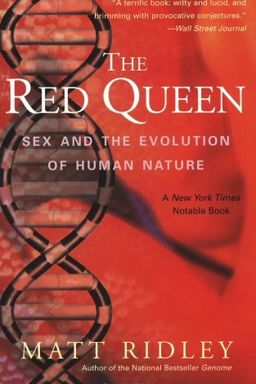
The Red Queen cover

The Red Queen

by Matt Ridley

The Red Queen delves into the evolutionary forces driven by reproduction rather than mere survival, unraveling the mysteries of sexual selection. Discover how these forces give rise to phenomena like human intelligence and gender differences, while offering insights into our evolutionary past and present.

The Red Queen and the Logic of Sex

Why do organisms persist with sex despite its cost? In The Red Queen, Matt Ridley builds a sweeping argument: sexual reproduction, the evolution of two sexes, and even the human mind are best understood as outcomes of endless evolutionary competition. In biology, as in Lewis Carroll’s fable, you must keep running just to stay in place. Parasites, rivals, and selfish genes continually adjust their strategies, forcing every species—including us—to adapt through genetic mixing, mate choice, and social ingenuity.

The Enigma of Sex

Ridley begins with the paradox outlined by John Maynard Smith: asexual organisms could double their reproductive rate because all offspring can bear young. Yet most complex life remains sexual. Early theorists proposed group-level benefits (species evolve faster), but genetic logic favors individual advantage. Genetic hypotheses such as Müller’s ratchet and Kondrashov’s mutation-purging model show that sex helps cleanse genomes of harmful mutations. Even DNA repair theories (Bernstein’s) suggest sex originated as a mechanism to maintain genome integrity.

The Red Queen’s Race

Ridley shifts from genetic housekeeping to ecological combat. Parasites evolve faster than their hosts because of rapid generation times. In the Red Queen model (after Leigh Van Valen), hosts must continually reshuffle their genes through sex to stay one step ahead. Empirical evidence—from Curtis Lively’s snail populations to Vrijenhoek’s topminnows—shows sexual species fare better in parasite-rich environments. Even exceptions like bdelloid rotifers strengthen the case: they survive without sex only by escaping parasites via desiccation, implying they found a different treadmill.

From Genes to Beauty and Mind

The same coevolutionary arms race applies internally: selfish genetic elements such as segregation distorters and male-killing bacteria force the genome to invent balancing systems. Recombination, separate sexes, and meiotic policing all emerge as strategies to contain genetic mutiny. Externally, sexual selection produces beauty, ornament, and cognitive sophistication. Peacock tails, widowbird feathers, and human wit are all instruments of competition—signals that combine Fisherian runaway dynamics with honest quality indicators (Zahavi’s handicap and Hamilton–Zuk parasite models).

Humans on the Treadmill

Ridley extends the Red Queen metaphor across humanity. Concealed ovulation promotes continuous mating and mate-guarding; sperm competition drives anatomical evolution; female infidelity becomes a tactic to combine reliable care with genetic quality (the Emma Bovary strategy). Power and status translate directly into reproductive rewards in polygynous systems, while democracy and social institutions constrain those biological impulses. Even parental sex allocation reflects evolutionary logic: in high-status families, sons yield higher variance in reproductive success; in low-status ones, daughters are safer genetic investments.

Runaway Brains and Culture

The Red Queen also explains why human intelligence exploded. Social competition—mind-reading, gossip, and persuasion—created selection pressure that shaped our brains. Geoffrey Miller’s “Scheherazade effect” adds a sexual-dynamic twist: impressing potential mates with creativity or wit triggered a runaway expansion of mental abilities. In Ridley’s synthesis, our minds, beauty standards, and moral codes are all recent adaptations of an ancient pattern: in a world of perpetual competition, sex and cooperation remain intertwined engines of change.

Ultimately, Ridley argues that the Red Queen’s race runs through genes, bodies, and societies alike. Sex is not merely about reproduction; it is a grand evolutionary strategy for resilience in a constantly shifting landscape of parasites, rivals, and desires. If you see evolution as a never-ending contest for novelty, then sex—and everything built upon it—stops being a mystery and becomes the reason life continues to thrive under pressure.


The Genetic Gamble of Sex

You learn that the simple act of mixing genes each generation is a costly gamble. Asexual reproduction guarantees genetic continuity, yet sex reduces an individual’s genetic stake by half. John Maynard Smith’s 'twofold cost of males' encapsulates the puzzle. Ridley reviews competing solutions, reminding you that selection operates on genes and individuals, not species altruism.

Genetic Explanations

Hermann Müller’s ratchet shows that asexual lineages accumulate harmful mutations they cannot purge, while Alexey Kondrashov demonstrated that recombination can remove deleterious genes by generating offspring extremes—some highly loaded, some clean. Natural selection weeds out the defective ones, maintaining fitter genotypes. This mechanism works if mutation rates exceed one per genome per generation, a threshold near what many species exhibit. Yet Ridley notes timing matters: asexual clones can exploit their short-term advantage before mutation purging helps sexuals recover, making sex’s persistence an enduring paradox.

Molecular Repair Hypothesis

Harris Bernstein and molecular biologists saw the chemical similarity between recombination and DNA repair as a clue: perhaps sex originated as a repair mechanism for damaged DNA. Ridley treats this as mechanistically plausible but insufficient—repair explains recombination inside a cell, not the evolutionary preference for outcrossing between individuals.

The Continuing Puzzle

Ridley’s conclusion is that genetic maintenance alone cannot account for sex’s ubiquity. You must look beyond the genome into ecology and coevolutionary pressure to see why mixing remains the winning long-run strategy. The book uses this unresolved puzzle as the foundation for understanding how parasites and competition keep sex relevant in every generation.


The Red Queen’s Treadmill

Leigh Van Valen’s metaphor of the Red Queen portrays evolution as perpetual motion. Ridley adopts this image to explain why sex endures: it keeps host species ahead of parasites, predators, and competitors in an endless arms race. You see that genetic variability generated through sexual mixing equips populations to withstand fast-evolving threats.

Parasites and Local Adaptation

Curtis Lively’s snail experiments in New Zealand reveal higher sexual activity in parasite-rich lakes. The parasites infect local genotypes better than foreign ones, proving rapid microevolution. Similarly, hybrid fish studies show asexual varieties are disadvantaged in parasite-heavy pools. The pattern holds beyond biology—Thomas Ray’s digital 'Tierra' simulations produce parasitic programs spontaneously, underscoring that information systems inherently breed such dynamics.

Exceptions that Prove the Rule

The bdelloid rotifers, seemingly ancient asexuals, thrive because they desiccate and kill parasites. Their survival confirms Ridley’s point: any escape from sex demands an alternative means to stay parasite-free—proof that the treadmill cannot be stopped, only sidestepped.

Broader Lessons

The Red Queen argument transcends species. It explains why sex maintains genetic diversity, why immune systems remain variable, and why beauty and intellect themselves may be parasitic countermeasures—signals of resilience and resistance rather than arbitrary fashion.


Selfish Genes and the Design of Sexes

Inside every genome, Ridley shows, exists a parliament of competing interests. Genes that distort inheritance—like the segregation distorter in fruit flies—gain transmission at others’ expense. To contain such cheating, genomes evolve mechanisms like crossing over during meiosis, effectively reshuffling alleles to prevent selfish hitchhikers from dominating. This genetic policing parallels social checks and balances.

Cytoplasmic Conflicts

Organelle genes, transmitted maternally, create asymmetric incentives. Mitochondria prosper by promoting female reproduction, spawning male-killers and sterility mutations in insects and plants. Nuclear genes counteract with restorers, leading to stable two-sex systems: sperm shed organelles, eggs retain them. Ridley interprets this as the origin of distinct sexes—a truce forged from conflict between nuclear and cytoplasmic interests.

Examples and Consequences

Ladybird male-killing bacteria, PSR chromosomes in wasps, and plant breeders’ exploitation of cytoplasmic male sterility reveal the conflict’s real manifestations. The genome’s enforcement tools—imprinting, recombination, and sex determination—arose to safeguard fertility against such genetic mutiny.

In Ridley’s synthesis, sex represents not just external adaptation but internal governance. Our genes invented cooperation within the cell before cooperation evolved between individuals—an elegant microcosm of evolutionary politics.


Beauty, Choice and Sexual Selection

Darwin’s idea of sexual selection helps decode nature’s extravagance. Ridley walks you through competing theories that explain why peacocks flaunt tails and why humans care about beauty: Fisherian runaway, Good-genes signaling, Zahavi’s handicap, and sensory bias. These mechanisms together describe how mate preferences shape morphology, behavior, and even morality.

Runaway and Honesty

Fisher’s runaway effect begins with arbitrary preference; once both trait and taste co-inherit, the system can spiral, creating elaborate displays. Zahavi argued such traits endure because they are costly and therefore honest—only fit males can afford them. Parasite-driven models (Hamilton–Zuk) link ornamentation to disease resistance: flashy individuals advertise robust immune systems.

Evidence from Birds and Humans

Ridley cites Andersson’s widowbird tail experiments and Møller’s swallow studies, showing ornament costs survival but enhances mating success. In humans, Devendra Singh’s waist-to-hip ratio findings reveal consistent attraction toward fertility indicators. Cultural fashions—thinness as modern status—overlay biological signals but rarely replace them entirely.

Pluralism and Paradox

Sexual selection operates through many feedbacks: sensory exploitation, honest handicaps, and cultural escalation. Beauty thus becomes both biological communication and social currency—a multidimensional product of evolution’s taste for spectacle and truth.


Human Strategies and Infidelity

Humans combine monogamous bonds with frequent deviations. Ridley and cited researchers describe the 'Emma Bovary strategy': women retain investing husbands while seeking genetic upgrades through lovers. This strategy balances provisioning and offspring quality, echoing patterns seen in birds like swallows that mate outside their pair bonds.

Mechanisms and Evidence

Robin Baker and Mark Bellis found that female orgasm timing can bias sperm retention—higher retention occurs with lovers, subtly increasing conception chances. Ethnographic records (Kim Hill’s Ache studies) show women trading resources for affairs, while genetic surveys expose substantial nonpaternity rates. Such behavior mirrors evolutionary optimization rather than moral failure.

Concealed Ovulation and Mate Guarding

Because ovulation in humans is hidden, continual sexual availability evolved, encouraging pair bonding but leaving space for stealthy infidelity. Men compensate with mate-guarding, jealousy, and social gossip—language itself becomes an evolved vigilance system. Ridley highlights this ambiguity as an adaptive compromise: continuous intimacy secures care, while secrecy preserves genetic choice.

These intertwined strategies reveal the human condition as a nuanced negotiation between biology and culture—love shaped by selection pressures, fidelity guarded by storytelling, and desire sustained by concealment.


Power, Status and Reproduction

Across history, power has bought reproductive privilege. Ridley surveys emperors with harems, aristocrats with concubines, and warriors rewarded with wives. Laura Betzig traced this pattern through primogeniture and religious politics, showing how social systems structure male reproductive payoffs.

Ecology and Opportunities

Socioecological theory (Robert Trivers, John Hartung) explains that female distribution shapes male strategy. Aggregated females enable polygyny; scattered ones enforce monogamy. Pastoral wealth and empire concentrated resources, allowing harem systems. Where institutions enforce equality, mating systems flatten accordingly.

Violence and Constraint

Anthropological cases like Napoleon Chagnon’s Yanomamö show violent men gain wives, illustrating ancestral links between aggression and mating success. Modern democracy transformed this linkage—scandals destroy careers rather than enhance them. Ridley interprets political evolution as sex’s social regulation: civil order replaces brute reproductive advantage.

In this view, civilization reengineers mating through law and ethics, moderating evolutionary impulses. Power still tempts, but systems increasingly dilute its reproductive rewards—a cultural victory over ancient biology.


Sperm Rivalry and Sexual Anatomy

You discover that sexual competition continues after copulation. Ridley synthesizes sperm competition research showing how testes size, ejaculation volume, and sperm behavior adapt to multi-male mating systems. Roger Short’s comparative study made the key observation: chimpanzees have huge testes for promiscuous mating, gorillas tiny ones for harems; humans fall between, implying moderate competition.

Behavioral Strategies

Males adjust sperm investment unconsciously. Baker and Bellis found men ejaculate more sperm after long partner absences—a psychic risk calculation translated into biology. Sperm may even form physical 'plugs' or sabotage rivals. Female physiology joins the contest: orgasm timing increases lover’s sperm retention, subtly skewing paternity.

Evolutionary Consequences

Testicular scaling across species, competitive ejaculation, and continuous copulation (due to concealed ovulation) reveal a deeply strategic reproductive landscape. Sex’s theater includes hidden races beneath human intimacy, making anatomy itself a record of evolutionary competition.


Sex Differences and Evolved Minds

Ridley cautions that while culture molds gender, biology sets background tendencies. Men and women evolved overlapping but distinct cognitive profiles: female advantage in verbal and emotional reading, male strength in spatial mapping and aggression. These differences reflect different ancestral reproductive roles.

Hormones and Development

Testosterone exposure in prenatal and pubertal windows imprints and activates sex-specific brain organization. Medical cases—adrenogenital syndrome or 5-alpha-reductase deficiency—prove hormonal sculpting of identity. Cross-species analogies, like meadow and pine voles’ hippocampal differences, show how mating system shapes cognition.

Cultural Interaction

Ridley urges balance: understanding sex-linked tendencies should refine education and policy, not justify bias. Adapted pedagogy can honor differences without inequality. Evolution built variety, not hierarchy, and the Red Queen metaphor reminds you that adaptability, not rigidity, defines success.


Brains Built for Gossip and Seduction

Ridley closes by merging social and sexual evolution. Human brains grew huge not just for tools but for relationships. Richard Alexander and Nicholas Humphrey saw survival increasingly hinge on predicting others’ intentions—a social chess demanding recursive thought. Geoffrey Miller added a seductive layer: mating favors display minds. Intelligence became a courtship performance; storytelling, humor, and creativity wooed partners and advertised genes.

Social Complexity

Gossip serves cognitive and moral functions. It monitors status and deters betrayal, scaling directly with group size and language capacity. Sexual and social selection intertwine—the Scheherazade effect turns wit into an attractor, while neoteny (extended youthfulness) prolongs brain growth, compounding cognition and allure.

The Red Queen’s Final Challenge

Tool use alone stagnated for millennia; conversation, deception, and romance kept evolving. Our intelligence is thus the artifact of a continuous social Red Queen race—an unending exchange of cleverness, empathy, and persuasion that made Homo sapiens the planet’s most complex collaborator and rival.

Dig Deeper

Get personalized prompts to apply these lessons to your life and deepen your understanding.

Go Deeper

Get the Full Experience

Download Insight Books for AI-powered reflections, quizzes, and more.