
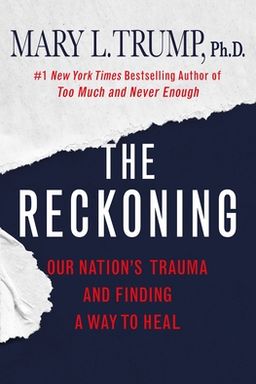
The Reckoning cover

The Reckoning

by Mary L Trump

The Reckoning by Mary L Trump explores the deep-seated traumas and systemic failures in American society. It connects historical injustices with modern-day issues, urging citizens and leaders to take decisive action for a more equitable future.

America’s Unhealed Wounds and the Price of Denial

Why do old traumas never die—either in families or in nations? In The Reckoning, Mary L. Trump confronts that haunting question through both personal and national lenses. She contends that America’s collective failure to face its traumatic past—slavery, genocide, inequality, and willful cruelty—has left deep psychic scars that continue to shape its politics, policies, and relationships. Through analysis, history, and personal reflection, Trump argues that the rise of her uncle Donald Trump is not an aberration but a symptom of a centuries-long refusal to reckon with these wounds.

The daughter of Fred Trump’s eldest son and niece of the former president, Mary Trump brings an unusual perspective: she combines the insider view of a dysfunctional family that produced a destructive leader with a psychologist’s understanding of trauma, denial, and recovery. She uses both vantage points to argue that the United States operates much like an unhealed family system—denying pain, papering over shame, and repeating cycles of abuse.

A Nation Born in Trauma

Trump begins by describing America as a country “born in trauma”—from the genocide of Native Americans to the enslavement of Africans and the greed that justified both. She insists that the violence and trauma inflicted at the birth of the nation didn’t vanish; they became foundational myths. Americans tell comforting stories about freedom and justice, yet suppress the suffering that built those very ideals. The result, she says, is a society where many white citizens prefer ignorance to accountability, believing that acknowledging systemic cruelty threatens their identity. This denial, however, ensures repetition.

Trump extends the concept of collective trauma beyond historic abuses to modern events—from the insurrection of January 6, 2021, to the mass death of the COVID-19 pandemic. These experiences, she argues, exposed not new fractures but long-hidden wounds: the fragility of democracy, the persistence of racism, and the moral corrosion that allows cruelty to pass as strength.

Intergenerational Pain, National Patterns

Trump weaves her own experience with trauma into the story. As someone diagnosed with Complex PTSD, she describes how denial operates both in individuals and nations. What is repressed, she argues, will always resurface—unless faced honestly. She parallels her family’s secrecy, hierarchy, and emotional starvation with American culture’s refusal to look clearly at its own history. The Trump family, like the U.S., maintained control through fear and denial; both punished truth-tellers and rewarded loyalty to the abuser. The result in each system: pathology mistaken for normalcy.

Her uncle’s presidency, Trump suggests, was the logical culmination of that pathology. His election showed how unresolved national trauma can crystallize in an individual who embodies it—an authoritarian figure who thrives on grievance and cruelty, appealing to citizens conditioned to avoid the pain of self-examination. But she also insists that Donald Trump didn’t create America’s divisions—he exploited them. The disease preceded the symptom.

The Cost of Avoidance

Trump traces the long arc of impunity—from the leniency shown to Confederate traitors after the Civil War, to presidents who pardoned corrupt predecessors, to the banks bailed out while citizens lost their homes in 2008. In every era, she says, powerful men avoided consequences, sending the message that crimes committed in the name of profit or whiteness would be forgiven. This impunity, she argues, defines American exceptionalism—not moral leadership, but moral evasion.

As a clinician, Mary Trump interprets these political catastrophes as symptoms of unprocessed grief. Trauma compounded by neglect shifts into rage or despair. When people feel powerless and ashamed, they lash out or look for strongmen promising to protect them from discomfort. This dynamic, she argues, explains not only her uncle’s enduring support but America’s broader cycles of progress and backlash—Reconstruction followed by Jim Crow, Civil Rights followed by mass incarceration, Obama followed by Trump.

The Reckoning We Resist

The book’s title, The Reckoning, points to two intertwined meanings. On one level, it’s a demand for accountability: facing historical crimes, dismantling systems of white supremacy, and holding leaders responsible. On another, it’s psychological—the reckoning within each person to confront fear, guilt, and complicity. Without both reckonings, she warns, America will repeat its cycle of crisis and denial. Democracy itself may not survive if citizens choose comfort over truth.

Throughout the book, Trump draws a through-line from national lies to personal mental health. Denying trauma, whether familial or societal, clouds perception, distorts relationships, and destroys empathy. Only by acknowledging shared pain can genuine healing begin. Thus, her message is both historical and intimate: to repair democracy, Americans must learn the psychological tools of recovery—honest reflection, accountability, empathy, and courage to change.

Why It Matters Now

Trump’s argument arrives as both diagnosis and prescription. The events of 2020–2021—the pandemic, the rise of authoritarian movements, systemic racism, and democratic fragility—are not isolated crises but the result of cumulative unhealed trauma. Her message is urgent: without reckoning with the past, we cannot build a humane future. The reckoning she calls for, like therapy, is painful but necessary—a process of remembering, mourning, and taking responsibility. “Trauma ignored is trauma relived,” she reminds us. The Reckoning is thus less a history of failure than a guide to collective recovery, urging you, the reader, to face the pain that defines America—not to despair, but finally to heal.


The Historical Roots of Trauma

Mary Trump insists that America’s current dysfunction didn’t begin with recent politics—it began with Reconstruction’s unraveling. In the late nineteenth century, the nation had a chance to rebuild itself after slavery, but racism, greed, and weak moral will doomed the effort. The author recounts, in forensic detail, the failures that set the foundation for century-long inequality and violence.

Reconstruction’s Broken Promises

After the Civil War, more than four million enslaved people became free, but freedom without land, education, or protection was a cruel illusion. The Freedmen’s Bureau was created to help, yet Congress underfunded it, and President Andrew Johnson—a Tennessee Democrat and former enslaver—actively undermined its mission. Johnson pardoned Confederate leaders, restored their land, and blocked Black suffrage. He voided General Sherman’s Order No. 15, the famous “forty acres and a mule,” returning property to white planters while evicting freed families. This betrayal, Trump argues, ensured the South’s racial caste would continue by new means.

The Thirteenth Amendment abolished slavery “except as punishment for a crime.” That loophole permitted states to invent new laws—Black Codes—that re-enslaved African Americans through convict leasing. For minor offenses like vagrancy or unemployment, people were arrested, fined, and leased to plantations or factories. It generated immense profit and normalized racial criminalization, setting a template that echoes in mass incarceration today.

Terror and Denial

Trump highlights barbaric realities often omitted from sanitized history books. She describes the 1904 lynching of Luther and Mary Holbert in Mississippi—burned alive before a crowd of hundreds—and countless other atrocities that white mobs carried out with impunity. By sharing such details, she forces readers to confront the depravity that “ordinary Americans” justified under the banner of white supremacy.

Equally damaging, she notes, was the North’s growing indifference. Northern whites wanted reunion more than justice. As historian Eric Foner observed, the end of Reconstruction wasn’t inevitable—it was surrendered. When federal troops withdrew in 1877 for political convenience, the South reclaimed domination through Jim Crow. That decision planted the seeds for every racial crisis that followed.

Legacies That Linger

By tracing the arc from emancipation to the 1896 Plessy v. Ferguson decision that legalized segregation, Trump shows how a nation’s conscience calcified. Every attempt at progress—Reconstruction, Civil Rights, the election of Obama—faces the same backlash. Each backlash, she argues, arises from white fear of losing dominance. “The prejudice now felt against freedmen cannot die out immediately,” one educator predicted in the 1860s. Trump replies: it never died out at all.

In exposing these continuities, Trump links historical denial to ongoing trauma. The trauma wasn’t just the violence inflicted on Black Americans; it was the moral injury inflicted on whites who learned to justify that violence. This dual inheritance—pain and numbness—became the psychological architecture of America itself.


The Politics of Impunity

Trump’s second major argument is that America’s moral decay stems from its obsession with forgiveness for the powerful. She calls this pattern “impunity”—a centuries-long refusal to punish criminals when their crimes serve white supremacy or political convenience.

Heroes Turned Monsters, Monsters Turned Heroes

Trump takes aim at the romanticization of Confederate figures like Robert E. Lee and Jefferson Davis. Lee is still revered as a noble soldier, yet Trump reminds us he was a traitor who tortured enslaved people, broke families apart, and presided over mass death. Instead of being punished, Lee became the president of a college that now bears his name, and in 1975 President Gerald Ford posthumously restored his citizenship. In 1978, Jimmy Carter extended the same pardon to Jefferson Davis. Such acts, Trump says, didn’t heal national wounds—they reopened them. They told future generations that treason in defense of slavery could be rebranded as valor.

America’s failure to hold perpetrators accountable, she continues, normalized corruption at every level. Ford’s pardon of Richard Nixon for Watergate crimes set a precedent that presidents are “superhuman and not held to the rule of law.” Barack Obama’s decision not to prosecute torture during the Bush era reinforced it. Each bipartisan refusal to confront wrongdoing sends the same message: power absolves itself.

The Chain of Corruption

Trump maps a continuum: Andrew Johnson nullifying Reconstruction, Gerald Ford excusing Nixon, and Obama sparing Wall Street bankers after the 2008 crash. These moments, she argues, are links in a chain of unspoken agreement among elites. The result is a culture where white men in power can destroy institutions and still retire with honors. The moral logic of slavery—profit without punishment—never ended; it evolved.

For Trump, impunity is both political and psychological. It creates collective learned helplessness: citizens conclude that justice is impossible, so outrage gives way to cynicism. This emotional resignation allows new abuses to flourish. In her reading, the Trump presidency was built upon this weariness—the belief that corruption is inevitable, so why not embrace it?

The cure, she insists, isn’t more forgiveness but courageous accountability. True healing cannot occur while criminals walk free and myths protect their memory. Facing the truth may divide temporarily, but denial destroys permanently.


When Cruelty Became Policy

In her section titled “Here There Be Monsters,” Trump examines the Trump administration as the embodiment of moral collapse. The cruelty of policy—from child separations to pandemic neglect—wasn’t accidental; it was the point. This chapter is where her background as a clinical psychologist sharpens her political critique.

Authoritarian Psychology

Trump argues that authoritarianism thrives when trauma and fear go unaddressed. People traumatized by instability crave a powerful protector. Donald Trump exploited this instinct by portraying himself as both victim and savior. His lies about immigrants and “American carnage” activated collective paranoia, creating an “us versus them” mindset essential to fascism. (She draws parallels to scholars like Ruth Ben-Ghiat and Timothy Snyder, who describe this emotional manipulation as the dictator’s primary tool.)

The administration’s policies, from the Muslim ban to weaponized lies about election fraud, mirrored classic authoritarian tactics: isolate, divide, dehumanize, and dominate. Trump notes how even small acts—like lying about crowd size or doctoring a hurricane map—were psychological tests of power: if citizens accepted falsehoods, greater lies would follow.

Institutions Captured

One of Trump’s central warnings concerns institutional erosion. She chronicles how Trump and loyalists reshaped the Justice Department under Jeff Sessions and Bill Barr into a weapon of self-protection, echoing the same impunity patterns from earlier centuries. Barr’s manipulation of the Mueller Report, she writes, demonstrated how truth can be “disappeared” when media normalization and public fatigue converge.

Across agencies—from State to CDC—competence was replaced with loyalty. Qualified experts were driven out, leaving the machinery of government hollowed. Trump likens the effect to an abusive family system in which every member learns that honesty invites punishment. Bureaucrats, journalists, and supporters alike adapted to survive by staying silent.

The Ultimate Betrayal

When COVID-19 struck, this corrosion proved fatal. Trump details how her uncle downplayed the virus despite privately calling it “deadly stuff,” chose self-interest over lives, and turned masks into partisan symbols. Nearly a million deaths later, she concludes that the pandemic became a mirror reflecting the collective moral collapse—citizens refusing empathy, leaders abandoning science, and a nation confusing cruelty with strength. The pandemic wasn’t America’s first tragedy, she writes, but it was the first that revealed to every citizen how thoroughly broken empathy had become.


The Myth of American Innocence

Trump devotes “American Exceptionalism” to dismantling a national myth: that the United States’ greatness is moral as well as material. She argues that our exceptionalism lies not in freedom but in our capacity for denial. Using history, psychology, and data, she proves how the belief in American innocence masks cruelty and perpetuates inequality.

Two Conflicting Origins

America’s founding paradox, Trump observes, is the clash between liberty and slavery, equality and hierarchy. She identifies two tracks of development: one grounded in genocide and forced labor, the other in the myth that freedom was universal. The latter became the dominant story, concealing the violence under “manifest destiny” and “the American dream.” The moral dissonance, she notes, still echoes whenever white America insists, “This is not who we are.”

Religion and Race

Trump traces white supremacy’s theological roots to Puritan Calvinism—the idea that prosperity reveals divine favor. Success thus equaled virtue, poverty signaled damnation. From plantations to Wall Street, this belief justified exploitation. Calvin’s descendants simply swapped the language of salvation for the language of capitalism. “Rugged individualism,” she writes, is America’s secular predestination.

She also dissects pseudosciences like eugenics and IQ testing, showing how self-proclaimed rationalists replaced religious justifications for racial hierarchy with “objective data.” The logic persisted: white elites defined intelligence and morality by traits they already possessed. Trump bluntly concludes that America’s intellectual traditions have often been mechanisms for maintaining dominance, not truth.

The Arbiter of Justice or Its Enemy?

Trump’s critique of the Supreme Court is one of her most provocative sections. While the Court is venerated as democracy’s guardian, she highlights its long record of reactionary decisions: Dred Scott declaring Blacks non-citizens, Plessy entrenching segregation, and Milliken v. Bradley allowing resegregation to flourish. Even modern “originalists,” she argues, sanctify a Constitution written by enslavers. True reform, she suggests, must include structural changes like term limits and court expansion, or justice will remain a myth.

In short, America’s “exceptionalism” isn’t moral superiority—it’s the unparalleled ability to mythologize our sins. To move forward, she insists, we must replace innocence with integrity: a willingness to see clearly what we are and what we’ve done.


Trauma Passed Down the Generations

In “Suffering in Silence,” Trump bridges psychology and history to reveal how slavery, violence, and repression created collective trauma that endures through generations. Drawing on epigenetics and trauma theory, she argues that historical atrocities alter not just memory but biology.

Inherited Pain

Trump references the work of Judith Herman and Dr. Joy DeGruy, who coined “Post-Traumatic Slave Syndrome” to describe multigenerational injury among African Americans. Trauma rewires the body’s stress systems, and studies of Holocaust survivors show similar transgenerational effects. For descendants of enslaved people, daily racism and economic exclusion keep the trauma active—never fully healed.

Sophiacide—The Killing of Knowledge

Trump introduces the concept of “sophiacide,” the destruction of Black intellectuals and educators through terror and policy. From the burning of Black schools after Reconstruction to the Tulsa massacre of 1921, she shows how white supremacy targeted intelligence as much as lives. The lesson, she says, was clear: literacy and prosperity made Blacks dangerous because they exposed the lie of inferiority.

She recounts Tulsa with chilling specificity—Dick Rowland, Sarah Page, and the white mob that leveled Greenwood, killing hundreds and leaving thousands homeless. The physical destruction of that community, she argues, mirrored an emotional assault aimed at suppressing hope itself. Both victims and perpetrators carried that psychic damage forward: victims through fear, whites through moral rot.

The Mirror of Violence

Trump powerfully notes that it wasn’t only the victims who were traumatized. White children raised to witness or celebrate lynchings were psychologically damaged too—their empathy blotted out by indoctrination. This shared sickness perpetuated systems of dehumanization. Healing, she insists, requires truth-telling from both sides—a national acknowledgment that the trauma of white supremacy has corrupted all who live within it.


The Precipice of Democracy

By the time Joe Biden took office, Mary Trump writes, America had barely survived a brush with fascism. The insurrection of January 6, 2021, was not an anomaly; it was the logical climax of years of lies, impunity, and denial. In “The Precipice,” she charts the anatomy of collapse—and the fragile rebirth that followed.

A Party Without Shame

Trump portrays the modern Republican Party as a danger to democracy itself. Once her uncle lost the 2020 election, party leaders had multiple chances to distance themselves from his lies. Instead, they doubled down, amplifying the “Big Lie” that would culminate in violence. Trump argues that fear of alienating the base—a base forged in grievance and racism—was more powerful than commitment to country. In effect, she says, the GOP traded democracy for minority rule.

The psychology is clear: when shame disappears, anything becomes permissible. Trump compares the Republican Senate’s refusal to convict Donald Trump after two impeachments to an addict’s enablers protecting his self-destruction. The pattern is familial, familiar, and fatal.

The Tyranny of the Minority

Trump underscores the structural flaws that allow minority rule—an Electoral College favoring smaller, whiter states, a Senate skewed by population imbalance, and a judicial system captured by lifetime appointees from one ideological faction. She points out that fifty Republican senators represent forty-one million fewer citizens than the Democratic fifty—a glaring contradiction of the “one person, one vote” ideal. Figures like Mitch McConnell, she writes, exploit these flaws not to govern but to hoard power.

This “tyranny of the minority,” she argues, is unsustainable. Yet it persists because America still reveres its founding myths and resists systemic reform. Here again, trauma theory becomes political: an abused system clings to dysfunction because the unknown feels scarier than the intolerable present.

Ultimately, Trump warns that fascism will return—not because of one man, but because millions find comfort in domination and fear empathy. The weapon against that darkness is civic courage: the willingness of ordinary citizens to face truth, reject apathy, and hold power accountable. Without that courage, she says, the reckoning delays—and the cycle restarts.


Healing the National Psyche

In the book’s final chapters, Trump returns to the theme of trauma and healing, asking what it might mean for a country—not just a person—to recover. Drawing on her psychological training, she describes America as a patient in long-term therapy: exhausted, divided, ashamed, but alive enough to change.

The Cost of Forgetting

Trump reminds readers that forgetting has been our national reflex after every crisis—the 1918 flu, the Depression, Vietnam, Iraq. Each time, we sought comfort rather than confrontation, mistaking silence for peace. COVID-19, she warns, risks becoming another unspoken catastrophe unless we choose to memorialize its dead and reckon with how leadership failures magnified suffering.

Trauma ignored, she explains, creates dissociation: citizens detach from empathy, normalize cruelty, and lose capacity for connection. Healing requires recognition, ritual, and repair—the same steps that individuals need to recover from abuse. “We can’t fix what we refuse to feel,” she cautions.

Reparations and Accountability

Trump closes with a powerful moral argument for reparations as therapy for the nation’s original wound. The wealth of America, she writes, was built on stolen land and stolen labor; true democracy demands restitution. HR 40, a bill to study reparations, represents not charity but justice. Beyond policy, reparations symbolize acknowledgment—“the apology that should have come centuries ago.”

She also calls on white Americans to abandon defensiveness: to see racism not as personal guilt but as inherited responsibility. In her view, whiteness has been constructed as emotional armor—shielding its bearers from empathy. Dismantling that armor, though painful, is liberation: “Our white power and privilege come at a great emotional cost,” she writes. Healing means surrendering what was never ours to keep.

The Path Forward

Trump doesn’t offer simple hope. She offers work: education that tells the truth, accountability for officials, equitable health and justice systems, and a collective commitment to empathy. She envisions a democracy modeled less on dominance than on relationship—where kindness is not weakness but strength. “Being kind doesn’t make you weak,” she insists. “Receiving kindness fortifies us.” The Reckoning ends with a call to kneel: a symbolic act of both humility and resistance, acknowledging pain so that, finally, the nation might stand again.

Dig Deeper

Get personalized prompts to apply these lessons to your life and deepen your understanding.

Go Deeper

Get the Full Experience

Download Insight Books for AI-powered reflections, quizzes, and more.