
Idea 1
Creating Growth Through Reciprocity
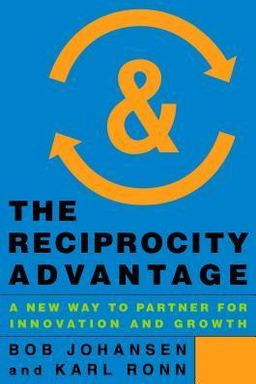
Have you ever wondered how businesses can grow faster in an increasingly connected, competitive, and disrupted world? In The Reciprocity Advantage, futurist Bob Johansen and innovation leader Karl Ronn argue that the next wave of business success will belong to those who learn to grow by giving. Rather than clinging to scarcity and control, thriving companies will embrace reciprocity—intelligently giving away some assets today in order to multiply value tomorrow.
At its heart, the book proposes a bold idea: competitive advantage no longer belongs to the most secretive or dominant firms but to those that can form strategic, trust-driven, large-scale partnerships. These partnerships exchange value in ways that create mutual benefit—what the authors call a “reciprocity advantage.” This concept sits in a new space between ordinary market transactions (where you pay and get) and philanthropy (where you give with no expected return). Reciprocity means giving smartly, learning from what you share, and ultimately growing stronger with others.
A World of “And” Instead of “Or”
Johansen and Ronn position the reciprocity advantage as a response to what they call a “world of And.” The modern world is volatile, uncertain, complex, and ambiguous—the famed VUCA environment that military strategists and futurists now apply to business. In such chaos, old either/or thinking (profit or purpose, competition or collaboration) collapses. Tomorrow’s innovators must practice AND-thinking: profitable AND ethical, competitive AND collaborative, open AND strategic.
This shift from competition to cooperation is not utopian—it’s pragmatic. The authors demonstrate that reciprocity-driven businesses are more adaptable, resilient, and innovative. By partnering around shared challenges, organizations can lower risk, co-create new markets, and address societal problems too big for any single entity. As Johansen puts it, “You can’t change the future alone.”
Why the Future Belongs to Givers
Drawing from both futures research at Institute for the Future (IFTF) and Ronn’s hands-on design experience at Procter & Gamble (creator of hit products like Swiffer, Febreze, and Mr. Clean Magic Eraser), the book fuses foresight with practice. The authors predict that as cloud networks and digital connectivity expand, reciprocity will become the primary business currency of the cloud. Those who share useful data, intellectual property, or community trust will reap exponential network effects in return.
Think about how Apple’s App Store, TEDx, or Google Fiber thrive by giving access to platforms where others create—even competitors. These open systems don’t weaken their creators; they expand their ecosystems and brand power. As the authors show, the world’s most adaptive organizations—IBM, Microsoft, Google, and even McDonald’s—are already practicing reciprocity at scale, often without calling it that.
The Four Steps of the Reciprocity Cycle
To operationalize this abstract ideal, Johansen and Ronn propose a clear, repeatable four-step model for building your own reciprocity advantage:
- Uncover Your Right-of-Way: Identify underutilized assets, permissions, or capabilities your organization already owns—what gives you the right and trust to act in a certain space. IBM discovered its “big data” right-of-way and turned it into its Smarter Planet initiative.
- Partner to Do What You Can’t Do Alone: Form alliances—especially asymmetrical ones between big and small entities—to merge strengths and tackle new opportunities.
- Experiment to Learn: Give away small, clever pieces of your knowledge or assets to test ideas quickly and cheaply. Use failures as research, not setbacks.
- Scale It: Once you’ve proven what works, amplify it massively through digital networks, cloud technology, and networks of trust.
Each step echoes an iterative innovation cycle—foresight (see what’s next), insight (understand what matters), and action (prototype, then scale). Over time, these cycles build growth engines far more durable than isolated transactions. Reciprocity, then, becomes not philanthropy but a profitable way of collaborating with purpose.
Why This Idea Matters
In an economy defined by transparency, trust, and turbulence, traditional advantages based on secrecy and ownership erode quickly. As the authors warn, “If you have a right-of-way that nobody trusts, it’s not a right-of-way.” Through vivid stories—like IBM’s reinvention into a Smarter Planet, Microsoft’s embrace of hacker culture with Kinect, or TED’s transformation from elite conference to global platform—they show that giving up control can lead to greater power.
Ultimately, The Reciprocity Advantage invites you to rethink how your business grows and how you as a leader build influence. By intelligently sharing rather than hoarding, you can open doors to innovation, attract partners who multiply your value, and shape a smarter, more connected world. This book is not about charity—it’s about the future logic of profit in the age of collaboration.