
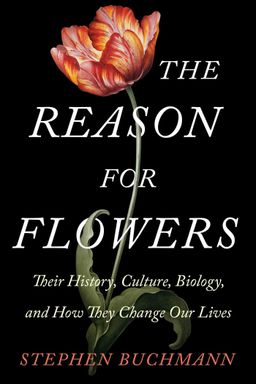
The Reason For Flowers cover

The Reason For Flowers

by Stephen Buchmann

The Reason for Flowers delves into the captivating world of flowers, exploring their biology, cultural significance, and the profound ways they impact human life. Discover how these vibrant creations of nature have evolved, their intricate relationships with pollinators, and their enduring influence on human culture and well-being.

The Secret Life of Flowers

Why do flowers matter? In this sweeping exploration of floral biology, culture, and commerce, the author argues that flowers are not decorative accidents but evolutionary masterpieces—living advertisements through which plants conduct sexual reproduction, ecological negotiation, and symbolic communication with both animals and humans. Flowers, from the Stargazer lily to the smallest daisies, are biological designs refined by time and touch, announcing fertility, seduction, and exchange on nearly every continent.

You’re invited to see a flower not as a passive ornament but as the plant’s sexual storefront. Beneath its color and scent lies a complex machinery of reproductive organs—the pistil receiving pollen, the stamens producing it, and the ovary packaging the next generation. This evolutionary adaptation gave rise to angiosperms (vessel seeds), leading to double fertilization, a clever maneuver that builds not only embryos but also endosperm—the seed’s first meal. These advantages made flowering plants the most successful branch of the plant kingdom.

Evolution and Pollinator Partnerships

Flowers coevolved with animals. Each partnership—bee to orchid, hummingbird to salvia, bat to cactus—shows reciprocal innovation. Evolution favors outcrossing (mating between unrelated individuals), so plants had to recruit intermediaries. The lures are visual, chemical, tactile, and even electrical. Petals display pigments like anthocyanins and carotenoids, often with ultraviolet patterns invisible to human eyes but obvious to bees. Fragrances serve as long-distance lures: some sweet, some grotesque, some species-specific. Pollinators perceive them through highly tuned sensory systems, responding to color, motion, and charge—bees land on flowers charged with negative electricity while they themselves are positively charged, producing a subtle electric dialogue.

Signals, Rewards, and Strategies

To secure these couriers, flowers offer incentives—nectar rich in sugars, pollen packed with protein, or exotic oils and fragrances used by bees for nest-making or courtship displays. Some interactions are one-on-one mutualisms, as in yucca moths that deliberately pollinate before laying eggs, or fig wasps entering fig syconia. Others are diffuse webs of commerce among many species. In every case, flowers broadcast signals tailored to their chosen pollinators. You might see beauty; to a bee, it’s a coded advertisement written in light, scent, and surface texture.

From Fossil Origins to Modern Ecosystems

Fossils tell the long story behind these unions. The earliest flowers were minute, preserved as charcoalized fragments or pollen in amber. Finds like Archaefructus sinensis reveal primitive enclosed seeds without showy petals. Amber fossils show pollen-dusted insects, proving that the flower–animal alliance existed 100 million years ago. Darwin’s “abominable mystery”—why flowering plants emerged and diversified so rapidly—makes sense once you consider the speed of coevolution: every improvement in floral design was rewarded by more efficient pollination, fueling an evolutionary sprint.

Human Connections: Food, Fragrance, and Art

Humans joined this story late but enthusiastically. We eat flowers—broccoli, cauliflower, daylily buds, nasturtiums—and we crystallize, stuff, or scent them. We distill their volatile compounds into perfumes like jasmine absolute or rose attar, marveling that one pound of essence can require thousands of pounds of petals. We paint and worship them, embedding their shapes in funeral rites and gardens from Egypt to China to the Aztec chinampas. In every culture, flowers signify love, purity, and transience. Their transient beauty mirrors our own.

Commerce, Conservation, and Well‑Being

Today, flowers are global commodities—bred for form and shipped worldwide under refrigerated surveillance. Biotechnologists engineer blue roses; logisticians auction tulips in Aalsmeer. Yet amid this commerce, ethical issues surge: pesticide exposure, carbon footprints, labor practices, and gene flow into wild relatives. At the same time, flowers heal and calm us. Studies on biophilia and hospital recovery show tangible psychological benefits of bloom and greenery, echoing Wilson’s idea that humans crave living forms. But their survival now depends on stewardship: conserving native flora, supporting pollinators like bees and bats, and integrating sustainable horticulture.

Core message

Flowers are the nexus of biology and culture: they join sexual function, sensory communication, art, commerce, and human emotion. To understand them is to see how evolution, technology, and beauty coalesce into one enduring story of life’s attraction and renewal.

Across all these layers—biology, history, art, and industry—the same theme recurs: flowers exist to connect. They connect plants to pollinators, humans to ecosystems, emotions to symbols. Once you begin to notice those connections, every bouquet on your table becomes part of an ancient, intricate conversation among species, senses, and souls.


Floral Architecture and Reproduction

Every flower’s form is an optimized structure engineered for reproduction. The lily’s pistil, stalk, anther, and stigma form a design of exchange between male and female gametes shaped by evolution. When a pollen grain lands on the stigma, it sends a tube downward; two sperm cells move through it—one fertilizes the egg, the other produces endosperm, the plant’s first nutritional reserve. This system of double fertilization is unique to flowering plants and helps explain their success across the planet.

Hermaphroditism and Outcrossing

Most flowers are hermaphroditic, carrying stamens and pistils together. Yet natural selection favors genetic diversity, so plants tend toward outcrossing—finding unrelated mates using pollinators. The color, symmetry, and timing of blooms all serve to control who carries pollen where. Self-pollination offers security, but cross-pollination offers evolutionary innovation.

Floral Rewards and Economic Exchange

Flowers bribe their visitors. Nectar delivers sugar fuel; pollen gives protein or fatty acids; oils and resins feed or protect insect larvae. Some species offer novel rewards: orchids trade fragrances for sperm delivery, and tropical flowers yield waxes for nest materials. What we perceive as aesthetics—the shimmer of petals or aroma of jasmine—is functional advertising.

Key idea

Each floral structure is both anatomical and economic: a precise device to exchange genetic material and a billboard paying pollinators for transport service.

Understanding these mechanisms helps you appreciate the flower as more than beauty—it’s evolution displayed in color and form, a living engine of reproduction masked as art.


The Language of Attraction

Flowers must advertise effectively to their target audience, and they do so through multiple sensory channels: sight, smell, touch, and even electromagnetism. Their signals are meticulously tuned to the neurobiology of each pollinator. When you glimpse a red tubular flower, know that it’s speaking primarily to hummingbirds, not bees; bees register UV-visible patterns invisible to human eyes.

Visual Cues and UV Patterns

Petal pigments—anthocyanins, carotenoids, betalains—create human-visible colors, while UV mapping forms hidden nectar guides. The black-eyed Susan might look plain yellow to you but displays bull’s-eye UV rings to bees. Experimental photography confirms that these patterns act as landing guides, reducing forager confusion.

Scent and Timing

Fragrance functions as long-distance signaling. Datura and cacti perfume the night to reach moths and bats. Carrion flowers mimic rotting flesh using cadaverine compounds to attract flies. Timing matters—scents peak when pollinators are active, conserving resources and increasing effectiveness.

Tactile and Electrical Dialogue

Bees read surfaces. Petal microtextures—smooth, hairy, reflective—affect grip and recognition. Electrically charged fields around blossoms further refine communication: flowers carry a mild negative charge, bees a positive one, forming “electric footprints” detected by sensory hairs on their legs. Studies from Bristol University demonstrate that bees avoid recently depleted flowers by sensing residual electrical changes.

Insight

Floral signaling is a multimodal conversation—visual, olfactory, tactile, and electromagnetic. Each dimension evolved through coevolution with pollinator perception.

To design or preserve pollinator habitats, you must think like a flower: combine contrast, scent, and timing into one orchestrated advertisement for attention and mutual survival.


Co‑Evolution and Scientific Discovery

Flowers have driven some of science’s most profound discoveries. Nehemiah Grew’s microscopic examinations identified stamens as male organs, ending centuries of misconception. Darwin later built on this understanding, recognizing that orchid morphologies are “contrivances” adapted for precise pollinator fits. Mendel’s pea experiments transformed patterns of floral traits into the universal laws of inheritance.

Darwin’s Orchids and Evolutionary Proof

Darwin predicted a moth with a fifteen-inch tongue to pollinate Madagascar’s Angraecum sesquipedale—later proven correct. Such foresight validated evolution by showing how morphology must evolve under ecological pressure. Flowers are therefore natural laboratories of adaptation, demonstrating how selection yields exquisite functional forms.

Genetic and Geographic Milestones

Mendel’s monastery gardens revealed trait segregation; later biogeographic discoveries explained why flowering plant families concentrate by continent. Fossil flowers in amber and continental drift clarify distribution patterns—Proteaceae in Australia and Africa link back to Gondwanan ancestry.

Evolutionary Implications

Every blossom expresses millions of years of adaptive experimentation. Understanding this helps you appreciate gardens as snapshots of evolutionary history. To conserve flowers and pollinators is to protect dynamic processes that continue shaping life’s diversity.

Scientific milestones show that by observing flowers—Darwin’s greenhouses, Mendel’s crosses, Grew’s microscopes—we learned how nature writes genetic and ecological poetry through color and form.


Flowers in Food and Fragrance

Beyond their botanical roles, flowers have become ingredients and aromatics. Culinary traditions worldwide include blossoms as food, beverage flavoring, and decoration. When you bite a squash blossom or sip rose syrup, you sample centuries of human experimentation bridging nature and taste.

Edible Flowers and Safety

Nasturtiums, pansies, violas, roses, and chive blossoms are common edible species, offering peppery or sweet notes. Calendula substitutes for saffron; daylily buds appear in Chinese cuisine. Safety is crucial: avoid pesticide-treated blooms, unknown wildflowers, or toxic species like oleander and buttercup. Proper harvesting—rinsing, removing bitter petal bases, immediate chilling—preserves both flavor and health.

Floral Perfumes and Chemistry

Humans also capture flower scent through distillation and extraction. Steam distillation suits lavender; solvent methods yield delicate absolutes from jasmine or rose. Headspace analysis now lets chemists study scent without destroying blossoms. Perfume creation balances natural and synthetic molecules—rose absolute for authenticity, synthetic musks for longevity.

Practical perspective

When you cook or wear floral elements, you’re extending pollination chemistry into culture: volatile molecules first meant for bees become instruments of human pleasure and identity.

Every petal on your plate or perfume bottle carries ancestral codes of attraction—proof that flowers appeal across species, evolved to stimulate hunger, curiosity, and desire.


Cultural Gardens and Symbolic Meaning

Flowers shape civilizations. As agriculture produced surplus, humans built gardens not for food but for meaning and beauty—from Egypt’s temple ponds to China’s poetic courtyards and Japan’s reflective landscapes. The rose dominated Persian and Islamic tradition; the lotus anchored Hindu and Buddhist philosophy as symbols of purity.

The Language of Flowers and Art

Victorians turned blossoms into coded messages—floriography—assigning emotions to species: love as red rose, mourning as lily, betrayal as yellow bloom. Literature and art follow this lexicon: Shakespeare’s violets symbolized fidelity; Monet and O’Keeffe transformed flowers into explorations of sensation and sexuality. Dutch still lifes and the Blaschka glass flowers display technical and philosophical reverence for transient life forms.

Ritual and Continuity

Across time, flowers mark births, marriages, and funerals—from ancient Natufian graves lined with petals to modern festivals like Día de los Muertos. Each arrangement is a cultural act linking people to life cycles and emotion. When you plant or offer a bouquet, you participate in millennia of ritual exchange.

Cultural insight

Flowers convey beauty and mortality simultaneously; their impermanence makes them potent symbols of human experience.

Seen through art and ritual, flowers become mirrors of humanity—objects that embody nature’s cycles and our need to find meaning in them.


Global Floriculture and Ethics

Today’s floral industry transforms ephemeral petals into a global supply chain valued in billions. From pollination to bouquet, flowers pass through breeding labs, refrigerated planes, auctions, and marketing campaigns. It’s a triumph of logistics but also a moral test.

Breeding and Biotechnology

Hybridizers like Burbank pioneered crossbreeding; now molecular tools create new colors and vase life traits. Black Velvet petunias arose from mutation breeding, while blue-rose efforts inserted delphinidin genes for lavender tones. Yet such modification raises ecological and genetic concerns regarding gene flow and biodiversity.

Economics and Environmental Impact

Roses grown in Colombian highlands reach customers via Miami or Aalsmeer auctions. Long-distance air freight, energy-demanding refrigeration, and chemical preservation yield environmental burdens. Certification programs like Veriflora and MPS attempt accountability, promoting pesticide safety and fair labor.

Ethylene and Shelf Life

Ethylene gas triggers petal decay; new genetics target ethylene-insensitive varieties. Exporters use inhibitors and scrubbing technology, extending freshness. But this preservation often trades off fragrance—the very essence of human love for flowers—for longevity.

Moral takeaway

Behind every perfect stem lies an ethical choice—between beauty as commodity and beauty as life-sustaining biodiversity.

Your consumer awareness—choosing local, sustainable, pesticide-free flowers—can turn commerce back toward ecological partnership.


Honey, Health, and Conservation

Honey shows how flowers, pollinators, and humans merge into one product of chemistry and ecology. Bees collect nectar and transform it by enzymatic concentration, yielding honey that retains floral terroir—each bottle a map of blossoms and places.

Floral Terroir

Unifloral honeys like tupelo or buckwheat bear distinctive flavors; stingless-bee honey from Yucatán (Melipona) is prized for its floral sweetness. Raw, unfiltered honey retains volatile molecules that pasteurization erases. Tasting honey is tasting flowers translated by bees.

Flowers and Healing

Flowers and their products heal—the book recounts manuka honey’s wound applications and chamomile’s sedative effect. Scientific revival of floral medicine connects ancient Egyptian and modern clinical practices. The biophilia hypothesis reinforces this: human well-being depends on connection to living systems.

Conservation and Action

Floral diversity faces crisis; species like Hawaiian Brighamia insignis survive by hand pollination. By planting native flowers, avoiding harmful chemicals, and supporting pollinator corridors, you can participate in conservation. Organizations like the Xerces Society and Monarch Watch show practical paths forward.

Final reflection

To protect bees and blossoms is to protect yourself; floral health translates directly into human health and environmental resilience.

Honey thus closes the loop—from nectar to nutrition, from ecosystem to empathy—reminding you that every drop is both sweet and sacred.

Dig Deeper

Get personalized prompts to apply these lessons to your life and deepen your understanding.

Go Deeper

Get the Full Experience

Download Insight Books for AI-powered reflections, quizzes, and more.