
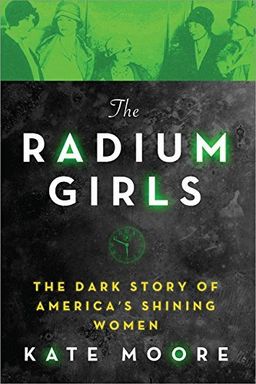
The Radium Girls cover

The Radium Girls

by Kate Moore

The Radium Girls by Kate Moore tells the gripping tale of early 20th-century American women whose fight against corporate negligence led to significant changes in labor laws and safety standards. Their courage and determination continue to inspire and inform the ongoing battle for workplace justice.

The Courage That Sparked a Movement

What would you do if your dream job—the one that promised freedom, glamour, and independence—was slowly killing you? This haunting question sits at the heart of The Radium Girls: Young Readers’ Edition by Kate Moore. Through her compassionate storytelling, Moore reveals the true story of ordinary young women who took extraordinary action against a powerful industrial empire. These women, known as the Radium Girls, transformed from victims into pioneers of workers’ rights and medical science, leaving a legacy that still protects millions of people today.

A Deadly Dream Job

In the early 20th century, radium was celebrated as a miracle element. It glowed softly in the dark, symbolizing progress and innovation. When companies like the United States Radium Corporation (USRC) in New Jersey and Radium Dial in Illinois offered young women high-paying jobs painting luminous watch dials, it felt like a chance to shine—literally. The women worked in elegant studios, chatted with friends, and laughed about painting their nails or dresses with the shimmering dust. They called themselves the “ghost girls” because they glowed on their way home. But none understood that each lick of the brush they used to fine-point their tools was a fatal dose of poison.

Science Meets Betrayal

At first, the illnesses were mysterious. Teeth fell out, jaws ached, and bones crumbled. Doctors and dentists called it an infection, rheumatism, or “phossy jaw” like match-factory workers once suffered. But when women began dying—one after another—the truth became impossible to ignore. Scientists later proved that radium, not phosphorus, was destroying their bodies from within. The same element that glowed with beauty had a half-life of 1,600 years. Once it entered the body, it never stopped attacking.

A System Stacked Against Them

The tragedy wasn't just biological—it was systemic. The companies knew radium was dangerous. Their male chemists wore protective gear, but the girls received none. When the first lawsuits surfaced, the firms hired fake doctors, delayed trials, and denied responsibility. In an era before workplace regulations or women’s legal power, few believed young factory workers could stand up against corporations backed by wealthy lawyers. Yet they refused to back down. Grace Fryer, Katherine Schaub, Quinta McDonald, and others dedicated their lives—literally—to revealing the truth about what the companies had done.

The Light That Wouldn’t Fade

Moore’s narrative follows decades of struggle: the initial outbreak in New Jersey (1917–1920s), the later wave in Illinois (1930s), and the courtroom battles that defined industrial safety law. As the women grew sicker, they built alliances with investigative journalists, scientists like Dr. Harrison Martland, and advocates like Katherine Wiley. Their bravery forced the first changes in workers’ compensation laws, required companies to provide safety protocols, and even laid the groundwork for the formation of the Occupational Safety and Health Administration (OSHA) decades later. Their suffering taught the world how radioactive substances behave in the human body—a discovery that saved countless lives in the atomic era.

Why Their Story Matters Today

The story of the Radium Girls is not just a historical account—it’s a moral blueprint for courage in the face of exploitation. It shows how courage doesn’t always roar; sometimes it whispers through cracked teeth and trembling hands signing court affidavits. The women’s determination to protect future generations echoes in every workplace safety policy and union reform today. Moore reminds readers that justice isn’t an abstract ideal; it’s built one brave act at a time. Their luminous legacy—once thought a curse—became their greatest victory. Their bodies glowed in the dark, but their story continues to light the world with truth, courage, and compassion.


The Glow That Killed

When radium was first discovered by Marie and Pierre Curie, it was hailed as a dazzling gift of science. Its mysterious glow conjured images of vitality and immortality. By the 1910s, companies in America saw profitable potential in its luminescence for watch dials and military instruments. For young women in towns like Orange, New Jersey, and Ottawa, Illinois, the chance to paint with radium meant freedom and financial independence. They weren't told the danger: every time they licked their brushes, they swallowed radioactive particles that would seep into their bones forever.

Lip, Dip, Paint

The women were taught to sharpen their brushes between their lips—a routine nicknamed “lip-pointing.” It was efficient and precise, but deadly. The powders entered their systems, settling in their skeletons where the body mistook radium for calcium. Grace Fryer, one of the earliest dial-painters, remembered her boss, Dr. von Sochocky, passing by and warning, “Don’t do that—you will get sick.” Yet management continued encouraging the technique to finish more dials. (Note: This mirrors the industrial negligence described by Upton Sinclair in The Jungle, where factory profits outweighed human lives.)

The First Signs of Pain

By 1917, women like Mollie Maggia began suffering painful ulcers, tooth decay, and what dentists believed was “phossy jaw.” When her jaw literally crumbled in the hands of her dentist, the link between radium and illness should have been obvious. Instead, the company dismissed it as coincidence, even as more women—Hazel Kuser, Marguerite Carlough, and Irene Rudolph—developed similar necrosis. Doctors offered misdiagnoses, while industrial leaders concealed findings that would confirm their culpability.

Science and Denial

When independent investigators like Dr. Harrison Martland finally tested the women, they discovered their bones emitted faint light—“glow in the dark” corpses. Autopsies of victims like Mollie Maggia and Hazel Kuser proved their bones were radioactive. Still, the companies manipulated these findings, rewriting scientific reports to suggest the paint was harmless. Radium poisoning was deemed incurable because the element’s half-life ensured it would radiate from their skeletons for centuries.

The glow that once symbolized patriotism and beauty became a curse. Yet it also became proof. It was because of these glowing skeletons that scientists could finally trace the human effects of radioactivity—knowledge that later shaped radiation safety standards and saved the workers of the atomic age.


From Silence to Outcry

As death tolls rose, the women realized their only chance for justice lay in making noise. The turning point came when Grace Fryer decided to sue the United States Radium Corporation. She wasn’t after money—she wanted recognition of the truth. But because the law didn’t recognize “radium poisoning” as an industrial disease and imposed strict time limits for claims, every attorney she approached refused. Her resilience transformed private pain into public protest.

The First High-Profile Case

In 1927, Grace finally found a young lawyer, Raymond Berry, who took her case. Five women—Grace, Katherine Schaub, Edna Hussman, Quinta McDonald, and Albina Maggia—joined forces in what newspapers dubbed “The Case of the Five Women Doomed to Die.” Their attorney argued that the company deliberately concealed hazards to protect profits. Yet the battle was never only legal—it was moral. The courtroom became a stage for human endurance: women in braces, with rotting jaws and steel corsets, facing executives who denied responsibility.

Public Opinion as a Weapon

Press coverage changed everything. Reporters portrayed the women as tragic heroines rather than complainers. Headlines like “Doomed to Die” and “Radium Girls’ Bones Glow in the Dark” stirred outrage. Public sympathy forced the courts to act faster, pushing Judge William Clark to broker a settlement in 1928. Each woman received a lifetime pension and payment for medical care—small comfort for certain death, but a monumental breakthrough for industrial law.

Their victory didn’t end the suffering; it proved that workers could no longer be treated as disposable. Like Erin Brockovich decades later, their fight made invisible harm visible. Their courage shifted the burden of proof: from sick workers having to prove guilt, to companies having to prove safety.


Betrayal and Corporate Cover-ups

Even after settlements, deceit thrived. Companies like USRC and Radium Dial refused to admit wrongdoing. They continued manufacturing luminous paint, falsifying safety tests, and silencing sick workers through intimidation and false reassurances. In Illinois, the same cycle repeated—new girls, same poison, same lies.

The Illinois Chapter

The Radium Dial Company in Ottawa, Illinois, opened in 1922—right as the New Jersey warnings hit the press. Supervisors told recruits like Catherine Wolfe Donohue and her friend Peg Looney that radium was safe. When peg died horribly of radiation necrosis, the company orchestrated a “clean” autopsy and falsified the cause of death as diphtheria. Executives even sold radioactive waste as playground sand, calling it “most hygienic.”

Science Versus Greed

Investigators like Swen Kjaer documented radiation dangers, but government follow-ups were halted due to cost and corporate pressure. Doctors hired by the company declared ill workers healthy; employees who limped or lost teeth were fired for “giving the company a bad image.” By 1930, dozens were dead, and survivors like Catherine Donohue resolved to fight back. The betrayal wasn’t only physical—it was spiritual. The women’s trust in science, employers, and faith all collided as they realized the people sworn to protect them valued profit over lives.

Each cover-up deepened public mistrust of corporations. Like future disasters from tobacco to asbestos, the radium scandal taught the world that profit-driven denial can kill. But it also spotlighted whistleblowers and small-town courage that refused to be silenced.


The Ghosts Who Wouldn’t Rest

The haunting image of glowing bones became a courtroom weapon. Exhumations of victims like Mollie Maggia shocked the public when doctors found her skeleton still luminous years after burial. Her radioactive remains delivered chilling proof: the girls’ deaths were not syphilis, as the company claimed, but radium poisoning.

Science For the Living—and the Dead

Dr. Martland’s studies on these remains became foundational to radiation medicine. He demonstrated how radium mimicked calcium, embedding itself into bones. His research drew international acclaim and influenced subsequent studies on nuclear fallout, medical radiology, and chemotherapy. Yet his discoveries came at the cost of the women’s lives. Each autopsy—a macabre scientific triumph—was also an act of justice for those previously mocked and forgotten.

Turning Horror into Hope

Through these women, mortality became medicine. The “list of the doomed” that Martland kept transformed human tragedy into scientific data. It’s because of these ghostly remains that radiation exposure is tracked, monitored, and controlled today. Their bodies glowed long after death—but their scientific contribution illuminated the future.


Catherine Donohue’s Final Trial

Among the bravest of all was Catherine Wolfe Donohue of Illinois. Fired for limping, she spent her final years bedridden, yet refused to stop fighting. Her face sunken, her bones glowing faintly in the dark, Catherine became the moral center of the last great radium trial. Her home turned into a courtroom when she was too sick to leave her bed.

Justice From a Sickbed

In 1938, lawyer Leonard Grossman represented Catherine and several surviving women in a case against Radium Dial. During her testimony, she held up pieces of her own fractured jawbone to the judge. She whispered, “That’s the way we were told to do it.” Her demonstration of the lip-pointing technique moved the entire court to tears. Reporters described her as glowing “so faintly that it seemed her soul itself was shining through.”

A Victory Written in Blood

Judge Marvel ruled in her favor, declaring the company guilty of crippling and killing its workers. Catherine won her case a few months before her death, becoming one of the first people in American history to prove employer responsibility for workplace safety. Her final words—“I hope now my children can live again”—echoed as both a blessing and a warning. She died holding onto faith that her suffering wasn’t in vain.

Her victory became a cornerstone for modern labor law. Like Rosa Parks’ quiet defiance decades later, Catherine’s testimony from her deathbed was an act of moral resistance that reshaped justice itself.


Legacy of Luminous Courage

The Radium Girls’ legacy glows brighter with each passing decade. Their lawsuits catalyzed a seismic shift in occupational safety, medical ethics, and environmental regulation. They turned personal agony into public awareness, transforming corporate accountability forever.

Scientific and Legal Transformation

Their cases led to landmark reforms in workers’ compensation laws, the establishment of OSHA, and federal recognition of radiation as a workplace hazard. Medical research from their bodies informed safe exposure limits for nuclear scientists, radiologists, and atomic workers. Decades later, these standards guided radiation protocols in World War II’s Manhattan Project and modern cancer treatment.

A Warning for All Time

Even after their deaths, companies like Luminous Processes continued exploiting workers until the 1970s, proving that greed often forgets history. But their story persisted, inspiring activism, plays like These Shining Lives, and the establishment of a memorial statue in Ottawa in 2011. The statue portrays a woman holding a paintbrush and a tulip—a silent tribute to light, growth, and resilience.

Their Living Light

The Radium Girls remind you that voice matters. Even powerless individuals can change the system when they choose truth over silence. Their luminous courage outlasted the radium that killed them. Today, whenever workers’ rights or environmental safety are defended, you can trace that light back to their glowing hands.

Dig Deeper

Get personalized prompts to apply these lessons to your life and deepen your understanding.

Go Deeper

Get the Full Experience

Download Insight Books for AI-powered reflections, quizzes, and more.