
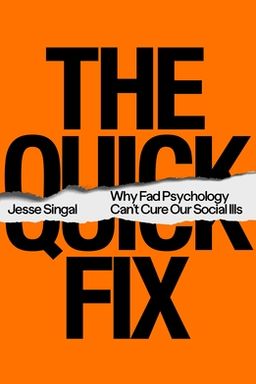
The Quick Fix cover

The Quick Fix

by Jesse Singal

The Quick Fix by Jesse Singal delves into the pitfalls of fad psychology, exposing how oversimplified theories can mislead the public and influence harmful policies. This insightful exploration urges a more rigorous, nuanced understanding of human behavior.

The Age of Primeworld

You live in what the author calls Primeworld—a cultural moment obsessed with cheap, psychological solutions for complex social problems. In this world, subtle primes, quick behavioral tweaks, and attractive TED‑style narratives replace structural reform. Instead of redressing inequality or investing in institutions, you’re told to fix individuals: impel people to grit, boost their self‑esteem, teach them resilience, and call it transformation.

The book threads together stories from self‑esteem campaigns, the grit movement, implicit bias tests, and failed psychological policies to show how scientific half‑truths become political commodities. It asks a pressing question: why do people keep chasing easy psychological fixes for hard social realities? The answer lies at the intersection of media incentives, methodological fragility, and cultural mood.

How science melted into slogans

Since the 1980s, psychology has produced compelling claims—self‑esteem makes good citizens, primes steer unconscious behavior, posture empowers you, grit predicts success. These ideas spread rapidly because they promised measurable, personal improvement without expensive systemic reform. Journalists, educators, and policymakers could brand them as evidence‑based solutions even when replication was shaky and causal proof thin.

In California, John Vasconcellos’s self‑esteem Task Force sold emotional uplift as crime prevention. Angela Duckworth’s grit reassured schools that teaching perseverance could replace fixing structural disadvantages. The Army’s massive Comprehensive Soldier Fitness program scaled resilience training before proving efficacy. And the Implicit Association Test (Banaji & Greenwald) became a public diagnostic despite low reliability. Each case echoed Primeworld logic—big promises, tiny interventions, and quick policy visibility.

The cultural and political logic behind Primeworld

Primeworld flourished in what historian Daniel Rodgers called the Age of Fracture—when collective institutions seemed powerless and personal responsibility reigned. Cheap interventions align perfectly with neoliberal temperaments: they sound bipartisan, low‑cost, and avoid ideological conflict. Officials can hold a press conference announcing an implicit‑bias workshop or grit curriculum, spend little, and appear progressive or pragmatic. Structural remedies—redistribution, school funding, healthcare equity—require years of money and political courage. Psychological quick fixes require slogans and slides.

Methodological roots of misbelief

Behavioral science’s credibility crisis amplifies the book’s warnings. You learn about p‑hacking (massaging data until significance emerges), file‑drawer bias (burying null results), and range restriction (testing elites like West Point cadets, making grit look potent). Combined, these practices fabricate certainty. As the replication crisis revealed through Many Labs projects, priming and posture effects crumbled under scrutiny. Dana Carney’s recantation of power‑posing and Kahneman’s public letter to social priming researchers signal deep epistemic correction within the field.

Yet science reform lags behind public appetite for feel‑good stories. Media platforms and consulting cultures reward TED‑ification—bullet‑point conclusions that travel easily and sell hope. Psychologists and communicators often become inadvertent storytellers rather than cautious empiricists. (Note: Charles Tilly once argued that humans think through stories; when we crave coherence, simple causality triumphs over complexity.)

The social cost of simplicity

When society treats racism, poverty, or violence as problems of psychology rather than policy, moral attention misdirects. Self‑esteem workshops substitute for welfare equity; bias‑training replaces desegregation; grit classes substitute for fair college funding. The author warns this narrative does emotional work—it lets privileged institutions feel virtuous while sidestepping real redistribution.

Concrete evidence shows the cost. Researchers like Natalie Daumeyer find that labeling discrimination as "implicit" rather than structural reduces public willingness to punish wrongdoing. Hart Blanton and Elif Ikizer show how exposure to tidy "wise‑intervention" stories increases belief that disadvantaged people just need to try harder. These patterns mirror Primeworld’s moral hazard: empathy without action, awareness without architecture.

Escaping Primeworld

You don’t need to reject behavioral science—it has genuine power when tethered to evidence and humility. The solution is to pair psychological insight with institutional reform: use nudges to ease form designs or communication barriers, but pursue policy that changes ground conditions. Favor cumulative evidence, pre‑registered trials, and objective outcome measures. Treat catchy psychological ideas as inspiration, not as endpoints.

"Primeworld thrives on plausibility, not proof. The cure is not cynicism but proportion."

Ultimately, the book calls you to intellectual and civic maturity. Psychological tools matter, but only when you keep the scale of human problems honest. Behind every seductive micro‑fix is the temptation to replace complex institutions with personal hope. Escaping Primeworld means resisting that temptation—and putting method, evidence, and structure back at the center of reform.


Self‑Esteem Politics

The self‑esteem saga is one of Primeworld’s earliest templates. It began as humanistic psychology and evolved into state‑sponsored ideology. In 1986, California legislator John Vasconcellos launched a Task Force promising a moral revolution through confidence: increase citizens’ self‑regard and social ills will vanish. The pitch sounded pragmatic and humane—cheaper than new welfare programs, less divisive than cultural wars.

From promise to crackup

The movement drew on Nathaniel Branden’s and Norman Vincent Peale’s positive‑thinking lineage. Teachers replaced red pens with praise; mirrors proclaimed “You are lovable.” “Toward a State of Esteem” became policy reading. But evidence lagged behind enthusiasm. Neil Smelser, the sociologist behind the Task Force’s academic volume, privately doubted causal claims yet faced political pressure to stay upbeat. When Roy Baumeister’s later meta‑analysis (2003) examined hundreds of studies, the causal fantasy collapsed: high self‑esteem correlated with success mainly because success raises esteem, not the reverse.

Cheap hope, real costs

Politically, the idea was irresistible. It made emotional uplift sound like governance. Classrooms adopted praise curriculums rather than teacher training or resource investment. Critics like Steve Salerno argued the fad replaced real educational reform with feel‑good rituals. By substituting emotional band‑aids for structural investment, the craze formed a prototype later echoed by grit and growth‑mindset campaigns: measure psychology, ignore inequality.

Lessons for skepticism

Baumeister emphasized that acting on partial evidence isn’t wrong—it’s error when it refuses revision. His review distilled three diagnostic warnings: beware self‑report data, differentiate correlation from causation, and stay alert to political overselling. These remain vital in judging any social‑psychological cure‑all. (Note: many modern “character education” programs unknowingly repeat these same mistakes.)

"Confidence without competence is merely public policy theater."

The self‑esteem experiment taught a lasting lesson: when psychological comfort stands in for institutional remedy, optimism becomes ideology. You should test hope empirically—not legislate it.


Superpredators and Panic

Few examples illustrate policy distortion through bad social science better than the 1990s “superpredator” myth. Political scientist John DiIulio’s 1995 warning of remorseless youth predicted tidal waves of crime. Backed by respected scholars like James Q. Wilson and James Alan Fox, the phrase entered headlines and legislative halls almost overnight.

Methodological failure

The claim rested on misread data from a Philadelphia cohort study—mistaking police contact for violent criminality. DiIulio extrapolated city observations into national apocalypse. Soon child defendants were transferred to adult courts en masse. States toughened juvenile punishments. Black and Latino youths bore the brunt, despite subsequent crime declines proving the prophecy false.

Institutional incentives

The episode mirrors Primeworld psychology from another angle: moral panic and over‑simplified causality. Politicians craved strong narratives. “Superpredator” conjured irresistible clarity—a villainous category that justified harsh action. Later recantations by DiIulio, Wilson, and Fox came too late to reverse punitive laws.

Your takeaway

Always test whether a new buzzword describes a measurable phenomenon or merely rhetorically repackages fear. Ask whether definitions are falsifiable, whether data are replicable, and whether social outcomes justify the response. Science gains authority through precision; when precision erodes, politics fills the void.

The superpredator panic embodies a recurring pattern—the speed with which complex behavior gets simplified for policy theater.


Power‑Posing and Replication

Amy Cuddy’s viral 2012 TED talk promising that posture could transform hormones encapsulates social psychology’s credibility crisis. The original 2010 paper with Dana Carney and Andy Yap found changes in testosterone and cortisol after brief “high‑power” stances. The claim fit the culture’s appetite for noninvasive confidence tricks: posture as psychology without therapy.

Collapse and confession

By 2015 replication teams led by Eva Ranehill disproved hormonal shifts. In 2016 co‑author Dana Carney publicly disavowed the finding, describing p‑hacking—selective analysis to reach statistical significance. Simonsohn and colleagues’ p‑curve diagnostics later confirmed evidential weakness: clusters of p‑values just below 0.05 betrayed selective reporting.

Media asymmetry

TED, Times features, and corporate workshops amplified the initial story; the correction barely registered. As journalist outlets prize novelty, early hype normalizes flawed results. You learn why replication and sample size matter: fragile findings can seduce millions before truth catches up. (Note: Kahneman called this pattern the discipline’s “train wreck.”)

Practical stance

If you hear universal claims from small lab studies, demand pre‑registration, objective measures, and large samples. Harmless interventions can still misallocate resources. Real reform means rewarding cumulative replication, not viral novelty.

Power‑posing’s journey from triumph to mea culpa became a symbol: psychological storytelling without methodological spine is modern magic—persuasive but unreal.


Grit and the Character Paradox

Angela Duckworth’s grit concept—passion and perseverance predicting success—became a schooling mantra. Charter networks like KIPP adopted “character report cards.” Politicians hailed grit as teachable equality. The book dissects this narrative, exposing how grit repackages old psychological constructs under fresh branding.

Scientific overlap

Meta‑analyses by Crede, Tynan & Harms show grit overlaps almost completely with conscientiousness. Statistical overlap r ≈ 0.80 implies redundancy—the “jangle fallacy” of renaming old measures as new virtues. Grit’s predictive power for performance hovers at r ≈ 0.18, explaining a few percent of variance—minuscule compared with intelligence or socioeconomic access.

Policy distortion

Despite weak effects, schools treat grit as scalable pedagogy. But personality traits change slowly. Evidence for longitudinal grit interventions remains minimal. Meanwhile, teaching study skills or attendance yields stronger results. The moral hazard persists: structural failure becomes individual deficiency.

Ethical caution

Linda Nathan’s stories of under‑resourced college students prove that grit without support can’t overcome systemic scarcity. Focusing on character shifts responsibility downward—from institutions to individuals. You should champion persistence but never mistake aspiration for policy.

The grit narrative offers inspiration but little transformation. Personality isn’t policy; perseverance needs scaffolding.


Positive Psychology’s Army Experiment

When Martin Seligman’s Positive Psychology met military crisis, scale multiplied risk. Facing high PTSD rates, the U.S. Army funded his Comprehensive Soldier Fitness (CSF) to cultivate resilience across 1.1 million soldiers. Jill Chambers and General George Casey expedited rollout, skipping pilot phases—because, as Casey insisted, “This is war.”

Mixed research, massive reach

CSF adapted Seligman’s Penn Resilience Program (PRP). Yet PRP’s meta‑analyses showed only small effects on depressive symptoms, none on prevention of mental illness. The Army’s GAT survey lacked validated clinical measures. Independent reviewers (Eidelson, Soldz, Nick Brown) documented methodological flaws and cherry‑picking. The Institute of Medicine concluded measurable benefit was negligible.

Opportunity cost

Hundreds of millions in contracts diverted attention from proven PTSD therapies like Prolonged Exposure (Edna Foa) and Cognitive Processing Therapy (Patricia Resick). Institutional appetite for morale branding outpaced consideration for clinical rigor. CSF reflects how Primeworld’s optimism culture scales even under crisis.

What you can learn

Before scaling psychological programs, demand validation. Check whether metrics measure the intended outcome—does “resilience” correlate with lower suicide rates or merely survey cheerfulness? Ask whether prevention adaptations have empirical support. Glamorous ideas often appeal politically but collapse therapeutically.

The Army case exemplifies how institutional urgency and narrative comfort can trump evidence. “Scale is not proof,” the author reminds you; it’s often camouflage for the absence of proof.


Implicit Bias and Mismeasurement

The Implicit Association Test (IAT) promises to reveal hidden prejudice through milliseconds. Corporations and police departments adopted it eagerly. Yet psychometric scrutiny shows the tool’s reliability and predictive power are weak—average test‑retest correlations around r ≈ 0.45, behavioral predictability near 1% of variance. Even its founders admit it cannot diagnose individuals.

What the IAT actually measures

Reaction‑time differences reflect more than unconscious bias. Familiarity with stereotypes, empathic awareness, cognitive speed, or test experience all alter outcomes. Studies with fictional groups (“Noffians”) show new associations can instantly inflate “bias” scores. Hart Blanton & Elif Ikizer confirm contamination from non‑attitudinal factors—such as intelligence or response effort.

Implications for practice

Labeling individuals as biased based on one IAT result risks misdiagnosis and moral confusion. You can use it as reflection catalyst, not forensic tool. Real discrimination demands examining structures—hiring funnels, policing norms, decision architectures—not reaction times. (Note: Greenwald, Banaji, & Nosek warned against diagnostic use in their 2015 response paper.)

The IAT saga underlines Primeworld’s temptation to quantify morality cheaply. Foundations or HR offices buy instruments they mistake for reform.


Structural Racism and the Limits of Awareness

Modern antiracism often mirrors psychological individualism—train attitudes, check implicit metrics, correct microaggressions. The book contrasts this with structural approaches that target policy and material inequities. Writers like Michelle Alexander and Ta‑Nehisi Coates show racism lives in housing and wealth gaps, not just in the mind.

Cultural practice vs. systemic repair

Workshops on “white fragility” and “racial etiquette” prioritize confession over design change. Elisabeth Lasch‑Quinn calls this therapeutic moralism. DOE training slides listing traits like “Sense of Urgency” as white supremacist culture illustrate how focus can drift from justice to jargon. John McWhorter critiques certain antiracist rituals as quasi‑religious absolution—comforting but circular.

The imbalance of attention

Psychological trainings rarely produce behavioral longevity. They can even shift responsibility back onto minorities by implying that success equals emotional adjustment. Studies confirm that institutions favor symbolic fixes because they’re cheaper and photogenic. It’s easier to host a workshop than to reform housing lending rules.

Real antiracism blends both scales—psychology helps empathy; policy alters realities. The key is proportion: scale your effort to evidence, not to guilt.


Methodological Discipline and Reform

To cure Primeworld’s excesses, you need rigorous method. The book’s final chapters teach you to recognize distortions—p‑hacking, omitted variables, range restriction, and file‑drawer bias. These statistical practices built the illusions behind self‑esteem, grit, and priming.

Core methodological tools

Learn to ask: are results pre‑registered? Are samples representative (not just WEIRD college students)? Are effects objective rather than self‑reported? Meta‑analytic correction often erases early excitement. Range restriction explains why elite samples inflate correlations; omitted variables explain why socioeconomic context is ignored.

Reform movements

Registered Reports, data sharing, and open‑science platforms now reshape norms. Bayesian approaches weigh prior plausibility, demanding strong evidence for unlikely claims. Brian Nosek’s Open Science Framework embodies this shift toward transparency. Reform isn’t only statistical—it’s cultural: reward accuracy over charisma.

"Registered Reports change the incentive from telling the best story to telling the truest one."

The conclusion invites you to carry scientific humility into civic life. Every behavioral intervention should meet evidence before ideology. Replace performative certainty with methodological care—that’s the moral of all the book’s cautionary tales.

Dig Deeper

Get personalized prompts to apply these lessons to your life and deepen your understanding.

Go Deeper

Get the Full Experience

Download Insight Books for AI-powered reflections, quizzes, and more.