
Idea 1
The Pursuit of Happiness as Self-Government
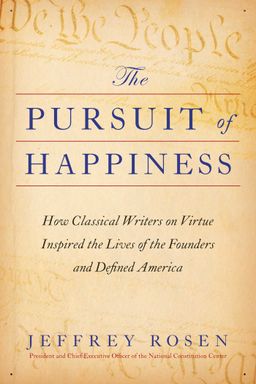
What do you actually pursue when you pursue happiness? Jeffrey Rosen argues that for the American Founders—and for the classical authors they revered—happiness means a life of virtue, not a spike of pleasure. In this telling, the pursuit of happiness is a disciplined program of self-government in your inner life, scaled up into constitutional self-government in public life. You train reason to rule passion, you practice habits that stabilize character, and you build institutions that cool collective fury. The book links Cicero’s eudaimonia, Franklin’s daily ledger, Madison’s checks and balances, and Lincoln’s self-made education into a single moral project.
Happiness redefined: from mood to moral excellence
Rosen restores the classical meaning of happiness (Greek: eudaimonia; Latin: felicitas): a steady state of flourishing grounded in virtue. When Jefferson quotes Cicero—“the man… whose soul is tranquillized by restraint and consistency… he is the happy man”—he channels a tradition where temperance, prudence, justice, and courage constitute the good life. External goods (wealth, reputation) may help or hinder, but they never define true happiness. If you adopt this frame, you stop chasing feelings and start building stable habits of soul.
Private technologies of character
The Founders turn ancient counsel into daily tools. Franklin’s thirteen-virtue chart with black marks for lapses, Adams’s nightly diary of self-reproof, Jefferson’s regimented reading schedule, and Washington’s Rules of Civility give you a practical kit. Influenced by Pythagoras’s Golden Verses, Seneca’s “On Saving Time,” and Epictetus’s Enchiridion, they treat time as a moral asset and attention as a trainable faculty. You can copy their mechanics: an end-of-day review, one habit focus per week, and protected morning study.
A psychology that scales to a constitution
Behind these routines sits faculty psychology: reason should steer passions much like Plato’s charioteer guiding two unruly horses. The Stoic “dichotomy of control” sharpens the point: invest in what you command (judgment, desire), accept what you don’t (fortune, fame). The Founders then map this inner engineering onto the state. Madison’s “ambition must be made to counteract ambition” and Hamilton’s call for an energetic executive both assume you cannot wish passions away; you must counterbalance and channel them through design.
Key Idea
The Constitution is a psychological architecture: representation, separation of powers, and a large republic are brakes that turn hot impulses into considered judgment (compare Federalist Nos. 10 and 51).
Books that built a republic
Rosen reconstructs the reading that formed this worldview: Cicero’s Tusculan Disputations (a pivot for “pursuit of happiness”), Locke on rights and consent, Hutcheson and Reid on the moral sense, Hume’s skepticism about reason, and Montesquieu on the spirit of laws. Popularizers like Addison and Steele’s Spectator and practical textbooks printed by Franklin spread these ideas in colleges and clubs. If you want the Founders’ mind, you must enter their libraries.
Contradictions that test the creed
Rosen does not sanitize. Jefferson preached thrift but lived in debt; Wilson theorized public happiness but died fleeing creditors; many enslaved people underwrote elite “virtue.” Phillis Wheatley’s achievement punctured claims of Black inferiority even as Jefferson demeaned her. These contradictions show how systemic incentives—credit speculation, plantation economics, racial ideology—can overwhelm private intention. The lesson is bracing: virtue needs both personal courage and institutional reform.
From tranquility to abolition
Late in life, Adams and Jefferson found serenity in friendship and cross-cultural wisdom (Stoicism, the Gospels, and even the Bhagavad Gita’s counsel of non-attachment). In the next generation, literacy turned the creed against slavery: Douglass’s Columbian Orator and Lincoln’s readers armed them to argue that self-mastery and the right to improve yourself belong to all. John Quincy Adams’s disciplined petitions and the Amistad case kept the abolitionist long game alive.
Why it matters to you now
Today’s media accelerates passions; institutions groan under speed and outrage. Rosen’s synthesis urges you to recover the Founders’ two-part remedy: rebuild private discipline (habitual attention, moral accounting) and reinforce public friction (deliberation, buffers, civic education). Happiness becomes a civic mission: cultivate a tranquil, industrious self and demand institutions that help reason prevail without denying the reality of passion. That is the American pursuit of happiness, rightly understood.