
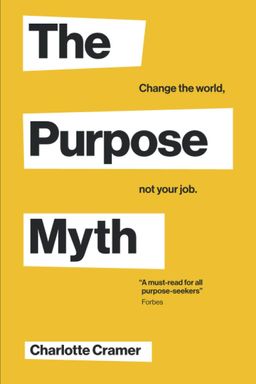
The Purpose Myth cover

The Purpose Myth

by Charlotte Cramer

The Purpose Myth by Charlotte Cramer challenges the notion that your job should be your life''s purpose. It guides readers to find true fulfillment and joy through Purpose Projects, aligning their actions with personal passions and values. Discover how to thrive beyond the office and make meaningful contributions to the world.

Escaping the Purpose Myth: Finding Meaning Beyond Your 9-to-5

Have you ever stared at your computer screen thinking, “Is this really what I’m meant to do with my life?” In The Purpose Myth, Charlotte Cramer argues that many of us have been misled into believing that our day jobs should fulfil our deepest sense of purpose. She contends that this idea—the Purpose Myth—is both unrealistic and harmful. Work can help you survive, but not necessarily help you thrive or strive. To live a fulfilling life, Cramer insists, we must learn how to separate our income-generating work from our meaningful, purpose-driven endeavors.

Over the past decade, modern society has conflated identity with occupation, creating a culture where “what do you do?” defines who you are. Cramer draws from her experiences in neuroscience and advertising to expose how capitalism and corporate marketing have hijacked our desire for meaning. We’ve been seduced by career-site slogans that promise to “change the world” while selling tobacco, oil, or weapons. Yet, this repackaged moral language masks a deeper truth: corporations are not built to fulfil our human need for purpose; they are built to generate profit.

The Three Human Needs: Survive, Strive, and Thrive

Cramer breaks our needs into three categories. To survive is to meet material security—shelter, food, safety. To strive is the emotional aspiration to make a positive difference. To thrive is to experience personal growth and self-development. And while most jobs satisfy the survival part, they often neglect the need to strive and thrive. The result? An epidemic of disengagement and burnout—what David Graeber famously called “bullshit jobs.”

The antidote, Cramer suggests, is not quitting everything to find a “perfectly meaningful” career. Instead, it’s learning to diversify our work portfolio—to treat our lives like an ecosystem with different functions. Your nine-to-five might pay the bills, while you design a Purpose Project that fuels your growth and contribution. This simple shift transforms how we think about work. It’s not about escaping your job; it’s about reclaiming agency outside of it.

The Purpose Vacuum

Why did we end up chasing meaning in our jobs in the first place? According to Cramer, modern life dismantled the traditional pillars of purpose: religion, community, and family. Consumerism replaced connection. Shopping malls replaced temples. Work became the new sanctuary, and corporations became our high priests of purpose. This “purpose vacuum,” she argues, made employees susceptible to the illusion that their labor could substitute moral legitimacy and meaning.

Yet the paradox remains: the more we seek existential satisfaction through corporate work, the more disappointed we become. We want meaning, but job structures built for productivity can’t offer spiritual fulfilment. Cramer’s research shows that over 70% of millennials want to quit their jobs for lack of purpose. As she puts it, “Positions were created to fill pockets, not to fulfil dreams.”

Purpose Projects: The Alternative Blueprint

A Purpose Project is a small-scale, personal initiative created outside your day job to address an issue you care about. It can take the form of a social enterprise, volunteer effort, or creative mission. Cramer’s own example—the project CRACK + CIDER—illustrates this. After feeling guilty for not helping a homeless man in Berlin, she and her co-founder launched a transparent donation platform where people could buy essentials for unhoused individuals. What started as a side project eventually helped over 40,000 people and earned international recognition, without either founder quitting their corporate roles.

This became Cramer’s proof that you can meet your needs to survive through your paycheck, while you meet your needs to strive and thrive through your Purpose Project. When you pursue projects that satisfy curiosity and compassion, you wake up with energy not anxiety. You work harder, more creatively, and experience genuine fulfilment—all without burning down your career.

Why This Idea Matters Now

In a world of layoffs, automation, and social anxiety, The Purpose Myth offers relief. Cramer’s message isn’t anti-work—it’s anti-delusion. She wants readers to see purpose not as a job title but as a human practice. By unbundling passion and paycheck, we can reframe work as one ingredient in a fulfilling life rather than the recipe itself. Purpose can be found in the 5-to-9, not just the 9-to-5.

Key takeaway

You don’t need a perfect job to have a purposeful life. You need a clear sense of what makes you come alive—and the willingness to create space for it alongside work that pays the bills.


How We Lost Purpose—and How to Reclaim It

Charlotte Cramer reveals that our disconnection from purpose isn’t a personal failure—it’s the predictable result of cultural erosion. Religion, family, and community used to anchor us in meaning. But in industrialized societies, those anchors have been replaced by consumerism and corporate ideology. Now, the concept of 'purpose' is marketed back to us by employers and influencers.

Consumerism’s Hijacking of Purpose

Purpose became profitable. Companies discovered that workers who believe in their company’s mission will work longer hours for less pay (research cited from Harvard Business Review confirms this trend). Thus, corporations—from missile manufacturers to vape companies—use moral language to attract talent. The result? Even exploitative industries now advertise jobs that promise world-changing impact. Work has become a moral stand-in for faith and community—but lacks the substance to deliver real fulfilment.

Identity Crisis at Work

The question “What do you do?” encapsulates this modern dilemma. As Cramer recounts, when asked by a stranger while surfing in Los Angeles, she replied, “What do I do for income, you mean?” It’s a small but radical shift in language. It exposes how we equate our professional roles with our entire selves. Psychologist Esther Perel calls this “identity fulfilment through occupation.” When work becomes identity, unemployment feels like erasure—not just economic loss.

But Cramer refutes this notion. You are not your job. You are someone who works at a job. Detaching from this internalized myth is the first step toward reclaiming personal meaning.

Survivors of the Purpose Vacuum

As we lost our moral compass, we built a new false idol: productivity. “Busy” became synonymous with “value.” When corporations realized this, they filled the vacuum with slogans like Facebook’s “Do the Most Meaningful Work of Your Career.” But as Glassdoor reviews reveal, employees rarely find the belonging those taglines promise. The culture of performative purpose leaves workers simultaneously exhausted and empty.

Reclaiming Purpose as a Collective Act

To fight back, Cramer calls for a new approach: collective purpose. This is purpose that emerges not from a corporation’s slogan, but from human collaboration to solve social problems. It’s about connection, empathy, and impact—not status or salary. When individuals build Purpose Projects together, they rebuild a sense of meaning that work culture stole from them.

Key takeaway

Meaning isn’t handed to you by employers—it’s created through connection and contribution. The work of purpose starts when you stop defining yourself by your job title.


Purpose Projects: Redefining How We Make Meaning

The heart of Cramer’s argument is simple yet revolutionary: you can create your own purpose outside your nine-to-five. She calls these Purpose Projects—small, focused initiatives born from personal curiosity, compassion, or frustration. They enable you to translate emotion into action, and fulfillment into reality.

From Frustration to Creation

Cramer’s own project, CRACK + CIDER, emerged from guilt and moral confusion. After refusing a homeless man a euro in Berlin, she and co-founder Scarlett Montanaro explored why people hesitate to give money to those in need. They discovered that donors worry their money will be misused. This insight birthed the idea of a shop where people could buy exact items—like jackets or umbrellas—for London’s homeless, ensuring transparency and dignity.

The project exploded, covered by major outlets and praised by social advocates like Stephen Robertson of The Big Issue Foundation. Yet its deepest success lay not in publicity but purpose: it gave Cramer and Montanaro back a sense of agency and fulfilment that their day jobs couldn’t offer.

Why Purpose Projects Work

Purpose Projects satisfy the two neglected human needs—striving (to contribute) and thriving (to grow). They function outside corporate structures, letting creativity and compassion meet without hierarchy. Psychologically, they rely on intrinsic motivation—the internal drive to act because the work itself feels meaningful. Studies cited from Teresa Amabile and Dan Pink confirm that intrinsic motivation leads to greater creativity and persistence than external rewards like money or praise.

Moreover, Purpose Projects nurture self-belief. When you’re responsible for all decisions—idea, design, outreach—you gain direct evidence of your competence. Each completed task builds confidence and resilience, reinforcing the feedback loop of growth.

Real People, Real Projects

Cramer interviewed over 100 Purpose Project founders worldwide. They included Johanna Yoo, whose Curl Talk Project explored identity through natural hair; and Sara Venn, who turned public spaces into edible gardens with Incredible Edible. Each found joy and commitment not from corporate agendas, but from their personal missions. These projects thrive because they’re authentic—born from genuine questions and real empathy.

Key takeaway

Purpose doesn’t come from finding the “right” job—it comes from designing your own way to do good. A Purpose Project turns guilt or curiosity into growth and contribution.


From Striving to Thriving: Building Inner Strength

A common misconception is that personal growth requires grand change—a new career, a new identity. Cramer argues the opposite: thriving comes from consistently challenging yourself within the life you already have. The Purpose Project model provides that daily challenge, bridging aspiration and action.

The Neuroscience of Growth

Thriving, Cramer explains, is a neurological process. When we do something new and meaningful, our brains literally rewire. Novelty stimulates learning; emotions cement memory. A Purpose Project delivers both. This combination of novelty and meaning strengthens neural pathways—making each achievement a physiological marker of growth.

Building Self-Belief Through Action

Self-belief, or self-efficacy (Bandura’s term), grows when you tackle challenges directly. Each fear overcome rewrites the story of who you are. When CRACK + CIDER faced backlash from activists accusing it of stigmatizing homelessness, Cramer and Montanaro learned to stand firm. They absorbed criticism and transformed it into conviction. This resilience became part of their psychological toolkit.

Cramer explores three pillars for cultivating self-belief: facing your fears, recognizing small wins, and “faking it till you make it.” For instance, the act of ticking small tasks triggers dopamine release—the brain’s pleasure signal—reinforcing momentum. By celebrating incremental victories, you keep motivation alive even during long projects.

Confidence as Behavior, Not Mood

Confidence isn’t innate; it’s trained through repetition. Borrowing principles from Cognitive Behavioral Therapy, Cramer suggests acting “as if” you already believe in yourself. Studies she cites—from Harvard to Kansas—show that body language (like adopting a smile or power stance) can immediately affect emotion through biofeedback. When you project confidence, your body responds in kind.

Key takeaway

Purpose Projects transform psychology as well as society. Every act of creation rewires your brain for curiosity, courage, and confidence—the building blocks of thriving.


Get Out of Your Own Way: Overcoming Resistance

If Purpose Projects sound inspiring but impossible (“I don’t have time,” “I’m not creative”), Cramer’s Chapter Four dismantles those barriers. She calls them myths—the internal voices that trap us in paralysis. The real obstacle isn’t lack of time or talent; it’s resistance—the primal fear of failure and vulnerability.

The Lie of No Time

Cramer deconstructs the illusion of busyness. Research shows we unlock our phones 79 times daily and watch nearly eight hours of TV. The issue is not time scarcity but attention scarcity. Borrowing from Cal Newport’s Deep Work, she demonstrates that true productivity comes from short, focused sprints. A two-hour weekly commitment can launch a meaningful project if done strategically.

She shares how the eight-hour workday was designed for industrial factories, not creative workers. Henry Ford’s schedule optimized consumption, not imagination. Today, cognitive science shows humans can only concentrate effectively for 90-120 minutes at a time. Purpose Projects thrive when you work in intentional bursts, not traditional workdays.

You Are Creative

Schools may have taught us conformity, but creativity is innate. You were drawing castles out of cardboard before academia told you you weren’t artistic. Cramer revives that instinct with simple exercises—combining random words, trouble-shooting problems from new perspectives. Creativity is recombination, not revelation.

Perfection Isn’t Perfect

Finally, perfectionism—the silent killer of creativity. Cramer cites psychologist Andrew Hill’s research showing rising perfectionism among millennials, driven by social media and comparison. She urges readers to follow the Pareto Principle: 20% effort delivers 80% results; the last 20% consumes most of your energy. Done is better than perfect.

Her story of creating a book in honor of her late professor Jo Hodges embodies this lesson. Though unfinished and imperfect, the project became priceless—an act of love, not judgment. When you shift from “Am I good enough?” to “Is this useful?”, you unlock authentic creation.

Key takeaway

Stop waiting for ideal conditions. You already have the time, talent, and courage to begin. Perfection isn’t the goal—motion is.


Making It Happen: Turning Ideas into Impact

Even the most meaningful idea dies without execution. Cramer devotes the second half of her book to practical steps for launching your Purpose Project. From project management to branding, this section feels like a hands-on guide to entrepreneurship—with soul.

Planning with Purpose

She simplifies business theory into accessible formats. Using a “Minimum Viable Project” approach (adapted from Eric Ries’s The Lean Startup), she teaches how to test, launch, and iterate quickly. You start with the smallest version that delivers real value, gather feedback, and evolve. CRACK + CIDER began as a one-week pop-up with five essential items, proving its concept before expanding globally.

Branding and Communication

A memorable project name and story amplify reach. The name CRACK + CIDER—taken from a homeless man’s sarcastic remark—was provocative enough to attract attention and debate. Cramer challenges creators to choose names with tension, meaning, or surprise rather than bland descriptions. She explains how branding, tone, and aesthetics can communicate personality—the “person your audience wants to hang out with.”

Public Relations and Visibility

Cramer demystifies PR: find journalists who’ve covered similar topics, craft an emotional press release, and pitch them personally. Real stories, not corporate jargon, resonate. When CRACK + CIDER launched, coverage from outlets like BBC and The Guardian didn’t come from luck—it was the result of strategic storytelling combined with authenticity.

Scaling and Sharing the Mission

To sustain momentum, “milk it.” Whether public speaking at TEDx or creating a franchise like Incredible Edible, reuse your work to inspire others. Purpose multiplies through visibility. As she says, “ideas can be stolen, but passion cannot.” Sharing your Purpose Project invites others to start their own, creating a ripple of impact.

Key takeaway

Purpose is practical. Start small, plan smart, and speak loudly. Your personal project can change lives—beginning with your own.


The Dark Side of Purpose: Ego, Reflection, and Integration

When purpose starts taking off—followers, press, awards—something dangerous can emerge: ego. Cramer’s later chapters are raw and self-critical. After achieving success with CRACK + CIDER, she admits she became addicted to praise. Checking statistics, reading articles, living for validation—it all felt intoxicating. She calls this phase “working for applause, not cause.”

Purpose vs. Performance

Drawing on Ryan Holiday’s Ego Is the Enemy, Cramer confesses that success without self-reflection can pervert purpose. Her decision to take a job in San Francisco was driven less by impact and more by prestige. She later recognized how ego disguises itself as ambition. A Purpose Project should nourish humility, not status.

Shadow Work and Authenticity

Borrowing from Carl Jung’s concept of the “shadow,” Cramer encourages readers to confront uncomfortable truths about themselves—the envy, jealousy, and desire for recognition—that accompany 'doing good.' Integrating these traits, she explains, leads to authenticity. Purpose without shadow work risks becoming performance.

Finding Balance Through Reflection

Purpose is not permanent—it’s a dance. You’ll leap forward, stumble back, and sometimes get lost. Reflection restores clarity. After years of activism and burnout, Cramer found peace working quietly in a children’s hospital—no spotlight, no applause. Her fulfillment came not from visibility but contribution. The book closes with humility: “When you realize you are both good and bad, only then will you be free to strive and thrive.”

Key takeaway

Purpose without self-awareness invites ego. Purpose with reflection builds wisdom. True service begins when you know both your light and your shadow.

Dig Deeper

Get personalized prompts to apply these lessons to your life and deepen your understanding.

Go Deeper

Get the Full Experience

Download Insight Books for AI-powered reflections, quizzes, and more.