
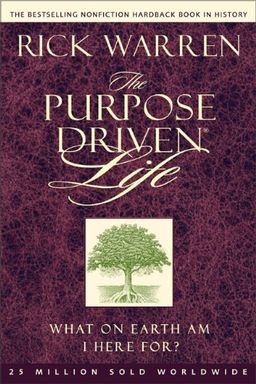
The Purpose Driven Life cover

The Purpose Driven Life

by Rick Warren

The Purpose Driven Life provides a transformative guide to discovering your life''s divine purpose. Through daily worship, community, and the guidance of the Holy Spirit, find meaning and fulfillment in every moment. This Christian roadmap offers insights into living a faith-filled, purposeful life.

A Life Built on God’s Purposes

What is the purpose of your life? Rick Warren’s The Purpose Driven Life answers this question by declaring that life’s meaning comes not from self-centered pursuits but from living according to God’s design. The book unfolds across forty days, guiding you through five divine purposes—worship, fellowship, discipleship, ministry, and mission—that together outline what it means to live a God-centered, eternally significant life. From beginning with God to fulfilling a personal mission, Warren crafts a step-by-step path to meaning, blending theology, Scripture, and practical application.

Identity Before Purpose

The journey starts with a radical assertion: “It’s not about you.” You were created by God and for God, and until you understand that truth, life will never make complete sense. Warren argues that self-help methods fail because they start with self. Instead, he directs you to begin with the Creator. You discover who you are by knowing whose you are—your purpose is revealed in relationship, not introspection. Quoting Bertrand Russell’s candid admission that a universe without God leaves life meaningless, Warren contrasts speculation with revelation, urging readers to open Scripture like an owner’s manual for their lives.

Earthly Life as Preparation for Eternity

Recognizing that your life extends beyond earth reframes everything. Earth is both a preparation and a test for eternity. Warren describes life as three metaphors: a test that refines character, a trust that measures stewardship, and a temporary assignment that reminds you of your heavenly citizenship. When you see yourself as an ambassador on assignment, suffering becomes training, not punishment, and success is measured by faithfulness rather than comfort or fame. (Note: Like C. S. Lewis, Warren reminds us we are “not bodies with souls, but souls with bodies.”)

Living for God’s Pleasure

Out of this eternal perspective grows the first life purpose: worship. Worship, Warren insists, is not confined to church or music—it is a lifestyle. “True worship,” he writes, “is surrender.” This surrender turns ordinary acts into offerings. Noah’s story demonstrates what pleases God: loving Him supremely, trusting Him completely, obeying wholeheartedly, praising continually, and using abilities faithfully. Worship is simply life aimed at pleasing God rather than self.

Formed for Family, Shaped for Service

The second and third purposes—fellowship and discipleship—show that faith is communal and transformative. You were formed for God’s family. Through adoption into His household, you gain belonging, purpose, and inheritance. Love becomes the ultimate mark of maturity, exercised not in theory but through commitment to a local church. Fellowship deepens through authenticity, humility, and forgiveness; conflict is inevitable but can become a vehicle for grace. Spiritual growth then continues as you become like Christ. The Spirit transforms character slowly but deliberately, using Scripture as His primary tool. Spiritual maturity, Warren cautions, takes time—like an oak tree, it grows through seasons of testing and patience.

You Were Shaped to Serve and Sent to Share

Warren teaches that your unique combination of gifts, passions, abilities, personality, and experiences—your SHAPE—equips you for ministry. Service is not optional; it is the mark of belonging to God’s family. Real servants focus more on obedience than recognition, seeing every interruption as a divine assignment. Finally, every believer is “made for a mission.” The Great Commission applies personally: you are sent into the world to share your life message—your testimony, lessons, and the Good News itself. Like Warren’s father’s dying exhortation to “save one more for Jesus,” the book’s conclusion challenges readers to live for eternal impact.

Summary of the Journey

In the end, Warren’s argument is coherent and cumulative: begin with God, see life as temporary, worship Him with all you are, grow in His likeness, serve others through your God-given shape, and fulfill your mission by sharing Christ’s love. Purpose blossoms from identity, matures in community, grows through Scripture and hardship, and culminates in service and mission. The result is not self-fulfillment alone but a God-centered, world-changing life of significance.


Begin with God

To understand your purpose, you must start with God rather than yourself. When you ask “What do I want from life?”, you chase self-made goals; when you ask “What does God want from me?”, you uncover eternal design. Warren contrasts “speculation” with “revelation.” Only the Creator reveals why you exist.

Identity Before Mission

Scripture anchors your identity in divine intention: you were created to bear God’s image, not define your own purpose. Colossians 1 reminds you that “all things were created by Him and for Him.” When this truth sinks in, you begin to trade self-centered thinking for God-centered living. Practical application includes replacing questions like “How can I be happy?” with “How can I honor God?”

Practical Steps to Live from Revelation

  • Pause daily to ask what God values most in your decisions.
  • Measure success by obedience, not popularity or possessions.
  • Rely on Scripture as your compass and memorize key verses as decision filters.

When you root identity in God’s revelation, life moves from aimless pursuit to purposeful progress. Every later principle—worship, fellowship, growth, service, and mission—rests on this foundation.


Live with Eternity in Mind

Warren asks you to view life through heaven’s horizon. Earthly existence is brief rehearsal for eternity. Accepting that you are made to last forever changes everything—how you spend time, use money, treat people, and endure pain.

Life as Test, Trust, and Temporary Assignment

The Bible’s metaphors organize life’s meaning. Life as a test refines virtue through trials. Life as a trust reminds you that possessions and talents are God’s, on loan for stewardship. Life as a temporary assignment keeps you detached from worldly obsession and focused on eternal citizenship. Fix your eyes on the unseen, Warren quotes, because the unseen is everlasting.

Choices Shaped by Forever

  • Invest time and energy into relationships and character rather than status or acquisitions.
  • Interpret suffering as refinement rather than punishment.
  • Simplify decisions by asking: “Does this serve God’s eternal purposes?”

When you orient daily life around eternal outcomes, values reorder themselves. You discover freedom from comparison and find resilience in hardship, knowing you are preparing for forever.


Worship Through Surrender

Warren redefines worship as a daily lifestyle of pleasing God. You were planned for God’s pleasure, and that calling extends beyond Sunday services. Worship means offering yourself completely to God because He first loved you.

What Pleases God

Using Noah as an example, Warren highlights five ways to bring God joy: love Him supremely, trust Him completely, obey wholeheartedly, praise and thank constantly, and use your abilities faithfully. These patterns shift worship from performance to devotion. True worship measures not your feelings but God’s delight.

Turning Ordinary Life into Worship

  • Do your work as if directly serving Christ, infusing labor with gratitude.
  • Surrender control over time, money, and outcomes—areas where faith is most tested.
  • Use interruptions as reminders to honor God amid routine.

Core of Worship

“True worship is surrender.” This surrender frees you from self-reliance and focuses your joy on God’s pleasure. In giving yourself away, you paradoxically discover who you were made to be.


Formed for God’s Family

You were created for community. Spiritual growth happens in relationships—not in isolation. Warren describes the church as God’s family where believers learn to love as He loves. Membership is not symbolic but practical: baptism marks your public belonging, and fellowship forms your spiritual backbone.

Love as the Central Command

Love is the supreme duty of God’s family. The most valuable gift you give others is your time. Warren lists love above knowledge or talent because eternity will measure how you treated others, not how much you accomplished. Therefore, relationships become spiritual training grounds for patience, forgiveness, and humility.

Practicing Real Community

Fellowship flourishes in small groups that embody honesty, sympathy, humility, and frequency. Conflict is inevitable, but reconciliation is required. Warren outlines biblically grounded steps to resolve differences: pray first, meet directly, confess your part, listen, and restore unity. Protecting church harmony becomes an expression of obedience.

When you commit to community and love practically, you mature emotionally and spiritually. Relationships become the incubators where grace grows.


Becoming More Like Christ

Discipleship is the third life purpose: learning to think, act, and love like Jesus. Warren cites Romans 8:29 to assert that God’s ultimate goal for you is not comfort but character. This transformation—known as sanctification—occurs through cooperation with the Holy Spirit and immersion in Scripture.

The Spirit and the Word

The Holy Spirit works within you, but you must partner by obeying. God often waits for your step of faith before releasing power; obedience activates transformation. Scripture is the primary tool in this process. Warren advises five practices—receive, read, research, remember, reflect—to internalize truth until it reshapes your thinking. (Note: This approach mirrors classical spiritual formation practices from St. Benedict’s lectio divina.)

Growth Through Trials and Time

Adversity is not an interruption but a classroom. Trials build endurance; temptations train response. God never wastes pain. Understanding the anatomy of temptation—desire, doubt, deception, disobedience—helps you prepare like Jesus did, resisting by recalling Scripture. Growth is slow, akin to a military campaign that liberates territory length by length. Keeping a journal of lessons learned ensures you remember God’s faithfulness and avoid repeating old mistakes.

The Patience Principle

Spiritual maturity has no microwaved version. Lasting strength grows through repetition, testing, and obedience. Pray “conform me,” not “comfort me,” Warren advises. Over time, you will become the kind of person who naturally reflects Christ’s life and love.


Shaped to Serve, Called to Care

Service expresses discipleship in action. Warren’s SHAPE concept—Spiritual gifts, Heart, Abilities, Personality, and Experiences—explains how uniquely you were designed for ministry. You serve best where your design and God’s purposes meet.

Discovering and Developing Your SHAPE

Each believer receives distinct spiritual gifts and natural talents. Passion, personality, and experience refine how you apply them. God even redeems past pain to prepare you for compassion-based service. To discover this shape, you must experiment, receive feedback, and embrace your limitations. Ministry effectiveness flows from authenticity, not imitation.

The Heart of Servanthood

Attitude matters as much as ability. Availability, humility, and faithfulness define real servants. They act quietly, without self-promotion, treating interruptions as God’s appointments. Warren quotes John Wesley’s motto—“Do all the good you can”—as a practical summary. Thinking like a servant means preferring others, seeing yourself as a steward of time and money, and focusing on God’s approval, not applause. True greatness, Jesus taught, is measured by the number of people you serve, not by how many serve you.

Kingdom Builders

Warren distinguishes between “Wealth Builders” who accumulate for self and “Kingdom Builders” who earn to give. Servants view every resource—money, time, talent—as tools for God’s agenda. This mindset turns daily life into mission fields for grace.


Living on Mission

The final purpose is mission: sharing God’s love with the world. Every Christian is commissioned to spread hope, beginning locally and extending globally. This mission gives ultimate significance to your story because it influences eternal destinies.

Your Life Message

Warren defines your “Life Message” in four parts: your testimony (how Christ changed you), your life lessons (what God taught you), your passions (what breaks or drives your heart), and the gospel itself. Writing and sharing these stories personalizes evangelism, turning experiences into bridges for others. Authenticity, not perfection, opens hearts.

Global Eyes, Local Hands

A world-class Christian prays and acts beyond borders. Acts 1:8 structures the outreach—starting with your own Jerusalem (local community) and expanding to the ends of the earth. Warren challenges believers to pray for nations, use news as prayer prompts, and take mission trips that widen compassion. His father’s parting words—“Save one more for Jesus”—serve as the book’s emotional cornerstone.

Your Purpose Statement

To sustain focus, Warren suggests writing a personal purpose statement that integrates all five purposes: worship, fellowship, discipleship, service, and mission. This statement becomes a compass for daily decisions, ensuring your life message aligns with God’s overarching plan.

Final Call

Life’s greatest use, Warren concludes, is to invest it in that which outlasts it. Living on mission transforms not only others’ destinies but also your legacy. By following God’s purposes day by day, you prepare not just for success—but for significance.

Dig Deeper

Get personalized prompts to apply these lessons to your life and deepen your understanding.

Go Deeper

Get the Full Experience

Download Insight Books for AI-powered reflections, quizzes, and more.