
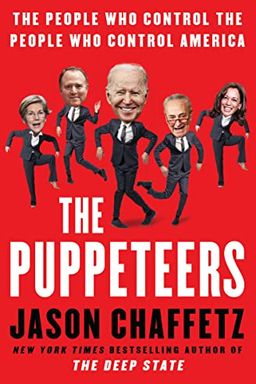
The Puppeteers cover

The Puppeteers

by Jason Chaffetz

The Fox News contributor and former congressman argues that liberals remain in power no matter who gets elected.

The B‑Team State

How do you keep democratic control when decisive power moves off the ballot? In this book, Jason Chaffetz argues that governing authority in America has migrated from elected officials—the visible A Team—to a durable, less-accountable B Team made up of career bureaucrats, asset managers, NGO networks, ratings agencies, union machines, and aligned consultants. He contends this coalition increasingly sets policy through rules, guidance, settlements, and finance—not statutes—so their decisions can outlive elections and resist popular correction.

At the center is a simple claim: if you only watch Congress and the White House, you miss where policy is actually made. The B Team writes the fine print, allocates capital, controls data, and steers enforcement priorities. To see the system, you must watch the lever points they use: ESG scoring, proxy voting, disparate-impact enforcement, off-budget slush funds, pandemic-era procurement, surveillance partnerships, “equity” action plans, and domestic-terror narratives that broaden federal police powers. The argument is not academic; it touches what you pay for energy, whether your kids’ schools stay open, and who gets audited, investigated, or quietly frozen out of capital markets.

From ballots to the bureaucracy

Chaffetz opens with the A Team vs. B Team distinction. The A Team—presidents, members of Congress, governors—comes and goes. The B Team—career regulators, nonprofit operators, ratings firms, and consulting networks—stays. He recounts an anecdote of a congressman told by staffers, “We ‘B’ here before you, we ‘B’ here after you, and we ‘B’ the ones to make the decisions.” That line captures the structural power shift. Agencies embed policy through rules and guidance that are difficult to unwind, while private institutions enforce preferred norms through ratings and capital access (a theme reminiscent of administrative-state critiques by Philip Hamburger and Christopher DeMuth).

Finance as policy without votes

ESG—environmental, social, governance—sits at the book’s core. Chaffetz likens it to a soft social-credit system: when mega–asset managers and ratings agencies coordinate, they can raise capital costs for disfavored sectors (oil and gas) and reward compliant firms. He points to BlackRock, State Street, and Vanguard’s concentrated ownership across the S&P 500 and their stewardship teams’ ability to set corporate priorities via proxy voting. The Exxon-Engine No. 1 episode becomes a case study: a small activist fund nudged by supportive giants won board seats and redirected investment away from hydrocarbons before market signals justified it (and before energy shocks like Russia’s invasion of Ukraine). The result, he argues, is policy by portfolio.

Enforcement and funding off-budget

The B Team also thrives where penalties and settlements replace appropriations. Under Eric Holder, the DOJ steered civil settlement dollars into “community relief” routed to favored nonprofits, bypassing Congress. The CFPB’s Civil Penalty Fund (financed via the Federal Reserve rather than appropriations) similarly channeled money to selected recipients. Chaffetz highlights the Fifth Circuit’s 2022 ruling challenging the CFPB’s funding mechanism to show how structural design can evade accountability—and then face constitutional backlash.

Legal doctrines that move markets

Doctrines like disparate impact fortify this machinery. If agencies and litigants can treat statistical imbalances as discrimination without proving intent, they gain immense leverage to demand settlements, impose new business rules, and redirect capital. The Redfin “digital redlining” case illustrates how neutral price thresholds became grounds for a discrimination suit that forced operational change. For you, this means underwriting, marketing, and platform rules can be recast as civil-rights violations based on outcomes, not actions—lowering the bar for intervention.

Capturing the classroom and crisis contracts

In K–12, Chaffetz argues unions function as a B Team within education. He documents the NEA’s and AFT’s political spending, influence over CDC reopening guidance, and an expansion into “community schools” that channel public dollars into allied vendors and data platforms. Pandemic procurement is the cautionary tale: emergency purchasing and AFT-linked PPE deals (e.g., Little Lives PPE; Empire Global Ventures ties) show how crises open shortcuts for politically connected actors. The result isn’t only waste; it’s path dependence—networks built in emergencies stay in peacetime.

Security narratives and the data dragnet

The book charges that domestic-terror rhetoric and surveillance tools extend B Team reach. He revisits FBI programs like PATCON to argue that undercover work sometimes crossed into provocation. He challenges current “most lethal threat” claims about white supremacy, citing disputed data and House Judiciary testimony alleging inflation of case counts. Parallel to this, agencies and contractors buy location and social-media data (Venntel, X-Mode) and even the Postal Service’s iCOP scans online posts. These practices—especially when they bypass warrants (see Carpenter v. United States for the legal baseline)—blur lines between safety and viewpoint policing.

Equity plans as an operating system

“Equity” action plans appear, to Chaffetz, as an administrative operating system for centralization. Coordinated by officials like Susan Rice, Jake Sullivan, and Brian Deese, they combine targeted benefits with enforcement tools and data collection. He connects this to efforts like the DHS Disinformation Governance Board (Nina Jankowicz) and CAP blueprints that contemplate purging problematic employees—signaling a fusion of HR, intelligence, and policy to enforce ideology inside institutions (note: supporters view these measures as overdue civil-rights corrections; Chaffetz warns about mission creep).

Your leverage: states and sunlight

Chaffetz’s solution lives in federalism. State treasurers like Utah’s Marlo Oaks can disentangle pensions from politicized managers. Attorneys general can force disclosures (Missouri’s lawsuit surfacing White House–platform pressure; Rob Flaherty emails). Governors can reframe DEI (Youngkin’s “Diversity, Opportunity & Inclusion”; DeSantis’s fights with corporate and academic “woke” initiatives). For you, that means the most effective pushback may be local: school boards, statehouses, and pension boards—where oversight can still bite.

In short, the book teaches you to watch power where it hides: in guidance letters and ESG term sheets, in penalty funds and procurement lists, in school reopening memos and data-broker invoices. If you track the B Team’s levers and engage at the state and local level, Chaffetz argues you can still bend policy back toward accountability.


Power, Schools, and Surveillance

What happens when crises hand powerful institutions a pretext to grow? In this book, Jason Chaffetz argues that the pandemic exposed and accelerated a pattern you can trace across K–12 education, federal law enforcement, and modern surveillance: entrenched organizations used COVID-era disruption to entrench themselves further. The result, he says, was preventable learning loss for children—especially the most vulnerable—paired with expanded union clout in schools, a federal response that chilled parental dissent, and a broader security apparatus that stretched definitions and tools to monitor ordinary citizens.

If you care about students, free speech, and accountable government, the book asks you to weigh how specific choices—keeping schools closed, reframing pandemic lessons into union growth agendas, tagging parent protests, and normalizing data collection—interlock. It’s not one scandal; it’s a system. The author connects local classroom decisions to national security narratives and surveillance technologies to show how, step by step, emergency justifications became enduring powers.

Schools as the proving ground

The story starts where you felt it first: schools. Researchers documented stark learning losses, and the book highlights that policy choices—not just the virus—shaped outcomes. Districts that reopened sooner saw smaller declines; those that stayed remote longer suffered bigger hits, particularly for Black and Latino students concentrated in large, union-heavy urban districts. The American Federation of Teachers (AFT) and its affiliates, the author argues, pushed for closures—via actions like a Washington, D.C. "sickout" and a San Francisco petition to "shut the whole system down"—and then advanced a post-pandemic agenda that grew staffing, funding, and union control inside schools.

You see the thread: first, a closure fight; then, a funding and influence push framed as equity and recovery. The book contends that relief dollars often prioritized support services over direct academic catch-up (San Francisco Unified reportedly used funds to retain counselors and nurses), and that parents, frustrated by both outcomes and rhetoric (such as an L.A. affiliate describing reopening as "rooted in white privilege"), organized and voted accordingly.

Parents vs. the security state

When parents showed up at school-board meetings, the conflict jumped levels—from local governance to federal law enforcement. In Virginia’s 2021 governor’s race, Glenn Youngkin capitalized on parental rights amid controversy over curriculum and COVID policies, after Terry McAuliffe said, "I don’t think parents should be telling schools what they should teach." Soon after, Attorney General Merrick Garland directed the FBI to address a "disturbing spike" in threats to school officials; an internal memo created a "threat tag" to track incidents. Senators like Chuck Grassley warned this would chill normal civic engagement. The author frames this as a template: redefine dissent as risk, then apply national tools to local debate.

Historical precedents and data games

To argue this isn’t new, the book revisits PATCON, a 1990s FBI operation that, according to whistleblower John Matthews and reporting cited by attorney Jesse Trentadue and journalist Roger Charles, allegedly went beyond infiltration to incitement inside extremist groups. The account includes claims of editorial suppression, recantation under pressure, and a court-appointed special master to probe witness tampering. Whether or not you accept every allegation, the episode functions as context: expansive missions plus opaque methods invite abuse.

The author also interrogates a contemporary foundation of domestic security policy: the claim that white supremacy is the "most lethal" threat. He critiques widely cited datasets (like CSIS) for opaque methods and asymmetric categorization—counting nonviolent or ambiguous right-wing cases (a peaceful Planned Parenthood protest; a hatchet brandished at a sign) while omitting or sidelining lethal incidents tied to other ideologies. Counting rules, he argues, can manufacture a narrative that channels surveillance and prosecution at one political cohort (a point that echoes debates in media studies about framing and agenda-setting).

From contact tracing to dragnet tools

Finally, the book tracks how surveillance capabilities—contact-tracing systems, data-broker purchases of location data, facial recognition, and agency programs like the Postal Service’s iCOP—migrated from public-health or security use cases to monitoring protest activity and online speech. Examples include government buys of geolocation data (IRS with Venntel, Secret Service via Babel Street or X-Mode), GAO-documented facial-recognition usage across 20 federal agencies, and concerns over CIA bulk collection under EO 12333 plus FBI backdoor queries of NSA data. The caution: emergency-born tools rarely stay in their lane.

Core claim

"Crises concentrate power. Unless you push back—locally, legally, and politically—those powers normalize and target you, your kids, and your speech."

What you’re asked to decide

The book doesn’t minimize COVID’s danger or deny the reality of racially motivated violence. It asks whether the responses were proportionate, transparent, and effective for students—and whether the same institutions now demand even more authority without fixing core problems. For you, that means scrutinizing union agendas for academic impact, insisting on open and consistent threat data, and pressing lawmakers to rebuild guardrails around surveillance. (Note: This echoes broader concerns about "function creep" in technology and policing.)

In short, the narrative moves from classroom harm you can measure, to political backlash you witnessed, to federal power you rarely see but increasingly feel. It’s a call to pair empathy for public servants with vigilance about mission drift—and to center student learning and civil liberties in every policy trade-off.


A Team vs. B Team

Chaffetz explains that the visible A Team (presidents, Congress, governors) no longer commands the most durable levers of policy. The quiet B Team—career officials, NGOs, asset managers, ratings agencies, consultants—implements and entrenches rules that outlast elections. The core difference is temporal: the A Team cycles; the B Team persists. When the B Team controls funding streams, rulemaking calendars, and enforcement discretion, it can make political change sticky regardless of who wins the next vote.

(Note: This argument echoes “administrative state” critiques across the political spectrum, but Chaffetz frames the tilt as asymmetrically exploited by progressives who prefer federalization and centralized rulemaking.)

How the B Team governs

The B Team operationalizes policy through a repeatable toolkit. It rotates loyalists into agencies and partner nonprofits to keep priorities aligned. It issues guidance and FAQs that re-interpret statutes without passing new laws. It wields settlement leverage to force industry-wide changes. It forges public–private partnerships that outsource coercion to ratings firms, index providers, and asset managers. And it uses grantmaking to fund aligned advocacy that generates the “demand” for the next round of rules.

Why federalization favors entrenchment

Moving decisions up from cities and states to federal agencies reduces voter leverage. If your school district or energy utility answers to Washington guidance, your local ballot matters less. Chaffetz points to the Biden administration’s equity directives across 90+ agencies as a structural example: simultaneous, government-wide pushes establish norms that are hard to unwind piecemeal. The SEC’s climate-disclosure regime under Gary Gensler similarly sets national compliance baselines independent of Congress.

Concrete agency examples

The CFPB’s Civil Penalty Fund shows how enforcement can finance policy. Rather than returning all fines to the Treasury, the fund pays “victim relief” and “education” grants to NGOs that often share the agency’s ideology. Leadership cycles amplify this pattern: Rohit Chopra’s return marked a renewed disparate-impact emphasis in lending, priming more enforcement and more funds. Parallelly, the DOJ’s Obama-era settlements with banks funneled billions to “community” programs outside congressional appropriations—policy by checkbook, not by statute.

Private intermediaries as enforcers

Private arbiters—S&P, Moody’s, MSCI; BlackRock, Vanguard, State Street—effectively extend the administrative project into markets. Ratings agencies embed ESG factors into credit, making it costlier for fossil-fuel firms to borrow. Passive managers vote your proxies, pressuring boards toward climate commitments and DEI targets. The net result is a shadow rulebook enforced by the cost of capital and investor relations, even where no statute compels change.

Where your leverage still works

Federalism and finance oversight remain levers you can pull. State treasurers and pension boards (e.g., Utah’s Marlo Oaks) can terminate managers who run “dual mandates” (politics alongside returns). Attorneys general can sue to expose coordination (Missouri’s social-media case). Governors can redirect DEI offices toward opportunity and viewpoint diversity (Youngkin) or challenge corporate–academic orthodoxy (DeSantis). School boards can force transparency on curricula and vendor contracts. In Chaffetz’s telling, these state nodes are where you can still reset incentives and reclaim accountability.

The lesson for you: don’t be dazzled by the A Team’s spectacles. Map the B Team’s incentives, follow the settlement dollars and stewardship memos, and focus your civic energy where decision rights still live—often close to home.


Pandemic Closures’ Academic Cost

Chaffetz starts where the data are clearest: students lost ground, and those losses were not evenly distributed. He cites research summarized by The New York Times and scholars like Thomas Kane showing that students who spent most of 2020–2021 in person suffered about a 20 percent learning loss in math, while those who learned remotely lost roughly 50 percent. You can feel the scale in your own community: sudden pivots, unstable schedules, and the grind of Zoom instruction for children who needed structure and support.

Why some districts did better

The book emphasizes that policy choices mattered. Conservative-led districts tended to reopen earlier; progressive, union-dominated districts, especially in large cities, stayed remote longer. The American Federation of Teachers (AFT) and local affiliates often argued for continued closures on safety grounds. In Washington, D.C., an AFT affiliate organized a "sickout" to block reopening; in San Francisco, nearly 600 teachers petitioned to "shut the whole system down." These actions, the author argues, disproportionately harmed minority and low-income students who are heavily concentrated in those districts.

Who fell furthest behind and why

Remote learning amplified existing inequities. If your child lacked reliable internet, a quiet workspace, or adult help during work hours, every day’s lesson demanded more than you could supply. The book links these obstacles to the lopsided losses among Black and Latino students, noting that staying closed longest where these students live meant compounding disadvantage. Thomas Kane called it the largest increase in educational inequity in a generation—a warning that today’s gaps become tomorrow’s earnings and opportunity divides.

Where the money went

COVID relief dollars poured into districts, but not always into direct academic catch-up. San Francisco Unified reportedly spent funds on counselors and nurses—support roles the AFT had long favored—rather than intensive tutoring or extended learning time at scale. The author doesn’t deny that students needed mental-health support; he argues that if you measure outcomes, the core crisis was academic, so investments should have primarily targeted reading and math recovery with evidence-backed interventions.

The rhetoric that hardened battle lines

The politics of reopening got personal. In Los Angeles, an AFT affiliate described pressure to reopen as "rooted in white privilege," a framing that alienated many parents of color pleading for in-person school. Chaffetz notes that parental testimony in Los Angeles and San Francisco captured a broader mood: frustration that adults with secure salaries could delay reopening while children without resources bore the costs. (Parenthetical note: This mirrors research showing that school closures hit low-income families hardest due to childcare constraints and learning environment gaps.)

From classrooms to ballots

The fallout moved voters. Polling in 2022 showed households with children trending more Republican, which the book links to anger over closures and curriculum fights. Whether or not you see a permanent realignment, the Virginia governor’s race became emblematic: schools transformed from routine local governance to the most visceral arena of national politics, with parents reasserting themselves as a counterweight to union influence and district bureaucracies.

Takeaway

Learning loss was measurable and unequal, and decisions—not just pathogens—drove the gap. If students paid the bill, the book asks who should be accountable: unions, district leaders, or elected officials who deferred to them.

What you can do locally

If you’re a parent or taxpayer, focus your advocacy on high-dosage tutoring, transparent recovery goals, and public dashboards by school. Ask your district to show how relief dollars map to academic outcomes, not just staffing levels. Press for contingency plans that keep schools open in future disruptions, with priority supports for students lacking tech, space, or supervision. The most equitable policy, the book suggests, is the one that keeps actual classrooms open.


ESG as Social Credit

Chaffetz argues that ESG functions as a soft social-credit system: it rewards firms that adopt specific climate and social policies and restricts capital for those that do not. Because major asset managers and ratings agencies set the terms, ESG becomes less about investor preference and more about private governance with public consequences. If your retirement sits in passive index funds, your voice is often delegated to stewardship teams whose priorities you may not share.

(Parenthetical note: ESG advocates see it as risk management and values alignment; Chaffetz focuses on coercive effects when a few gatekeepers dominate both votes and credit.)

Concentration enables leverage

BlackRock, Vanguard, and State Street frequently rank among the largest shareholders in S&P 500 companies. They control proxy votes for millions of passive-investing clients. This concentration lets a small cadre influence director elections, executive pay, and strategic pivots. Larry Fink’s annual letters become signals to boardrooms. Brian Deese’s move from BlackRock to lead Biden’s National Economic Council symbolizes policy–finance revolving doors that reinforce alignment.

The Exxon case as proof of concept

Engine No. 1, a new activist fund, won board seats at Exxon in 2021 by convincing large passive managers and proxy advisors that Exxon should invest less in oil. The move preceded an energy crunch and the Ukraine war. Chaffetz uses this to show how activists can effectively legislate climate policy via boards before consumer demand or geopolitics justify the shift, potentially reducing supply and raising prices later.

Ratings and rulemaking as twin drivers

Credit raters like S&P and Moody’s embed ESG into sovereign, municipal, and corporate assessments. A lower score increases borrowing costs, steering capital away from disfavored sectors. Meanwhile, the SEC under Gary Gensler pushes climate disclosures that standardize ESG data and raise compliance costs, turning voluntary frameworks into quasi-mandates. Combined, they shape markets without Congress voting on a climate bill.

Economic and security spillovers

When fossil-fuel investment falls faster than demand, you get price spikes and shortages. Chaffetz cites Europe’s reliance on Russian gas as a cautionary tale: shutting off hydrocarbons without resilient alternatives invites geopolitical risk. He also notes renewables’ heavy supply-chain dependence on China (polysilicon, rare earths), arguing that rapid “net zero” alignment can swap one dependency for another.

Protecting beneficiaries and pluralism

For your 401(k), the issue is fiduciary duty. Do ERISA trustees pursue maximum risk-adjusted returns or political goals? State treasurers from Utah to West Virginia have challenged BlackRock and ratings firms for “politically subjective” metrics and pulled funds when managers couldn’t separate stewardship activism from pure returns. Chaffetz recommends transparency (publish proxy votes and stewardship policies), choice (pass-through voting for retail investors), and competition (diversify managers to avoid common-ownership monocultures).

His bottom line for you: ESG, as currently practiced by concentrated gatekeepers, governs the economy by reallocating capital. If you want pluralism in corporate strategy and energy abundance, you need fiduciaries and regulators who decouple politics from portfolios—and states willing to enforce that decoupling.


Unions’ Post-COVID Playbook

After the closures fight came the reconstruction fight: who defines recovery? Chaffetz summarizes the American Federation of Teachers (AFT) and National Education Association (NEA) proposals as a four-part expansion—more specialized staff, more tutoring and small-group instruction, union-centered professional development and apprenticeships, and a nationwide push for full-service community schools. The unions framed this as addressing "deep structural inequities" and structural racism revealed by the pandemic. The author sees something else: a bid for more government, more unions, and more taxpayer dollars—without tackling the root academic crisis.

What the agenda includes

First, staffing. The AFT and NEA call for "substantially more" specialized instructional support personnel: counselors, therapists, school psychologists, speech-language pathologists, nurses, and behavioral specialists. Second, remediation. They prioritize additional tutoring—virtual and in person—and smaller groups with more teachers to close "opportunity gaps." Third, union-centered development. They insist on union-developed-and-led professional development and propose taxpayer-funded apprenticeship programs for recent graduates, negotiated into contracts. Fourth, community schools. They urge federal investment to expand wraparound services—coordinating child care, healthcare, and social services—from pilot programs to a national model.

The author’s critique

Chaffetz argues that while some elements (like tutoring) can help, the package largely grows unionized headcount and influence rather than directly and measurably boosting core learning. Training non-teacher staff with a "focus on equity and racial and social justice" may reflect ideological priorities that aren’t synonymous with evidence-based reading and math recovery. He questions whether union-run PD and apprenticeships, subsidized with public dollars, would crowd out diverse providers and pedagogical competition (compare debates over district-run vs. third-party tutoring marketplaces).

Examples on the ground

The book points to San Francisco Unified, which reportedly used relief funds to retain counselors and nurses—jobs AFT had long supported—rather than scaling proven academic interventions. It highlights union affiliates’ push to codify new roles via collective bargaining, locking in higher baseline spending. In practice, you might see expanded Student Support Teams and PD days branded as equity training, while tutoring implementation remains inconsistent and lightly measured.

Questions you should ask

Chaffetz doesn’t tell you to oppose supports or community services outright. He asks for clarity: What’s the evidence each role improves reading and math at scale? How will districts publish recovery targets and report disaggregated results? Who designs PD content and reviews it for ideological tilt and instructional rigor? If unions run PD and apprenticeships, what are the guardrails to ensure open competition, transparent curricula, and measurable outcomes?

Principle

Tie dollars to demonstrated gains in student learning, not just to headcount or hours trained. If it doesn’t move proficiency, rethink it.

A balanced way forward

You can support targeted mental-health and health services while demanding academically focused spending and competitive procurement for tutoring. Community schools can coordinate help for the neediest families, but their expansion should not come at the cost of classroom time, teacher effectiveness, and curriculum quality. (Note: Researchers across the spectrum agree that high-dosage tutoring and explicit instruction are among the highest-impact recovery tools.) The book’s broader point: recovery is too urgent to become a vehicle for institutional wish lists untethered to measurable gains.


Enforcement Without Congress

You expect Congress to control the purse. Chaffetz shows how agencies have built parallel funding channels through fines, settlements, and off-budget structures that empower political allies while evading appropriations. The Department of Justice and the Consumer Financial Protection Bureau are the principal case studies, illustrating how enforcement can morph into fiscal policy.

(Note: Critics of these practices frame them as necessary consumer relief; Chaffetz argues the design sidesteps democratic accountability and fuels partisan ecosystems.)

DOJ’s settlement pipelines

During the Obama years, Attorney General Eric Holder’s DOJ negotiated civil settlements that required banks to fund “community” programs directly. Instead of Congress appropriating dollars, defendants paid third-party groups chosen by the executive branch. Chaffetz calls this a shadow budget: money flows to ideological allies who then deliver political value—mobilization, litigation, or narrative support—outside legislative scrutiny.

CFPB’s insulated funding

Created under Dodd-Frank, the CFPB draws funds from the Federal Reserve rather than annual appropriations. Its Civil Penalty Fund pays victim relief and finances “education” efforts, with recipients often coming from progressive NGO networks. Leadership matters: Rohit Chopra’s tenure signals aggressive enforcement, including disparate-impact theories in lending that expand the pool of penalty dollars. In October 2022, the Fifth Circuit ruled the CFPB’s funding mechanism unconstitutional under the Appropriations Clause, underscoring constitutional risk in agency design.

Guidance as de facto law

Agencies increasingly govern by guidance—bulletins, FAQs, and supervisory letters that re-interpret statutes and nudge industry behavior. Though formally nonbinding, guidance often carries implied enforcement risk. Companies comply to avoid audits or penalties. Combined with settlement leverage, guidance becomes quasi-legislation enacted by regulators rather than representatives.

Political returns on enforcement

Redirected settlement funds do double duty. They finance services and create a cadre of aligned nonprofits dependent on an enforcement-driven cash flow. Those organizations lobby for the rules that generate more enforcement. This positive feedback loop—penalties to nonprofits to advocacy to rules to penalties—locks in a policy pipeline resilient to elections. If you’re a banker, lender, or small-business owner, the practical effect is predictable: higher compliance cost, more legal exposure, and less room for neutral, market-based decisions.

Restoring the power of the purse

Chaffetz’s remedies are straightforward and localizable. Congress should bar third-party payment provisions in settlements and require funds to go to the Treasury. Inspectors general and GAO should audit penalty funds and grantees. States can refuse to partner with agencies that condition participation on ideological training or equity quotas. And you can demand line-item transparency: who receives settlement dollars, for what purpose, and with what outcomes.

If policy is being written by checkbook, then putting appropriations back in the sunlight, Chaffetz argues, is your fastest way to shrink the B Team’s off-budget state.


Parents vs. The State

The pandemic didn’t just change schools; it reactivated parents as a political force. In Virginia’s 2021 gubernatorial race, Glenn Youngkin won after centering parental rights and school accountability. His opponent, Terry McAuliffe, handed him a galvanizing line: "I don’t think parents should be telling schools what they should teach." That sentence, replayed endlessly, crystallized the sentiment many of you carried from kitchen tables to school-board microphones: we expect a say in what our kids learn and how they’re treated.

How grievances converged

Mask mandates, extended closures, remote instruction failures, and concerns over curriculum on race and gender fueled packed, emotional meetings in districts like Loudoun County. Black parent Shawntel Cooper declared, "CRT is racist; it is abusive; it discriminates against one’s color," capturing a broader discomfort with frameworks parents saw as divisive. Whether you agreed with every claim, you couldn’t miss the energy: parents across the spectrum organized slates, ran for office, and made schools a top voting issue.

The federal response

As tensions rose, Attorney General Merrick Garland sent a memo citing a "disturbing spike" in harassment and threats against school officials, directing the FBI and DOJ components to coordinate responses. A leaked internal DOJ email revealed a new "threat tag" to track incidents involving school administrators, board members, teachers, and staff. To many parents, the message was unmistakable: your activism might now live in a federal database.

Why this chilled speech

Senators Ted Cruz, Mike Lee, and Marsha Blackburn raised concerns about conflicts and civil liberties; Senator Chuck Grassley warned about "a chilling effect" that equates dissent with domestic extremism. The book’s argument is not that threats don’t happen—they do and should be prosecuted—but that federal counterterrorism tools should not hover over routine, passionate civic discourse. If the FBI is in the room—literally or figuratively—many ordinary people will stay home.

Precedent and principle

Chaffetz frames this as a constitutional issue: local self-government depends on fearless participation. Labeling unruly public comment as a security problem inverts accountability—citizens become subjects. The author connects this to a pattern seen elsewhere in the book: redefine opposition as risk (whether by data categorization or rhetoric), then deploy tools built for serious security threats against everyday politics. (Note: Civil libertarians across ideological lines have long warned about mission creep from terrorism policy to domestic governance.)

Civic norm

Protect the forum, punish true threats. Don’t invert the rule by surveilling the forum and missing the learning loss.

What you can do

If you speak at meetings, remain calm, specific, and factual—then follow up in writing to create a clean record. Organize parent data teams to track district outcomes against spending. Support candidates who commit to transparency, evidence-based academics, and respectful debate. The goal isn’t endless confrontation; it’s a reset of governance so that student learning, not institutional protection, drives decisions.


Disparate Impact Leverage

Civil-rights enforcement moved from punishing discriminatory intent to policing statistical outcomes. Chaffetz argues this shift to “disparate impact” gives agencies and activists a powerful lever to reshape markets and extract settlements, even when policies are neutral on their face. For you, that means pricing rules, underwriting standards, and platform features can be recast as discrimination if they produce uneven group outcomes—no proof of bias required.

(Parenthetical note: Proponents say disparate impact is essential to reveal structural barriers; Chaffetz warns it invites ideological enforcement and rent-seeking.)

From treatment to impact

Disparate treatment requires evidence of intent; disparate impact requires only a measurable disparity across protected groups. Agencies like the EEOC advanced this framework, and financial regulators picked it up for lending and marketing. The lower evidentiary bar enables more investigations and negotiated remedies, which in turn fund nonprofits and normalize new business constraints.

Redfin’s “digital redlining”

Redfin set minimum-price thresholds to avoid losing money on low-priced listings. Plaintiffs, led by the National Fair Housing Alliance (NFHA), argued that because low-priced areas correlate with minority neighborhoods, Redfin’s neutral policy had discriminatory impact. Even as Redfin espoused equity rhetoric, it faced costly legal exposure. Chaffetz presents this as emblematic: sincere public alignment does not immunize you from statistical claims, and business logic can be subordinated to outcome parity.

Politics and incentives

Chaffetz highlights Rep. Maxine Waters’s emphasis on disparate-impact enforcement in financial services and notes NFHA’s federal grants and major-donor backing (e.g., Open Society Foundations). The mix of political priority, funding streams, and low litigation thresholds creates a system where companies face a choice: settle and change core operations or risk reputational and legal war. Either way, market rules migrate to the courtroom.

Downstream effects on you

Banks may loosen underwriting or pull products from markets to avoid disparate outcomes, reducing credit access for some borrowers. Real-estate platforms might alter algorithms in ways that degrade user experience or raise costs. Municipal issuers could face suit risk that raises borrowing costs. The aggregate effect is slower innovation and pricier services as legal risk is priced in.

Rebalancing the standard

Chaffetz suggests reforms: require plaintiffs to show a workable, less-burdensome alternative; emphasize business necessity; and restore more weight to intent in enforcement decisions. He also urges transparency around settlement recipients and metrics so the public can judge whether remedies help consumers or mainly fund advocacy.

For you, the takeaway is practical: audit your policies for unintended disparities, but resist abandoning sound business logic to chase statistical symmetry. When the law becomes a numbers game, clear evidentiary standards are your best defense against ideological capture.


Manufactured Threats? PATCON Lessons

To argue that today’s overreach has roots, the book revisits PATCON—the FBI’s 1990s operation targeting militant right-wing groups like the Ku Klux Klan and neo-Nazi networks. Officially, PATCON aimed to monitor and preempt domestic terrorism. But according to accounts gathered by attorney Jesse Trentadue and journalist Roger Charles, an FBI asset named John Matthews (a former Marine) said the mission went further: "infiltrate and incite." Matthews reported infiltrating more than 20 militia, libertarian, gun-rights, and racist groups, and alleged that agents provided ideas, instructions, and even explosives in cases that later became prosecutions.

A contested, fraught history

The narrative includes a planned Newsweek exposé that was reportedly edited down, a subsequent recantation by the whistleblower under alleged pressure, and the whistleblower’s disappearance from public view. In a related proceeding, Judge Clark Waddoups appointed a special master to investigate possible witness tampering, and Trentadue’s FOIA lawsuit dragged on for years. These details do not prove every allegation; they demonstrate how difficult it is to verify claims once an operation is classified and dispersed across agencies.

Why PATCON matters now

Chaffetz invokes PATCON as a cautionary tale: when authorities both surveil and stimulate plots, the line between prevention and provocation blurs. If you later see headlines about a foiled conspiracy, you can’t easily tell whether the FBI quelled a danger or midwifed a narrative that justifies more resources and authorities. The lesson isn’t cynicism about all counterterrorism; it’s skepticism about operations run behind heavy secrecy and assessed by their arrests rather than by transparent risk reduction.

Parallels to modern practice

The book pairs this history with recent patterns: aggressive domestic-labeling of threats, a widened net over political dissent (as in the school-board "threat tag"), and the use of broad datasets to retroactively link incidents to preferred narratives. It argues that once you accept incitement and expansive surveillance as normal, targets can shift from violent cells to ideological opponents under the banner of public safety. (Parenthetical note: Similar concerns surfaced in debates about FBI use of informants in mosque communities after 9/11.)

Guardrail

Investigate crimes; don’t incubate them. Measure success by reduced violence and transparent oversight—not by body counts of sting operations.

What you should watch

When authorities announce domestic terrorism priorities, ask to see the definitions, counting rules, and independent audits. Support FOIA reform that speeds access and penalizes stonewalling. Encourage bipartisan oversight—abuse risks are not partisan, they’re structural. The PATCON chapter is less about relitigating the 1990s than about teaching you the questions that keep today’s operations honest.


Schools as Power Hubs

Chaffetz argues teachers’ unions evolved from labor advocates to political machines that shape policy, curriculum, and procurement—functioning as a B Team inside education. He profiles the NEA and AFT’s leaders (e.g., Randi Weingarten) and spending to show how unions aligned with broader progressive agendas, from “racial justice” curricula to pandemic guidance and content-moderation partnerships (AFT’s work with NewsGuard). The result, he says, is that classrooms and budgets increasingly reflect ideology and vendor networks rather than parental priorities or instructional outcomes.

(Note: Union advocates see this as holistic support for students and staff; Chaffetz sees mission creep and political capture.)

Community schools as expansion vehicle

“Community schools” broaden the mission: health clinics, counseling, food pantries, and wraparound services co-located at school. Chaffetz warns these models create procurement ecosystems—contracts, data-collection platforms, and nonprofit partners—where unions and allied vendors wield influence. New York City examples show large allocations and embedded partners who can outlast changes in school boards or city halls.

Pandemic-era leverage

FOIA emails reveal AFT input on CDC reopening guidance. Chaffetz links that influence to prolonged closures and strict masking regimes in big blue districts. He argues union power increased during emergencies, as districts spent federal relief dollars on ideological programming—ethnic studies initiatives, anti-bias training—rather than targeted learning recovery. United Teachers Los Angeles’s 2020 demands (Medicare-for-All, wealth taxes, $500B bailouts) exemplify political bargaining embedded in health policy negotiations.

Procurement and crony risk

Chaffetz details AFT’s PPE efforts and ties to Empire Global Ventures (Alexandra Stanton, Sam Natapoff; links to Rosemont Seneca circles). Transactions with CECII and Stanton’s Little Lives PPE raise conflict-of-interest questions. In crisis procurement, speed trumped vetting, creating opportunities for insiders. He argues these networks become sticky: once a vendor integrates with district processes and data, contracts renew by inertia.

Parents and transparency

The Leon County case of January Littlejohn—where a school crafted a gender-transition plan for her daughter without parental notification—illustrates policymaking that sidelines parents. Chaffetz links such policies to union-backed guidance and national advocacy ecosystems. He urges you to demand line-item transparency for community-school vendors, curriculum repositories (e.g., Share My Lesson, Rethinking Schools), and pandemic-spending audits.

Resetting governance

The fix starts local: run for school boards, insist on consent-based data practices, and require competitive bidding with public vendor disclosures. At the state level, condition education grants on transparency and parental-rights protections. The overarching point: if schools become hubs for social services, governance must expand parental oversight at the same pace—otherwise union and vendor priorities will crowd out instructional mission.


Counting Threats, Shaping Narratives

Public policy follows numbers, so whoever defines the dataset often defines the debate. The book scrutinizes the now-familiar assertion from President Biden and DHS Secretary Alejandro Mayorkas that white supremacy is the "most lethal" domestic threat. While acknowledging real racially motivated crimes, Chaffetz argues that some of the evidence used to justify a singular focus suffers from opacity and bias, especially datasets like those produced by the Center for Strategic and International Studies (CSIS).

Methodology matters

Chaffetz flags three problems: incomplete or non-public incident lists that prevent independent verification; asymmetric definitions that expand "right-wing" to include threats or nonviolent protests while narrowing left-wing or Islamist categories; and specific categorizations that strain common sense. For example, CSIS reportedly counted a peaceful October 10, 2020 Planned Parenthood protest in Fort Myers as a "right-wing domestic terrorism incident," and a June 3, 2020 Longmont case—where a man briefly brandished a hatchet and cut a sign before leaving—as terrorism. Meanwhile, high-profile left-associated incidents like the killing of retired police captain David Dorn during BLM unrest or the Waukesha parade attack did not appear in the same frame, either by selection window or categorization.

Why asymmetric counting is dangerous

When you treat threats and nonviolent protests on one side as "terrorism" but exclude comparable acts or fatalities on the other, you do more than bias a report—you build a policy scaffold. Budgets, task forces, media focus, and investigatory zeal then skew in one direction. The book’s point isn’t to invert the script and declare another ideology the chief menace; it’s to demand transparent inclusion criteria, accessible datasets, and consistent coding so that citizens and lawmakers can trust the threat picture.

A call for evidence discipline

Chaffetz aligns with a basic social-science norm: publish the list, justify the categories, and invite replication. If domestic threat assessments are to guide surveillance powers and prosecutorial priorities, they need open-source scrutiny. (Note: This echoes concerns in academic circles about p-hacking and selective reporting—different field, same incentive problems.) Consistency and transparency protect everyone: if the case for a heightened focus on any ideology is strong, it should survive full sunlight.

Rule of thumb

Before you accept a sweeping security claim, ask: What’s in the denominator? What’s in the footnotes? Who checked the coding?

How this links back to schools

This isn’t an abstract fight among think tanks. The logic of inflated metrics can travel—from counting incidents to justifying the FBI’s presence at school-board meetings. If parents become data points on an extremism dashboard, their speech gets chilled even when no law is broken. The same discipline you want in recovery spending (show me the gains) applies here: show me the methodology.


Closures and Inequity

You lived the school closures of 2020–21. Chaffetz argues unions, not just public-health data, drove prolonged closures that worsened inequality—especially for Black, Latino, and low-income students concentrated in big blue cities. He cites research (Thomas Kane and colleagues) showing roughly 20% math losses for mostly in-person students versus about 50% for remote students, calling it a potential “generational loss.” The gap reflects policy choices: where unions pressed hardest, classrooms stayed shut longer.

(Parenthetical note: Debates continue over optimal reopening timelines; Chaffetz’s emphasis is on differential harm and political incentives.)

How decisions amplified gaps

Students in conservative-led communities returned earlier; urban districts in progressive regions remained remote. Remote students lacked stable broadband, quiet space, and mid-day parental support. In Washington, D.C., an AFT affiliate staged a sickout. In San Francisco, hundreds of teachers urged “shut the whole system down” as districts routed relief dollars to hires like counselors and nurses rather than accelerated academics. United Teachers Los Angeles cast reopening resistance as anti–“white privilege,” while tying return-to-class to national policy concessions.

Political realignment

Parents rebelled at school boards, and the Virginia governor’s race turned on parental rights. Terry McAuliffe’s assertion that parents shouldn’t tell schools what to teach helped Glenn Youngkin win. Polls showed households with children shifting sharply toward Republicans. Chaffetz reads this as a backlash against union-driven closures and curricula politics—a warning that education policy can reorder coalitions.

Missed recovery opportunity

Post-pandemic, unions prioritized more staffing and expanded community-school models—creating more government and union jobs—rather than structural fixes like high-dosage tutoring, intensive summer academies, or mastery-based progression. The result, Chaffetz argues, was a resource diversion from direct learning recovery to permanent programmatic growth.

What you can do

Demand district-by-district recovery dashboards: hours of tutoring delivered, student growth by subgroup, vendor spend, and return-on-investment. Condition new hiring on measurable gains. Support policies that prioritize in-person learning and keep closures a last resort. And insist that future emergency guidance exclude political bargaining; public health should not be a lever for unrelated agendas.

Chaffetz’s bottom line for you: intentions don’t erase outcomes. If emergency responses widen gaps, re-center metrics and accountability on learning, not optics.


The New Surveillance Architecture

Chaffetz traces how crisis-driven tech and legal shortcuts outlive the emergencies that birthed them. During COVID, contact-tracing apps proliferated worldwide. In China, health codes reportedly turned protesters’ status to red during a bank-run demonstration, blocking travel—a vivid example of public-health systems repurposed to suppress dissent. The book warns that function creep isn’t a China-only risk; in the United States, agencies increasingly sidestep oversight by buying data, expanding biometric databases, and deputizing unlikely actors to monitor speech.

Buying your movements

Rather than seek warrants, U.S. agencies at times purchased location data harvested from apps via data brokers. The IRS previously bought Venntel’s geolocation data, raising concerns in light of the Supreme Court’s Carpenter ruling on cell-site data. The Secret Service and other agencies reportedly procured data from vendors like Babel Street or X-Mode, while analytics firms such as Mobilewalla publicly profiled the demographics of George Floyd protest crowds. Aggregated or anonymized, these datasets still enable powerful inferences—without the friction of probable-cause review.

Unexpected watchers

The Postal Service’s Internet Covert Operations Program (iCOP) expanded after the George Floyd protests to trawl social media for "inflammatory" content and later assisted January 6 inquiries. For most citizens, USPS evokes stamps, not surveillance. Yet the program illustrates how mission creep can convert specialized agencies into domestic intelligence helpers—without the cultural or procedural guardrails of traditional law enforcement.

Faces in the database

GAO reporting shows the FBI’s facial-recognition holdings run to hundreds of millions of images, many sourced from non-criminal databases. Twenty federal agencies use facial recognition, including Fish & Wildlife, NASA, and USPS. Accuracy gaps and racial disparities in misidentification raise serious risks: a false match can trigger an arrest or reputational harm, while the mere existence of vast searchable galleries chills anonymity in public life. When combined with location data, the state can reconstruct your movements and associations at a keystroke.

Legal shadows and backdoors

The book flags concerns that the CIA conducts bulk collection under Executive Order 12333—outside the congressional and court oversight that binds FISA programs. It also cites declassified opinions faulting FBI "backdoor searches" of NSA-collected data for compliance lapses. The through-line is simple: if agencies can query vast datasets for domestic purposes without meaningful audits, privacy protections become paper promises.

Risk pattern

Emergency-born tools + opaque procurement + elastic missions = a durable surveillance state that drifts toward politics.

Your playbook

Support legislation that requires warrants for government data purchases, logs and audits facial-recognition searches, and sunsets emergency authorities unless reauthorized with public reporting. Ask state AGs to issue guidance limiting agency use of data-broker feeds without court orders. Locally, push districts to publish surveillance policies for student devices and platforms—if adults face dragnet risks, students do too. (Note: Scholars of surveillance capitalism have long warned that markets for personal data will inevitably tempt state use.)


Guardrails and Action Steps

The book closes by turning critique into a roadmap you can use to protect students and civil liberties. The core move is to realign incentives: measure what matters, publish it, and attach consequences. In education, that means tying dollars to demonstrable gains in reading and math; in security, it means demanding transparent definitions, auditable datasets, and judicial checks before surveillance tools touch domestic politics. The same principle governs both realms: power expands until citizens reset the rules.

Rebuild academic focus

Insist your district publish recovery goals by grade and subgroup, then report quarterly on progress. Prioritize high-dosage tutoring, extended learning time, and evidence-based curricula over diffuse staffing expansions. If unions propose PD or apprenticeships, require competitive procurement, open curricula, and independent evaluations. Relief dollars should sunset unless programs show gains. (Note: This mirrors best practices in philanthropic grantmaking—milestones, transparency, and course correction.)

Protect the civic forum

At school-board meetings, pair passionate advocacy with procedural discipline: submit written remarks, cite sources, and request formal responses. Support policies that separate security from speech—clear protocols for handling true threats, zero tolerance for violence, and ironclad protections for robust criticism. Encourage bipartisan statements from officials affirming parents’ right to question curriculum and policy without being treated as security risks.

Constrain surveillance creep

Back warrant requirements for government purchases of location data; require public inventories of agency data sources and facial-recognition tools; mandate third-party audits and accuracy tests, with penalties for misuse. Press Congress to narrow EO 12333 bulk collection and to tighten rules around FBI backdoor queries. Advocate for independent privacy offices with subpoena power inside major agencies—sunlight beats slogans.

Fix threat assessment standards

Demand that domestic extremism datasets publish full incident lists, coding rules, and inclusion/exclusion rationales. Require bipartisan academic panels to review methodologies before agencies cite them in strategy documents. If a threat is indeed "most lethal," it should withstand replication and scrutiny. This improves policy and deters the temptation to use security labels as political weapons.

North Star

Center the people most at risk—students and ordinary citizens—and force institutions to prove their programs make them safer and smarter, not more surveilled.

Coalitions that win

Build alliances that cross party lines: parents who want schools open and effective; civil libertarians wary of dragnet tools; community leaders who value both safety and rights. Institutional power is resilient, but coalitions that demand evidence, transparency, and accountability tend to prevail—because they offer something better than outrage: results.


Domestic Terror Playbook

Chaffetz challenges the Biden-era framing of “domestic terrorism” as primarily a right-wing threat warranting expanded surveillance and policing of political speech. He revisits historical programs (e.g., FBI’s PATCON) to argue the government has a record of crossing the line from monitoring to provocation. Today, he claims, agencies inflate case counts, conflate nonviolent dissent with violence, and deploy the label to justify censorship partnerships and investigations into ordinary civic activity (like school-board opposition).

(Note: Agencies defend prioritization based on threat assessments; Chaffetz disputes the underlying data and warns of civil-liberty erosion.)

History and data disputes

PATCON allegations and whistleblower John Matthews’s claims set the backdrop: infiltration sometimes shaded into incitement. In the present, Chaffetz critiques studies (e.g., CSIS) and DHS claims that white supremacists are the “most lethal threat,” arguing methodologies overweight right-wing incidents while undercounting others. A House Judiciary report and FBI whistleblowers alleged pressure to reclassify cases to inflate domestic-extremism stats.

School boards and chill

Merrick Garland’s DOJ memo directing FBI coordination on threats to school officials drew fire from Senators Ted Cruz, Chuck Grassley, and others who warned of chilling parental speech. Chaffetz sees the memo as symptomatic: national-security tools drifted into routine democratic disputes, where heated criticism becomes a pretext for federal scrutiny.

Narrative control and platforms

State lawsuits (e.g., Missouri AG Eric Schmitt) exposed communications between the White House (Rob Flaherty) and social platforms about moderating content. For Chaffetz, this shows how domestic-terror rhetoric pairs with censorship pressure, creating a loop: officials cite security risks to demand platform enforcement that then narrows permissible debate—especially on COVID policies and elections.

Guardrails for liberty

Chaffetz calls for clear, consistent definitions of threats; prohibition on reclassification quotas; robust whistleblower protections; and transparency around platform–government contacts. For you, the action is vigilance: document interactions with school districts and local officials, file FOIAs, and support AGs who litigate to surface coercive moderation. Security must target acts, not viewpoints.

In brief, the book warns that once the domestic-terror lens stretches to cover civic disagreement, it rarely snaps back. Only public scrutiny and legal checks can recalibrate it.


The New Surveillance Web

You carry a surveillance device in your pocket. Chaffetz details how agencies and contractors buy or access data from brokers—location pings, app metadata, social posts—building end runs around warrant requirements. He spotlights the CIA’s bulk collection under EO 12333, FBI access to NSA databases, and commercial feeds from Venntel and X-Mode. Even the Postal Service’s iCOP monitors social media. When combined with facial recognition and cross-agency sharing, this web risks normalizing domestic dragnet practices.

(Parenthetical note: Carpenter v. United States (2018) requires warrants for certain cell-site data; Chaffetz argues agencies circumvent Carpenter by purchasing equivalent datasets.)

Beyond the three-letter agencies

The USPS iCOP surprised Congress: postal inspectors scanning “inflammatory” posts, tracking fringe platforms, and sharing leads. This illustrates the B Team thesis—unexpected bureaucratic nodes can expand surveillance under vague mandates. The GAO and the Brennan Center have flagged the legal gray areas around agencies buying data instead of obtaining it via subpoena or warrant.

Religious and sensitive data flows

Media reports revealed military units acquired data from apps like Muslim Pro and Muslim Mingle through intermediaries, raising civil-liberty and religious-freedom concerns. Apple and Google moved to restrict certain SDKs, but the episode shows how your most intimate data can wind up in intelligence workflows through seemingly harmless apps.

Comparisons and slippery slopes

Chaffetz contrasts U.S. practices with China’s health-code and face-surveillance systems, warning that emergency tools (contact tracing) can be repurposed for control. He points to the New York Times’s reporting on China’s vast faceprint databases as cautionary context: capabilities once built are hard to dismantle and tempting to expand.

Reforms you can back

Push for legislation that extends Carpenter to purchased data, mandates warrants for location and sensitive inferences, and requires privacy impact assessments for federal contracts involving commercial data. Support bans on government purchase of data it could not compel without a warrant. Demand public reporting on each agency’s data vendors and query rules. On your device, restrict app permissions, disable ad IDs, and avoid apps with invasive SDKs.

Chaffetz’s point for you: the surveillance web thrives in the shadows. Make the buying transparent, tether it to warrants, and you shrink the B Team’s quiet reach into your life.


Equity as O.S.

“Equity” sounds noble; Chaffetz argues it now operates as an administrative operating system that centralizes power. Equity action plans combine data collection, targeted benefits, and enforcement tools (including disparate-impact doctrines) to reorient agencies around outcome parity. He highlights the unusual alignment of domestic policy (Susan Rice), national security (Jake Sullivan), and economic levers (Brian Deese) to coordinate this push, and ties it to attempts at narrative control (the short-lived DHS Disinformation Governance Board led by Nina Jankowicz).

(Note: Supporters see equity plans as overdue civil-rights remedies; Chaffetz cautions against ideology-driven screening and surveillance powers.)

Blueprints and purges

He cites Center for American Progress recommendations to leverage executive authorities to combat white supremacy, including enhanced employee screening and potential removal of personnel deemed problematic. Paired with FBI whistleblower claims of a conservative “purge,” Chaffetz warns that equity frameworks can translate into ideological hiring and firing regimes within the civil service—turning HR into a political filter.

Data as the fuel

Equity plans require granular demographic and sometimes ideological data to measure “gaps.” That data then justifies interventions, contracting preferences, or investigations. Without tight rules, such datasets can be repurposed for surveillance or viewpoint targeting. Combined with platform contacts and content-moderation pressure, equity becomes a rationale to shape not just services but speech.

How it shows up for you

Expect agencies to require new forms, trainings, and certifications tied to equity metrics. Grants may prioritize applicants with specific DEI infrastructures. Contractors could face audits for workforce composition. Lending and permitting processes might incorporate impact analyses. If you lead an organization, these mandates absorb time and budget regardless of whether they improve services or outcomes.

A balanced response

Chaffetz recommends distinguishing between remedying proven discrimination and enforcing ideological conformity. Support transparency: publish every agency’s equity data, methods, and effects. Insist on privacy safeguards and strict purpose limits for collected data. Codify viewpoint diversity as an explicit value alongside opportunity (Youngkin’s “Diversity, Opportunity & Inclusion” is offered as a model). And demand legislative—not merely executive—authorization for programs that redistribute resources based on equity scores.

In essence, if equity is the OS, then due process, privacy, and pluralism must be your antivirus—hard-coded guardrails that keep noble aims from becoming instruments of centralized control.


State Counterstrategy

Chaffetz closes with a playbook: use federalism to check the B Team. States remain powerful—financially, legally, culturally. When they litigate, they force disclosures; when they regulate pensions, they shape capital; when they reframe offices, they reset norms. Your leverage multiplies at this scale because access is higher, costs are lower, and victories cascade upward.

(Parenthetical note: This strategy echoes Brandeis’s “laboratories of democracy,” updated for a world where finance and data centralize power.)

Legal sunlight

Missouri AG Eric Schmitt’s lawsuit pried loose communications showing the White House (notably Rob Flaherty) pressuring platforms on content moderation. Discovery created a public record that catalyzed broader scrutiny and court rulings. Similar suits can expose agency–NGO coordination, settlement disbursements, and surveillance purchases. Sunshine resets incentives.

Financial leverage

Treasurers like Utah’s Marlo Oaks led multi-state letters challenging DOL/SEC ESG rules and pulled allocations from managers running dual mandates. Comptrollers can demand pass-through proxy voting, publish stewardship conflicts, and blacklist ratings methodologies deemed “politically subjective.” Pension boards can diversify managers to minimize common-ownership effects and ideology risk.

Institutional reframing

Governors can repurpose existing offices rather than abolish them. Virginia’s Glenn Youngkin kept a DEI structure but reoriented it to “Diversity, Opportunity & Inclusion,” appointing Angela Sailor to emphasize viewpoint diversity and support for the unborn. Florida’s Ron DeSantis challenged corporate–academic “woke” initiatives, offering a template for policy and cultural repositioning.

Citizen tactics that work

You can make a difference locally. Attend and run for school boards. File state open-records requests to track curriculum, vendor contracts, and pandemic spending. Push for statutory warrants for purchased data, settlement-fund transparency, and parental-rights protections. Support state AGs who litigate over speech and surveillance. Ask your employer’s retirement committee for proxy-voting reports and manager stewardship letters.

Why this path wins

Chaffetz argues truth and proximity are your edge. State fights generate documents; documents change minds. Local offices are accessible; accessible offices are accountable. When states reassert fiduciary duty, insist on due process, and protect civil liberties, they blunt the B Team’s national leverage. Your task is to engage where your voice still counts—and scale victories from there.

In sum: starve unaccountable pipelines of money, surface hidden coordination, and rebuild democratic control from the states up. That’s the author’s roadmap to put power back on the ballot.

Dig Deeper

Get personalized prompts to apply these lessons to your life and deepen your understanding.

Go Deeper

Get the Full Experience

Download Insight Books for AI-powered reflections, quizzes, and more.