
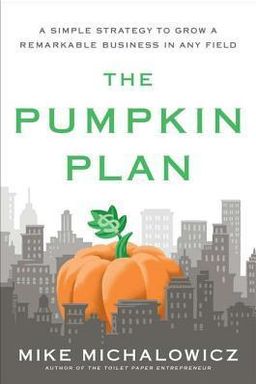
The Pumpkin Plan cover

The Pumpkin Plan

by Mike Michalowicz

The Pumpkin Plan presents a transformative strategy for business growth, focusing on profitable clients, efficient operations, and a dynamic company culture. With real-life examples and actionable insights, Mike Michalowicz guides entrepreneurs to cultivate success in any industry.

The Pumpkin Plan: Turning Your Business into a Prize-Winning Giant

What if growing your business was more like growing a prize-winning pumpkin—one enormous, irresistible creation that outshines all the rest? In The Pumpkin Plan: A Simple Strategy to Grow a Remarkable Business in Any Field, entrepreneur and author Mike Michalowicz proposes exactly that. He argues that by studying how farmers cultivate those half-ton, record-breaking pumpkins, you can unlock the secret to building a sustainable, magnetic business that dominates its field.

Michalowicz contends that most business owners fall into a tragic trap: they work harder and harder trying to grow, but all they really cultivate is burnout. The key, he insists, isn’t working more—it’s working differently. You must identify the few customers, products, and systems that have the greatest potential to grow exponentially—and focus all your time and energy on nurturing them while you uproot everything else that holds you back. It’s ruthless, but it’s how giant pumpkins—and giant businesses—are born.

From Fictional Farmers to Real Entrepreneurs

Drawing inspiration from a newspaper article about a farmer who grew colossal pumpkins step by step, Michalowicz outlines seven principles adapted for entrepreneurs. The farmer’s method starts with planting the strongest seeds, eliminating diseased pumpkins early, and ruthlessly focusing resources on the single most promising fruit. Translating this into business terms means identifying your company’s “Atlantic Giant seed”—a combination of your best customers and your strongest offering—and concentrating every bit of effort there while cutting dead weight.

He supports this philosophy with vivid stories of personal failure and breakthrough. Early in his career, Michalowicz’s computer company, Olmec, was stuck in survival mode: lots of clients, but no profits and endless stress. His mentor Frank, a seasoned millionaire businessman, forced him to see the truth—he would never succeed if he kept trying to serve everyone. When Michalowicz finally focused on his top clients, his business stabilized, then soared. The same transformation, he explains, is possible in any industry—from airlines to florists, dog walkers to breweries, even law firms.

Why We Stay Stuck on the Hamster Wheel

Michalowicz uses relatable characters like Bruce the overwhelmed florist and Eric the high-earning but exhausted consultant to show that most entrepreneurs are either trapped chasing money (because they don’t have it) or trapped chasing time (because they have none left). Both suffer from the same delusion: “I’m just one more client away from making it.” In reality, more is not better—better is better. The more you chase volume, the less impact any of your efforts have. Success comes when you start trimming the vine.

The author’s voice throughout is equal parts coach and comic. He motivates you to face hard truths and laugh at the chaos of entrepreneurship. Like a cross between Simon Sinek’s purpose-driven advice (Start With Why) and Jim Collins’s disciplined growth mindset (Good to Great), Michalowicz blends humor and practicality to show how focusing narrowly on what works produces far greater results than trying to do everything for everyone.

The Building Blocks of a Giant Business

The rest of the book unfolds as a practical playbook. Each chapter corresponds to a step in the pumpkin-growing process. You’ll learn to:

  • Plant the right seeds by discovering your “sweet spot”—where your best clients, your unique strengths, and your ability to systematize intersect.
  • Weed the field by firing unfit or toxic clients, ending unprofitable services, and cutting unnecessary expenses.
  • Nurture the healthiest pumpkins by going above and beyond for your top clients: under-promise, over-deliver, and solve their biggest frustrations.
  • Systematize growth so your business can run without you—using checklists, clear roles, and the “Airline Safety Card Method” for simplicity and consistency.
  • Kill the curve by innovating so distinctly that you no longer compete in your old category—you create your own.

Together, these steps are your blueprint for becoming the “giant pumpkin” of your industry: the remarkable, irresistible business everyone notices, talks about, and remembers.

Why It Matters — The Freedom Behind Focus

At its core, The Pumpkin Plan isn’t just a strategy—it’s a philosophy about freedom. Michalowicz believes the ultimate goal of entrepreneurship isn’t to work more hours but to gain back your life. When your business becomes focused, profitable, and systemized, you stop being its slave. You serve the few clients that give you energy, hire people who share your values, and design processes that let your company grow beyond you. Like a farmer staring at a half-ton pumpkin, you can step back, smile, and finally appreciate the remarkable thing you’ve cultivated.

“Ordinary pumpkins are forgotten; only the giant ones become legends. The same goes for businesses.”

If you feel overworked and underpaid, The Pumpkin Plan offers you a way out—a disciplined but joyful path to growing something truly exceptional. What follows are the key principles of that path: how to find your best seed, prune your vine, serve your champions, and turn your modest business into a behemoth that draws its own crowd.


Finding and Planting Your Giant Seed

Every great business starts with one extraordinary seed—the sweet spot where your strength meets your market’s greatest opportunity. In Mike Michalowicz’s terms, this is your ‘Atlantic Giant seed’, named after the legendary strain of pumpkin seeds that can grow gourds the size of cars. His point: you can’t grow something massive from ordinary seeds. You must choose one that is genetically—and strategically—built for greatness.

Understanding Your Sweet Spot

Michalowicz maps your sweet spot as the intersection of three things: your top clients, your unique offering, and your ability to systematize. If even one of these is weak, your vine will wither. For example, when electrical engineers Jorge Morales and Jose Pain launched Specialized ECU Repair, they initially said yes to every luxury car owner who needed help—but fixing unfamiliar Jaguar parts drained their time and morale. When they focused exclusively on BMWs and Porsches, their skills aligned perfectly with client needs. By deepening expertise instead of widening it, their revenue soared. Their sweet spot? High-end German performance cars, fast turnaround, and reliable systems.

Your Area of Innovation

Every business competes primarily in one of three areas—price, quality, or convenience—but can only dominate one. Michalowicz calls this your Area of Innovation (AOI). Walmart wins on price; Mercedes masters quality; McDonald’s dominates convenience. Trying to crush all three? Suicide. Entrepreneurs who chase multiple directions lose focus, dilute resources, and end up as commodity players. Pick one AOI and push it to an extreme rarely seen in your industry.

Systematizing Your Strength

Systematization converts individual genius into repeatable excellence. A true giant pumpkin farmer doesn’t rely on luck—he builds watering schedules, soil tests, and pruning routines. Similarly, you must design repeatable systems that let your team deliver results even when you’re not around. Systematization transforms passion into a process, ensuring your company grows sustainably rather than chaotically.

In essence, planting your Atlantic Giant seed means focusing your energy where your natural talent, market opportunity, and repeatable process overlap. Do that, says Michalowicz, and you stop being a jack-of-all-trades and become a master grower—of wealth, of reputation, and of time.


Assessing and Trimming the Vine

Once you’ve chosen your seed, the real challenge begins: you must prune your vine—cutting every client, service, or distraction that siphons energy away from your best opportunities. Michalowicz calls this step ‘Assess the Vine’, and it’s the entrepreneurial equivalent of slashing diseased pumpkins off the field. Painful at first, liberating soon after.

Ranking Your Clients Honestly

To help entrepreneurs see clearly, he introduces the Assessment Chart—a spreadsheet for grading clients on paying speed, respect, profit potential, and communication. His own writing partner, AJ Harper, used it when she ran a freelance writing business. After realizing her “favorite” clients were those who respected her time and vision, she stopped bidding for random gigs and focused only on top clients who shared her values. That clarity allowed her business to flourish without extra marketing.

Immutable Laws: Your Core Compass

Next, he introduces Immutable Laws—the unshakable principles you live by, like his own trio: “Give to Give,” “No Dicks Allowed,” and “Blood Money.” These aren’t just ethics; they’re filters. Clients who violate your core laws will always end up costing you emotionally and financially. When you align your business with people who share your principles, relationships flow naturally, referrals multiply, and stress evaporates. The point isn’t to be liked—it’s to work only with people like you, who ‘get you.’

Better Is Better

Michalowicz challenges the myth that more clients lead to more money. The truth: bad or average clients suck resources and attention from your best ones. He recounts how a PR executive turned down a $15,000-a-month client because her schedule was clogged with $2,000-a-month ones—a lesson in opportunity cost. By releasing low-value or toxic clients, you create space for the ones who can actually fund your dream.

Pruning your business feels risky, but it’s the only way to concentrate your energy where it matters. In short, you don’t need more customers—you need more of your best customers.


Killing the Dead Weight

In Chapter Five, Michalowicz goes full farmer: to grow your giant pumpkin, you must kill first—nurture later. Diseased vines, unfit clients, outdated services, and redundant costs must go. Every minute spent maintaining a bad pumpkin starves the prizewinner.

Lessons from Solar Panels and Stubborn Clients

The story of John Shaw, founder of Shaw Solar in Colorado, drives this home. Overworked and underpaid, John made half his revenue from solar-hot-water installations that consumed half his time but returned only 10% of his income. By killing that segment and focusing only on solar-electric systems—the projects he could systematize and scale—his revenue doubled in one year even while working three months less. His secret? Saying no to almost everything.

Practical Firing Strategies

If you’re squeamish about cutting clients, Michalowicz offers tactical, non-confrontational methods: eliminate certain services, de-prioritize chronic complainers, raise prices so problem clients self-select out, or cite exclusivity (“contractually we now serve only these clients”). The point isn’t cruelty—it’s clarity. Firing the wrong clients frees up bandwidth for the right ones.

Weeding as a Habit

He reminds readers that weeding isn’t one-and-done—it’s seasonal work. Businesses, like gardens, grow messier with time. Every quarter, revisit your Assessment Chart, identify new weeds, and yank them early. Sustained discipline in pruning ensures your top client base has the sunlight—and attention—it needs to grow massive and healthy.

When you finally experience the relief of firing your first rotten client, you’ll realize the truth: pruning isn’t painful—it’s power. It’s your first taste of real entrepreneurial freedom.


Stopping the Bleeding and Growing Profit

Cash is your company’s blood. Run out, and you die. In the chapter aptly titled The Tourniquet Technique, Michalowicz illustrates how entrepreneurs hemorrhage money by maintaining bloated teams, paying for vanity expenses, or chasing growth that isn’t profitable. The cure? A swift, calculated tightening of the belt focused on your top clients’ needs.

Luke’s Programming Company

Take Luke, a talented web programmer making half a million a year but losing money. He had eight employees writing in seven programming languages for every client imaginable. Michalowicz forced him to face the truth: no more languages, no more extra staff, no more excuses. Focus on the one most profitable service, fire excess employees, and simplify. Luke balked—and went broke. The lesson? Growth without pruning leads to suffocation.

Question Every Expense

Like a doctor cauterizing a wound, you must examine your finances line by line: What costs exist only to please bad clients? What ‘nice-to-haves’ don’t serve your top clients’ interests? When Athelia Wolley launched her clothing line Shabby Apple, she skipped expensive showrooms and publicists, opting instead to send sample dresses to fashion bloggers. The result? Viral word of mouth and hundreds of thousands saved yearly—proof that a clear focus cuts fat without starving growth.

Build Around the Ideal Org Chart

Michalowicz emphasizes that staffing should follow purpose, not habit. Design your ideal organizational chart first—one that perfectly serves your best clients—and then assign or hire people to fit it. Most entrepreneurs do the opposite, building structure around existing employees rather than an optimal system. If a person doesn’t fit, retrain or replace. Every role must support the prize pumpkin.

When you stop the bleeding and rebuild from the core, cash starts flowing freely again—fueling growth that’s sustainable, streamlined, and deeply satisfying.


Playing Favorites and Overdelivering

Entrepreneurs are taught to treat all customers equally—but Michalowicz says equality is overrated. Exceptional businesses succeed by playing favorites with their best clients and by mastering the art of Under-Promise, Over-Deliver (UPOD). Doing so builds loyalty thicker than pumpkin skin.

Top Clients First, Always

The story of “Tommy Muenich” (a pseudonym for a $30-million success story) proves the point. Tommy identified his nine most valuable clients, posted their names on his office walls, and made them his team’s top priority. When they called, everything else stopped. The remaining 191 customers benefited indirectly from improved systems, but the elite nine received the best care—and fueled the company’s explosive growth. After Tommy sold the business, new owners naively tried to “make everyone number one.” Within two years, they were bankrupt. Moral: universal equality kills excellence.

Underpromise, Then Wow Them

UPOD is deceptively simple: tell clients you’ll deliver less, then quietly exceed expectations. It’s how Zappos became legendary for service and how you can create wow moments even without big budgets. Promise delivery in five days—deliver in three. Announce a basic newsletter—send a beautifully designed strategy guide instead. Random acts of overdelivery build trust quickly and differentiate you from competitors.

Don’t Hide the Secret Sauce

Gone are the days when secrecy secured success. Today’s internet-savvy clients can access any information in seconds. Instead of guarding your methods, share them generously. Transparency builds authority and credibility; it proves you know your craft. As Michalowicz jokes, “The more information I share, the more people hire me.”

Play favorites, reward loyalty, and overdeliver consistently—and you’ll become the trusted, indispensable partner every top client brags about. In business, being remarkable is rarely about doing more; it’s about doing what matters most, brilliantly.


The Wish List: Innovate from Your Clients’ Dreams

Every great innovation begins with a question: “What do my clients wish we could do for them?” In The Wish List strategy, Michalowicz teaches you to mine your clients’ frustrations and aspirations for breakthrough ideas that will separate you from the pack

Ask, Don’t Assume

He advises entrepreneurs to interview top clients—not with generic satisfaction surveys, but with curiosity. Ask what frustrates them about your industry, what they’d change if they could, and what goals keep them awake at night. When John Shaw of Shaw Solar listened, he realized clients struggled to afford upfront costs for solar panels. His solution: personally front the rebate funds until clients were reimbursed. The result? A flood of new customers and deep loyalty.

Ask for Advice, Not Approval

When developing a new service, Michalowicz advises, approach clients for advice—not sales. Seeking their wisdom flatters them, gives you honest feedback, and quietly pre-sells your concept. Pharmaceutical marketers Scott Weintraub and Jeff Spanbauer used this approach in launching Healthcare Regional Marketing. By presenting their idea as a prototype and asking for input, they transformed their pitch meeting into a $500,000 contract. The moment clients ask, “How much does it cost?”—you know your idea has hit the sweet spot.

Change the Label

To stand out, give your business a label that redefines the playing field. Best Buy didn’t hire “computer repair techs”—they created the Geek Squad, a name that screams expertise and personality. Labels signal difference before you even open your mouth. When Michalowicz rebranded his IT firm as “Hedge Fund Technology Specialists,” he went from one of hundreds of local computer guys to one of three national experts. Same work—different perception.

The Wish List forces you to stop guessing what clients want and start evolving with them. Their dreams become your roadmap to market domination.


Let Them Lead: The Insider Strategy

Imagine if you could guarantee that every new product or service you launched would sell out—before you even built it. Michalowicz’s Insider Strategy gives you that power by inviting your clients to help design what they’ll eventually buy. It’s crowdsourcing with precision—community-driven business growth that reduces risk to near zero.

From Crowd to Insider

Traditional crowdsourcing often asks for ideas after a product is built. The Insider Strategy flips this: test the idea first. Ask your community, “Would you be interested if we built X?” Yes responses predict actual demand; silence signals failure before you invest. This predictive approach helped handmade leather artisan Paul Scheiter of Hedgehog Leatherworks perfect his business. By polling his audience about which knife sheath to design next, sharing prototypes via email and video, and accepting small deposits, he guaranteed sellouts months before production began.

The Win–Win Science of Co‑Creation

Involving clients in creation deepens loyalty. People support what they help build. They also promote it ferociously because they see it as theirs. Michalowicz compares it to giving them the sun that fuels your business growth—they nurture your seed while basking in the pride of participation. Followers become fans, and fans become evangelists. (This mirrors community‑driven marketing ideas explored in Seth Godin’s Tribes.)

The Eight-Step Sequence

To execute the Insider Strategy, Michalowicz provides a repeatable process: predict interest, appreciate early responders, announce development, engage the community, ask for small deposits, limit availability, overdeliver surprises, and track data. The beauty lies in scarcity—limited editions drive urgency while ensuring profitability. Threadless used this model for T‑shirts; you can apply it to any product or service.

Letting clients lead doesn’t mean surrendering control. You remain the captain steering the ship; your crowd provides the wind. The result is innovation without waste—and a fan base that sells for you.


Systematize Everything: The Airline Safety Card Method

Can your business run flawlessly while you’re on vacation? If not, you haven’t yet built the systems that Michalowicz calls the ‘Airline Safety Card Method’. Just as airline safety cards condense complex emergency procedures into clear, visual steps anyone can follow, your systems should do the same for every task in your business.

From Firefighting to Flight Plans

Early in his journey, Michalowicz fell into the typical trap—doing everything himself. When he hired “experienced” employees, they brought bad habits; when he hired novices, he was too busy to train them. His mentor reminded him that real entrepreneurs don’t do the work—they build processes so others can. That realization freed him from working 100-hour weeks and let him focus on strategy.

Break It Down—Then Break It Again

Document every recurring task: the steps, the pitfalls, the tiny details only you usually remember. Then simplify and condense until even your receptionist—or a pizza delivery guy, as he jokes—could execute it perfectly. Test the system until it’s foolproof. It may take ten hours to build a system that saves ten minutes daily, but in three weeks, it will have paid for itself forever.

Guide Thinking with the Three Questions

To handle unpredictable situations, equip your team with decision‑filters rather than endless rules. Before choosing any action, they must ask: (1) Does this better serve our top clients? (2) Does this improve our Area of Innovation? (3) Does this grow or maintain profitability? If the answer isn’t yes to all three, don’t do it. This empowers employees to think like owners and keeps your company aligned with its mission.

When you document thoroughly and think systematically, your business becomes a self-sustaining machine—predictable, consistent, and scalable. That freedom, says Michalowicz, is true entrepreneurship: a company that works for you, not the other way around.


Killing the Curve and Creating Your Own Market

Once your systems and client base are strong, growth depends on one radical move: kill the curve. Stop competing on the same bell-curve of expectations as everyone else and create a new market altogether. Michalowicz defines this as flipping industry norms on their head until you no longer have competitors—you have followers.

The 180 Technique

Start by listing every assumption in your industry—then do the opposite. Commerce Bank thrived by opening longer hours when other banks closed early. Netflix replaced Blockbuster’s late fees with no-return subscriptions. Cirque du Soleil turned dusty circuses into theatrical art. Each 180-degree flip killed an old curve and created a new one. (This aligns with Clayton Christensen’s idea of ‘disruptive innovation.’)

Becoming the “EST”

If total reinvention feels daunting, strive to be the “est”—the fastest, cheapest, funniest, boldest, or even weirdest. The ICEHOTEL in Sweden became world-famous not by being a better hotel but by being the coldest. When Michalowicz redefined his IT firm as the nation’s only “Hedge Fund Technology Specialist,” he didn’t improve on competitors; he eliminated them entirely.

Killing the curve turns you from another player into the game changer. The moment clients say, “I didn’t know anyone did that,” you’ve become the giant pumpkin of your industry.


Next Season: Continual Reinvention and Legacy Growth

Even giant pumpkins eventually rot. In the final chapter, Michalowicz reminds us that no business stays healthy forever. The Pumpkin Plan teaches not just how to grow one great company but how to keep planting new seeds from your past success—each one better adapted to the next season.

The Habit of Reinvention

Every thriving entrepreneur—from Steve Jobs to an ancient Greek banker-slave named Pasion—built empires by continuously reinventing themselves. Jobs moved from computers to animation to handheld devices, each time planting a new ‘seed’ while his previous giant operated independently. Likewise, Michalowicz moved from tech services to forensic investigation to behavioral marketing—each new venture rooted in his prior expertise.

Timing the Next Planting

Don’t start new ventures too soon. Wait until your current business is automated, profitable, and thriving without you. Then extract its best seed—the process, philosophy, or audience that made it great—and use it to cultivate the next idea. Giant pumpkins come from giant seeds, not random experiments.

In the end, the Pumpkin Plan is not a one-season project; it’s a lifelong practice. It’s about freedom through focus, mastery through pruning, and legacy through renewal. Grow one giant pumpkin at a time, and when it’s ripe—plant another.

Dig Deeper

Get personalized prompts to apply these lessons to your life and deepen your understanding.

Go Deeper

Get the Full Experience

Download Insight Books for AI-powered reflections, quizzes, and more.