
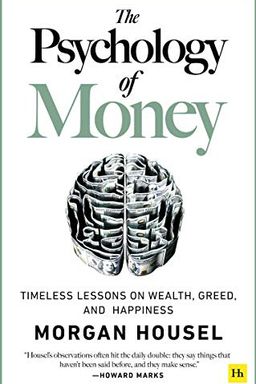
The Psychology of Money cover

The Psychology of Money

by Morgan Housel

Morgan Housel''s ''The Psychology of Money'' delves into the intricate relationship between human psychology and financial decisions. Through engaging stories and insights, the book reveals how emotions, experiences, and luck influence our financial behavior, challenging traditional economic theories. It''s a must-read for anyone seeking a deeper understanding of money''s role in our lives.

The Psychology of Money: Why Behavior Beats Intelligence

Why do some people with average incomes build fortunes while others with high salaries struggle to stay solvent? In The Psychology of Money, Morgan Housel argues that financial success depends far less on intelligence or technical brilliance and far more on how you behave with money. While many books focus on mathematical formulas and strategies, Housel insists the real determinant of wealth lies in emotions—patience, humility, risk awareness, and self-control.

Housel’s central claim is deceptively simple: doing well with money is not about what you know, but how you act. He contends that finance is a soft skill, driven not by equations but by psychology. Money decisions aren’t made in spreadsheets; they’re made at dinner tables, under stress, and amidst family hopes and fears. What seems rational to one person might look crazy to another because everyone has lived through different financial experiences. The person who grew up during inflation interprets risk differently from the one raised during decades of prosperity.

The Behavioral Foundation of Wealth

Through vivid storytelling, Housel contrasts characters like Ronald Read, a janitor who quietly saved and invested until he died with over $8 million, with Richard Fuscone, a Harvard-educated executive who went bankrupt after reckless spending. The juxtaposition reveals an essential truth: wealth isn’t measured by possessions—it’s defined by restraint. Fuscone’s intelligence and connections couldn’t save him from his own behavior, while Read’s patience and modesty compounded modest savings into a vast fortune.

This isn’t a coincidence. Housel invites you to think of money not as an engineering problem but as a mirror of human emotion. Financial success requires temperance more than IQ. A genius who loses control of emotions can destroy their fortune, while ordinary people with discipline can thrive. (Note: This echoes Daniel Kahneman’s work in Thinking, Fast and Slow, which argues that most decisions stem from emotional impulses we must learn to regulate.)

Why “No One’s Crazy” About Money

In the opening chapter, Housel makes a profound observation: no one is crazy about money because everyone’s life experiences are unique. Each person’s financial worldview, built from family, education, and economic context, forms distinct habits. Someone raised amid scarcity and uncertainty will see risk differently than someone groomed in abundance. As Housel writes, our personal experiences shape 80% of our beliefs about money—even though they reflect only 0.00000001% of all global financial history.

Understanding this perspective cultivates empathy instead of judgment. When you see people making irrational-seeming choices—taking loans, playing the lottery, or chasing risky investments—it’s often their emotional history, not stupidity, driving behavior. (Psychologist Ulrike Malmendier’s research supports this, showing that people’s willingness to take risks corresponds directly to the economy they grew up in.)

Finance as a “Soft Skill”

Housel criticizes how traditional finance education treats money like physics—a world of knowable laws and formulas. But investing and personal finance involve unpredictable human behavior. Fear, greed, envy, and optimism—these soft forces dominate results. Smart people often fail financially because behavior can’t be solved mathematically; it must be managed psychologically.

He illustrates this through the 2008 financial crisis. Engineers can predict a bridge collapse based on structural data, but no economist could fully predict the market collapse. Panic and emotion, not numbers, triggered it. This insight reframes money as the study of psychology and history—how people repeatedly react under fear or euphoria. Voltaire’s observation that “History never repeats itself; man always does” becomes the book’s guiding principle.

Why This Book Matters

Money touches every aspect of life—security, love, status, freedom—but confuses most people because it’s taught as a science rather than a human narrative. Housel’s approach makes financial wisdom accessible: focusing on humility, patience, and emotional control rather than precision forecasting or market timing. His message is practical for everyone—from Wall Street professionals to families saving for the future. He doesn’t tell you where to invest; he helps you understand how to think about money.

In the chapters ahead, Housel explores how luck and risk shape outcomes, why “enough” is the key to happiness, how freedom is the highest dividend money pays, and why compounding depends on survival more than genius. He also reminds you that financial wisdom evolves: what makes sense today may change as your goals, family, and identity change over time.

Key takeaway: The real skill in finance isn’t forecasting market movements—it’s managing yourself. Wealth is behavioral, not intellectual. Once you master your emotions, time, and expectations, you unlock the true psychology of money.


Luck, Risk, and Life’s Unfair Dice

Morgan Housel reminds you that luck and risk are siblings—two invisible forces that shape every financial result. We often credit success to intelligence and effort, yet much of what happens in life is guided by chance. To ignore luck is to misunderstand success; to ignore risk is to misunderstand failure.

Bill Gates, Kent Evans, and the One-in-a-Million School

In 1968, a young Bill Gates attended Lakeside School, one of the few high schools in the world that owned a computer—a result of a teacher petitioning a local moms’ club to spend rummage sale money on a terminal. That single decision gave Gates a one-in-a-million head start. He met Paul Allen there, and together they began experimenting with code outside class. As Gates later admitted, “If there had been no Lakeside, there would have been no Microsoft.”

Contrast that with Kent Evans, Gates’ best friend and partner-in-brilliance. Equally gifted but tragically unlucky, Kent died in a mountaineering accident while still in high school—a one-in-a-million stroke of risk. Two extraordinary lives were separated by chance. Gates’ luck launched a trillion-dollar company; Evans’ risk ended infinite potential. Housel uses their story to show that outcomes often depend more on timing and randomness than effort.

Why We Struggle to See Luck and Risk

Economist Robert Shiller once said his biggest question is “the exact role of luck in successful outcomes.” The difficulty is that admitting luck feels like humility, while denying it feels like confidence. Similarly, failures are blamed on poor decisions rather than bad breaks. Housel argues that this human bias causes most misinterpretations of financial history.

Consider Cornelius Vanderbilt and John D. Rockefeller—men who broke laws to build empires. History remembers them as visionaries, but both relied heavily on luck to dodge legal ruin. Had courts ruled differently, they’d be remembered as criminals instead of geniuses. Luck and risk are mirror images: the same force acting in opposite directions.

Why Broad Patterns Matter More Than Anecdotes

Studying extreme success stories like Buffett or Musk can be misleading because these tales are laced with luck. Instead, Housel encourages learning from common patterns—like saving consistently, avoiding debt, and thinking long-term—that work for everyone. You can’t replicate Bill Gates’ luck, but you can adopt Warren Buffett’s patience or Ronald Read’s frugality.

Lesson: Don’t judge success or failure too harshly. When you respect the roles of luck and risk, you understand that outcomes are never as good or bad as they seem. Focus instead on process and behavior—the only parts of money you truly control.


The Power of Enough

How much is enough? Housel believes this question defines your financial sanity. Having enough isn’t about resignation—it’s about wisdom. It means recognizing that endless growth leads to misery, not prosperity.

Rajat Gupta and Bernie Madoff: When Wealth Isn’t Enough

Gupta rose from poverty in India to become CEO of McKinsey, a multimillionaire with unmatched prestige. Yet greed drove him to insider trade for a few million more. Madoff, already wealthy from a legitimate business, built a Ponzi scheme to amplify his riches. Both men risked what they had and needed for what they didn’t. Their downfall shows that lacking a sense of enough can ruin even great success.

Happiness as Results Minus Expectations

Social comparison intensifies this danger. A rookie earning $500,000 feels poor next to a teammate making $20 million. That comparison moves the goalpost endlessly forward. Housel points out that the hardest financial skill is stopping the goalpost from moving. Modern capitalism fuels envy because it shows you what others have, not how happy they are.

Knowing When to Stop

“Enough” doesn’t mean too little; it means protecting what’s priceless—your freedom, reputation, and peace of mind. Housel draws on Buffett’s mantra: never risk something you have and need for something you don’t have and don’t need. Money buys comfort and flexibility, but not worthiness. In the long game of wealth, restraint and security beat ambition without bounds.

Key takeaway: The moment you define what’s “enough,” you reclaim power over greed. True wealth isn’t about more money—it’s about fewer desires.


Compounding: The Quiet Force of Growth

Compounding is the closest thing to magic in finance. It transforms small, consistent actions into extraordinary results—but only if you give it enough time. Housel compares compounding to the forces that created ice ages: a tiny shift that sustains itself can reshape the world.

Buffett’s Real Secret

Everyone knows Warren Buffett’s genius, but few recognize his true advantage—time. Buffett began investing at 10 and kept at it into his 90s. He earned 22% annual returns, impressive but not the world’s highest. Jim Simons achieved triple that, yet Buffett’s wealth dwarfs Simons’. Why? Longevity. Sixty years of uninterrupted compounding beats spectacular short-term performance.

Patience Over Prediction

Compounding rewards endurance, not brilliance. Housel calls it the “superpower of survival.” The greatest returns come not from exceptional investment skill but from the ability to stick with strategy long enough for time to do its work. That means tolerating volatility, remaining consistent, and avoiding the temptation to interrupt growth with panic or envy. The most powerful wealth strategy may be simply: shut up and wait.

If you grasp the math of compounding but fail to grasp its psychology—patience—you miss the point. Compounding isn’t just growth of money; it’s growth of mindset.


Freedom: The Highest Dividend Wealth Pays

Money’s greatest intrinsic value, Housel argues, is the freedom to control your time. True wealth isn’t a luxury car or giant home—it’s waking up and saying, “I can do whatever I want today.” This benefit often goes unnoticed because people chase visible comfort over invisible autonomy.

From Overwork to Independence

Housel recounts his short stint in investment banking—a glamorous job that left him miserable because every hour belonged to someone else. The lesson: doing something you love under someone else’s command feels the same as doing something you hate. Freedom requires saving, not extravagance. A modest emergency fund lets you quit a toxic job; more wealth lets you choose meaningful work, flexible hours, and peace of mind.

Freedom as Happiness

Psychologist Angus Campbell’s research found that control over one’s life predicts happiness more strongly than income. Six months of savings brings confidence; six years of savings brings independence. The ability to say “no” to things that violate your priorities is the ultimate financial power. Money buys options, and options buy serenity.

Lesson: Use money not to impress others but to liberate yourself. The richest life is a flexible one.


Room for Error: The Safety Net of Success

No plan survives reality unchanged. That’s why Housel insists on building room for error into every financial decision. Life is messy; survival is victory. He likens good financial behavior to blackjack card counting—bet more when odds favor you, but never bet every chip, because luck always intervenes.

Planning for Surprises

Benjamin Graham’s margin of safety “renders the forecast unnecessary.” Buffett kept enough cash to pay all bills even in disaster periods, while Microsoft’s Bill Gates stashed funds to pay a year’s payroll with no revenue. That’s room for error—preparing for the unseen. Housel calls it “the confidence of endurance.” It’s less about fear, more about flexibility.

Avoiding Ruin

A Russian roulette strategy might win nine out of ten times, but the tenth destroys you. Leverage can do the same in finance: it magnifies returns until one downturn wipes you out. Staying conservative looks dull but ensures you live long enough for compounding to work. Wealth grows not through risk-taking but through not dying financially.

Your most powerful skill isn’t maximizing profit—it’s maximizing survival. Room for error isn’t caution; it’s endurance.


Changing Selves: How Time Alters Your Financial Goals

We don’t just change jobs or locations—we change identities. Housel explores the End of History Illusion, the tendency to think we’ve become the person we’ll always be. In truth, our desires evolve, and rigid financial plans often collapse because they assume our future selves will want what our current selves want.

When Plans Age Faster Than People

Imagine deciding your career and savings strategy at 18. Your 40-year-old self might crave flexibility more than wealth, or purpose over prestige. Yet most financial advice assumes stability. The result: people get trapped in careers, homes, and budgets chosen by earlier versions of themselves. Jason Zweig’s story about Daniel Kahneman’s “I have no sunk costs” philosophy shows the power of reinventing without regret.

Balance and Endurance

Housel proposes moderation as the antidote to regret. Instead of extreme saving or extreme risk, live with moderate comfort, work hours, and freedom at every stage. Balance supports endurance, which supports compounding. The real goal of financial planning isn’t efficiency—it’s sustainability across changing selves.

Lesson: Expect your future self to disagree with you. Flexibility—not perfection—is the hallmark of lasting wealth.

Dig Deeper

Get personalized prompts to apply these lessons to your life and deepen your understanding.

Go Deeper

Get the Full Experience

Download Insight Books for AI-powered reflections, quizzes, and more.