
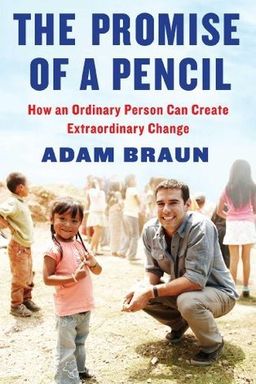
The Promise of a Pencil cover

The Promise of a Pencil

by Adam Braun

The Promise of a Pencil is an inspiring journey of how Adam Braun turned $25 into a global movement, building over 200 schools. Discover the lessons on passion, intuition, and confidence that empower anyone to turn dreams into reality and create lasting change.

Turning Purpose into Action: The Promise of a Pencil

Have you ever wondered what would happen if you acted on a fleeting idea — one that hits like lightning, demanding you do something meaningful with your life? In The Promise of a Pencil, Adam Braun poses this challenge to all of us: What if a small act of kindness could ignite a global movement? Braun argues that the difference between those who dream and those who transform the world comes down to one moment of decision — the willingness to pursue purpose over comfort. Through his journey from corporate consultant to founder of Pencils of Promise, he contends that anyone, regardless of age or resources, can change lives when guided by vision and persistence.

This book isn't just about education or charity — it’s about living with intentional purpose and proving that fulfillment comes from service, not success. Braun tells how a simple encounter with a boy in India who wanted nothing more than a pencil led him to launch a thriving global nonprofit that builds schools for children in poverty. But more than a memoir, it’s an actionable manifesto that blends entrepreneurship, storytelling, and moral clarity into a roadmap for anyone seeking meaning in their work.

From Wall Street to the World

Braun's story begins on a fast-lane trajectory — a young consultant at Bain & Company convinced that wealth and recognition were equivalent to happiness. He was ‘winning’ in every conventional sense but found himself restless and unfulfilled. When a near-death experience on the Semester at Sea ship forced him to confront mortality, he awakened to a realization: life’s worth isn’t measured in salaries or promotions, but in the lives we touch. That shift in perspective began his quest for purpose and eventually led to founding Pencils of Promise with just $25 in his bank account.

The Core Argument: Every Person Can Change the World

Braun’s central claim is simple yet revolutionary: “Where you start in life should not dictate where you finish.” He shows this through stories of transformation – from meeting children who saw pencils as magical keys to knowledge, to building schools alongside local communities that literally invested sweat equity in their children’s education. His experiences demonstrate that meaningful impact is born from empathy and persistence rather than privilege or perfection.

He redefines success as purpose-aligned progress — a lesson that echoes the principles of leaders like Muhammad Yunus (founder of microcredit through Grameen Bank) and Blake Mycoskie (Start Something That Matters), who also turned small social ideas into global change. For Braun, “education is the greatest gift one can give,” and teaching others to help themselves is far more powerful than handouts.

Mantras That Guide a Meaningful Life

Each chapter of the book centers around a mantra — compact principles that guided Braun’s growth. They read like wisdom distilled from experience: “Know that you have a purpose,” “Asking for permission is asking for denial,” and “Surround yourself with those who make you better.” These mantras act as checkpoints for readers, practical truths we can embed into our daily lives to strengthen our ability to act boldly and lead wholeheartedly.

Through these maxims, the author explores how courage emerges from vulnerability, how gratitude fuels authenticity, and how persistence converts idealism into measurable progress. He challenges the notion that youth or lack of money is a barrier — reminding readers that “even big waves start with small ripples.”

Why These Ideas Matter Now

In a world saturated with ambition but starved for meaning, Braun’s narrative strikes a deep chord. It’s not just inspiration—it’s instruction. He demonstrates how to build culture, navigate risk, cultivate authenticity, and lead with heart in any endeavor, whether entrepreneurial, creative, or social. His story shows how rethinking language (“for-purpose” instead of “nonprofit”) reshapes how organizations attract talent and generate impact. And his growth from an uncertain twenty-something to a confident global leader models how introspection and gratitude create sustainable success.

Ultimately, The Promise of a Pencil invites you to reflect on your own restless voice—the quiet intuition telling you there’s more to become and more to give. It argues that the power to change the world begins not with grand plans but with the courage to take one small, unreasonable step forward. Whether that first step is giving a pencil or starting a conversation, it can alter countless lives—including your own.


Know You Have a Purpose

Early in his journey, Adam Braun faces a life-or-death moment aboard the Semester at Sea ship when a sixty-foot rogue wave crashes into the vessel. Amid the chaos and fear, he feels a sudden and inexplicable calm—an assurance that he will survive because he has a purpose yet to fulfill. This becomes one of his defining revelations: everyone has a purpose, even when they haven’t yet discovered what it is.

Facing Mortality to Awaken Meaning

In the pitch-black, freezing waters off Alaska, Braun realizes that fear can become a mirror revealing what truly matters. He doesn't know his mission yet, but he understands that his life is not random. That clarity propels him to pursue discovery rather than comfort—a theme paralleling Viktor Frankl’s insight in Man’s Search for Meaning, where purpose becomes the only antidote to despair.

Finding Clarity Through Catastrophe

When the storm finally subsides, the ship’s survival feels miraculous. Braun’s journal entries afterward suggest a permanent shift in worldview: catastrophe can catalyze clarity. He begins to view every hardship as an opportunity to understand what he was meant to do. That sense of destiny doesn’t come from ego but from humility before life’s fragility.

Purpose Requires Action

Purpose is not discovered through thought alone—it’s confirmed through action. When Braun later travels to developing countries, asking children what they most want in the world, their answers—books, health, magic, and dancing—reveal how universal dreams transcend circumstances. This insight turns his philosophical purpose into practical commitment: he will help children achieve those dreams by giving them access to education.

He learns that “knowing you have a purpose” means listening when life screams for attention, then having the courage to respond. For readers, this chapter is a reminder that even if you don’t yet know what your purpose is, the simple belief that you have one can change how you live each day.


Every Pencil Holds a Promise

In India and beyond, Braun’s travels expose him to deep poverty and unfiltered human aspiration. When he asks one boy what he would most want if he could have anything, the boy simply replies, “A pencil.” That small answer becomes the seed of the entire movement. Braun realizes that a pencil—something he takes for granted—is for many children a symbol of opportunity, creativity, and independence. It’s the first spark of empowerment.

Finding Sacred Meaning in Simplicity

This moment parallels how Mother Teresa saw significance in small acts of love. Braun transforms that epiphany into a mission: education can unlock human potential more effectively than charity. By handing out pencils, he discovers the joy of shared dignity—where giving doesn’t reinforce power imbalance but restores connection. The boy’s reaction, treating a pencil like a diamond, embodies how abundance often hides in overlooked simplicity.

Listening Instead of Speaking

Braun shifts from talking about his goals to listening deeply to others’ dreams. In travels through Vietnam, China, and Kenya, he realizes that curiosity and sincere listening uncover needs that statistics can’t. His mantra evolves from “having answers” to “asking better questions.” The backpacking experience teaches him that transformation begins not with giving goods but with giving attention.

A New Understanding of Impact

When he later decides to build schools, he anchors PoP on the insight that every pencil represents possibility. The organization’s name honors that realization. He commits to building educational structures rather than temporary relief programs—a “hand up” instead of a “handout.” Readers learn that real service empowers others to thrive independently. One small, unreasonable act—the gift of a pencil—becomes proof that anyone can spark monumental change.


Culture and Leadership Guided by Values

As Pencils of Promise grows, Braun emphasizes that success without culture collapses. He defines his team’s culture through five pillars: happiness, friendship, reward, improvement, and fun. These aren’t perks—they’re the glue that sustains emotional commitment when funds are low or pressure is high. He insists that organizational energy comes not from financial compensation but from fulfillment and shared purpose.

Practices That Build Trust

To embed gratitude and connection, he implements handwritten thank-you notes, Monday meditation sessions, and Lunch & Learn conversations. These rituals combat burnout and foster belonging. When a delayed thank-you letter leads to a transformative partnership with donor Larry Petretti—who ultimately funds PoP’s new office build-out for free—Braun proves that authenticity and appreciation can yield unexpected rewards. Gratitude is not just polite; it’s strategic.

Closing the Loop

Braun introduces the concept of “closing the loop,” meaning to always follow up with supporters and show them the impact of their contribution. Sending photos, GPS coordinates, and student drawings makes donors see the tangible results of their involvement. This practice transforms transactional giving into emotional investment. Leaders learn that acknowledging others’ contributions sustains long-term trust far more effectively than marketing alone.

Faith in People Over Systems

Under this value-based leadership, PoP becomes not just a nonprofit but a community grounded in gratitude. Aligning people through shared meaning outlasts organizational hierarchy. As Braun notes, “What knits us together—a commitment to improving ourselves and the world—keeps us tightly bound.” For readers leading any team, this offers a timeless principle: culture eats strategy for breakfast (as Peter Drucker famously said), and sustained purpose depends on human connection first.


Change Your Words to Change Your Worth

Braun’s turning point at a Manhattan rooftop party reveals a deeper truth about identity and impact. When a venture capitalist dismissively calls Pencils of Promise a “nonprofit project,” Braun realizes how language shapes perception and power. He replaces the limiting term “nonprofit” with “for-purpose,” arguing that social good deserves the same prestige and rigor as profit-driven business.

The Power of Reframing

By changing vocabulary, Braun reframes his organization’s worth. Words like “for-purpose” rename charity as optimization, not opposition to profit. This linguistic pivot mirrors Simon Sinek’s concept of starting with “why”—a mission-driven approach that transforms how organizations attract partners. It reminds readers that redefining one term can shift entire paradigms.

Building Trust and Transparency

Once the team adopts business discipline, PoP develops transparent frameworks: clear metrics ($25 educates a child, $25,000 builds a school), public financials, and donor choice over where money goes. They guarantee that 100% of online donations support schools while operational costs are covered by gala revenues and corporate sponsors. That structure restores faith in giving by making impact measurable.

Treating Philanthropy Like Entrepreneurship

Braun brings startup rigor into altruism—firing underperforming volunteers, demanding results, and benchmarking progress against Fortune 500 standards. Treating passion like performance doesn't cheapen purpose; it empowers it. By merging heart and head, PoP doubles sponsorships from companies like Google and Microsoft. Braun’s linguistic shift turns an emotional mission into a scalable enterprise. Readers learn a profound lesson: change the language, change the culture, change the outcome.


Vulnerability Is Vital

Despite success, Braun admits his biggest fear: asking people for money. For years, he fundraises indirectly through events and campaigns but refuses to make direct requests. His breakthrough comes when he reveals this vulnerability to his board, acknowledging his weakness openly. The honesty transforms his leadership and the organization’s trajectory.

Owning Weakness to Build Strength

By admitting his discomfort, Braun creates trust. The board not only empathizes but invests in his growth by enrolling him in Harvard's Exponential Fundraising program. There, he learns that asking isn’t begging—it’s inviting partnership. He realizes his reluctance stems from ego: fearing rejection because he saw the organization as a personal reflection, not as a collective mission. Vulnerability unveils authenticity, echoing Brené Brown’s research that openness is the cornerstone of courage.

Transforming Fear into Connection

When Braun finally asks investor Paul Foster to join the advisory board, the conversation shifts from awkwardness to genuine connection. Foster agrees to contribute $100,000 per year for three years, but also teaches Braun about professional polish and relentless follow-up. The experience redefines vulnerability as a gateway to mentorship and growth.

The Courage to Ask

This chapter turns a universal fear—the fear of asking—into a lesson in leadership. Authentic requests require honesty and heart, not persuasion. When you ask for others’ support in something bigger than yourself, you allow them to participate in purpose. Braun learns that the hardest climbs, personal or professional, yield the most profound rewards. Readers are reminded that true strength isn’t in invincibility but in self-awareness and openness.


If Your Dreams Don't Scare You, They're Not Big Enough

By the end of his journey, Braun looks back and realizes how far PoP has come—from a single pencil to hundreds of schools educating thousands of children worldwide. But instead of resting at success, he heeds leadership advice from Kevin Roberts: “Make the little decisions with your head and the big ones with your heart.” The next big decision is daunting—build one hundred schools in one year. It’s terrifying, and that’s exactly why he pursues it.

Defining Audacious Goals

Braun learns that goals must stretch belief. When he sets the “Big Hairy Audacious Goal” (BHAG), Pencils of Promise’s team rallies behind it. Fear becomes fuel. Courage replaces comfort. This mindset echoes Jim Collins’s framework from Good to Great: greatness demands disproportionate ambition combined with disciplined execution.

Celebrating Momentum and Legacy

When PoP reaches its hundredth school in Ghana, Braun dances with the children—a moment of unity and joy that embodies genuine freedom. Yet he knows the milestone isn’t a finish line but a launching pad. The dream expands to train teachers, award scholarships, and reach five hundred schools. By continually moving the finish line, Braun demonstrates that sustained purpose means evolving goals.

The Lesson for You

If your ambitions don’t scare you, you haven’t dreamed big enough. Growth lies beyond comfort, and courage grows when stretched. For readers pursuing purpose, this mantra is an invitation to raise the stakes. As Braun proves, the most powerful dreams are the ones that make you tremble—and choosing to chase them defines both your destiny and your impact.

Dig Deeper

Get personalized prompts to apply these lessons to your life and deepen your understanding.

Go Deeper

Get the Full Experience

Download Insight Books for AI-powered reflections, quizzes, and more.