
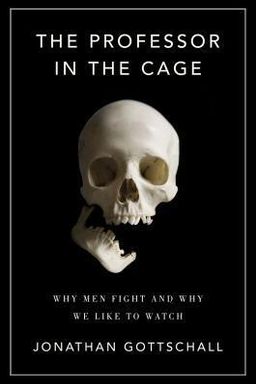
The Professor in the Cage cover

The Professor in the Cage

by Jonathan Gottschall

The Professor in the Cage delves into humanity''s primal attraction to violence, examining how mixed martial arts reveal our deep-seated instincts. Jonathan Gottschall explores the historical and psychological motivations behind our fascination with combat, offering a compelling look at the rituals and social structures that have evolved to channel aggression.

The Fighting Instinct Across Nature and Culture

Why do humans watch and wage fights? Jonathan Gottschall’s book dissects our enduring fascination with violence—the biological, social, and moral circuitry behind duels, sports, and spectacles. He argues that combat rituals—whether among ants, aristocrats, or cage fighters—stem from the same evolved toolkit that lets animals test dominance without destroying their group. Violence, in his view, becomes ritualized behavior aimed at managing conflict, maintaining order, and broadcasting hierarchy, rather than sheer mayhem.

Evolutionary Roots of Ritual Combat

The book begins with animal analogues. Deer lock antlers, elephant seals brawl, and chimpanzees hoot and slap dirt before physical clashes. These aren’t random acts—they’re the universal choreography Gottschall calls the “monkey dance”: threat, display, delay, and limited violence. Ritual combat evolved to make dominance contests survivable. The same pattern later surfaced in human duels and sporting contests—cultural extensions of an ancient evolutionary mechanism that tests strength while protecting the tribe from total war.

Honor and Status as Social Currency

Honor, in Gottschall’s schema, functions as social wealth—a system of value that compels men to risk injury or death to preserve their standing. It links Hamilton’s fatal duel with modern prison fights. In honor economies, reputation determines access to power, mates, and safety. Not retaliating to public insult invites exploitation—what Gottschall calls “social suicide.” Whether in eighteenth-century New York or a modern penitentiary, fighting becomes a rational way to enforce deterrence and maintain dignity.

Masculinity and Sexual Selection

Gottschall connects male aggression to reproductive logic. Because female fertility is constrained and male reproductive variance is high, evolution favored size, strength, and risk-taking in males. Across species, males compete intensely for access to females; human societies channel that drive into displays of athletic prowess, dueling, and hero quests. Societies that suppress open warfare still cultivate “safe” arenas—boxing rings, football fields, or Toughman contests—where men symbolically prove themselves.

From Tradition to Empirical Combat

The contrast between mystical martial traditions and MMA illuminates our shift from ritual to science. Early UFC tournaments exposed the limits of traditional forms when karate stylists were overpowered by wrestlers and jiu-jitsu practitioners. The lesson, Gottschall says, is empirical: survival depends on adaptability and evidence, not myth. MMA gyms operate like laboratories testing combat hypotheses. Yet even these high-tech duels remain ritualized outlets for primal drives.

Spectators and Social Order

Audiences complete the ritual. Whether in ancient coliseums, noisy football bleachers, or modern cageside crowds, spectators transform violence into social bookkeeping—confirming who is feared, admired, or desired. Watching fights activates tribal instincts; team affiliations mimic ancient war bands. Even presidential debates follow the choreography of the duel: posturing, gaze, and dominance displays under public judgment.

The Role of Fear and the Gaze

Prefight stare-downs symbolize how deeply fear intertwines with the monkey dance. Eyes become weapons—Mike Tyson’s piercing stare operates like a dominance signal in primate societies. The anxiety of being watched, Gottschall admits, exerts immense pressure; his own sleepless nights before fights show the cost of social observation. Fear of humiliation often outweighs fear of physical harm. As Maupassant wrote, duelists dread cowardice more than death itself.

Ritual Resolution and Reconciliation

After combat, handshakes and embraces signify reconciliation. Postfight rituals echo chimpanzee reconciliations—signals that group cohesion survives contest. The cage, field, or ring thus acts as a civic tool that channels aggression and dissolves grudges. Gottschall reads sport as conflict management: it transforms lethal impulses into bounded, socially productive drama.

Violent Spectacle and Tribal Theater

From gladiators to pro wrestling, violent spectacle taps our tribal circuitry. Promoters craft narratives—heroes and villains, local versus foreign—that ignite collective passion. Pro wrestling fans in Pittsburgh and Roman chariot cliques alike illustrate how symbolic warfare and identity merge. Gottschall observes that we crave drama even when we “know” it’s fake; tribal emotion makes play feel real.

Learning from Defeat

Gottschall’s own cage fight, which ends in swift defeat, crystallizes the moral lesson. Losing strips illusions and exposes the paradox of masculinity—it teaches courage, humility, and respect through failure. His later reflections show that ritual combat doesn’t make men brutes; it can cultivate discipline, honor, and compassion if approached consciously. But it remains double-edged—both a test and a temptation to cruelty.

Main takeaway

Violence, when ritualized, becomes a social technology—a way to negotiate hierarchy, prove worth, and maintain peace. Understanding that instinct means learning not just how humans fight, but why we need rituals to make fighting bearable.


Honor and the Economics of Respect

Honor, Gottschall insists, isn’t sentimental—it’s a practical economy of esteem. In historical dueling societies, reputation determined social mobility, marriage prospects, and livelihood. Alexander Hamilton risked death because public cowardice would have ruined his influence. In prison, inmates enforce respect for survival; small slights escalate into fights because failing to retaliate invites predation. Honor systems distribute deterrence through fear and reputation maintenance.

How Public Judgment Governs Action

You act differently when others watch. Pushkin fought to preserve reputation before peers; modern fighters glare for dominance under stadium lights. The power of the audience makes violence rational—it sets the stage where courage and cowardice are measured socially. Gottschall’s paradox—being too cowardly not to fight—reveals how reputation traps men inside cycles of risk, fueled by external judgment rather than bloodlust.

Key lesson

Honor functions as a rational survival strategy within social hierarchies—it enforces respect, but also perpetuates public pressures that make risk-taking inevitable.


Masculinity and Risk Selection

Masculinity, Gottschall shows, emerges from evolutionary selection pressures. Males compete because the payoff—reproductive success—is large. Females, investing heavily in fewer offspring, evolve caution; males, whose sperm is plentiful, evolve risk tolerance. This biological asymmetry drives global patterns of male aggression and competitiveness.

Cultural Channels of Male Competition

Societies reframe natural risk impulses into ritual testing. Land diving in Vanuatu, football, and MMA sparring all serve as masculine certification rites. Even when traditional channels vanish, men seek symbolic outlets—racing cars, binge drinking, professional sports. These aren’t meaningless behaviors; they are cultural expressions of ancient reproductive logic, moderated by norms.

Dimorphism and the Body’s Message

Men’s muscle mass, especially arm strength, is far higher than women’s—biological data show 60% more lean and 80% more arm muscle. This physical template supports male–male competition. When women enter sport under equal opportunity systems (Title IX), participation rises, yet motivational differences persist: more men still pursue risky, dominance-oriented sports. Biology provides baseline tendencies; culture modulates expression.

Practical takeaway

Recognizing average sex differences doesn’t excuse inequality—it helps design fair practices and understand why risky masculine competitions remain a human constant.


Sport as Civilized Warfare

Sport, Gottschall argues, is ritualized warfare—a way to rehearse and sublimate aggression. Ancient Greek athletics trained soldiers; Native American lacrosse and medieval tournaments simulated battle between tribes or classes. These ceremonies allowed societies to test skill and valor without collapsing into bloodshed. The same structure underlies modern football or MMA.

Team Games and Territorial Psychology

Team sports, at heart, remain "sham warfare." When you watch or play football, you’re enacting a symbolic battle for territory. The war vocabulary persists—trenches, blitzes, field generals—because the psychology does. Such contests unify communities through tribal displays. Ritual combat translates group defense into play.

Managing Violence Through Rules

Ritualization limits catastrophe by enforcing boundaries—rules, referees, weight classes. These designs civilize violence, enabling honor displays while preventing vendetta. The paradox remains: games train and restrain aggression simultaneously. They are both preparation for war and prevention of it.

Core idea

Sport transforms destructive potential into social order—it channels aggression safely, while sustaining ancient communion through symbolic battle.


Spectatorship and Tribal Emotion

Watching fights is participation. Gottschall contends that audiences turn combative displays into public accounting of status. A cheering crowd doesn’t merely observe—it judges, amplifies, and rewards dominance signals. The spectacle is a means of maintaining shared norms about courage and respect.

Why We Love Violence

Humans respond to violence with fascination and horror—Gottschall calls this our moral paradox. Gladiator arenas, boxing rings, and reality shows all cater to that instinct. Research rebuts catharsis theories: we don’t purge aggression by watching it, we indulge a thrill. The spectacle of risk and control satisfies ancient curiosity about power and mortality.

Tribalism in Collective Fandom

Pro wrestling, football chants, and soccer riots reveal our coalition psychology. Fans act like tribes—bonded by color and curse, moralizing defeat and victory. Promoters exploit that instinct, scripting villains and heroes to trigger passion. These crowd rituals echo Roman factions and medieval rivalries, showing tribal emotion’s endurance under modern branding.

Psychological insight

Spectators sustain human hierarchies—they validate dominance and ensure that ritual conflict continues to function as a shared myth.


Learning Through Fighting

Gottschall’s personal cage fight stands at the book’s climax. Preparing for an amateur bout, he endures dehydration, fear, and anticipation—a modern echo of traditional rites of passage. After losing by armbar in under a minute, he confronts the emotional wreckage: humiliation, self-doubt, and new humility. This loss refines his understanding of courage—it’s not dominance but the willingness to face fear publicly.

The Gym as a Modern Forge

MMA gyms operate as workshops of controlled pain. Sparring teaches composure; repeated exposure to stress inoculates against panic. The culture values stoicism, mutual respect, and empathy after brutality—the same virtues that stabilize warrior societies. Training becomes spiritual discipline under modern conditions.

Moral Lessons from Defeat

Losing tempers arrogance. It reminds fighters and spectators that bravery includes vulnerability. Gottschall’s later sparring against traditionalist Nobu expands the reflection: strength without wisdom becomes cruelty. Combat teaches limits and social empathy through pain. The gym community encodes this ethic—fight fiercely, but leave enmity behind when the bell rings.

Enduring principle

Confrontation, when ritualized, evolves into learning. It tests courage, builds humility, and sustains the ancient human quest to master fear through practice.

Dig Deeper

Get personalized prompts to apply these lessons to your life and deepen your understanding.

Go Deeper

Get the Full Experience

Download Insight Books for AI-powered reflections, quizzes, and more.