
Idea 1
Productivity as the Art of Working Deliberately
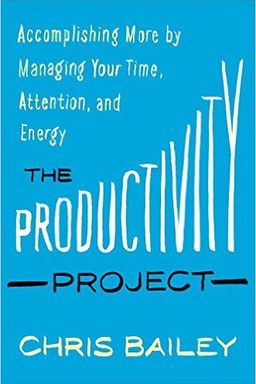
How can you truly get more done without burning out? In The Productivity Project, Chris Bailey argues that real productivity isn't about doing more—it’s about doing what matters with clear intention. Over the course of a yearlong self-experiment, Bailey tested every major productivity tactic he could find, from meditating thirty-five hours a week to working ninety-hour workweeks, all to understand what makes us truly effective in the modern world.
Bailey’s central claim is simple but revolutionary: in today’s knowledge economy, productivity depends not just on managing time (the way it did in the factory era) but on balancing three resources—time, energy, and attention. To be your most productive self, you must spend these three resources intelligently on your highest-impact activities. His project reveals how focusing on fewer, better things enables us to accomplish dramatically more without adding hours to the day. The key, he argues, is working deliberately—slowing down enough to decide what’s truly worth your limited time, attention, and energy.
From the Factory Floor to the Knowledge Economy
Bailey situates his ideas in history. In the industrial age, productivity meant efficiency—more widgets produced per hour. But now, most people trade ideas, creativity, and problem-solving for money. In this world, sheer output isn’t enough. You can’t measure your value by how long you sit at a desk or how many emails you send. Instead, success comes from how deliberately you use your attention and energy to accomplish meaningful, high-return tasks (a central theme he explores through the Rule of 3, focus strategies, and energy experiments).
Managing time is still useful, but Bailey says it should take a backseat to managing energy and attention. His metaphor is vivid: time is the backdrop, while energy and attention are the actors. Without them, time by itself does little. What counts is how deliberately you use those hours.
The Yearlong Experiment
Instead of just reading productivity advice, Bailey turned himself into a human lab. He spent a year testing ideas from David Allen’s Getting Things Done, Tim Pychyl’s work on procrastination, Charles Duhigg’s The Power of Habit, and new neuroscience research. He meditated for thirty-five hours a week, watched seventy hours of TED Talks, drank only water for a month, tried isolation for ten days, and alternated between ninety-hour and twenty-hour workweeks. Along the way, he tracked every minute of his time and meticulously recorded his energy levels.
His findings are empirical yet personal: productivity doesn’t come from hacks or apps, but from aligning your actions with your deepest values. As he jokes, quick hacks are like fad diets—they might help in the short term, but sustainable results take awareness, experimentation, and care.
Why Productivity Must Be Redefined
Bailey confesses that he began his project obsessed with efficiency. But after burning out, he realized that effectiveness matters more than busyness. A monk who moves too slowly gets nothing done; a hyperactive stock trader moves fast but lacks reflection. True productivity lies between these extremes—fast enough to accomplish meaningful work, slow enough to notice what matters. This discovery reframes productivity as a conscious practice rooted in awareness and self-care.
“Productivity isn’t about doing more things—it’s about doing the right things.”
Throughout The Productivity Project, Bailey urges you to adopt a curious, experimental mindset. Try new tactics, measure what works for you, and recognize that productivity is deeply individual. For some, it means steady focus on long-term creative work; for others, it’s simplifying a hectic schedule or boosting mental energy through exercise and sleep. The unifying thread is intentionality—choosing deliberately rather than reacting automatically.
Why This Matters
In an era of constant distraction, information overload, and remote work, Bailey’s message is urgent. Attention—not time—is the new currency of success. The modern world rewards those who can concentrate deeply, manage their energy like a resource, and say “no” to the unimportant. The book’s experiments give you permission to slow down, focus, and restructure your habits—because productivity, at its best, is about building a meaningful life, not just an efficient one.
Ultimately, Bailey’s work delivers both a philosophy and a toolkit: a mindset rooted in clarity and care, and a set of actionable strategies—from managing energy through sleep, food, and exercise to strengthening attention through meditation and single-tasking. As you’ll see in the following key ideas, The Productivity Project is less about working harder and more about working deliberately on what matters most.