
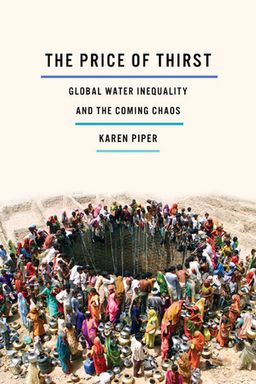
The Price of Thirst cover

The Price of Thirst

by Karen Piper

The Price of Thirst exposes the hidden dangers of water privatization, revealing how corporate greed leads to environmental harm and social turmoil. Karen Piper''s book is a call to action, highlighting the urgent need for equitable water management.

The Price of Thirst and the Search for Humanity

At its heart, The Price of Thirst explores what it means to be human in a world that blurs the line between predator and lover, power and compassion. You’re invited to follow Vivienne Courbet—from a poor human girl in Paris to an immortal creature of appetite—and later Deirdre and Mitch, whose long lives reveal the social, ethical, and psychological cost of surviving beyond time. Each transformation, wound, and act of love pushes the same question: how much of humanity can you preserve when immortality demands compromise?

From survival to seduction

Vivienne’s origin defines the moral structure of the book. Her rise from hunger and rebellion to vampiric grace reveals that transformation is not just physical—it is cultural. The House of the Swan teaches her that survival depends on performance. Later, Max and Victor refine this lesson into vampiric doctrine: feed discreetly, obey rules, conceal identity. The entire vampire world operates as a shadow society governed by etiquette, fear, and mentorship. You learn that immortality is less a gift than a complex social contract.

Love as vulnerability

Love becomes the book’s moral crucible. Vivienne’s attachments—to Diego, Monique, and Eduard—turn survival into sacrifice. Each bond exposes her to betrayal, violence, or loss. But even later, when Deirdre and Mitch face poisoned weapons and media hunts, love remains their compass. The phrase “my only home was with him” captures the paradox: love grants meaning and simultaneously threatens survival. (Note: this echoes Anne Rice’s theory that affection and guilt create the true pain of the immortal.)

Power and mirrors

Every relationship—mentor, lover, rival—mirrors the structures of politics. Victor and Max act as tutors; the Cadre functions like government; masques and mirrors dramatize identity as public performance. You see this pattern again with the Others and the DeRouchards, whose biological and media empires weaponize control. The governance of bodies and information becomes continuous from Paris salons to television studios. The story argues that even immortals replicate human hierarchies.

The new threat: science and propaganda

When Eduard DeRouchard and his descendants appear, the stakes shift from private ethics to evolutionary war. The Others manipulate DNA, souls, and governments to breed replacements for vampires. Later, media propaganda (Terri and Bob’s sensational broadcasts) accomplishes similar ends—destroying belief in nuance and fueling persecution. The novel reframes modernity as the new sunlight: exposure is deadly. To survive, Deirdre and Mitch must hide behind steel doors, false names, and moral grayness.

Ethics and medicine as redemption

Deirdre’s poisoning and memory loss bring science to the center. Mitch’s crude treatment—burning wounds, feeding blood—meets Sam’s laboratory diagnostics. The fusion of field medicine and scientific empathy redefines care: you heal with both instinct and intellect. The poison’s attack on memory symbolizes more than physical damage—it erases selfhood. Fighting to reclaim memory becomes the fight to reclaim moral identity itself.

What remains: moral evolution

By the end, every thread—Vivienne’s first bite, Maggie’s guilty motherhood, Mitch’s ethical dilemmas—converges on one truth: immortality magnifies the cost of choice. Survival demands violence, yet compassion insists on restraint. You come to understand that the title’s thirst is not only for blood but for meaning, memory, and forgiveness in lives that never end. The story asks you to weigh the soul’s endurance against the temptation to forget. In that balance lies the true price of thirst.


Transformation and the Ethics of Turning

Transformation defines both the plot and philosophy of the book. You see it first with Vivienne’s turning in Paris, where life and death blend in erotic ritual, and later with Deirdre’s physiological changes and the Others’ engineered soul transfers. Every metamorphosis challenges the ethics of intervention. What does it mean to alter another’s fate forever?

Mechanics and meaning

Vivienne learns the rules: drain slowly, return blood, control cravings. Turning is described clinically—timing, physiology, psychology. But these mechanics hide moral complexity. When she turns Diego to keep him close, love becomes coercion. His resulting savagery forces Max to kill him, exposing the cost of possession. Transformation has ripple effects: emotional, social, and political. Later, Monique’s conversion adds devotion and power hierarchy—she becomes servant, sister, protector, and betrayer.

Parallel modern transformations

Centuries later, the Others replicate the same process through medicine and technology. Eduard’s experiments transfer souls into new bodies—an industrial version of Vivienne’s intimate ritual. Maggie’s forced motherhood and Phoenix’s awakening show the horror of engineered immortality. You realize that immortality’s ethics remain identical across time: manipulation of life in the name of love or progress leads invariably to suffering.

Transformation as social contagion

Every new vampire or hybrid disturbs balance. Turning echoes immigration or contagion—it expands power but compromises stability. Victor’s Cadre builds rules to manage this spread, while the Others exploit it for domination. Transformation thus acts as metaphor for cultural replication and moral infection. (Note: compare to Mary Shelley's use of creation as rebellion against divine order.)

Core idea

To turn someone is to rewrite their destiny. The book insists that this act, though often born of love, carries irreversible ethical weight. In transforming others, you multiply the burden of your own survival.

You leave the section understanding transformation as living paradox—an act of mercy that breeds tragedy, an assertion of connection that dismantles autonomy. It is both a biological process and a mirror for human desire to control fate.


Love and the Fragility of Attachment

Love drives every disaster and every redemption in the book. You meet it first in Vivienne’s reckless affection for Diego, then in her quieter devotion to Eduard and Monique, and finally in the fierce partnership between Deirdre and Mitch. Love here is not sentimental—it is tactical, an act of survival and resistance against eternity.

The pattern of affection and fallout

Each love story follows the same rhythm: protection leads to transformation, transformation breeds dependency, and dependency invites loss. Vivienne turns Diego and loses him to violence; she saves Monique and inherits jealousy and betrayal; she loves Eduard and watches him die publicly under revolutionary justice. Centuries later, Deirdre and Mitch repeat the cycle—home becomes refuge and trap at the Black Rose pub, devotion makes strategy impossible.

How love reshapes ethics

Immortals learn that love undermines rules. The Cadre forbids deep attachments because they cloud judgment, but characters repeatedly choose them. When Deirdre erases journalist George Montgomery’s memory to protect him, she performs an act that is both loving and coercive. The text asks you: is mercy valid when it erases consent? In every case, love challenges governance and reason.

Emotional realism

You participate emotionally because the writing makes pain physical: burned flesh, trembling voices, empty mirrors. Through these images, love obtains mass and consequence. It is the price that rivals hunger. (Parenthetical note: the tone recalls Proust’s idea that memory and love are inseparable forms of survival.)

Insight

Love defeats immortality’s logic—it restores vulnerability and reminds you that devotion, not power, measures what remains human in the endless night.

Ultimately, you learn that love in this universe costs memory, morality, or life—and yet none would renounce it. That acceptance defines the moral core of the story.


Power, Politics, and Governance in the Night

Behind every act of feeding or affection stands power. The book builds a complex political ecology: the Houses, Cadre, and Others mirror human bureaucracies. You see private appetites translate into collective structures. Mentorship becomes government; discretion becomes law; secrecy sustains order.

The hierarchy of survival

Madame’s House of the Swan trains Vivienne in compliance; Max and Victor expand this into empire. The Cadre emerges to manage vampires across Europe—a council that dictates feeding and exposure. Victor acts as philosopher-king, combining rules with rhetoric. But under the surface, ambition corrodes unity. Max’s dominion over Diego and Victor’s manipulations of alliances show governance as weaponized intimacy.

Parallel institutions

The Others operate their own state within a state—scientific, media-savvy, and financially driven. Their breeding programs and propaganda resemble modern corporations. The Cadre represents monarchy; the Others, technocracy. Both are united by fear of exposure and lust for control.

Masques, mirrors, and diplomacy

Masquerades symbolize politics as theater. Vivienne’s swan headdress and Victor’s piety perform legitimacy; later, television broadcasts stage morality. The act of masking—whether in a Paris salon or on Real-Life Vampires—illustrates power by image management.

Idea

Immortal societies repeat human governance—hierarchical control wrapped in charisma—and every breach of those rules leads to catastrophe.

You end up reading power as choreography: mentorship, secrecy, and theater hold civilization together only until love, hunger, or evolution breaks the rhythm.


The Others, Media, and Modern Warfare

The Later sections shift conflict from blade to broadcast. The Others, heirs to Eduard’s experiments, use both genetics and mass media to wage war against vampires. This turn from mythic struggle to technological propaganda reveals how narratives shape survival.

Scientific domination

The Others engineer soul transfers to outlive vampires without their hunger. Their leaders—Eduard and Steven DeRouchard—reframe immortality as research. Mothers like Maggie become unwilling biotechnicians. Phoenix, the child host, embodies progress corrupted by nostalgia, carrying Mitch’s dead son’s soul. These biological strategies demonstrate the new evolution of control—immortality rendered institutional.

Media manipulation

Real-Life Vampires, a television spectacle, weaponizes perception. Terri and Bob’s lurid programming edits footage to cast Deirdre and Mitch as monsters. Their moralistic slogan—“We believe you have the right to know”—hides exploitation. The public hunt that follows blurs journalism and warfare, showing how fear and donation appeals unite propaganda and profit.

Reversal and uncertainty

When Steven later recants and apologizes, it’s unclear whether truth or political necessity drives him. Media becomes hydra-headed—first condemning, then absolving, always controlling. For immortals, exposure becomes poison more deadly than sunlight.

Lesson

Modernity transforms hunting into storytelling. The war is fought not with stakes but with cameras, edits, and headlines.

You finish realizing that eternal life depends on managing narrative as much as blood—truth must be curated to keep death at bay.


Memory, Identity, and the Battle for Self

Memory is the final battlefield. The poison that infects Deirdre’s body attacks her sense of self, wiping years as if deleting files. The loss is existential: when you forget who you were, immortality becomes mechanical survival.

Physical illness and psychic erosion

After being shot by a poisoned bolt, Deirdre’s body fails to heal. Fever, vomiting, and confusion spread to memory blanks. Sam’s scientific work—blood draws, electrophysiology, hypnosis—reveals that memory blockage may be reversible. This gives hope, yet you feel tension: the longer she forgets, the less of her past anchors her morality.

Identity and ethical implications

Memory ties Deirdre to Vivienne, Mitch, and the entire lineage. Losing it means losing accountability. Mitch vows to remember for her, creating shared identity between lovers. But Deirdre requests release if she becomes an “empty bottle”—a plea that redefines love as acceptance of death. (Note: The question echoes theories of identity continuity in Locke’s philosophy—without memory, the self dissolves.)

Recovery as resistance

The act of remembering becomes rebellion. Hypnotic retrieval functions as reclaiming agency from poison and propaganda alike. In rediscovered memories lie ethics and hope. Memory restoration equals moral resurrection.

Key takeaway

Immortality only matters if identity endures—the loss of memory transforms eternal life into empty repetition. To be human is to remember.

The closing arc ties body, love, and will into one truth: survival demands not just feeding and hiding, but remembering who you chose to become.

Dig Deeper

Get personalized prompts to apply these lessons to your life and deepen your understanding.

Go Deeper

Get the Full Experience

Download Insight Books for AI-powered reflections, quizzes, and more.