
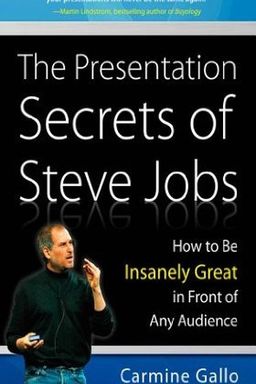
The Presentation Secrets of Steve Jobs cover

The Presentation Secrets of Steve Jobs

by Carmine Gallo

Unlock the secrets of Steve Jobs'' presentation mastery with Carmine Gallo''s insights. Learn to captivate audiences, simplify your message, and deliver with confidence. Transform any presentation into a memorable experience with practical, step-by-step guidance that draws from the legendary Apple co-founder''s techniques.

The Art of Insanely Great Presentations

Have you ever sat through a dull presentation—one that made you wish for the sweet release of the meeting’s end? Carmine Gallo’s The Presentation Secrets of Steve Jobs reveals how to do the opposite: to turn your presentations into experiences that inspire, energize, and move your audience to action. Gallo argues that Steve Jobs’s success on stage—and beyond—wasn’t magic, but mastery: the result of deliberate storytelling, disciplined preparation, and emotional connection. And here’s the good news: anyone can learn it.

The book draws you inside Jobs’s world of stagecraft, showing how he planned each keynote as if it were theater—complete with a plot, conflict, heroes, and dazzling reveals. Jobs didn’t just inform his audience; he became their director in a drama that made technology feel human. Gallo’s contention is simple yet profound: your ideas matter only if you can make people believe in them. Presenting is not about slides—it’s about crafting an experience that sells emotion, not information.

Crafting a Story That Moves Minds

Jobs approached every presentation like a play: Act One creates the story, Act Two delivers the experience, and Act Three refines and rehearses it until effortless. Each of these acts contains lessons for anyone who wants to communicate with charisma. In Act One, he developed a clear narrative—the central theme—and embedded it in a storyline filled with heroes, villains, problems, and triumphs. Unlike most corporate speakers who drown their audience in information, Jobs shared big ideas with clarity and emotional punch. His secret weapon was simplicity: he stripped out everything that didn’t serve the message, leaving only what made people care.

Turning Presentations into Experiences

Act Two explores how Jobs transformed a presentation into a sensory event. Every slide, gesture, prop, and demo was carefully orchestrated to elicit what Gallo calls the “holy shit” moment—those bursts of wonder when audiences gasp and feel the thrill of innovation. Whether it was pulling the MacBook Air from a manila envelope or making the iPod appear from his pocket with the words “1,000 songs in your pocket,” Jobs knew that emotion cemented memory. As neuroscientist John Medina’s research (referenced in the book) shows, our brains remember emotionally charged events far better than facts alone. Jobs deliberately staged those emotional peaks to capture people’s minds and hearts.

Refining, Rehearsing, and Radiating Passion

Finally, Act Three reveals the unseen labor behind Jobs’s effortless confidence. His practice routines were grueling. According to Apple insiders, he rehearsed for dozens of hours over several days, honing every word, slide transition, and demo until seamless. Like Malcolm Gladwell’s “10,000-hour rule” in Outliers, Jobs’s mastery came from relentless practice and deep passion. His stage presence—commanding body language, expressive voice, and open gestures—came not from improvisation but rehearsal. And beneath it all was genuine love for his craft. Jobs wasn’t trying to sell computers; he was sharing his mission to change the world through technology.

The Big Promise

Gallo’s message is clear: you can deliver presentations that mesmerize any audience if you combine storytelling, simplicity, rehearsal, and personal passion. Your job isn’t to convey information—it’s to create meaning. The more you believe in your story, the more your listeners will believe in you.

In the chapters that follow, Gallo unpacks specific techniques: how to plan in analog, craft Twitter-like headlines, channel your inner Zen, reveal one “holy shit” moment, and make everything look effortless. Together, these secrets form a practical guide to becoming “insanely great” at communication—whether you’re launching a product, pitching investors, or simply trying to inspire your team.


Plan Your Story Before You Touch PowerPoint

Before Steve Jobs opened his presentation software, he did something old-fashioned: he grabbed a pen. Gallo calls this approach “planning in analog.” The biggest mistake most presenters make is jumping straight into slides without understanding the story they want to tell. Jobs treated his presentations as theatrical performances—each one designed around emotion, clarity, and flow. He storyboarded his message first, deciding what he wanted people to feel, remember, and do. Only later did he translate those ideas into visuals.

Think Like a Filmmaker, Not a Technician

To Jobs, a presentation was “marketing theater.” He crafted it like a film: a central theme (“Today we reinvent the phone”), major scenes (the product reveal, the demo, the emotional climax), and a finale that left audiences exhilarated. This analog planning allowed him to build presentations around narrative structure, not technical slides. Communication expert Garr Reynolds (author of Presentation Zen) advocates the same principle—start with paper, not PowerPoint—because sketching ideas sparks creativity and organizes your story more visually.

Use the Nine Elements of Great Presentations

Gallo identifies nine key ingredients in Jobs’s preparation process:

  • Headline: One concise sentence that defines the message, like “Today Apple reinvents the phone.”
  • Passion statement: Jobs’s infectious excitement—“We’re here to put a dent in the universe”—set his tone.
  • Three key messages: People remember in threes (a principle later explored in Scene 5).
  • Metaphors and analogies: “A computer is a bicycle for the mind.”
  • Demonstrations: Physically show your product—like Jobs pulling the MacBook Air from an envelope.
  • Partners: Invite collaborators to amplify credibility (as Jobs did with Intel’s Paul Otellini).
  • Customer evidence: Use testimonials to build trust.
  • Video clips: Integrate short visual stories—ads, interviews, or product demos.
  • Props and visuals: Give audiences something tangible to see and touch.

Visualize Simplicity

Jobs once drew a two-by-two grid—consumer vs. professional, desktop vs. portable—to simplify Apple’s product line. That same simplicity governed his presentation planning. He eliminated clutter early, focusing only on message, emotion, and design harmony. The analogy of “napkin thinking” smacks of brilliance: if you can’t sketch your idea on a napkin, it’s not clear enough. Southwest Airlines’ founders literally drew their business model—three Texas cities connected by lines—on a cocktail napkin. Simplicity is the root of greatness.

Aristotle’s Persuasive Framework

Every memorable Steve Jobs talk follows Aristotle’s five-step formula: spark interest, introduce a problem, reveal a solution, show benefits, and end with a call to action. Jobs wasn’t improvising—he was performing persuasion at its highest level. Whether you’re pitching your product or motivating a team, plan in analog first to visualize your narrative, sculpt the emotional beats, and craft a message so clear it fits on a napkin. That’s how ideas become unforgettable.


Answer the Only Question That Matters

Every audience, Gallo insists, is silently asking one question: “Why should I care?” Jobs always answered it first. His focus was never on technology—it was on experience. When introducing the iMac in 1998, he described it as “the computer for people who want to get on the Internet simply and fast.” Not a word about processors or specs—just clarity about what mattered to the customer.

Speak Human, Not Tech

Jobs excelled at translating technical features into human benefits. When Apple transitioned from PowerPC to Intel chips, he didn’t discuss performance metrics—he explained that it would make “the best computers for our customers looking forward.” Similarly, when introducing the iPod, he didn’t tout gigabytes—he said it was “1,000 songs in your pocket.” That line became a global headline. Gallo labels this habit “selling benefits, not features.” (In Made to Stick, Chip and Dan Heath echo this principle, arguing that audiences grasp concrete images better than abstractions.)

Pain Before Gain

In Jobs’s storytelling model, every solution begins with a problem—a frustration the audience already feels. He contrasts the old world and new world vividly. Competing PCs were “slow, ugly, and complicated,” he said, before revealing the translucent, fast, Internet-ready iMac. This contrast placed Apple as the hero restoring simplicity and beauty. Gallo encourages businesses to identify their customer’s pain point clearly before unveiling their solution. Don’t just describe what your product does; articulate what problem it solves.

From Buzzwords to Clarity

Jobs avoided jargon in every press release and presentation. He never used phrases like “leveraging synergies” or “market-leading IP solutions.” Instead, he spoke plain English. Most corporations, Gallo laments, still release buzzword-riddled statements that answer everything except “Why should the customer care?” Journalists like Ashlee Vance and Walt Mossberg covered Apple precisely because Jobs made stories easy to tell—the language was simple, visual, and consistent.

The Lesson

Whether you’re pitching investors, selling products, or rallying a team, make the message customer-centric. Begin by answering “Why should you care?” Then connect emotion and benefit before describing technology or data. Simplify early, humanize always.

Jobs sold dreams, not devices. He told customers how the iPhone would “change the way you use your pocket”—not how many processors it contained. By shifting focus from product to experience, he created loyal fanatics instead of buyers. Your audience doesn’t want specs; they want stories that make their lives better. Teach them the “what’s in it for me” from the first minute, and they’ll keep listening until your curtain call.


Master the Rule of Three

Steve Jobs structured almost every presentation around groups of three—a psychological sweet spot that audiences find both memorable and manageable. Gallo calls this pattern “the verbal road map.” In 2007, Jobs began unveiling the iPhone by teasing the crowd with “three revolutionary products”: a wide-screen iPod, a mobile phone, and an Internet communicator. After suspenseful repetition, he landed the punch: “They’re not three separate devices ... this is one device!” The audience erupted.

Why Three Works

Cognitive research backs Jobs’s instinct. Psychologist George Miller’s classic paper “The Magical Number Seven, Plus or Minus Two” showed limits to short-term memory, but later studies pinpointed three or four items as most recallable. From childhood myths (three bears, three musketeers) to corporate slogans (“life, liberty, and the pursuit of happiness”), triads resonate. Even the U.S. Marine Corps structures units in threes for efficiency. Three ideas give your talk rhythm and clarity.

How Jobs Used It

Jobs applied threes everywhere: three transitions in Mac history (68K to PowerPC, OS 9 to OS X, and PowerPC to Intel), three segments in keynote agendas (“Leopard,” “iPhone,” “iTunes”), three product benefits (“ultraportable, fast, extraordinary battery life”). The repetition guided audiences smoothly through complex ideas. Even his Stanford commencement address followed the rule: “Today I want to tell you three stories.” Simplicity engages the brain—and Jobs knew brains crave pattern.

Applying the Rule Yourself

When crafting your next talk or pitch, condense your entire message into three anchor points. Under each, build only supporting stories and data. Journalists like USA Today columnist Ed Baig use the same method—three clear takeaways per article—to make technology understandable. As Barack Obama’s speeches and Jimmy Valvano’s famous ESPY address prove, three-point rhetoric also inspires. Keep it simple, structured, and rhythmic. Your audience will thank you with applause—and recall.


Channel Your Inner Zen

What makes Apple keynotes feel so clean and calming compared to the text-heavy slides of its rivals? Zen. Jobs’s design philosophy—“simplicity is the ultimate sophistication”—translates perfectly into his slides. Gallo defines this as “channeling your inner Zen.” Jobs’s visuals were minimal, stunning, and emotion-focused because he knew that clutter is the enemy of clarity. There were no bullet points. Ever.

Eliminate the Unnecessary

Each slide contained one idea. Words were few, images powerful: a single product photo, a striking number, or just the phrase “1,000 songs in your pocket.” Psychologist Richard Mayer’s multimedia learning research confirms Jobs’s instincts—pictures enhance memory retention when paired with concise words. When we overload slides with text, we force audiences to split attention and lose emotional impact. Jobs’s screens instead created breathing room—visual “white space” that exuded elegance and calm.

Engage All the Senses

Jobs built an experience for visual, auditory, and kinesthetic learners. Visual: mesmerizing imagery; auditory: storytelling and rhythm; kinesthetic: physical demos and props passed through the audience. Each type of learner absorbed the message differently, yet simultaneously. It was presentation design aligned with human cognition, not corporate templates. Garr Reynolds and Nancy Duarte call this true visual storytelling—presenting “in color,” not text.

The Psychology of Beauty

Jobs’s slides often looked like minimalist art: plain backgrounds, striking contrast, one vivid photograph. He designed them to make the brain happy. As scientist John Medina writes, we remember 65% of visual content versus only 10% of spoken words. Jobs’s slides hit dopamine receptors by connecting emotion, image, and simplicity. Each element served the core story—or it disappeared.

A Simple Practice

Before designing slides, ask: Can I convey this with fewer words and one compelling image? If not, refine again. Simplicity isn’t reduction—it’s revelation: removing the unnecessary so the necessary may speak.

Jobs’s Zen extends beyond visuals—it’s an attitude of focus, clarity, and balance. Simplicity is not plainness; it’s elegance born from discipline. The result: slides that breathe, stories that stick, and audiences that leave inspired rather than overwhelmed.


Reveal a 'Holy Shit' Moment

Every Steve Jobs presentation had one jaw-dropping moment—the instant audiences gasped, said “wow,” or even exclaimed something less polite. Gallo calls these “holy shit” moments. They’re the emotional climaxes of a corporate play, strategically placed and rehearsed to perfection. Jobs knew that people forget words but never forget feelings.

Design Emotion, Not Information

Consider the MacBook Air reveal. Jobs walked to a table, picked up a manila envelope, and slowly pulled out the notebook. Silence turned to hysteria. ABC News called it “the showstopper of the year.” This demonstration wasn’t spontaneous—it was scripted theater. Even press releases and ads had been planned around the same imagery. Jobs built these reveals like Spielberg sets up cinematic magic: one unforgettable scene that defines the whole story.

Choose One Theme

Memorable moments revolve around one central message—the “one thing” customers must remember. “It’s the world’s thinnest notebook.” “It fits in your pocket.” “It changes everything.” Gallo invokes neuroscientist John Medina’s concept of emotional “Post-it notes”: dopamine released during awe tells the brain, “Remember this.” Emotion is memory’s glue. When Jobs held up an iPod and said “1,000 songs in your pocket,” the phrase itself became a headline worldwide.

Create Drama Through Timing

Jobs never revealed his surprise too soon. Like a novelist, he built tension through pauses and pacing. Silence became suspense. When introducing the iPhone in 2007, Jobs hinted at “three revolutionary products,” then revealed they were one. Emotion spiked. The same formula applies to any field: tease, pause, and deliver with flair. Drama makes business human.

Practice Makes Magic

These moments look effortless because they’re rehearsed relentlessly. Gallo warns presenters to test every demo and rehearse every surprise. Like *The Sixth Sense*’s final twist, the revelation must feel inevitable yet unexpected. Plan a single, shareable moment—the one people will talk about afterward. The envelope, the pocket, the first “Hello, I am Macintosh”—each was engineered magic. Audiences crave that kind of beauty and surprise. Make them feel it.

Dig Deeper

Get personalized prompts to apply these lessons to your life and deepen your understanding.

Go Deeper

Get the Full Experience

Download Insight Books for AI-powered reflections, quizzes, and more.