
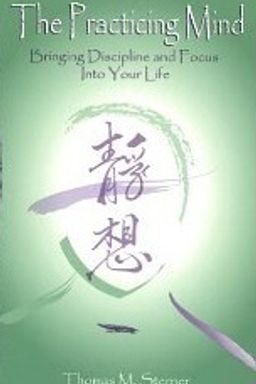
The Practicing Mind cover

The Practicing Mind

by Thomas M Sterner

The Practicing Mind provides a practical approach to managing anxiety and achieving goals by focusing on the present moment. Learn to set realistic expectations, simplify tasks, and apply mindful techniques to enhance productivity and personal satisfaction.

Mastering Life Through the Practicing Mind

Have you ever started something—a hobby, a new skill, or a personal goal—only to lose motivation halfway through? In The Practicing Mind: Developing Focus and Discipline in Your Life, Thomas M. Sterner argues that our struggle with learning, patience, and self-discipline stems from misunderstanding the process of practice itself. Sterner’s message is both simple and profound: life itself is practice. Everything from learning an instrument to managing your emotions can be refined through deliberate, process-centered awareness.

Sterner contends that the secret to mastery—of any skill or even of your own mind—is not about obsessing over results but about falling in love with the process. When you focus entirely on the act of doing rather than on the product you hope to achieve, you experience a sense of inner peace, heightened focus, and genuine joy. Drawing from his experiences as a piano technician, musician, pilot, and golfer, Sterner distills timeless philosophical insights into practical wisdom suited for modern life’s distractions.

The Journey from Product to Process

According to Sterner, our culture’s obsession with quick results—what he calls the “product mindset”—is the root of impatience and frustration. We chase achievements, grades, or material rewards and lose touch with what’s happening in the present moment. Practicing, in contrast, is about deliberate, repetitive action guided by awareness and intention. Whether you’re tuning a piano, hitting golf balls, or learning patience in everyday life, progress arises naturally from sustained, conscious engagement rather than rushed, judgmental striving.

Sterner uses his own golf lessons as a microcosm: While his classmates grew frustrated by their lack of progress, he found serenity in repeating small movements consciously, using the act of swinging as meditation. The lesson? True practice requires attention, detachment from outcomes, and presence. When you make the process itself your goal, you’re never failing—because success exists in every deliberate moment of practice.

Why This Matters in a Distracted World

Modern life, Sterner observes, has turned multitasking into a badge of honor. We scroll, talk, and think about five things while doing none of them well. This mental scattering breeds anxiety and impatience. The practicing mind reverses the damage by teaching us to quiet internal chatter and to live in flow. You’ve likely experienced this while absorbed in a hobby or sport—those rare times when time “disappears,” and you are purely doing. That sense of calm mastery, Sterner argues, can be cultivated in every part of life.

He links this quality of attention to what Zen calls “beginner’s mind”: the freshness we feel when learning something new. As we become more competent, we paradoxically lose this clarity because we stop giving full attention. The practicing mind restores that original awareness and shows us how to keep it alive.

The Intersection of Philosophy and Practical Skill

Sterner draws from both Eastern and Western traditions—from Zen and stoicism to modern sports psychology—to build a bridge between daily action and mindfulness. Like Jon Kabat-Zinn’s work on mindfulness or Mihaly Csikszentmihalyi’s concept of flow, his philosophy promotes balance, calm focus, and the ability to respond to life deliberately instead of reactively. Sterner’s simple reflection—“You can’t control what you aren’t aware of”—spans everything from learning the piano to managing stress at work.

He also connects these ideas to self-discipline and emotional regulation. Through present-moment awareness, you gain the ability to choose your reactions, foster patience, and quiet the critical “ego voice” that fuels discontent. The practicing mind becomes not just a strategy for skill-building but a spiritual practice of aligning with your true self, what Sterner calls “the Observer.”

From Philosophy to Daily Application

Throughout the book, Sterner offers tangible techniques to apply in your own life. You learn to reframe “boring” tasks as opportunities for practice, use the Four S’s (Simplify, Small, Short, Slow) to maintain focus, and apply his DOC method—Do, Observe, Correct—to remove emotional baggage from improvement. By developing such deliberate habits, you not only master skills but also reclaim control over your attention in a world that constantly pulls it elsewhere.

Ultimately, The Practicing Mind advocates a quiet revolution against hurried living. It invites you to experience serenity in process and to rediscover meaning in the very act of becoming. When you practice being present in your work, your relationships, and your growth, progress ceases to be something “out there.” You are already moving through it. As Sterner concludes, awareness isn’t something to attain—it’s your natural state once you release your attachment to outcomes. Through practice, you rediscover that peace and mastery were within you all along.


Process, Not Product

One of the central ideas of Sterner’s philosophy is the shift from being product-oriented to process-oriented. He illustrates this through his golfing story where classmates hoped to 'just wake up one morning and play well,' while he found solace in repeating the simplest drills day after day. They dreaded the work; he embraced it as meditation. The difference? He had made the process—not the end product—the goal itself.

Why We Fixate on Results

From early schooling, we’re conditioned to chase results. Grades measure worth; test scores define intelligence. This systems trains us to equate value with outcomes rather than effort, leading to anxiety and burnout. Sterner recounts a college class where students cheated through a timed music theory course because the grade— not knowledge—was the sole focus. They won the grade but missed the learning. Our culture, he says, idolizes results so completely that “process” feels like wasted time.

He contrasts this Western impatience with Japanese process-oriented craftsmanship. A piano factory worker in Japan, when asked how many harp plates he finished daily, replied: “As many as I can make perfect.” This attitude mirrors the Zen view that perfection lies in doing each act completely—a view that built Japan’s reputation for quality and calm mastery.

The Paradox of Letting Go

Here lies Sterner’s paradox: when you focus singularly on the process, the product takes care of itself. But when you obsess over the result, you block your natural flow and satisfaction. Anxiety replaces patience; comparison replaces focus. By shifting your goal from “finishing the work” to “being fully engaged while working,” pressure dissolves. Success then becomes constant—you succeed every moment you remain present. As he phrases it, “Every second you are in the process, you are achieving your goal.”

He uses the image of tossing tennis balls into a trash can: each throw gives immediate feedback. When you stop judging “good” or “bad” and instead simply adjust calmly—do, observe, correct—you access the sweet spot of growth. Judgment wastes energy; observation redirects it constructively.

Process Becomes Peace

“When your goal is to stay in the process and be fully where you are, every second you are doing so—you are successful already.”

Doing Without Emotional Drag

Sterner emphasizes removing emotional judgment from practice. Imagine learning a song on the piano: If your goal is to play it perfectly, every missed note feels like failure. But if your goal is to practice learning the song, then each mistake simply feeds feedback into your awareness. This mental shift makes practice relaxing and joyful. The Observer within you—your detached awareness—lets you correct without drama. In that state, discipline feels effortless because you are no longer battling yourself.

Ultimately, “Process, Not Product” teaches that mastery is not an achievement but a way of being. When you embrace the present step and stop rushing the journey, the horizon of perfection stops moving away. You realize, as Sterner writes later, that both peace and progress already exist here, now, in the act of deliberate doing.


Creating the Habits We Desire

Sterner asserts that everything in life—your thoughts, emotions, and actions—are practiced behaviors. You are, at every moment, either consciously or unconsciously practicing something. Recognizing this truth gives you immense power: you can deliberately choose what habits to reinforce.

How Habits Form

Drawing from sports psychology, Sterner notes that repeating a motion sixty times daily for twenty-one days can establish a new mental pathway. Athletes do this with swings or dives; you can apply it to mindfulness, patience, or communication. The key is awareness and repetition without emotional judgment. When you choose an action and repeat it deliberately, it becomes effortless. You turn discipline into instinct.

Replacing Old Patterns

Every time you react impatiently, you’re practicing impatience. Sterner teaches how to substitute these habits consciously using what he calls triggers—small cues that interrupt old reactions and initiate new ones. In sports, a golfer uses a “preshot routine” and a trigger—perhaps tugging on the shirt—to signal a calm, deliberate mindset before hitting. You can apply the same: when irritation arises, that emotion becomes your trigger to breathe, observe, and realign before responding.

Awareness Breaks Automancy

Most of our suffering, he argues, comes from acting automatically. The moment you become aware—watching your mind instead of being it—you begin replacing reactivity with choice. This act transforms mundane life into practice. When you stay present through repetition, you plant seeds for patience, focus, and calm responsiveness.

Like the martial artist who practices thousands of movements until defense becomes art, you can habituate awareness itself. This realization—that you can practice your way into being the person you wish to be—is one of the book’s most empowering insights and perhaps its greatest gift of control.


The Four “S” Words: Simplify, Small, Short, Slow

To make present-minded practice easier, Sterner offers four beautifully practical principles: Simplify, Small, Short, and Slow. Each serves as both a mindset and method for managing overwhelm. These tools remind you to tame ambition into focus, motion into awareness.

Simplify and Small

Simplification begins with breaking complex tasks into components. You can’t clean the whole garage—or master the whole instrument—at once. Instead, pick a single corner or one musical phrase. This aligns with the principle of Small: break grand goals into small, achievable segments that invite progress without fatigue. Every small success renews motivation. Sterner likens it to learning piano scales: precision in one section naturally leads to mastery across the whole.

Short and Slow

“Short” means giving focused attention for brief intervals. Work for forty-five minutes, rest, then return with fresh energy. Effort sustained in small bursts avoids burnout and keeps you engaged in learning. “Slow” may sound counterintuitive in a high-speed world, but the paradox Sterner discovered is that slowing down makes you faster. When he deliberately slowed his work tuning pianos one long day, his anxiety evaporated—and astonishingly, he finished 40% sooner than usual.

Integrating the Four S’s

All four principles reinforce one another. To simplify, you must focus on smaller portions; working slowly demands shorter sessions of steady concentration. Used in harmony, they reprogram you for flow. Sterner even recommends brushing your teeth slowly each morning as a small, daily exercise in mindfulness. This habit, he says, quietly rewires your brain toward presence amid the chaos of everyday life.

The elegance of these Four S’s lies in their practicality: they cost nothing, need no special setting, and reward you instantly with calm concentration. Over time, they become the invisible scaffolding of a disciplined yet peaceful life.


Equanimity and the Observer Within

For Sterner, equanimity—the ability to remain calm and even-tempered regardless of circumstances—is the highest fruit of a practiced mind. It grows from nonjudgment and alignment with what he calls the Observer, your quiet inner awareness detached from ego and emotion.

Judgment vs. Observation

We constantly judge: good versus bad, right versus wrong, desirable versus inadequate. Each judgment ties emotion to experience, breeding anxiety. Sterner explains that every judgment relies on an imagined ideal—a moving target that shifts as we age or as society changes. The more we chase these fluctuating ideals, the less peace we possess. Observation, in contrast, is detached and factual. Like a scientist noting data, the Observer inside you simply sees what is.

Discovering the Observer

Sterner describes the internal split between the ego (which talks and judges) and the true self (which quietly watches). The moment you recognize this split, awareness blossoms. The ego frets over problems; the Observer sees emotion for what it is—a passing wave. Aligning with this Observer is life-changing: anger becomes curiosity, stress becomes data. Through this lens, you regain conscious choice.

DOC: Do, Observe, Correct

To cultivate equanimity, Sterner proposes the DOC method—Do, Observe, Correct. It’s a feedback loop practiced without emotion. For example, Asian archers focus entirely on drawing the bow correctly, detached from where the arrow lands. Between shots, they observe without judgment, make adjustments, and repeat. This detached focus yields excellence effortlessly. DOC transforms any challenge—whether sports or strained relationships—into a process of playful refinement.

Through meditation or self-observation, you strengthen your awareness of the Observer. Each time you stop reacting and instead Do, Observe, Correct, you weaken the ego’s grip. Equanimity arises naturally—not as forced calm but as a practiced, peaceful presence that endures stress without strain.


Learning from Children

Sterner dedicates a chapter to the wisdom of children, reframing them not as empty vessels to fill but as natural masters of present-moment living. Adults, he suggests, could rediscover peace and focus by paying attention to how children learn, play, and experience time.

Children’s Perspective on Time

As adults age, life feels faster; days blur into years. Children, by contrast, experience time slowly because they live wholly in the present. To them, a week’s wait feels endless; to adults, it’s gone in a blink. They immerse themselves completely in one task at a time. Sterner urges us to emulate that presence consciously—to restore childlike immediacy through deliberate focus, not naïveté.

Patience Through Experience

In teaching his daughters, Sterner discovered the paradox of patience. When they grew impatient during piano lessons, they couldn’t see the long-term reward because they had no reference for skill blossoming through time. Adults, meanwhile, grow impatient because we can imagine the end result. Both miss the same truth: joy lies not in arrival but in engagement. His story of the pogo stick—where his daughter learned to wait two weeks before deciding she “needed” a new one—illustrates how patience can be taught by experience, not lecture.

Teaching by Example

Sterner emphasizes that children learn not from speeches but from modeled behavior. When parents conduct themselves with calm awareness, resilience, and honesty, kids absorb those traits intuitively. He reminds readers that children mirror our best and worst impulses; thus, being patient with them requires being patient with ourselves. Listening to their unfiltered honesty, as he did with his daughter overwhelmed by gymnastics demands, can remind us of our own misplaced priorities.

Listening, modeling balance, and living the practicing mind teaches the next generation what no lecture can: that happiness comes from presence, not performance. In this sense, teaching becomes another act of practice—an opportunity to refine how we live each day.


Evolving Through Endless Practice

In his closing reflections, Sterner reminds us that everything worthwhile—skill, peace, self-mastery—requires ongoing practice. There is no final arrival point, only evolving awareness. Like a flower, you are perfect in every phase of becoming, whether seedling or bloom. This metaphor, which opens and closes the book, encapsulates his worldview: perfection exists not at the end but in every step of growth.

Life as Continuous Practice

He likens existence to sailing toward the horizon—it recedes as you move. If you tie happiness to arrival, you’ll never feel fulfilled. But when you see fulfillment in the act of sailing itself—steadying the sails, adjusting to currents—then every moment becomes satisfying. Patience, he says, blossoms when we stop measuring progress and start inhabiting process fully.

Sterner’s mother’s wisdom echoes this beautifully: reviewing meaningful ideas repeatedly prevents life from “stealing them away.” Growth requires revisiting what nourishes awareness until it becomes second nature. As with piano tuning or meditation, consistency transforms inspiration into embodiment.

A Return to Simplicity and Choice

Sterner ends by warning of cultural noise that glorifies instant gratification, status, and possessions. True progress, he insists, lies in nurturing inner life. Ask yourself which pursuits enrich your soul and which merely distract. By focusing on what expands your awareness, you align with the enduring over the transient. You become a conscious choice-maker, steering your life with purpose instead of being dragged by habit and hurry.

In essence, The Practicing Mind closes where it began—with calm determination to treat life itself as a sacred practice. Every thought, reaction, and attempt is an opportunity for mastery. By living deliberately in the present moment, you don’t gain something new—you rediscover what was always within reach: a steady mind, a peaceful heart, and the freedom of disciplined awareness.

Dig Deeper

Get personalized prompts to apply these lessons to your life and deepen your understanding.

Go Deeper

Get the Full Experience

Download Insight Books for AI-powered reflections, quizzes, and more.