
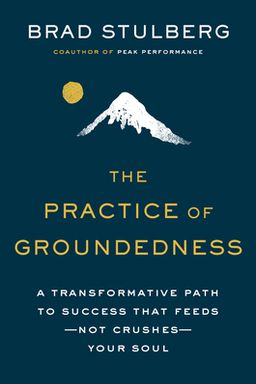
The Practice of Groundedness cover

The Practice of Groundedness

by Brad Stulberg

The Practice of Groundedness offers a refreshing approach to success that nurtures rather than depletes the soul. Brad Stulberg combines ancient wisdom with modern science to present six principles of grounded living, sharing his personal journey through mental health challenges to inspire a balanced and fulfilling life.

The Power of Groundedness: Redefining Success from the Inside Out

Have you ever achieved something that should have made you happy—yet felt strangely empty afterward? In The Practice of Groundedness, performance coach and writer Brad Stulberg argues that this experience is a symptom of what he calls heroic individualism: our generation’s relentless drive for more—more achievement, more optimization, more success—at the cost of genuine fulfillment and peace. We are pushed to climb higher and faster, but we’ve neglected the roots that keep us solid, whole, and connected.

The book is Stulberg’s answer to a cultural epidemic of burnout, anxiety, and restlessness. Drawing from modern psychology, ancient wisdom, and stories from world-class performers, he invites you to trade the constant striving for what he calls groundedness—an unshakable internal strength that anchors you through life’s fluctuations. True success, he insists, is not about chasing external validation, but about building stability, integrity, and presence from within.

From Heroic Individualism to Grounded Living

Stulberg opens with stories from his coaching practice: high-achieving executives, athletes, and entrepreneurs who outwardly seemed successful yet quietly confessed deep dissatisfaction. Their lives, like many of ours, were consumed by doing—by the next promotion, the next race, the next goal—but devoid of peace or stillness. He names this condition “heroic individualism,” a culture that glorifies independence, ambition, and endless productivity at the expense of well-being.

After suffering from debilitating obsessive-compulsive disorder (OCD) himself, Stulberg recognized that his own drive for achievement was part of the same trap. His turning point came when he began studying what both science and philosophy say about how to cultivate a deeper, steadier success—one that doesn’t constantly depend on external outcomes. His conclusion: happiness and fulfillment require groundedness, a state of being present, patient, connected, and aligned with one’s values.

The Six Principles of a Grounded Life

Through research and practice, Stulberg identifies six interdependent principles that form the foundation of groundedness. Each offers a counterbalance to the restlessness of modern ambition:

  • Acceptance – See and accept where you are before taking action. Instead of denying discomfort, you face it honestly.
  • Presence – Focus your attention and energy on the moment at hand, rather than scattering it across endless distractions.
  • Patience – Let go of the obsession with speed. True progress, like growth, takes time and rhythm.
  • Vulnerability – Embrace your imperfections as the path to authentic strength and connection.
  • Deep Community – Build genuine, supportive relationships that root you in something larger than yourself.
  • Movement – Engage the body to ground the mind; physical motion stabilizes emotional and mental health.

As he integrates these principles, Stulberg argues that groundedness is not a one-time achievement—it’s an ongoing practice. It asks for humility, repetition, and compassion. “The path is the goal,” he writes, echoing Zen Buddhist wisdom. Each principle can be cultivated through habits, reflection, and action, but they’re most powerful when woven together into daily life.

Ancient Wisdom Meets Modern Science

What distinguishes Stulberg’s approach is how it bridges fields. He draws from the Stoics, Buddhists, Taoists, Christian mystics like Meister Eckhart, and modern psychology—from Acceptance and Commitment Therapy (ACT) to behavioral science and neuroscience. The crossover is striking: wisdom traditions long advised cultivating “right effort,” “the Way,” or “interiority.” Modern researchers now confirm that practices like mindfulness, self-compassion, and social belonging create measurable improvements in resilience and well-being.

As Stulberg observes, today’s obsession with optimization—biohacking, productivity apps, endless goal-setting—mirrors a hungry ghost: no matter how much we achieve, we always want more. Groundedness counters that by rooting achievement in meaning and steady commitment instead of restlessness or insecurity. When you’re grounded, ambition becomes sustainable because it’s driven by love and purpose rather than fear or comparison.

Why Groundedness Matters

In an age when burnout, anxiety, and loneliness are at record highs, Stulberg’s message hits a cultural nerve. Groundedness offers an antidote to overstimulation and fragmentation. It encourages you to replace optimization with integration—to stop fragmenting your attention and instead align your thoughts and actions with your values.

The book’s structure mirrors its philosophy: slow, clear, and grounded in real lives. From Olympian Sarah True’s story of accepting failure, to executives rediscovering balance through vulnerability and patience, to psychologist Steven Hayes transforming panic into acceptance, each chapter reveals how to apply ancient insights to modern pressures.

Ultimately, The Practice of Groundedness invites you to reimagine success—not as a race toward “having it all,” but as a daily practice of being here, fully alive and at ease in your own skin. As Stulberg writes, “It is only when you’re grounded that you can truly soar.”


Accept Where You Are

The first practice of groundedness begins with an act of radical honesty: acceptance. You can’t move forward until you acknowledge where you are right now, even if that place hurts. This principle sounds simple but goes against everything heroic individualism teaches—always fight, fix, and strive. But as psychologist Carl Rogers wrote, “The curious paradox is that when I accept myself just as I am, then I can change.”

Facing Reality Instead of Resisting It

Stulberg shares the story of Olympic triathlete Sarah True, who fell into deep depression after her body failed her at the 2016 Rio Olympics. Instead of confronting her pain, she tried to push through—training harder, numbing feelings, avoiding therapy. Only after she accepted her depression and sought help did she begin to heal and rebuild. Acceptance, she realized, wasn’t quitting; it was courage.

Similarly, Stulberg recounts his own battle with OCD, where denial and resistance only strengthened his fear. Accepting his thoughts—without judgment and without turning them into identity—allowed genuine change to begin. He describes it as “making space” for discomfort instead of fighting it.

Acceptance in Science and Philosophy

Drawing from Acceptance and Commitment Therapy (ACT), Stulberg explains that avoidance amplifies distress. When you stop resisting reality and open up to it, your brain gains capacity to respond wisely. Ancient Buddhist teaching tells a similar story through the parable of the second arrow: pain in life is inevitable, but suffering comes from our resistance to that pain. The first arrow wounds us; the second is our reaction that deepens the hurt.

Acceptance doesn’t mean apathy. It means clarity—seeing the situation as it is so you can act from wisdom, not fear. Stulberg distinguishes between playing to win (acting from freedom) and playing not to lose (acting from fear). When we’re grounded in acceptance, our actions become freer and more skillful.

Practicing Acceptance

To develop acceptance, Stulberg suggests cultivating the lens of a wise observer—seeing your emotions from a distance, like clouds moving across a sky. Research shows that this “self-distancing” helps you make clearer decisions and respond with compassion instead of judgment.

He offers several practical mantras: “This is what is happening right now. I’m doing the best I can.” and “Stop shoulding yourself.” Acceptance also requires self-compassion—especially when you feel like you’ve failed. Studies from psychologist Kristin Neff show that treating yourself kindly after mistakes actually increases motivation and resilience.

Mood Follows Action

Finally, Stulberg introduces one of his most powerful tools: mood follows action. Don’t wait to feel good to act—act, and the good feeling will follow. Align your behavior with your core values even when you don’t feel like it. When you act out your values (integrity, love, creativity, service), your emotions eventually catch up. This shift—from reacting to responding—is the foundation of every other principle in the book.


Be Present and Own Your Attention

Presence, Stulberg argues, is the art of being fully here—for your work, for the people you love, and for your own life. In our hyperconnected culture, staying present is a radical act. We live amid constant distraction—emails, notifications, news alerts—that hijack attention and scatter energy. “A wandering mind,” researchers from Harvard found, “is an unhappy mind.”

The Cost of Constant Distraction

Stulberg compares our phones to an “existential slot machine.” Each notification gives us a small hit of dopamine, tricking us into thinking we matter because we’re connected. But the result is shallowness—what ancient philosophers like Seneca warned as “busy idleness.” Multitasking makes us feel productive while actually lowering IQ and performance.

When we lose presence, we lose meaning. Stulberg draws on the story of musician Mike Posner, who left stardom to walk across America, rediscovering presence and connection after years of digital noise. His revelation—“Life is now”—captures one of the book’s deepest truths: we’re not just losing time to distraction; we’re losing our lives themselves.

Flow and Productive Activity

Presence isn’t just mindfulness—it’s the precondition for excellence. When we’re absorbed in what we love, we enter flow, that state of joyful concentration where time dissolves. Psychologist Mihaly Csikszentmihalyi called this “optimal experience.” Ancient traditions called it Nirvana or the Way; Aristotle named it arête. Stulberg echoes them all: full attention is the source of both happiness and mastery.

He contrasts productivity (doing more) with productive activity (doing what truly matters). Productivity can be compulsive and scattershot; productive activity flows from purpose and focus. Following Erich Fromm’s writings in To Have or To Be?, Stulberg explains that what we pay attention to shapes who we become. Presence, therefore, is a moral practice as much as a mental one.

Cultivating Presence

The practical tools Stulberg recommends come from both Stoicism and Eastern mindfulness: set boundaries, remove digital “candy,” and plan blocks of undistracted work or connection. He suggests small steps: leave your phone in another room, create not-to-do lists, and practice mindfulness meditation focused on breathing. Over time, these micro-moments of stillness train your brain to focus again.

When you reclaim presence, you also reclaim freedom. You stop reacting to every ping and start choosing where your energy goes. In Stulberg’s words, “Attention is a finite resource—and attention vampires are lurking everywhere.” Learning to protect it means regaining sovereignty over your life.


Be Patient to Go Farther

Patience is perhaps the most underrated skill for modern success. Stulberg calls it “the difference between making things happen and letting them happen.” In a world infatuated with speed and instant gratification, patience feels countercultural—but it’s the secret to sustainable progress.

The Danger of Speed

Research shows most people would rather shock themselves than sit alone for 15 minutes. We crave stimulation and mistake motion for meaning. Stulberg cites studies showing our shrinking attention spans: we expect web pages to load in less than half a second, and we bring that impatience to careers, relationships, and creativity.

Through stories of Charles Darwin’s 20-year journey developing his theory of evolution and writer Ta-Nehisi Coates’s decade-long “overnight success,” Stulberg shows that breakthroughs are rarely sudden. They’re the result of slow accumulation—an idea echoed by philosopher Lao-tzu: “The master accomplishes the great task by a series of small acts.”

The Long Game of Growth

Patience allows consistency to compound. Stulberg explains how habits work like dollar-cost averaging in investing—small, steady deposits yield massive results over time. Citing Stanford professor B.J. Fogg, he reminds us that starting small and showing up beats heroic sprints every time.

Elite marathoner Eliud Kipchoge embodies this principle: he trains “slowly by slowly,” rarely exceeding 80 percent effort, and yet he’s the fastest marathoner in history. The takeaway: ease, not urgency, produces excellence. Patience creates stability; stability creates mastery.

Practices for Cultivating Patience

Three-by-five breathing—taking five deep breaths three times a day—teaches your body to pause before reacting. Leaving your phone behind while running errands retrains your brain for stillness. And “stopping one rep short” in workouts or work sessions builds endurance by balancing effort with restraint.

Ultimately, patience means trusting the process and accepting that growth takes time. As Stulberg writes, “The best way to move fast is to go slow.”


Embrace Vulnerability to Gain Strength

Vulnerability, for Stulberg, is not weakness—it’s the gateway to authentic strength and connection. After years of pretending to be bulletproof, he learned that his real power came from sharing his struggles, including his OCD diagnosis, publicly. “I needed to stop trying to be invincible,” he admits. “The cracks are where the light comes in.”

The Courage to Be Real

Vulnerability closes the painful gap between your front-stage self (how you perform for others) and your backstage self (who you really are). The less harmony between the two, the more fragmented and restless life becomes. Sharing honestly, even selectively, re-aligns your inner and outer worlds.

NBA athletes Kevin Love and DeMar DeRozan broke taboos by speaking about panic and depression, sparking a mental health movement across professional sports. Musician Sara Bareilles found truth and connection by writing rawly about her insecurities in her album Amidst the Chaos. The pattern is universal: authenticity invites healing—for you and others.

From Weakness to Confidence

When you acknowledge limitations, you build genuine confidence. Stulberg connects this to intellectual humility—curiosity about your blind spots instead of denial. Psychologists find that humble people are more adaptable and creative because they’re not protecting an image. As Lao-tzu advised millennia ago, “When you are content to simply be yourself... everyone will respect you.”

Vulnerability also strengthens teams. Harvard researcher Amy Edmondson calls this psychological safety—a culture where people feel safe showing their real selves and admitting mistakes. It’s the key to innovation and trust in any group, from hospitals to corporations.

Practicing Vulnerability

Stulberg offers reflection questions: What am I running from? What do I fear others seeing? What would it look like to hold both fear and desire at once? Start small: admit uncertainty, ask for help, or tell someone you’re struggling. “Everyone is going through something,” he reminds us. Vulnerability doesn’t come from trust—trust comes from vulnerability. When you open your cracks, you let others do the same.


Build Deep Community

If groundedness starts within, it grows through others. The fifth principle, deep community, challenges the myth of individual success. Like the redwood forests Stulberg admires, we thrive because our roots intertwine. Loneliness, he writes, is today’s hidden epidemic—linked to heart disease, depression, and early death. Yet heroic individualism prizes independence over connection, leaving many people emotionally starving.

Why Community Matters

Citing psychologist John Cacioppo’s research, Stulberg explains loneliness as both emotional and biological isolation. When you feel disconnected, your body acts as if under threat—raising stress hormones and lowering immunity. Belonging, by contrast, triggers healing hormones like oxytocin and endorphins.

Human connection is not optional—it’s evolutionary. The Buddha called community (“sangha”) the entire spiritual life. Saint Augustine called friendship the essence of happiness. Modern studies prove both right: strong relationships predict longevity better than wealth or fitness.

Technology and the Illusion of Connection

Digital networks give the illusion of belonging but rarely satisfy it. Social media, Stulberg notes, works only when it supplements—not replaces—real connection. It’s fine to use digital tools to meet or organize, but deep community requires embodiment: shared physical space, face-to-face vulnerability, empathy through tone and presence. As Cacioppo said, “Facebook can’t hug you.”

Studies confirm that online engagement without in-person follow-up increases loneliness. True community arises from shared commitment, trust, and service—not curated personas or shallow networking.

How to Cultivate Deep Community

Stulberg proposes simple, grounded practices:

  • Join or start meaningful groups—like book clubs, support circles, or volunteer teams.
  • Prioritize quality over quantity: Aristotle’s “friendships of virtue” built on shared values, not convenience.
  • Develop a “Braintrust”—trusted peers who provide honest feedback, empathy, and accountability (a concept borrowed from Pixar).

“If you’re lonely at the top, you’re doing it wrong,” says Olympian Shalane Flanagan, one of Stulberg’s clients. Her training group showed how lifting others lifts everyone. Grounded community isn’t a soft luxury—it’s your life support system.


Move Your Body to Ground Your Mind

The final principle ties mind to body: movement. Stulberg insists that we are not separate brains riding in bodies; we are integrated mind-body systems. Movement strengthens not just muscles but emotional resilience, cognitive clarity, and grounded presence.

The Science of Movement

Studies show regular exercise reduces depression by up to 41% and rivals therapy for mild to moderate mental illness. Physical activity balances serotonin, dopamine, and norepinephrine—neurochemicals that regulate mood and focus. Movement literally rewires the brain for calm and creativity.

Stulberg’s client, actress Andrea Barber (known from Full House), overcame anxiety and depression through running. “It saved me,” she says. Movement gave her rhythm, purpose, and perspective when everything else felt out of control.

Body as Teacher

Movement practices—whether running, walking, yoga, or even stretching—teach acceptance by turning discomfort into growth. They demand presence: you must be in your body, listening, adjusting, enduring. Athletes learn to distinguish pain that signals harm from the strain of growth. That wisdom applies beyond the gym.

Movement also mirrors patience and vulnerability. You can’t rush adaptation, and every attempt to overdo it leads to injury—metaphorically and physically. As coach Vern Gambetta says, “Running around constantly switching what you do doesn’t work. True progress requires consistency.”

Practical Application

Stulberg simplifies fitness into one rule: “Move your body often, sometimes hard—every bit counts.” You don’t need extreme workouts; brisk walking, standing breaks, or dancing all contribute. Studies show even two minutes of movement per hour offset the harms of sitting.

Motion connects you to your environment too. Nature walks lower stress and boost creativity (as Japanese “forest bathing” research confirms). Ultimately, movement grounds you back into your body and into the present. It teaches the same truth that runs throughout the book: you are already enough—just keep moving, slowly by slowly.


From Principles to Practice: Integrating a Grounded Life

Once you understand the six principles—acceptance, presence, patience, vulnerability, deep community, and movement—the question becomes: how do you live them? For Stulberg, groundedness is not a destination but an ongoing practice—a way of aligning your inner being with your outer doing.

Aligning Being and Doing

Many people, he notes, know mindfulness or self-care in theory yet live at odds with it day to day. His clients Parker (a CIO struggling with burnout) and Samantha (a young CEO and new mother) both understood the principles but failed to embody them consistently. Parker recommitted by syncing simple actions with his values: turning off his phone at dinner, having tough conversations, and woodworking for flow. Samantha stopped performing perfection and began to admit fears, meditate daily, and refocus on what mattered.

The key insight: self-awareness means little without behavior change. When doing and being align, anxiety fades and energy flows naturally.

Habits and Environment Design

Relying on willpower alone is exhausting. Instead, Stulberg borrows the Buddhist idea of habit energy: the invisible current of your life that pulls you toward certain behaviors. To change, don’t swim against it—redirect it. Shape your environment so your values become easier to live: place cues for meditation, remove addictive apps, integrate walking or reflection into routines. This way, groundedness becomes automatic, not aspirational.

Groundedness as Group Practice

Finally, groundedness multiplies in community. Stulberg encourages “practice circles”—small groups committed to living these principles together. Accountability and empathy sustain progress. Like Shalane Flanagan’s training group, mutual growth strengthens everyone’s roots.

In the end, groundedness is an infinite game, not a race. You will fall off the path—then rebuild, again and again. What matters is staying on it. As Stulberg concludes, “The path is the goal, and the goal is the path.”

Dig Deeper

Get personalized prompts to apply these lessons to your life and deepen your understanding.

Go Deeper

Get the Full Experience

Download Insight Books for AI-powered reflections, quizzes, and more.