
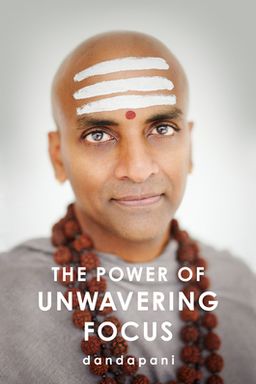
The Power of Unwavering Focus cover

The Power of Unwavering Focus

by Dandapani

The Power of Unwavering Focus is a transformative guide that provides actionable steps to help you harness mental clarity and focus. By mastering awareness, you can diminish distractions and anxieties, leading to a more joyful and purposeful life. Empower your mind with practical techniques for lasting happiness and success.

The Art and Power of Unwavering Focus

When was the last time you gave someone—or something—your full, undivided attention? In The Power of Unwavering Focus, Hindu priest and former monk Dandapani argues that your ability to concentrate is the single greatest determinant of your success, happiness, and spiritual growth. His core claim is simple but profound: learning to control where your awareness goes in the mind allows you to harness your energy, shape your experiences, and manifest the life you truly desire.

Yet, most people stumble through their days ruled by distraction—handing control of their awareness to the world, their technology, and their emotions. Dandapani insists that focus isn’t just a skill to use occasionally; it’s a way of living that must be integrated into every moment. He draws on the teachings of his guru, Satguru Sivaya Subramuniyaswami, and the philosophy he mastered during a decade as a monk to show how mastering focus transforms not only your productivity but your inner experience of life itself.

Why Focus Matters More Than Ever

Imagine the human mind as the most powerful tool in the world—capable of creating art, technology, and meaning—but with no instruction manual. According to Dandapani, few of us are ever taught how the mind works. We live with this immense power yet never learn to direct it. The result: chronic distraction, anxiety, fractured attention spans, and feelings of purposelessness. The cure is unwavering focus—learning how awareness, the mind, and energy interact.

He defines awareness as the glowing ball of light that moves through the vast space of the mind. Wherever awareness goes, energy flows, illuminating that part of the mind and making you conscious of it. If awareness moves to anger, you feel angry. If it moves to joy, you feel happy. This deceptively simple insight—that you are not the mind, but awareness moving through it—underpins the entire book. It shows that every experience and emotion can be shaped by choice rather than circumstance.

The Mechanics of the Mind

Dandapani introduces a series of visual metaphors for understanding this interplay between awareness and the mind. The mind is a mansion, with rooms representing different emotional and mental states—happiness, fear, creativity, anger. You can walk freely through these rooms, but many people live permanently in the rooms of worry and anxiety. Awareness, like a traveler, has the freedom to visit any space but needs willpower and concentration to choose where to stay. Over time, the places you frequently visit create deep grooves—mental pathways that become your habits and emotional defaults. These ruts, or grooves, form the mycelium of the mind, connecting experiences and energy patterns much like fungi connect forests underground.

The goal, then, is mastery of awareness—to consciously guide where awareness goes and ensure your energy nourishes the parts of the mind you wish to strengthen. Over time, this mastery creates an inner landscape of clarity, peace, and purpose rather than chaos and confusion.

The Path to Focus

To cultivate focus, Dandapani outlines two essential wings of the mind: concentration and willpower. Concentration is the ability to keep awareness on one thing until you consciously choose to move it to something else. Willpower is the mental muscle—the internal force that lets you return awareness to its chosen object whenever it drifts. These two work together to lift awareness above distraction and into mastery. He introduces practical ways to build them, such as making your bed intentionally, finishing tasks fully, and performing small daily rituals with attention and care.

Alongside discipline, he celebrates the power of small steps. Just as nature forms the Grand Canyon one drop at a time, you build focus through small, consistent actions. The key, he says, isn’t perfection—it’s persistence. He borrows from spiritual, philosophical, and psychological teachings to make this gradual refinement both realistic and empowering. (Comparable ideas appear in James Clear’s Atomic Habits, though Dandapani’s roots are more spiritual than behavioral.)

Focus in Life and Work

Beyond personal mastery, The Power of Unwavering Focus explores how focus enriches relationships, work, and creativity. Giving someone your undivided attention, Dandapani writes, is one of the highest forms of love. In a world of constant distraction, such presence communicates respect and connection. He extends these lessons to business and sports, urging leaders and athletes to train their teams and minds—not merely to tell them to focus. Awareness and focus, he reminds us, are the ultimate equalizers: once you learn to control them, you can control the unfolding of your life.

Why These Ideas Matter

At its heart, the book is spiritual but practical. It is a manual for life, blending ancient Hindu philosophy and modern psychology into an accessible system anyone can use. Dandapani insists that every great transformation begins internally—from mastering one’s mind. The power of unwavering focus isn’t about productivity hacks or attention tricks; it’s about using awareness and energy to align your inner world with your purpose. When you can hold awareness where you choose, you no longer live reactively—you live intentionally, joyously, and free.


Understanding Awareness and the Mind

One of Dandapani’s most profound teachings is that awareness and the mind are not the same. Awareness moves; the mind does not. He defines awareness as a glowing ball of light floating through the vast landscape of the mind. Wherever this ball goes, that area lights up—you become conscious of happiness, sadness, anger, or peace depending on where awareness resides. You are not your emotions; you’re simply experiencing them because your awareness happens to be in that part of the mind.

The Glowing Ball Metaphor

Imagine holding a lantern in a pitch-dark cave. The cave represents the mind; the lantern represents awareness. As you move through the cave, whichever rocks or corners the lantern illuminates become visible, but the rest remain in darkness. Likewise, when your awareness is in the happy area of your mind, that’s what lights up—you feel happy. When it moves to worry or sadness, that’s what dominates your perception. The key realization is that you can pick up your lantern and walk to another part of the cave at will.

This deceptively simple distinction liberates you from being emotionally hijacked. Instead of saying, “I am angry,” you can say, “I am in the angry area of my mind.” That linguistic shift, Dandapani argues, reshapes your subconscious understanding of identity and grants you control over your experiences.

The Mansion and Traveler Analogies

Dandapani expands this metaphor by comparing the mind to a vast mansion, with multiple rooms representing different emotions, abilities, and memories. You, as pure awareness, are the owner who can walk freely through these rooms. Some people live permanently in the rooms of fear or worry—they’ve simply forgotten they have access to every other part of the house. Like Mandela, imprisoned physically but free mentally, you can choose where to dwell.

Similarly, he describes awareness as a traveler and the mind as the world. You can visit New York or New Delhi in your thoughts, but you are not those places. You are pure awareness experiencing their qualities. These analogies make the abstract concept tactile—you can feel what it means to navigate awareness.

Becoming the Steward of Awareness

At any given moment, your awareness is controlled by either you or your environment. Most people surrender this control—their attention is pulled by phones, conversations, or emotions. Mastery means consciously choosing where awareness goes, as opposed to reacting. This stewardship transforms your life: by moving awareness toward joy, creativity, or peace, you direct your energy toward what you want to manifest.

“Where awareness goes, energy flows.” This simple phrase, coined by his guru, contains the core law of mental creation. Focused awareness strengthens the chosen area of the mind. Repetitive attention fortifies it—like watering one garden bed until it flourishes.

Understanding this relationship gives you the confidence to change your inner world. You learn that every emotion or thought is just a space in your mansion, and with willpower and concentration, you can walk out anytime you choose. This foundational insight—that awareness is the glowing intelligence directing energy—anchors everything Dandapani teaches about focus, emotion, and transformation.


Emotion and Energy: The Magnetic Mind

Dandapani equates emotion with energy expressing itself. When energy flows through a particular region of the mind—the happy or angry areas—it takes on that vibration and emerges as emotion. This means emotion isn’t something that happens to you; it’s simply energy moving through a specific mental frequency. The key insight: emotion is magnetic. The more energy you deposit in an emotional state, the stronger its pull becomes on your awareness.

The Icing Analogy

To make this vivid, he uses the image of icing flowing through different tips on a decorator’s tube. The icing represents energy; the metal tip represents the area of your mind. If energy flows through a happiness-shaped tip, it comes out as joy. If it flows through an anger-shaped tip, it emerges as fury. The icing itself doesn’t change—it’s molded by the tip it passes through. Likewise, your emotions are shaped by where energy travels.

This metaphor helps demystify emotion. It’s not random; it’s conditioned by where awareness lingers. If someone repeatedly dwells on resentment, energy constantly passes through that mental region, amplifying its magnetic power until awareness becomes trapped in it. That’s why some people seem perpetually angry or sad—their awareness lives in that charged zone.

Unresolved Emotions as Magnets

Unresolved emotional experiences are like mental leviathans haunting the subconscious. Each retains embedded energy and acts as a magnet, pulling awareness back to relive the past. A heated argument, never settled, continuously summons attention, draining energy. The solution is resolution—transferring the emotion out of the experience through reflection, therapy, or spiritual practice. Once the emotion is released, the magnetism dissipates.

The law of the mind holds firm: where awareness goes, energy flows. If you feed anger with attention, it grows; move awareness away, and the emotion weakens. This law empowers you to dismantle negative emotional patterns by deliberately redirecting attention toward uplifting states.

Tesla’s advice to “think in terms of energy, frequency, and vibration” echoes this truth: every emotion is a vibration you can choose to amplify or let fade through your focus.

By mastering awareness and energy, you become the architect of your emotional reality. You learn to spend your energy wisely—on joy, gratitude, and purpose rather than fear or resentment. Understanding emotion not as a mystery but as a function of energy transforms how you respond to life, opening the path to balance and happiness.


The Two Wings of Focus: Willpower and Concentration

To control awareness, you need two wings. Dandapani calls them willpower and concentration. Like twin forces, they lift awareness above distraction and let it soar through the mind’s vast spaces with precision. Together, they create mastery.

Concentration: The Art of Staying With One Thing

Concentration means keeping awareness on one thing until you consciously choose to move it to another. It’s not about duration alone; it’s about intention—the deliberate shifting of attention. You can focus for seconds as a nurse performing precise tasks or for hours as a meditator; what matters is the conscious choice of engagement.

Dandapani argues that we’re told to focus but never taught how. Schools, workplaces, and parents demand attention but fail to train it. He even critiques the medical tendency to diagnose ADHD when children are simply untrained in focus. You wouldn’t medicate someone for not knowing piano; you’d teach them to play. Focus, he insists, is a skill that must be taught and practiced—every day.

Willpower: The Mental Muscle

Willpower is what brings awareness back every time it drifts. Dandapani calls it the mental muscle—the biceps of the mind. You strengthen it by using it. Each time you resist distraction or finish what you started, you’re lifting mental weights. He offers three methods for developing willpower: finish what you begin, finish it well, beyond your expectations, and do a little more than you think you can.

These daily acts—making your bed neatly, washing dishes, completing small tasks—become spiritual gym workouts. Consistency, not intensity, builds strength. “You strengthen the will by using the will,” his guru taught. Over time, the will that steers awareness becomes steady, calm, and unstoppable.

Integration Through Rituals

You don’t build focus in a vacuum; you weave it into daily life. Identify what Dandapani calls your “nonnegotiable recurring events”—moments that occur every day without fail: waking up, eating, showering, talking to loved ones. Use these as training grounds for awareness. When speaking with your spouse, hold all attention on them; when eating, savor every bite without distraction. These moments are practical discipline—small yet transformative.

“Every moment is an opportunity.”

By integrating focus into ordinary life, you turn routine into a spiritual practice. The mundane becomes sacred because it trains the mind to be unwavering.

With practice, concentration becomes effortless. Awareness no longer wanders aimlessly—it stays put like a trained dog by your side. Willpower and focus merge into habit until being attentive feels natural, not forced. This disciplined state, sustained by clarity of purpose, allows you to meet life’s challenges with grace, joy, and calm control.


The Wheels of the Mind: Patterns of Distraction and Focus

Your subconscious records every movement of awareness in the conscious mind. Each time your attention drifts, you reinforce that pattern below the surface. Dandapani calls this interplay the Wheels of the Mind—vicious or virtuous cycles that determine how awareness behaves.

The Wheel of Distraction

When awareness repeatedly wanders, the subconscious creates a matching pattern that says, “You’re free to drift anytime.” Over time, this pattern gains power and spins the wheel of distraction—it takes over, pulling awareness away from your control. Like a tree’s roots cracking a foundation, these patterns become the architecture of a distracted mind. From habitual email-checking to scrolling social media, each repetition reinforces distraction.

The cost is enormous: lost time, wasted energy, and chronic anxiety. Dandapani warns that distraction consumes vast energy, leaving fatigue and confusion. It’s not the environment’s fault—technology amplifies the problem, but you train the mind to be distracted through constant practice.

The Wheel of Concentration

Fortunately, the mind works symmetrically. When awareness holds steady on one thing, the subconscious mirrors that discipline and strengthens your focus pattern. Each act of concentration adds momentum to the wheel of concentration. Eventually, even when you’re relaxed, your mind remains orderly, poised, and calm.

Dandapani likens this to a pilot switching between manual control and autopilot. If your subconscious has been programmed with focus, the “autopilot” governs awareness smoothly even when you aren’t consciously managing it. But if distraction rules your subconscious, that autopilot leads you into chaos. What you practice daily becomes the default setting of your mental plane.

Building Positive Patterns

The solution is repetition. Your subconscious thrives on consistency. Repeated concentration in daily tasks—working mindfully, listening fully, meditating regularly—reprograms the wheel. Over time, focus becomes effortless habit. Awareness settles like a trained dog beside you, no longer chasing every squirrel of distraction.

“Be careful what you repeat,” Dandapani cautions, “because what you repeat, consciously or unconsciously, shapes your mind.”

Real mastery means observing your patterns and choosing which wheel you want to spin. Each thought, each moment of attention, adds weight toward distraction or focus. With patience and awareness, you can turn vicious cycles into virtuous ones and design a mind that serves you rather than sabotages you.


Applying Focus to Modern Life

Focus isn’t confined to meditation or spirituality—it’s the cornerstone of performance in business, sports, relationships, and mental health. Dandapani illustrates this in vivid real-world examples, showing that teaching focus transforms how individuals and teams thrive.

Focus in Sports

When a coach yells, “Focus!” before a crucial game, players rarely know how. Dandapani describes a World Cup player stepping up for a decisive penalty. The difference between success and failure lies in awareness. If his mind races into the future—imagining triumph or fearing disappointment—he breaks concentration and misses. But if his awareness is anchored in the present, guided by trained willpower, he strikes cleanly and scores. This principle echoes a Navy SEAL quote: “Under pressure, you don’t rise to the occasion, you sink to the level of your training.”

Training awareness is mental conditioning for life’s high-pressure moments. When mastered, it eliminates fear and anxiety because awareness no longer strays into imagined outcomes—it stays with the act itself.

Focus in Business

Companies spend millions on productivity tools but neglect the root problem: poor focus. Dandapani recounts how meetings waste hours because people can’t stay mentally present, jumping topics like a dog chasing noises. Teaching teams to focus—by consciously holding awareness on one task and redirecting it when distracted—turns chaos into efficiency. Concentration breeds clarity; clarity breeds productivity.

He advises companies to adopt “focus policies”: leaders must first train themselves, then integrate concentration into the team’s culture through small group practices and rituals. When a company teaches awareness, energy, and willpower, it revolutionizes both performance and mental well-being. (Similar organizational mindfulness programs appear in Jon Kabat-Zinn’s workplace meditations, but Dandapani’s approach is structural rather than contemplative.)

Freedom from Distraction

Technology, he insists, isn’t the enemy—it’s our lack of discipline around it. Phones, social media, and notifications aren’t ruining attention; our choices are. If you decide when and how to engage with technology—using purpose and time limits—you train your awareness to remain sovereign over devices. Abstain, define intent, focus on one app at a time, set a timer, and manage your energy. Now technology serves you, not vice versa.

The Broader Impact

From boardrooms to family dinners, the same principle applies: presence equals purpose. Giving someone undivided attention, whether a child or colleague, communicates love and respect. A focused mind doesn’t just produce results—it strengthens relationships and emotional health. When awareness is calm and centered, you live each moment fully rather than reacting to life in fragments.

A focused life isn’t a narrow life—it’s expansive, because the more you concentrate on the present, the more deeply you can experience everything.

Ultimately, focus is not about doing more; it’s about being fully in whatever you do. Whether making a bed, leading a company, or taking a penalty kick, the principle remains constant: where awareness goes, energy flows—and your world unfolds accordingly.


Overcoming Worry, Fear, Anxiety, and Stress

The book’s later chapters form a panacea for mental distress, showing how worry, fear, anxiety, and stress all originate from uncontrolled awareness. These four foes are not external enemies but internal patterns caused by awareness leaving the present and wandering through unregulated areas of the mind.

Worry and Fear: Future-Based Illusions

Worry, Dandapani explains, occurs when awareness goes into the future, imagines a problem, and returns to the present distressed about it. Similarly, fear lives only in the future—it’s awareness projecting disaster and reacting emotionally to an illusion. His guru’s childhood revelation—realizing, “I am all right right now”—is the antidote. Anchoring awareness in the present dissolves both worry and fear instantly.

He cautions that fear can become self-perpetuating. If awareness repeatedly visits fearful images, energy strengthens that mental region until fear dominates perception. Protect your mind, he urges, as fiercely as you protect your body. Avoid inputs—like horror movies or hostile conversations—that program fear pathways. Create uplifting grooves instead.

Anxiety and Stress: Unfinished Patterns

Anxiety arises when awareness jumps from one unfinished thought to another. It’s the mental equivalent of spinning wheels. Each incomplete task pulls awareness to itself; as it cycles endlessly, unease grows. Prolonged worry morphs into anxiety, and anxiety into stress—the feeling of being unable to cope.

The cure is focus. Keep awareness on one thing at a time. When intrusive thoughts arise, gently bring it back. Write down other tasks and return later. This intentional redirection prevents the buildup of nervous energy that causes anxiety. You may feel pressure from responsibility, Dandapani notes, but pressure differs from stress—pressure is awareness under control; stress is awareness lost.

The Peace of Presence

All four foes vanish when you can hold awareness in the present. Being fully engaged with what you are doing prevents energy from splintering across worries or fears. Every moment lived consciously becomes healing. As Gurudeva taught, “Now is the only reality.” Once you learn to command awareness through willpower and concentration, you replace worry with wisdom and fear with peace.

“Mastery of awareness in the mind is the cure.”

This simple truth, repeated throughout the book, is its most powerful medicine. Any mental ailment—be it worry, fear, or stress—can be resolved by returning awareness to the here and now.

By practicing focus, mindfulness (in its proper sense), and observation, you build an inner sanctuary immune to external chaos. You learn not just to survive emotionally—but to live joyously, fully present in each precious, finite moment of your life.

Dig Deeper

Get personalized prompts to apply these lessons to your life and deepen your understanding.

Go Deeper

Get the Full Experience

Download Insight Books for AI-powered reflections, quizzes, and more.