
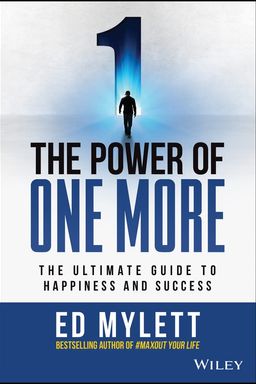
The Power of One More cover

The Power of One More

by Ed Mylett

The Power of One More by Ed Mylett unveils the secret to happiness and success through the simple yet profound philosophy of doing ''one more.'' Discover how small actions, positive mindset shifts, and strategic emotional control can lead to extraordinary outcomes in your personal and professional life.

The Power of One More: Unlocking Extraordinary Growth Through Small Daily Wins

When was the last time you felt stuck—like the next level of your life was just out of reach? Ed Mylett’s The Power of One More begins with a simple but radical premise: you’re closer to transformation than you think. Whether it’s one more rep in the gym, one more meeting, one more call, or one more forgiving conversation, the cumulative power of doing “just one more” can change everything. Mylett argues that greatness doesn’t come from massive leaps forward—it arises from small acts of intention repeated consistently until they compound into profound life change.

Mylett’s philosophy was forged over three decades of personal struggle and success. From growing up with an alcoholic father to becoming one of the most recognized performance coaches in the world, he discovered that success isn’t a matter of luck or talent—it’s the outcome of mastering the mindset to do one more effort when others stop short. The book presents an expansive framework for applying this principle across every domain of life—identity, emotion, relationships, leadership, time, faith, and equanimity.

A Philosophy of Compounding Effort

At its core, Mylett’s argument mirrors what behavioral experts like James Clear in Atomic Habits call the power of compounding small wins. Doing one more thing—especially when it’s uncomfortable—trains your brain to associate persistence with progress. Over time, these repetitions compound, creating personal momentum. Mylett insists that this philosophy transforms mediocrity into excellence, not through dramatic reinvention, but through consistency and faith in incremental change.

Mylett’s life story grounds this abstract principle in reality. Facing financial hardship, health scares, and doubt, he learned that “one more” isn’t simply a productivity tactic—it’s a spiritual discipline. Each decision to go beyond what feels sufficient aligns you with a higher standard of living and self-belief. He likens it to building a contract with yourself—each promise kept increases self-confidence, while each broken one erodes it.

From Ordinary to Elevated Living

The book invites you to abandon the need for external breakthroughs and instead look inward at your identity thermostat—the internal gauge that limits your self-worth and dictates your results. Mylett shows how most people unconsciously reset their internal standards to stay within familiar comfort zones. Raising this thermostat through faith, intention, and association helps you align your internal self-image with external success. This is the first of many One More strategies explored throughout the book, each offering practical tools for living above average.

Beyond personal motivation, Mylett expands the One More principle into cognitive and emotional mastery. He introduces “The Matrix”—his adaptation of the reticular activating system (RAS)—to explain how the brain filters information based on what we focus on. By consciously programming this system to notice opportunities instead of obstacles, you can rewire your reality to attract and act on success-enhancing patterns. This parallels Carol Dweck’s concept of the growth mindset but adds the spiritual dimension of seeing persistence as faith in action.

The Universal Reach of One More

Each chapter extends this philosophy into a different “One More” domain—identity, emotion, matrix, goals, leadership, and even inconvenience. Mylett shows that excellence isn’t about doing what’s comfortable—it’s about embracing inconveniences as a way of life. This ties to his father’s story of overcoming alcoholism through living “one more day sober.” For Mylett, the idea isn’t motivational fluff—it’s a survival mindset that builds resilience, faith, and purpose.

What makes The Power of One More compelling isn’t just its breadth—it’s that every principle integrates spirituality, neuroscience, and practical strategy. Whether you’re managing a business, refining your emotional intelligence, or deepening your faith, Mylett insists that breakthroughs follow the same pattern: doing a little more with intention. The result isn’t just success—it’s happiness grounded in identity, leadership through service, and spiritual equanimity in the face of adversity.

Key Reflection

Mylett challenges you to ask: What if I’m just one more decision, one more conversation, one more day from transforming my entire life? By adopting this lens, “one more” becomes not just an action—but a worldview that sees life’s limits as temporary and progress as always available, one step at a time.


Identity Thermostat: Reprogramming Your Self-Worth

Your identity controls every result in your life—your finances, relationships, health, and happiness. Ed Mylett compares it to an internal thermostat: even if external circumstances temporarily elevate your success, your subconscious will cool things down to match the temperature of how worthy you believe you are. If you think you’re a “75-degree person,” you’ll find unconscious ways to return to that level of comfort. To change your life, you must change the setting.

Faith, Intentions, and Associations: The Trilogy of Change

Mylett identifies three pillars for adjusting your identity: faith, intentions, and associations. Faith provides a sense of higher destiny—believing you’re made in God’s image and worthy of living at “100 degrees.” Intentions shift your internal narrative by replacing self-blame with self-belief (“I intend to create success,” not “I’m failing again”). And associations rewire your psyche through proximity: spending time with 100-degree people naturally raises your internal thermostat. This echoes Jim Rohn’s insight that “you are the average of the five people you spend the most time with.”

The Role of Self-Confidence

While identity defines worth, confidence activates it. According to Mylett, self-confidence comes from keeping promises to yourself. Each commitment fulfilled fortifies self-trust; each broken one erodes it. The result is a compounding belief system of integrity and momentum. He recommends a visualization technique—recording self-sabotaging thoughts and mentally striking them out until they disappear—to erase internal doubts. This habit aligns directly with cognitive behavioral methods used in psychology to retrain negative thought patterns.

Rejecting False Measures of Worth

Mylett warns against common misconceptions: linking identity to possessions (“I am what I own”), accomplishments (“I am my achievements”), others’ opinions (“I am what people say I am”), or physical appearance. Each one externalizes worth and leads to emotional volatility. True self-worth, he argues, emerges when you align internal faith and intentional behavior with external results. This stable identity becomes the anchor for achieving goals that last.

Practical Takeaway

Reprogram your identity thermostat by integrating faith into all areas of your life, setting intentional thoughts daily, and curating relationships that elevate your standard. The change may begin imperceptibly, but every degree you raise rewrites who you become.


Living in Your Matrix: Training Your Brain for Opportunity

In one of the most fascinating chapters, Mylett uses the metaphor of The Matrix to explain how your brain filters reality. Your personal Matrix—the reticular activating system (RAS)—decides what you notice and what you ignore. When you set it intentionally, opportunities that were previously invisible suddenly appear everywhere. Just like Neo discovering his power to reshape reality, you can train your RAS to see abundance instead of scarcity.

Programming Your Mind

Your Matrix operates through repetition, emotion, and visualization. When you imagine your desired outcomes in vivid detail—weight loss, financial success, reconciliation—it begins treating those visions as familiar. This is why you suddenly notice red cars or “blue vans” after thinking about buying one. Mylett explains that these neural filters transform your focus into reality. It’s not magic; it’s neuroscience—the same mechanism underpinning the Law of Attraction, refined by intentional practice.

Confirmation Bias and Selective Recall

Your Matrix also interacts with confirmation bias—the tendency to interpret evidence that confirms existing beliefs. If your inner dialogue expects rejection, you’ll notice every potential sign of it; but if you expect opportunity, you’ll see progress everywhere. This explains why success-oriented professionals like Tom Brady or entrepreneurs train themselves to perceive chances, not challenges. Over time, repetition converts obsessions into possessions—your subconscious drives behavior toward the reality it seeks.

Optimizing Your Matrix

To optimize your Matrix, Mylett advises filling it with gratitude, preparation, courage, and constant repetition. Your goal isn’t to eliminate obstacles but to interpret them differently. Train your mind to slow down like Neo in bullet time—pausing to see choices and act with precision instead of panic. Living intentionally rewires your consciousness from reaction to creation. (Similar to Carol Dweck’s growth mindset, but enhanced with spiritual intentionality.)

Key Lesson

Your reticular activating system is the doorway to your personal universe. Feed it deliberate visions, and your reality will reshape itself to match.


One More Try: The Secret to Never Quitting

For Mylett, persistence isn’t just a mindset—it’s measurable. In “One More Try,” he shows how repeating effort compels mastery and builds inner momentum. The metaphor he uses—a piñata cracking open after countless invisible hits—captures how progress often feels nonexistent until it suddenly erupts into reward. Success, therefore, is cumulative, not instantaneous.

Compounding Effort and Invisible Progress

Each try adds invisible pressure toward breakthrough. Whether learning a skill or building wealth, most people stop just before the wall gives way. Seeing effort as compounding reframes struggle into investment. He shares his own story of turning a failed business presentation with eight attendees into a multimillion-dollar career—simply because he decided to give it one more attempt instead of quitting. That decision became the hinge point of his life.

Three Principles of Overachievement

  • Extremity expands capacity: pushing beyond comfort zones builds strength. Mylett argues most people are tired not from activity but from too little of it.
  • Winning is a numbers game: repetition plus quality leads to advantage. Overachievers use both—Tiger Woods, Michael Jordan, Tom Brady—obsessed over perfecting basics.
  • Nothing creates everything: when you empty yourself completely, you make room for new creation—echoing Genesis and Bruce Lee’s “Empty your cup.”

Action Over Perfection

Mylett concludes that trying imperfectly beats waiting for perfect conditions. Courage, he reminds, doesn’t always roar—it’s often the quiet voice whispering, “I will try again tomorrow.” This simple mantra becomes the fuel for every leader, athlete, and parent striving toward something greater.


Mastering Time: Living Three Days in One

What if you could triple your life’s productivity without burning out? Mylett’s time philosophy—“three days in one”—revolutionizes how productivity works. Instead of a 24-hour cycle, he divides each day into three six-hour mini-days. This mental reframing creates urgency and focus so each block feels like a full day’s potential. While most people live seven days a week, he lives twenty-one.

Five Principles of Time Management

  • Add more days to your day: shrink timeframes to increase urgency and compound productivity.
  • Approach time with urgency: proximity to the finish line drives greater focus—people sprint when the end is near.
  • Control time instead of being controlled by it: begin mornings intentionally before distractions take over.
  • Measure performance often: what gets measured improves. Daily assessments align you with continuous course correction.
  • Focus on the future: stop living in the past—it’s gone forever. Direct focus toward imagination and design.

This reframing shifts you from reacting to life’s chaos toward dictating its pace. Mylett draws parallels to productivity thinkers like Peter Drucker and Darren Hardy (The Compound Effect): what you measure expands. When combined with One More mentality, measuring by mini-days builds exponential progress.

Practical Exercise

Try living one week as “twenty-one days.” Each morning, reframe six-hour windows as new chances to win in your career, health, and relationships. You’ll experience the compounding urgency that powers extraordinary people.


Emotional Mastery: Decluttering Your Inner Home

Every person lives in an emotional home—a familiar set of feelings they return to daily. Some live in peace and gratitude, others in worry and anger. Mylett insists your quality of life equals the average quality of your emotions. To elevate life, you must consciously choose which emotions to house and which to evict.

Understanding Emotional DNA

Drawing from neuroscience, he explains that emotions are coded in your DNA as survival mechanisms. Negative emotions like fear or guilt serve purpose—they signal danger or moral reflection—but dwelling in them breeds stagnation. Emotional intelligence tools from psychology echo this view: emotions aren’t good or bad—they’re data.

Decluttering and Balance

Decluttering your emotional home means releasing hoarded feelings—anger, shame, anxiety—through awareness and intentional replacement. Meditation, gratitude, and habit reset (see his later chapters on habits) enable your brain’s synapses to rewire toward peace. Mylett reminds that all extreme positivity or negativity creates imbalance; harmony requires embracing all emotions but living primarily in empowering ones—joy, love, strength.

Filling Your Home with Peace

Practical methods include morning meditation, practicing gratitude, and identifying triggers that provoke anger or sadness. By reframing emotional patterns, you align your inner home with the external peace you seek. This emotional minimalism isn’t denial—it’s choosing which guests you allow to stay. (Parallels Daniel Goleman’s concept of emotional self-regulation.)


One Last One More: Living with Urgent Gratitude

The final and most powerful idea is about mortality. Mylett’s father, Edward Joseph Mylett Jr., battled alcoholism before choosing One Last One More chance to live sober. His transformation became the foundation of Ed’s philosophy. When facing death years later, his father continued helping others through recovery calls—right until his last breath. His life models the essence of One More: urgency infused with purpose.

The Gift of the Present

Mylett urges us to treat every day as a new life—to see each sunrise as our One Last One More chance to love, forgive, and serve. By approaching relationships this way, you eliminate regret and live in perpetual gratitude. He recounts longing for just one more golf game with his father, illustrating that every moment counts infinitely more when viewed as potentially your last.

Transformation Through Service

His father’s practice of calling hundreds of recovering alcoholics demonstrates how One More can evolve into service. Even as illness ravaged him, he continued to give one more call, one more encouragement, one more act of love. That consistency created a ripple effect of transformation. Mylett’s closing challenge: your own One Last One More might be the gesture that changes someone’s entire life.

Living the Legacy

In the end, Mylett reframes success not as accumulation but as contribution. Doing one more act each day builds a legacy that outlives you. It’s an invitation to live urgently yet peacefully—to act now, forgive now, love now—because you may never get another One More.

Final Reflection

You can’t control how many moments remain—but you can control how much love, effort, and gratitude you invest in each one. The One More life isn’t about doing more tasks; it’s about living each day like it’s your last chance to be your best self.

Dig Deeper

Get personalized prompts to apply these lessons to your life and deepen your understanding.

Go Deeper

Get the Full Experience

Download Insight Books for AI-powered reflections, quizzes, and more.