
Idea 1
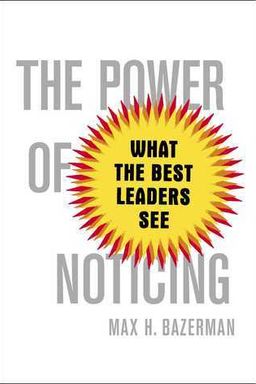
The Power of Noticing: Seeing What Others Miss
How often have you walked into a meeting, made a decision, and only later realized that critical information sat right in front of you—but you never saw it? In The Power of Noticing, Harvard professor Max H. Bazerman asks this piercing question to challenge the way you perceive your world. He argues that success, leadership, and ethics depend not on greater intelligence, but on the ability to notice what others ignore.
Bazerman contends that humans routinely suffer from what he calls bounded awareness — a psychological blind spot that keeps us from seeing salient data, ethical risks, or emerging dangers. Whether it’s an executive overlooking warning signs before a corporate collapse, a regulator ignoring the signals before a financial catastrophe, or ordinary people turning away from unethical behavior to protect their own interests, these failures stem from the same cognitive trap: we act as if “what you see is all there is.”
From Focus to Blindness
Bazerman’s argument begins with a deceptively simple experiment: the famous “basketball video,” where viewers asked to count passes fail to notice a person in a gorilla suit walking through the frame. This phenomenon, known as inattentional blindness, reveals how focus narrows perception. He expands the metaphor—showing that executives, policymakers, and entire institutions focus so tightly on their objectives that they miss the broader context entirely. His own reaction to missing the gorilla becomes a metaphor for professional life: everyone praises focus, but few recognize its hidden cost—blindness to what truly matters.
Why Noticing Matters for Leadership
For Bazerman, noticing isn’t just about spotting problems; it’s about cultivating a moral and strategic advantage. Leaders like Jamie Dimon at JPMorgan Chase or Joe Paterno at Penn State illustrate how blindness destroys careers and institutions. In dimly lit boardrooms or bureaucratic hierarchies, people fail to observe unethical or risky behaviors because they have motivations not to notice. They fear damage to their reputation, loyalty breaches, or career loss. When motivations distort perception, entire organizations can fail to act even in the face of glaring evidence—as with the Sandusky scandal at Penn State or the Catholic Church’s cover-up of abuse. Bazerman’s concept of motivated blindness captures this corrosive dynamic perfectly.
The Psychological Landscape of Blindness
Drawing on decades of behavioral science, Bazerman builds on heroes of the field—Herbert Simon’s bounded rationality, Daniel Kahneman’s System 1 and System 2 thinking, and Amos Tversky’s work on cognitive biases. But he adds a critical dimension: we don’t just misuse data; we fail to see data at all. System 1, our fast, intuitive brain, often blinds us. System 2, our slower, reflective thinking, can rescue us—if we learn to use it deliberately. Through stories like the Challenger space shuttle disaster, the Enron collapse, and the 2008 financial crisis, Bazerman shows how experts, engineers, and leaders missed obvious warning signs simply because they were focused on irrelevant details.
A Blueprint for Better Decision Making
Bazerman’s solution is practical. He urges leaders and individuals to build habits of questioning what isn’t presented. In meetings, ask, “What data do we not have?” In negotiations, consider what your counterpart withholds. In organizations, reward curiosity rather than blind loyalty. Effective noticing, he argues, can prevent predictable surprises—the kinds of disasters everyone “should have seen coming.” Notice the patterns, incentives, and blind spots that shape behavior. Notice the silence in the room. Notice what didn’t happen when it should have.
The Promise of Becoming a “First-Class Noticer”
In his closing chapters, Bazerman borrows the term “first-class noticer” from leadership scholar Warren Bennis. A first-class noticer sees emerging threats before they erupt, recognizes moral failures before they metastasize, and identifies opportunities others overlook. Whether you are a CEO, a teacher, or a citizen, your success depends not just on thinking harder, but on noticing better. The Power of Noticing is both a psychological manual and a moral call to action: broaden your vision, challenge your loyalties, and learn to see the invisible dynamics that shape decisions and behaviors. Because the things we don’t notice—those unasked questions, unchallenged assumptions, and unheard alarms—are often the ones that determine our fate.